Help a Struggling Reader in 3rd Grade: A Real Action Plan for 2026
What You'll Learn
- Why 3rd grade is the make-or-break year — and the specific research that proves kids who can't read by now face a dramatically different future
- The one diagnostic test that takes 5 minutes and tells you exactly where your child's reading broke down
- How to build a daily intervention routine at home — even if school is already "doing something"
- The mistake 90% of parents make when their struggling reader gets stuck on a word (hint: it involves pictures)
Your Kid Is in 3rd Grade and Can't Read Well. Let's Stop Pretending.
I'm not going to ease you into this.
If your 3rd grader is behind in reading — if they're guessing at words, avoiding books, melting down over homework — you don't have the luxury of "let's see how the rest of the year goes." You don't get to wait for the teacher conference in April. You don't get to hope summer reading camp fixes it.
Third grade is the year reading flips. Up until now, your kid was learning to read. Starting in 3rd grade, they read to learn. Science textbooks. Social studies passages. Word problems in math that require comprehension, not just number sense. If your child can't decode fluently and understand what they've decoded, every single subject is about to get harder. Not next year. Right now.
I've homeschooled four kids. My oldest two read independently — my 10-year-old devours novels, my 7-year-old just finished her first chapter book series. My 4-year-old is in the thick of CVC words at our kitchen table. I know what it looks like when reading clicks. And I know what it looks like when it doesn't.
Here's the thing most parents don't hear until it's almost too late: a 3rd grader who's behind in reading is not having a "slow start." They have a gap. A specific, identifiable, fixable gap. And the fix isn't more time. It's the right intervention, done with urgency.
The Third Grade Reading Wall Is Real — And the Data Is Brutal
Let me hit you with the numbers because I think you need to see them.
The 2022 NAEP — that's the Nation's Report Card, the only nationally representative assessment we have — showed that only 33% of 4th graders scored at NAEP's "Proficient" level, which is a rigorous benchmark. Many more scored at "Basic," but far too many landed at "Below Basic" — meaning they couldn't demonstrate even partial mastery of grade-level reading skills. The 2023 scores dropped another 3 points from 2019, the largest decline in 30 years.
But here's the number that should keep you up at night.
The Annie E. Casey Foundation's 2010 report, Early Warning!, analyzed a national dataset and found that students who weren't reading proficiently by the end of 3rd grade were four times more likely to leave high school without a diploma than their proficient-reading peers. And for kids who were both low-income and reading below grade level? The dropout rate climbed to 26%. One in four.
This isn't about test scores or report cards. This is about your child's entire trajectory.
David Kilpatrick — he's a school psychologist and researcher who wrote Equipped for Reading Success (2016) — puts it bluntly: by 3rd grade, the gap between strong readers and struggling readers is already enormous, and it almost never closes on its own. Strong readers read more, learn more vocabulary from context, and get better at reading simply by reading. Struggling readers avoid reading, fall further behind, and the gap compounds every single year. Researchers call this the Matthew Effect. The rich get richer. The poor get poorer.
So no, your 3rd grader is not going to "grow out of it."
Why Is Your 3rd Grader Struggling? (It's Probably Not What You Think)
Most parents assume their kid is struggling because they're "not a reader" or they're "more of a math kid" or they have some mysterious learning block. And look, dyslexia is real — it affects roughly 1 in 5 kids according to the International Dyslexia Association, and if that's what's going on, you need to know.
But here's what I see far more often: the kid was never properly taught to read in the first place.
I was at a playground in Raleigh last spring when another mom mentioned her son's school had just switched away from Lucy Calkins' Units of Study to a Science of Reading curriculum. North Carolina's SB 387 — the Excellent Public Schools Act — forced the change. She was confused and honestly kind of annoyed. "He was doing fine before," she said. I asked her if her kid could read the word "splint." He's in second grade. He could not. He stared at it, looked at me, and guessed "split." Close — but he wasn't decoding. He was approximating.
I spent twenty minutes on that playground bench explaining why the switch was happening. I told her about Emily Hanford's Sold a Story investigation that blew the lid off Balanced Literacy. I told her about the NAEP data. I told her about Stanislas Dehaene's research in Reading in the Brain (2009) — he's a French neuroscientist who proved that the brain doesn't learn to read naturally the way it learns to speak. Reading is a taught skill. The neural pathways have to be built through systematic instruction. They don't just appear.
She went home and listened to the Sold a Story podcast that night. Texted me at 11pm: "I had no idea. Why didn't anyone tell us this sooner?"
I hear some version of that question every single week.
The answer is ugly. For decades, most American elementary schools used a method called Balanced Literacy (or its predecessor, Whole Language) that taught kids to guess at words using picture clues, the first letter, and context. Instead of systematically teaching every grapheme-phoneme correspondence — the way letters and letter combos map to sounds — they handed kids leveled readers and told them to "use strategies." Look at the picture. Think about what makes sense. Skip it and come back.
That's not reading. That's guessing. And by 3rd grade, the pictures disappear, the texts get complex, and the guessing stops working.
So if your 3rd grader is struggling, the first question isn't "What's wrong with my kid?" It's "Was my kid ever taught systematic phonics?"
Step 1: Find the Exact Breakdown Point
You can't fix what you can't diagnose. And "behind in reading" is way too vague to act on.
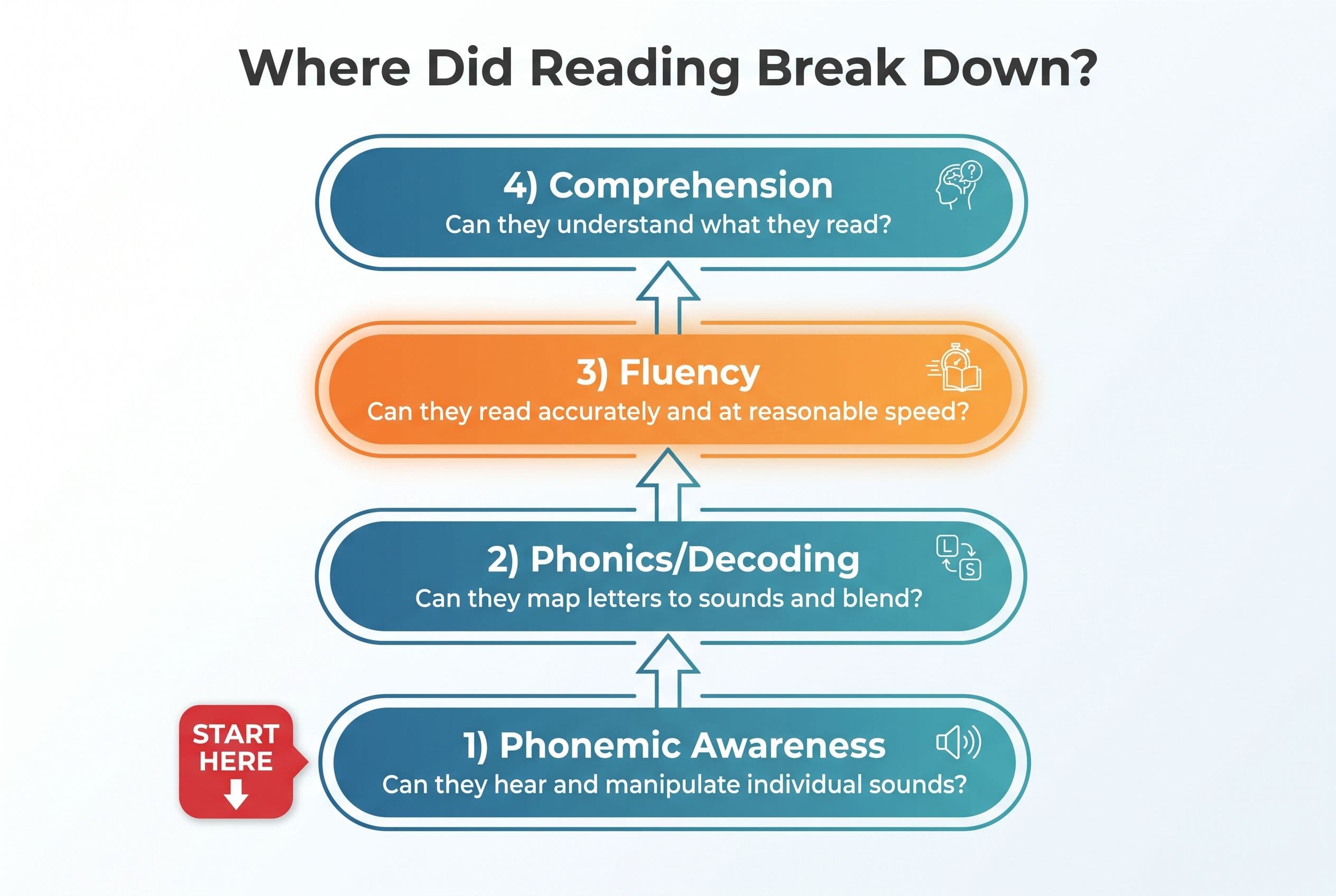
Your child's reading might have broken down at phonemic awareness (they can't hear and manipulate individual sounds in words). It might be at the phonics level (they know some letter sounds but can't decode consonant blends or vowel teams). It might be a fluency problem (they can decode, but it's so slow and labored that comprehension falls apart). Or it might be all three.
Here's what I'd do — and I mean this week, not "sometime soon":
Get Kilpatrick's PAST test. The Phonological Awareness Screening Test takes about 5 minutes to administer, and it tells you exactly where phonemic awareness broke down. You can find it in his book Equipped for Reading Success, and many reading tutors use it as their first diagnostic tool. If your kid can't do phoneme deletion tasks at the level expected for their age, you've found your culprit.
Ask the school for DIBELS or AIMSweb scores. If your child attends public school, they've almost certainly been assessed with DIBELS (Dynamic Indicators of Basic Early Literacy Skills) or something similar. Ask for the actual numbers, not just the color-coded risk level. Benchmarks vary depending on the DIBELS edition and the specific measure, but beginning-of-3rd-grade oral reading fluency targets are often in the ballpark of 70–90+ correct words per minute. Ask the school for the benchmark table that matches their specific assessment version — if your kid is well below that target, that's not a yellow flag. That's a red one.
Do a quick informal assessment at home. Write these words on a piece of paper and ask your child to read them: strap, blend, chill, shrimp, chain, flight, spoil, crowd. No picture clues. No context. Just isolated words. If they can't decode most of those accurately, they have a phonics gap — probably in consonant blends, digraphs, or vowel teams. Write it down. That's your starting point.
Step 2: Stop the Guessing. Today.
This one drives me crazy. I can't stress it enough.
Imagine your kid — let's call him Jayden — is sitting with a book and hits the word "stream." He looks at the picture of a creek, looks at the first letter, and says "river." If Jayden's teacher or tutor says "Good thinking! You used your strategies!" — that teacher is reinforcing a habit that is destroying his ability to read.
No guessing. That's Tiger Rule #2 in our house. Sound it out. If you don't know the sound pattern, I'll teach it to you. But you never, ever guess from the picture.
Remove the crutches:
- Cover the pictures in any book your child reads. I know it sounds harsh. I don't care. Pictures are for comprehension discussion after decoding — not as a word-identification strategy.
- Use decodable texts, not leveled readers. Leveled readers (like the Fountas & Pinnell system) throw irregular words at kids before they've learned the phonics patterns to decode them. That forces guessing. Decodable readers from publishers like Flyleaf Publishing or High Noon Books only use words the child has already been taught to decode. Massive difference.
- When your kid gets stuck, don't say "What word would make sense here?" Say: "Look at all the letters. What sounds do you see? Now blend them together." Every. Single. Time.
This is the hill I die on. Guessing is not reading. Guessing is the reason your 3rd grader is behind.
Step 3: Build a Daily Intervention Routine at Home
School might offer intervention. Great. Take it. But don't rely on it.
Here's the real talk: most school reading interventions give a struggling 3rd grader 20-30 minutes of small group instruction three to four times a week. That's better than nothing. But if your child has significant phonics gaps, they probably need daily one-on-one practice — and the school simply can't provide that for every kid who needs it.
So you do it at home. Twenty minutes a day. Non-negotiable.
Our Tiger Rule #1 is "We Never Skip." Birthdays, Christmas, vacation — we do phonics. Not because I'm heartless (OK, maybe a little), but because consistency is the single biggest predictor of progress. Twenty minutes every day beats an hour three times a week. Your child's brain needs daily repetition to build those orthographic mapping pathways — that's the process Kilpatrick describes where the brain permanently stores a word so it can be recognized instantly without sounding it out each time.
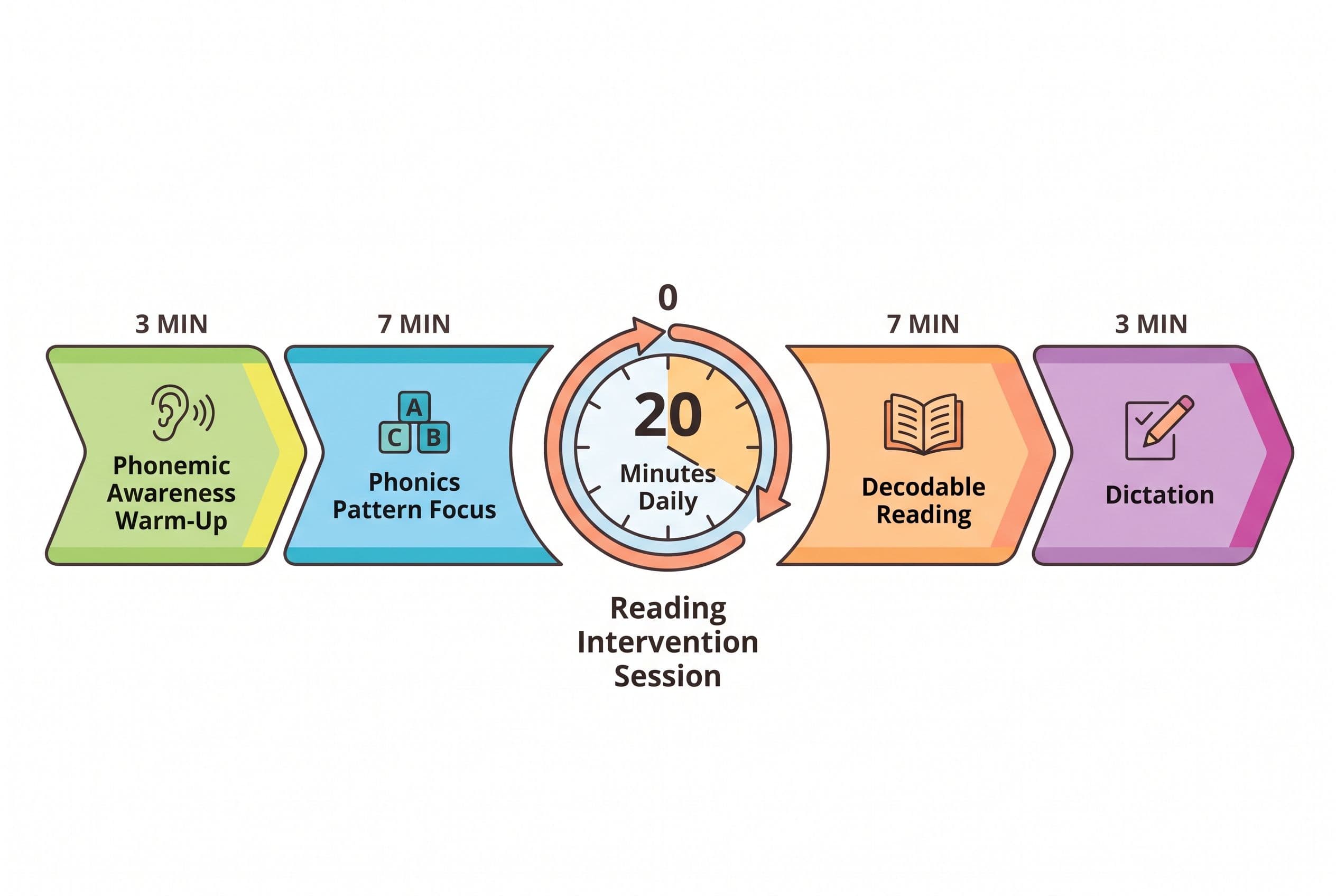
Here's what a solid 20-minute session looks like:
-
Phonemic awareness warm-up (3 minutes): Quick oral drills. "Say 'blast.' Now say 'blast' without the /b/." "Say 'train.' Now change the /t/ to /d/." This builds the foundational skill that makes phonics work.
-
Phonics pattern focus (7 minutes): Teach or review one specific pattern — say, vowel team "oa" as in boat, coat, road, soak. Use flashcards. Write the words. Have your kid read a short list of 10-15 words with that pattern.
-
Decodable reading (7 minutes): Your child reads connected text that uses the patterns they've learned. Not a random library book. A controlled, decodable text. Read it together. If they miss a word, stop and decode it. Then re-read the sentence.
-
Dictation (3 minutes): You say a word or short sentence. Your child writes it, saying each sound as they write the corresponding letter(s). This is the encoding side of reading, and it reinforces phonics knowledge like nothing else.
That's it. Twenty minutes. No screens, no apps-as-babysitter, no "fun" activities that skip the hard parts.
Step 4: Choose the Right Program (Not Just Any "Reading Help")
Not all reading intervention is created equal. Some programs are the real deal. Others are Balanced Literacy dressed up in new packaging.
Here's how to tell the difference: a good program teaches phonics systematically and explicitly, in a clear sequence, with cumulative review. A bad program throws random "sight words" at your kid and hopes for the best.
Programs worth knowing about:
- UFLI Foundations — developed at the University of Florida, free lesson plans, follows a clear scope and sequence. Solid option for parents doing intervention at home.
- Orton-Gillingham — the gold standard for structured literacy, especially for kids with dyslexia indicators. It's multisensory (see it, say it, write it, hear it). Many private tutors are OG-trained.
- Wilson Reading System — uses 12 steps with a controlled reader. Intense, but it works for kids with significant gaps. Often used in schools for Tier 3 intervention.
- Barton Reading & Spelling — designed specifically for parents and tutors without teaching degrees. Scripted, sequential, and effective.
- Teach Your Kid to Read — this is our program, and I'm biased, but I built it because I needed something that followed Orton-Gillingham principles without costing $100/hour for a private tutor. It uses systematic synthetic phonics, it's designed for parents to use at home, and it doesn't let kids guess. Ever.
Programs to be skeptical about:
- Anything that relies heavily on leveled readers and "reading strategies"
- Apps that turn reading into a game where decoding is optional
- Programs that teach all 220 Dolch sight words through memorization instead of phonics patterns (newsflash: 85% of those words ARE decodable)
Step 5: Know the Benchmarks — What "Caught Up" Actually Looks Like
Parents ask me all the time: "How will I know if it's working?" Fair question. Here are the concrete numbers.
By the end of 3rd grade, your child should be able to:
- Read connected text at approximately 100-120 correct words per minute with accuracy above 95% (DIBELS oral reading fluency benchmarks)
- Decode multisyllabic words with common patterns (compound words, words with prefixes and suffixes, words with open and closed syllables)
- Read and comprehend grade-level narrative and informational text independently
- Spell words with common vowel teams, r-controlled vowels, and consonant blends accurately
If your child is currently reading at 40-50 words per minute with shaky accuracy, you're looking at roughly doubling their fluency. That's doable — but it takes daily practice over several months. Not a few weeks. Months.
Track progress. Literally write it down. Time your child reading a passage once a week. Count correct words per minute. Chart it. When your kid sees that line going up, it builds confidence. And confidence fuels practice.
Step 6: Don't Let School Be Your Only Plan
I need to say this directly.
Over 40 states have now passed Science of Reading legislation since 2019. Mississippi's Literacy-Based Promotion Act of 2013 took them from 49th to 21st in national reading scores in six years. Ohio's Third Grade Reading Guarantee flags struggling readers and requires intervention. Florida's retention policy holds kids back if they can't pass the 3rd grade reading assessment.
These laws are pushing schools in the right direction. But policy change is slow. Curriculum change is slower. Teacher retraining is even slower than that. Your child's school might be in year one of a five-year transition. They might have a brand-new Science of Reading curriculum sitting on shelves while teachers are still figuring out how to use it.
You cannot wait for the system to catch up to your kid's needs.
I'm not saying pull your kid out of school (though homeschooling worked for us). I'm saying: whatever the school offers, supplement it at home. Be the backstop. Be the one who drills the phonics patterns every single evening, who reads with your kid every night, who refuses to let them guess.
The school has 25 kids in the class. You have one.
What Happens If You Don't Act Now
I promised I wouldn't sugarcoat this, so here it is.
Kids who can't read by the end of 3rd grade face a cascade of consequences that gets harder to reverse with every passing year:
- 4th grade and beyond: Textbooks become the primary way kids learn. A struggling reader can't access any of it — not science, not social studies, not even math word problems.
- Special education referrals: Many kids who were simply never taught systematic phonics end up classified as learning disabled. Some of them are. Many of them aren't. They just have phonics gaps that nobody filled.
- Self-esteem collapse: By 3rd grade, kids know they're behind. They compare themselves to peers. They stop trying. They start saying "I'm dumb" or "I hate reading." That identity hardens fast.
- The cost: Private Orton-Gillingham tutoring runs $80-$150 per hour, typically 2-3 sessions per week, for 1-2 years. That's $10,000-$15,000 per year. Insurance doesn't cover it. Schools often won't provide it unless the child qualifies for special education services — and that process alone takes months.
- The long game: The connection between illiteracy and incarceration is well documented. Multiple studies — including research from the National Institute for Literacy and the Bureau of Justice Statistics — have found that the majority of incarcerated individuals read at or below a basic level, and rates of reading difficulty among juvenile offenders are consistently and strikingly high. Correlation isn't causation, but the pattern is impossible to ignore.
I'm not telling you this to scare you. OK, maybe I am a little. Because the "Wait and See" approach is the most dangerous thing you can do for a struggling reader. Every month you wait is a month the gap widens.
The Bottom Line: Your 20-Minute-a-Day Action Plan
Let me give you the no-nonsense summary. Tape this to your fridge.
- This week: Assess your child's phonics knowledge. Use Kilpatrick's PAST test, get DIBELS scores from school, and do the informal word list I described above. Find the gap.
- This week: Choose a structured phonics program. UFLI Foundations is free. Barton Reading is parent-friendly. Teach Your Kid to Read was built for exactly this situation. Pick one and start.
- Every day starting now: Twenty minutes of structured phonics practice. Phonemic awareness warm-up, phonics pattern instruction, decodable reading, dictation. No skipping. Tiger Rule #1.
- Immediately: Ban guessing. Cover the pictures. Demand decoding. When your kid gets stuck, you say: "Look at the letters. What do you see? Sound through it."
- Weekly: Time your child reading a passage. Track correct words per minute. Celebrate growth — even two more words per minute is progress.
- Monthly: Reassess. Is the pattern you're teaching sticking? Can they decode words with that pattern in isolation AND in connected text? If yes, move to the next pattern. If no, review.
This isn't complicated. It's hard — because it requires your time, your consistency, and your willingness to sit down every single day and do the work alongside your child. But the methodology is straightforward. Systematic synthetic phonics works. The National Reading Panel report established this in 2000. The 40+ state legislatures that have passed Science of Reading laws since 2019 know it. The neuroscience confirms it.
Your kid can learn to read. They need you to stop waiting and start teaching.
FAQs: What Parents of Struggling 3rd Grade Readers Ask Me Most
Is my 3rd grader too old to learn phonics?
Absolutely not. Phonics instruction works for older struggling readers — Kilpatrick's research on orthographic mapping shows that the brain can build these pathways at any age with the right intervention. The instruction might look slightly different (you'll use age-appropriate reading material, not baby books), but the underlying method is the same: systematic, explicit, sequential phonics. I've seen 5th graders make massive gains in 6 months once someone finally taught them the code.
Should I get my child tested for dyslexia?
If your child has been receiving good phonics instruction and is still struggling significantly after several months, yes — get a full psychoeducational evaluation. A private evaluation runs $2,000-$4,000, but you can also request one through your school district for free under IDEA (they have 60 days to complete it in most states). The International Dyslexia Association estimates that 15-20% of the population has some degree of dyslexia. If that's your kid, you need to know so you can get the right support — Orton-Gillingham-based instruction is the gold standard.
My kid's school says they're providing reading intervention. Is that enough?
Maybe, but probably not on its own. Ask specific questions: What program are they using? How many minutes per day? Is it one-on-one or small group? What phonics scope and sequence do they follow? If the answers are vague — "we do guided reading" or "we use a balanced approach" — that's a red flag. Supplement at home regardless. The school has 25 kids. You have one.
How long will it take for my 3rd grader to catch up?
Every child is different, and I refuse to give you a fake timeline. But with consistent daily practice using a structured phonics program, most kids with phonics gaps (not severe dyslexia) make significant measurable progress within 3-6 months. "Significant" means 20-40 words per minute gains in oral reading fluency, which is enough to transform their classroom experience. Full catch-up to grade level might take a year or more. Stay the course.
Can't I just use a reading app or online program?
Be very careful here. Most reading apps are designed to be fun, not effective. They gamify reading in ways that let kids bypass actual decoding — tapping pictures, listening to audio, earning points for screen time. If an app follows a systematic phonics scope and sequence, requires the child to actually decode every word, and doesn't allow guessing, it can be a useful supplement. Teach Your Kid to Read was designed with exactly those principles. But no app replaces a parent sitting beside their child, listening to them decode, and correcting errors in real time. The app supports the work. You do the work.
Part of these guides

Xia Brody
Co-Founder, Teach Your Kid to Read
Mom of 4 who has successfully taught her kids to read. Currently in the trenches with her 4-year-old while her two oldest (10 and 7) devour books on their own. Passionate about phonics-based methods and building a lifelong love of reading.
Related Articles
Is My 3rd Grader Behind in Reading? Signs + App Plan
If your 3rd grader is guessing, avoiding books, or melting down over homework, don't wait. Here's how to tell if they're behind, which reading apps actually teach phonics, and what to do this week.
Read More →
My 8 Year Old Can't Read: Best Apps + Rescue Plan
If your 8-year-old is still guessing at words, this is not a wait-and-see moment. Here’s my no-nonsense app comparison and rescue plan for getting real phonics intervention started now.
Read More →
My 9 Year Old Can't Read: Parent Action Plan
If your 9-year-old can't read, don't wait for school to fix it someday. Here's how to check their reading level, stop guessing habits, and start a real phonics-based intervention at home.
Read More →