Best Phonics App for a 5-Year-Old: 5 Compared (2026)
What You'll Learn
- Why most top-rated phonics apps in the App Store actually teach kids to guess at words — and how to spot the difference in under 60 seconds
- The one non-negotiable feature a phonics app needs to align with the Science of Reading (hint: it has nothing to do with cute characters)
- Which 5 apps I compared — and the red flags that would make me delete one on the spot
- How to pair any phonics app with a 10-minute daily routine that builds real decoding skill, not screen-time dependence
The Problem Nobody Talks About: Most "Phonics Apps" Aren't Phonics
Let me just say it.
The App Store's "phonics" category is a disaster zone. I've looked at over a dozen apps in the last two years, and most of them have about as much real phonics as a box of Lucky Charms has real nutrition.
They've got dancing letters. Singing animals. Stars and coins and treasure chests. And your kid taps, taps, taps, and "reads" the word "elephant" because there's a picture of an elephant right there on the screen.
That's not reading. That's guessing with extra steps.
Here's what kills me. Parents search for the best phonics app for a 5-year-old, download whatever has 4.8 stars and a cute icon, and assume their kid is learning to read because the app says "Great job!" after every tap. Meanwhile, the app never once asks the child to blend /sh/ + /i/ + /p/ without a picture cue.
I was at a playground in Raleigh last spring when another mom told me her kid's school had just switched from Lucy Calkins to a Science of Reading curriculum because of North Carolina's SB 387 — the Excellent Public Schools Act. She was confused and honestly a little annoyed. "He was doing fine before," she said. I asked if her kid could read the word "splint." Her son is in second grade. He could not. He stared at it. Tried "split." Then "spent." Then looked at me like I'd asked him to solve calculus. I spent 20 minutes on that playground bench explaining why the switch was happening — Emily Hanford's APM Reports investigation "Sold a Story," the NAEP data showing only 33% of 4th graders read at proficient level, the research from Stanislas Dehaene and others showing that reading isn't an innate developmental process like spoken language — the brain has to be explicitly taught to map print to speech sounds. She went home and watched the "Sold a Story" podcast that night. Texted me at 11pm: "I had no idea. Why didn't anyone tell us this sooner?"
Know what she'd been relying on to supplement her son's reading? Two different "phonics" apps that were really whole-language guessing games with phonics branding.
That's the trap. And it's everywhere.
The Tiger Truth: What Happens When Your 5-Year-Old Doesn't Get Real Phonics
I know, I know. "Xia, she's only five. Relax." I hear it constantly.
But here's what the data says — and data doesn't care about vibes.
A widely cited Annie E. Casey Foundation analysis (2010) found that students who can't read proficiently by the end of third grade are about four times more likely to not graduate on time — and the risk is even higher for children from low-income families. That's not a scare tactic. That's a finding based on longitudinal data from nearly 4,000 students.
The 2022 NAEP — the Nation's Report Card — showed that only 33% of American fourth graders read at or above proficient level. That number dropped 3 points from 2019, the largest decline in 30 years.
And third grade is only three years away from five. Three years.
Mississippi understood this urgency. They passed the Literacy-Based Promotion Act in 2013, mandated systematic phonics instruction, and went from 49th to 21st in national reading scores in just six years. They didn't do it with cute apps. They did it with structured, explicit, systematic phonics.
So when I compare phonics apps for 5-year-olds, I'm not looking for the one with the best graphics. I'm looking for the one that actually teaches a kid to crack the code — because the clock is ticking whether we admit it or not.
What a Real Phonics App Must Have (The Non-Negotiable Checklist)
Before I get into the five apps I compared, you need to know what I'm measuring against. This isn't my opinion — this is the Science of Reading translated into app design.
The National Reading Panel report from 2000 — the one Congress actually commissioned — found that systematic phonics instruction produces significant benefits for kids in kindergarten through 6th grade. The key word is "systematic." Not random. Not incidental. A structured, sequential progression through letter-sound relationships.
David Kilpatrick's research on orthographic mapping — laid out in his 2015 book Equipped for Reading Success — shows exactly why this matters. Kids permanently store words in memory through a process that requires strong phonemic awareness and solid knowledge of grapheme-phoneme correspondences. No shortcut. No guessing from context. The brain needs the phonics pathway built brick by brick.
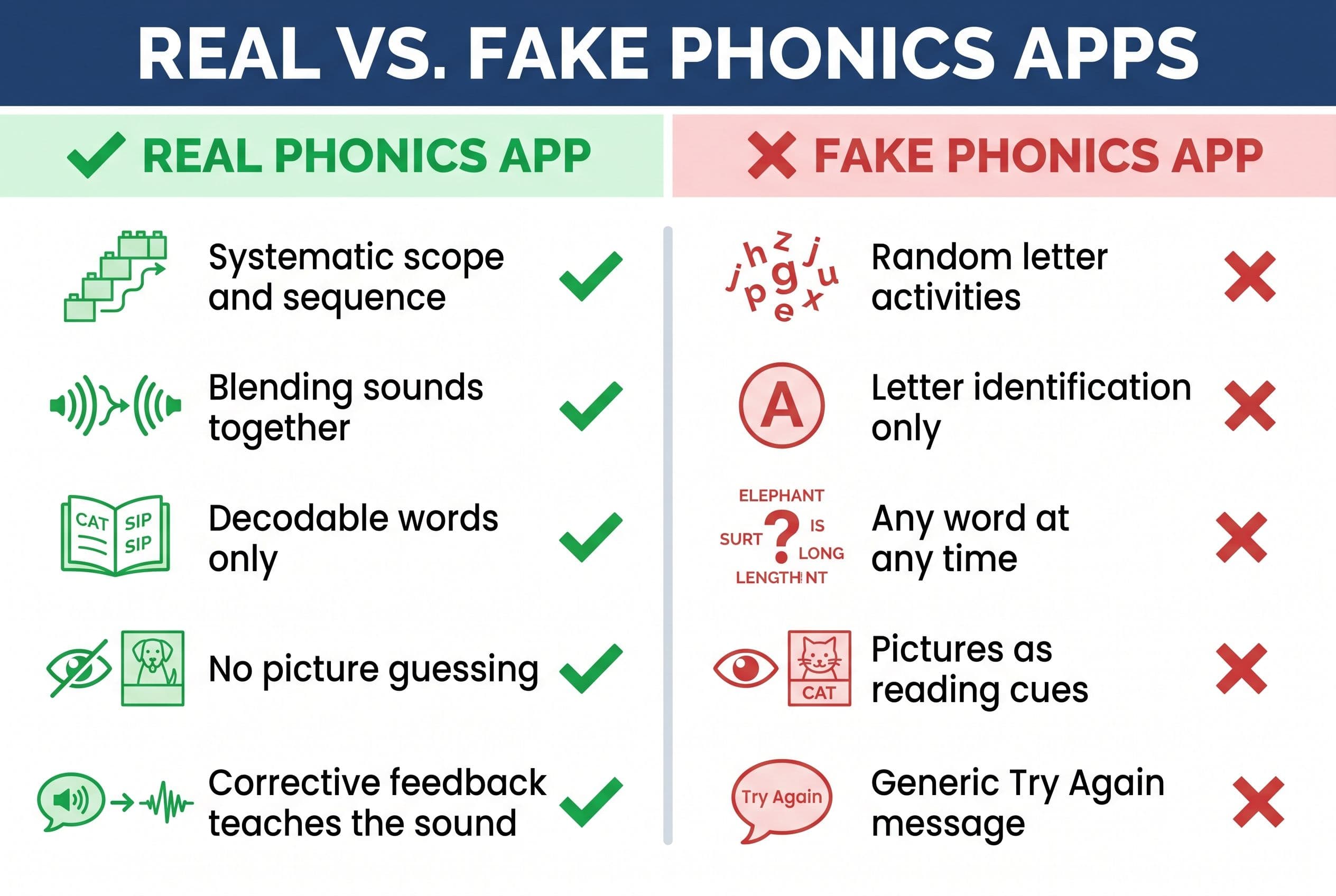
So here's my checklist. A real phonics app for a 5-year-old must have:
- Systematic scope and sequence. It teaches sounds in a logical, building order — not random letter-of-the-week chaos.
- Explicit blending instruction. The app shows the child how to push sounds together: /c/ /a/ /t/ → "cat." Not just letter identification.
- Decodable practice. The words the child reads use ONLY the letter-sounds they've already been taught. No throwing "beautiful" at a kid who just learned /b/.
- No picture guessing. The word is decoded from the letters, period. Pictures come AFTER reading, not as a crutch during reading.
- Correction feedback. When the kid gets it wrong, the app doesn't say "Try again!" with a smiley face. It re-teaches the specific sound.
Anything missing from that list? Red flag. Delete it.
The 5 Phonics Apps I Compared for 5-Year-Olds (2026)
I compared each of these apps on its published features and stated teaching approach. My evaluation is based on phonics methodology, not entertainment value.
Because here's my rule: a reading app is a teaching tool, not a toy. If my kid is having so much "fun" she forgets she's learning to sound out words, the app has failed.
1. Teach Your Kid to Read App
The Bottom Line: This is the one I actually use. It's built on Orton-Gillingham principles — the same systematic, multisensory methodology behind Wilson Reading System, Barton Reading & Spelling, and most structured literacy interventions recommended by the International Dyslexia Association.
What it does right:
- Strict systematic scope and sequence. You can't skip ahead. My daughter can't jump to lesson 12 because she liked the color of the icon. She has to master lesson 4 before she moves to lesson 5. Tiger mom approved.
- Real blending practice. The app has kids blend sounds together to read words — no picture cues during decoding. The picture appears AFTER the child reads the word correctly. This is huge.
- Decodable words only. Every word my kid encounters uses letter-sounds she's already been taught. No guessing. No memorizing.
- Built-in review. The app circles back to previously taught sounds so they stick. This aligns with Kilpatrick's orthographic mapping research — repetition of phoneme-grapheme connections builds permanent word storage.
What could be better:
- The design is clean but not flashy. My daughter doesn't beg to play it the way she begs for YouTube. I consider that a feature, not a bug.
Verdict: This is the best phonics app for 5-year-olds I've compared, and it's the one I recommend to every parent who asks me. It's doing real phonics instruction, not phonics-flavored entertainment.
2. HOMER
The Bottom Line: Homer gets a lot of press, and parts of it are genuinely good. But it's a mixed bag.
What it does right:
- Decent letter-sound instruction in the early lessons.
- Engaging stories that expose kids to rich vocabulary.
- Personalized learning paths based on initial assessment.
What concerned me:
- The reading portions blend phonics with whole-language strategies — the exact guessing strategy that Hanford's "Sold a Story" investigation exposed.
- Too many distracting games.
- The scope and sequence isn't as tight as I'd want. It jumps between skills in ways that felt scattered.
Verdict: Not bad for vocabulary building and exposure to books. But as a standalone phonics app for kindergarten? It's too loose. I'd use it as a supplement only — never as the primary reading tool.
3. Hooked on Phonics App
The Bottom Line: Hooked on Phonics has name recognition from the '90s (I remember the commercials), and the app has improved over the years. It follows a more structured sequence than Homer.
What it does right:
- Clear lesson structure: learn a sound, practice it, read a short story.
- Stories use mostly decodable text.
- Songs and videos reinforce letter-sound connections.
What concerned me:
- Some of the "practice" activities are glorified multiple choice. The kid picks the right word from three options, which means there's a 33% chance of guessing correctly and getting the dopamine reward without actually decoding.
- The decodable readers sometimes introduce words that haven't been taught yet and just throw in a picture cue.
- The subscription cost adds up.
Verdict: Better than average. The structure is there. But the execution has holes that a parent needs to actively monitor. You can't hand this to your kid and walk away assuming real phonics instruction is happening.
4. Khan Academy Kids
The Bottom Line: It's free and it's a quality product. But it's a general learning app, not a phonics-first app.
What it does right:
- Free. Seriously, completely free with no ads. In 2026 that's almost unheard of.
- Covers a wide range of early learning skills.
- Some solid phonemic awareness activities — rhyming, initial sound identification.
What concerned me:
- Phonics is one small piece of a much bigger app. Most of the app is about other skills — math, shapes, and social-emotional learning activities. Fine for those goals — terrible for focused reading instruction.
- The phonics activities aren't systematic. They teach sounds, but not in a tight, building sequence. You might get /m/ one day and /igh/ the next.
- Very little blending practice. Lots of sound identification ("What starts with /b/?") but almost no actual decoding of words from their individual sounds.
Verdict: Great free resource for general kindergarten readiness. Not a phonics app. Don't rely on it to teach your 5-year-old to read.
5. Reading Eggs
The Bottom Line: Reading Eggs is popular internationally and has a more structured approach than some competitors. But it has a problem I can't ignore.
What it does right:
- Clear leveling system with placement assessment.
- Lessons do teach letter-sounds in a sequence.
- The "cracking" egg animation is motivating for little kids.
What concerned me:
- Rewards dominate the experience. Golden eggs, virtual pets, customizable houses — the gamification is so aggressive that it can push a child to race through phonics activities as fast as possible to get more rewards, not to actually learn the sounds.
- Some reading activities present whole words with pictures, essentially training picture-guessing. This directly contradicts the systematic synthetic phonics the app claims to teach.
- The amount of "stuff" (games, videos, songs, rewards) is overwhelming. A 5-year-old's working memory is limited — Dehaene's Reading in the Brain (2009) explains that learning to read requires intense, focused attention on the letter-sound mapping, and constant distraction undermines that process.
Verdict: The phonics bones are decent but buried under so much gamification that the actual learning gets diluted. If you use it, sit with your kid and skip the reward screens. Don't let the tail wag the dog.
The Comparison at a Glance
| Feature | Teach Your Kid to Read | Homer | Hooked on Phonics | Khan Academy Kids | Reading Eggs |
|---|---|---|---|---|---|
| Systematic scope & sequence | ✅ Strict | ⚠️ Loose | ✅ Mostly | ❌ No | ⚠️ Mostly |
| Real blending practice | ✅ Yes | ⚠️ Some | ⚠️ Some | ❌ Minimal | ⚠️ Some |
| Decodable-only words | ✅ Yes | ❌ No | ⚠️ Mostly | ❌ No | ⚠️ Mostly |
| No picture guessing | ✅ Yes | ❌ No | ❌ No | ❌ No | ❌ No |
| Correction teaches the sound | ✅ Yes | ⚠️ Generic | ⚠️ Generic | ⚠️ Generic | ⚠️ Generic |
| Orton-Gillingham aligned | ✅ Yes | ❌ No | ❌ No | ❌ No | ❌ No |
That chart tells the whole story, honestly.
How to Actually Use a Phonics App (The Tiger Mom 10-Minute Method)
Look — even the best phonics app for a 5-year-old won't work if you just hand the iPad over and leave the room. I don't care what the app's marketing says. A kindergartener needs a human sitting next to them.
Here's my daily routine. It takes 10 minutes. We never skip. Not on birthdays. Not on Christmas. Not on vacation.
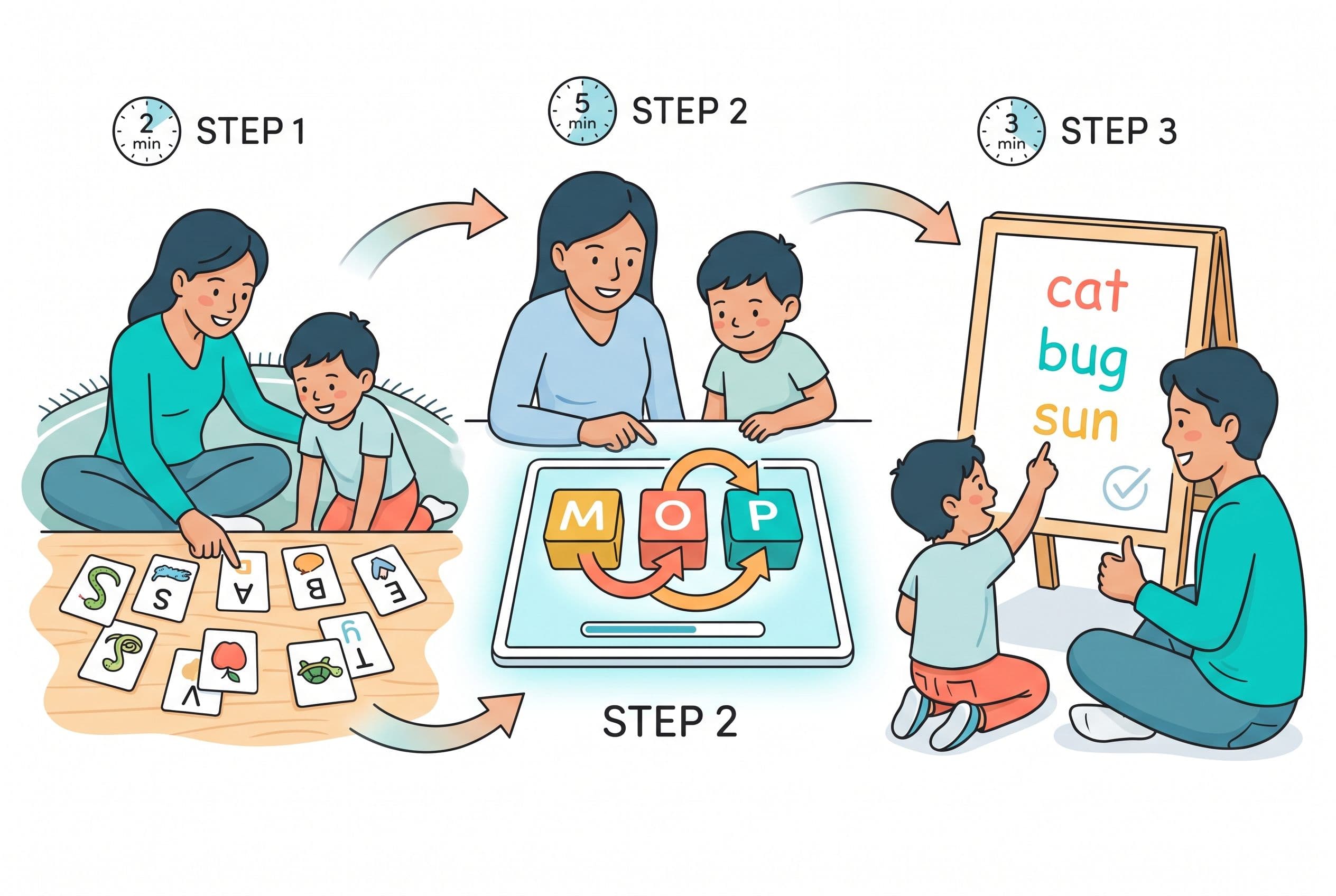
Step 1: The Warm-Up (2 minutes) Before opening any app, I do rapid-fire sound review with my daughter. I hold up flashcards (or just say letters) and she gives me the sounds. Not the letter names — the sounds. /b/, /a/, /t/, /s/, /m/. If she hesitates on one, we drill it three extra times.
Step 2: App Lesson (5 minutes) We open Teach Your Kid to Read and do one lesson. I sit next to her. When the app asks her to blend, I watch her mouth. If she's guessing — looking at me for hints, rushing through, not moving her mouth for each sound — I pause the app and we do it together out loud. "Sound it out. /sh/... /i/... /p/. Push them together. What's the word?"
No guessing. Ever.
Step 3: The Transfer (3 minutes) This is the step most parents skip, and it's the most important one. We close the app and I write three words on a whiteboard — words using the sounds she just practiced. She reads them without any app, without any screen, without any cute animation.
Because the goal isn't to read on the app. The goal is to read, period.
If you want to track whether this is working, Kilpatrick's PAST (Phonological Awareness Screening Test) takes about 5 minutes and tells you where your kid stands on phonemic awareness skills. You can find it free online. You can also ask your child's school for their DIBELS Nonsense Word Fluency (NWF) score and whether it's at or above benchmark for their point in kindergarten — check the official DIBELS benchmark tables for the edition your school uses. Those numbers give you something concrete to aim for — way more useful than an app's progress badge.
Why Screen Time for Phonics Is Not the Same as "Lazy iPad Parenting"
I need to address something because I know what some of you are thinking. "Xia, you hate screen time. Now you're recommending an app?"
Fair point. Let me be clear.
I hate passive screen time — the kind where your kid is a zombie watching unboxing videos or tapping random games while you fold laundry. That's not learning. That's digital babysitting.
A phonics app used correctly — with a parent present, for a limited time, as one tool in a structured reading program — is fundamentally different. It's a drill tool. It's a flashcard that talks back. It's a tutor that never loses patience (unlike me at 7:45am before coffee).
The American Academy of Pediatrics recommends that kids ages 2-5 get no more than 1 hour of "high-quality" screen time per day. Five minutes of systematic phonics instruction on a well-designed app absolutely qualifies as high-quality. Five hours of Reading Eggs reward-collecting does not.
The key distinction: is your child decoding words, or is your child playing a game that happens to involve letters?
One builds a reader. The other builds an app-dependent kid who falls apart when you hand them a real book.
The Bigger Picture: An App Can't Do It Alone
Real talk — no app replaces explicit phonics instruction from a knowledgeable adult. The best phonics app for kindergarten is a supplement, not a curriculum.
If your kid is in a school that teaches systematic phonics — like the 40+ states that have now passed Science of Reading legislation since 2019 — great. Use the app for extra practice.
If your kid's school is still using Balanced Literacy or three-cueing strategies (look at the picture, check the first letter, think about what makes sense)... you have a bigger problem that an app can't solve. You might need to look into structured literacy programs like UFLI Foundations, Logic of English, or Explode the Code for home use, and use the app as the daily drill component.
Either way, the app is one piece. You also need:
- Decodable books. Not leveled readers from Fountas & Pinnell (those are whole-language aligned). Look for decodable readers from Flyleaf Publishing or High Noon Books — they only use letter-sounds the child has been taught.
- Daily read-alouds. You read TO your kid from rich, complex books. This builds the vocabulary and comprehension side of Scarborough's Reading Rope while the app and decodable books build the word recognition side.
- Writing practice. Encoding (spelling) and decoding (reading) are two sides of the same coin. Have your kid write CVC words with a pencil. Yes, a pencil. On paper. I know. Revolutionary.
Frequently Asked Questions
What age should a child start using a phonics app?
Most kids can start structured phonics app work around age 4, once they can identify at least 15-20 letter names and sit for a 5-minute focused activity. My 4-year-old started on the Teach Your Kid to Read app right around her fourth birthday. But every child is different — if your 3-year-old knows all their letters and has the attention span, go for it. If your 5-year-old is still learning letter names, start there first with magnetic letters and alphabet flashcards before adding an app.
Can a phonics app replace a reading tutor?
No. An app can't observe your child's mouth position, catch subtle error patterns, or adjust in real-time the way a trained tutor can. If your child is significantly behind — can't decode CVC words by mid-kindergarten, for example — consider an evaluation. A tutor trained in Orton-Gillingham or Wilson Reading System methodology will do things no app can replicate. The app is a drill tool for daily practice, not a diagnostic or intervention tool.
How much time should my 5-year-old spend on a phonics app each day?
Five to ten minutes of focused, supervised phonics app time is the sweet spot for kindergarteners. That's it. More than that and you'll hit diminishing returns — your kid's working memory will max out, and they'll start guessing just to finish. Pair the 5 minutes of app time with the whiteboard transfer exercise I described above, plus 10-15 minutes of decodable book reading, and you've got a complete daily reading practice under 30 minutes total.
My kid's school says they teach phonics. Do I still need an app at home?
Maybe. Ask your kid's teacher one simple question: "Can my child read nonsense words like 'flom' and 'brap'?" If yes, they're decoding — great, and an app at home is just bonus practice. If they can't read simple nonsense words but can read "the" and "was" and "said" from memory, that can be a red flag — it may mean they're relying mostly on memorization rather than decoding. It doesn't automatically mean something's wrong (some schools explicitly teach irregular high-frequency words alongside phonics, which is fine), but it's worth digging deeper. Ask how the school teaches decoding and whether your child is meeting phonics benchmarks. If they're not, home phonics practice becomes non-negotiable. The DIBELS nonsense word fluency assessment is the gold standard here — ask if the school administers it.
Are free phonics apps as good as paid ones?
Sometimes. Khan Academy Kids is free and decent for general learning, but weak on systematic phonics. Most free apps rely on ad revenue or data collection, and many lack the structured scope and sequence that paid apps can afford to develop. My honest take: you'll spend $50-$100 on a paid phonics app. Average cost of a reading tutor? $50-$100 per hour. A private remedial reading program like Lindamood-Bell? That can run to thousands of dollars a year. A quality phonics app at age 5 is the cheapest reading intervention you'll ever buy.
The Bottom Line
Your 5-year-old doesn't need the most entertaining phonics app. They need the most effective one.
The best app to teach phonics to a 5-year-old will be systematic, explicit, sequential, and decodable-only. It won't let your kid guess from pictures. It won't bury the phonics under a mountain of gamification. It will do the boring, repetitive, essential work of building grapheme-phoneme connections one sound at a time — the exact process that Kilpatrick's orthographic mapping research says leads to permanent word storage.
I've compared five of the most popular options. Teach Your Kid to Read is the one that checks every box. It's the one I use with my own kids. That's not a marketing line — it's what happens when a tiger mom who reads the research builds her own solution because the App Store kept letting her down.
Download it. Sit next to your kid. Do 10 minutes a day.
And never, ever let them guess.
Ready to get your 5-year-old reading with a real phonics app? Visit start lesson one free to learn more about Teach Your Kid to Read, or call us at (407) 707-6850 with questions. We're parents too — we get it.
Part of these guides

Xia Brody
Co-Founder, Teach Your Kid to Read
Mom of 4 who has successfully taught her kids to read. Currently in the trenches with her 4-year-old while her two oldest (10 and 7) devour books on their own. Passionate about phonics-based methods and building a lifelong love of reading.
Related Articles
Reading Eggs vs ABCmouse for 5-Year-Olds: Best Pick
Choosing between Reading Eggs and ABCmouse? Here’s the no-fluff mom verdict on which app actually teaches a 5-year-old to read — and where both fall short.
Read More →
Reading Apps for 5-Year-Olds: 6 Skill-Level Picks
Most reading apps for 5-year-olds look cute. Too many teach guessing, tapping, and screen-zombie habits instead of real decoding. Here’s how I’d pick a phonics app by skill level if I were sitting at your kitchen table.
Read More →
HOMER vs Reading Eggs for 6-Year-Olds: Best Fit?
Choosing between HOMER and Reading Eggs for a 6-year-old? Here’s the no-nonsense parent breakdown: which app teaches decoding, which one fits which child, and where Teach Your Kid to Read beats both for focused phonics.
Read More →