Best HOMER Alternative in 2026: 5 Apps Compared Honestly

What You'll Learn
- Why HOMER's approach has a fundamental flaw that most parents don't notice until their kid hits a wall in 1st grade
- The one question to ask about ANY reading app before you hand it to your preschooler (hint: it involves the word "decodable")
- 5 HOMER alternatives ranked by actual phonics methodology — not by how cute the animations are
- Which app I'm personally using with my 4-year-old right now and what her progress looks like after 3 months
The Problem With "My Kid Loves This App"
Let me tell you what I hear at every playdate, park outing, and homeschool co-op meetup: "Oh, my kid LOVES HOMER. She's on it every day."
Cool. Can she read?
Not "can she tap the right picture when the app says the word." Not "can she sing the alphabet song." Can she look at the word frog on a page with no pictures, no audio hints, no animated owl giving her three choices — and actually read it?
Because that's reading. Everything else is a game.
I'm not saying HOMER is garbage. It's not. It's a well-designed app with beautiful illustrations and a genuinely engaging interface. But here's the honest question: is a kid learning to read on HOMER, or learning to play HOMER?
So I started digging into what these apps actually teach versus what they look like they're teaching. And that's what this whole comparison is about.
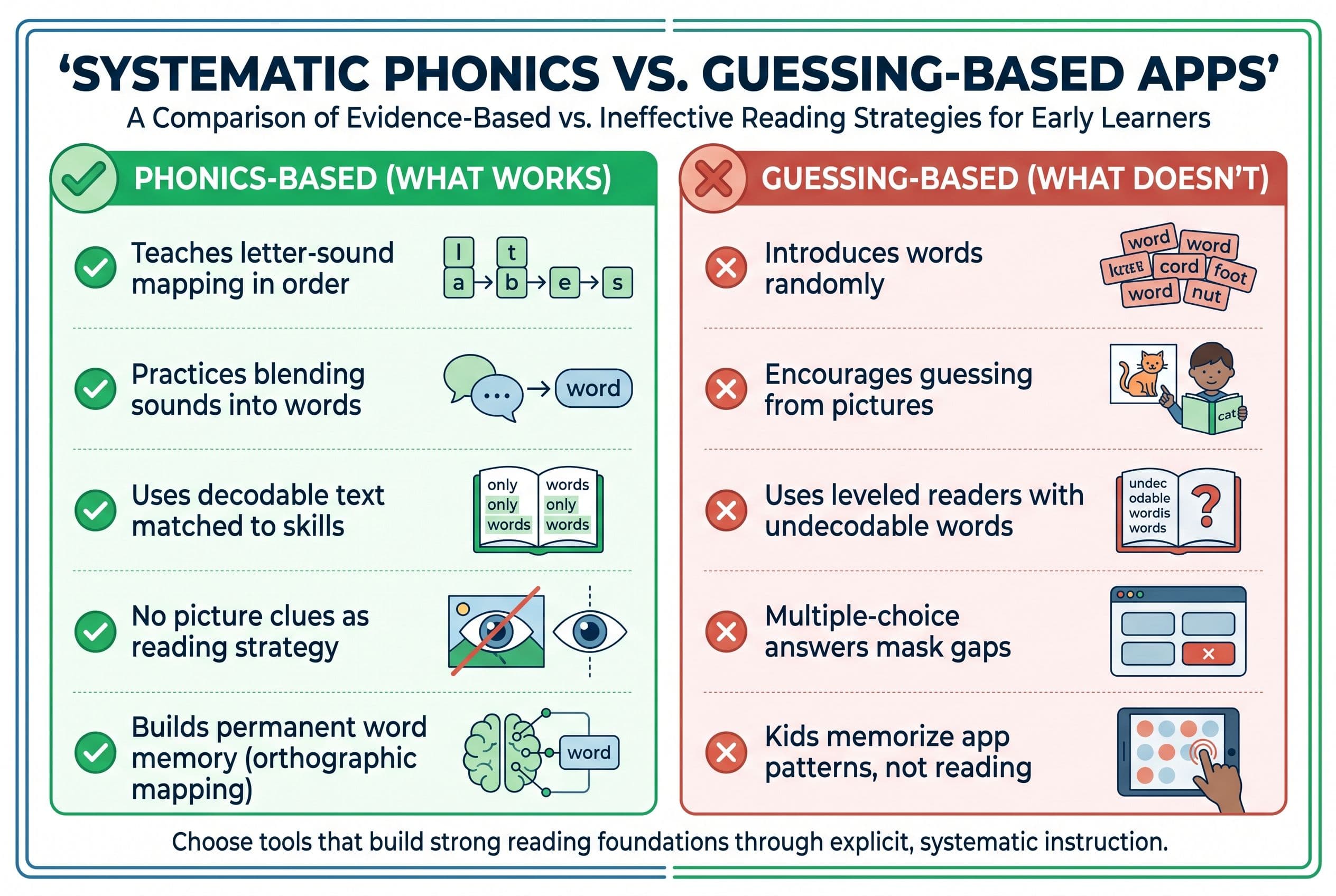
The Tiger Truth: What Happens When the App Does the Reading
Here's the thing nobody wants to hear. If your child's reading app relies on picture clues, multiple-choice guessing, and memorizing whole words by shape — it's using a Whole Language approach dressed up in a tech hoodie.
The data is brutal and clear.
On the 2022 NAEP 4th-grade reading assessment, only about a third of students scored at or above the Proficient level — a high benchmark, but one that signals solid grade-level reading ability. That means the majority of 4th graders in this country struggle with grade-level reading demands. Between 2019 and 2022, 4th-grade reading scores on the main NAEP dropped significantly — one of the steepest declines the assessment has recorded.
Research frequently cited by the Annie E. Casey Foundation (2010) suggests that students not reading proficiently by 3rd grade are much more likely to leave school without a diploma — one big reason early decoding matters so much.
And here's the kicker: private tutoring with an Orton-Gillingham-trained specialist, typically 2-3 sessions per week, can run to thousands of dollars a year. Insurance doesn't cover it. Most schools don't catch the problem until 2nd or 3rd grade — and the earlier you intervene, the fewer bad habits take root and the faster progress tends to be. Older kids can absolutely still learn with the right instruction, but why wait when you don't have to?
So yeah, the app your kid is playing matters. A lot.
I was at a playground in Raleigh last year when another mom told me her son's school had just switched from Lucy Calkins' Units of Study to a Science of Reading curriculum because of North Carolina's SB 387 — the Excellent Public Schools Act. She was confused and honestly kind of annoyed. "He was doing fine before," she said. I asked if her kid could read the word "splint." He's in second grade. He could not. He looked at it and said "split" — because it looked close enough. Classic guessing behavior.
I spent 20 minutes on that playground bench explaining why the switch was happening — Emily Hanford's APM Reports investigation Sold a Story that exposed how Balanced Literacy had been failing kids for decades, the NAEP data I just mentioned, the neuroscience from Stanislas Dehaene's lab showing the brain doesn't learn to read naturally the way it learns to speak. She went home and watched the Sold a Story podcast that night. Texted me at 11pm: "I had no idea. Why didn't anyone tell us this sooner?"
Nobody told her because the apps, the schools, and the publishers all looked like they were working. Her kid was engaged. He seemed happy. He could "read" his leveled readers. But he was guessing from context and pictures — not decoding.
That's exactly what a lot of these reading apps do. They feel like reading. They're not.
How I Evaluated These HOMER Alternatives
Before I get into the comparison, here's my rubric. I'm not rating apps on how pretty they are or whether my kid asks to play them. I'm rating them on whether they actually teach reading based on what the science says works.
My criteria:
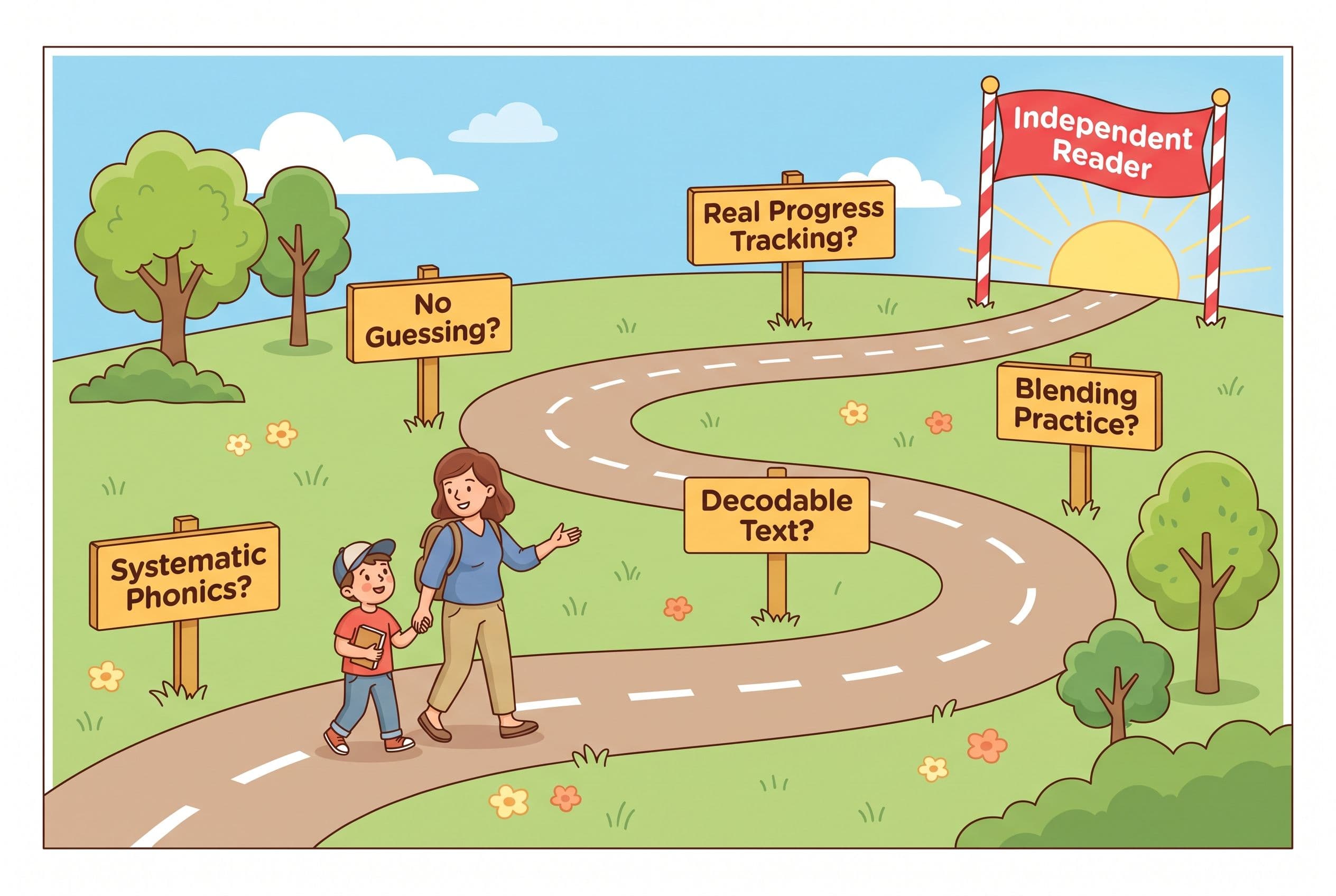
- Systematic Synthetic Phonics: Does the app teach letter-sound correspondences (grapheme-phoneme correspondence) in a logical, sequential order? The National Reading Panel report from 2000 — the one Congress actually commissioned — found that systematic phonics instruction produces significant benefits over non-systematic or no-phonics approaches. This isn't debatable anymore.
- No Guessing Encouraged: Does the app ever let the kid guess from pictures or context? If yes, that's a red flag.
- Decodable Text: Does the app use decodable readers that match the phonics skills already taught? Or does it throw in words the kid hasn't been taught to decode yet?
- Blending Practice: Does the app actually practice blending sounds together, or just identify individual letters?
- Progress Tracking: Can I see what my kid actually knows vs. what she's just clicking through?
- Price Transparency: How much does it actually cost, and is there a bait-and-switch with premium tiers?
The 5 Best HOMER Alternatives in 2026 — Ranked
1. Teach Your Kid to Read (TeachYourKidToRead.org) — The Best Overall
I'm biased. I co-founded this. But I'm biased because I built the thing I couldn't find anywhere else.
Teach Your Kid to Read follows systematic synthetic phonics based on Orton-Gillingham principles. That means your kid learns letter sounds in a specific order, practices blending those sounds into real words, and only reads words made up of sounds she's already mastered. No guessing. No picture clues. No "look at the first letter and think of a word that makes sense."
My 4-year-old, Mei, has been using it for about three months now. Last Tuesday she read "stamp" at the kitchen table without any help. Not because she memorized it — because she knows /s/, /t/, /a/, /m/, /p/ and can blend them together. That's orthographic mapping in action. David Kilpatrick's research in Equipped for Reading Success (2016) explains why this matters: kids who learn to map sounds to letters store words in long-term memory automatically. Kids who memorize words by sight run out of memory capacity by 2nd grade.
Phonics methodology: Systematic synthetic phonics. Orton-Gillingham aligned. Guessing encouraged? Absolutely not. This is a no-guessing zone. Decodable text? Yes. Every word is decodable based on skills already taught. Blending practice? Yes, it's the core mechanic. Progress tracking? Yes, detailed. Price: Affordable — check TeachYourKidToRead.org for current pricing.
Bottom line: If you want an app that teaches reading the way the science says it should be taught, this is it.
2. Teach Your Monster to Read — Solid Free Option
This UK-based app is surprisingly good for a free product. It follows synthetic phonics — which makes sense, because the UK has mandated synthetic phonics instruction since 2007 after the Clackmannanshire study (Johnston & Watson, 2005) out of Scotland showed that synthetic phonics kids outperformed analytic phonics kids even 7 years later.
The app takes kids through letter sounds, blending, and then into reading sentences. It's game-based, which means your kid is running around a little world collecting things, but the actual reading tasks are phonics-grounded.
The catch: The app was designed for the UK phonics sequence, so some letter-sound pairings come in a different order than American programs like UFLI Foundations or Fundations. It also gets a little loose with sight words in later levels — introducing words the kid hasn't been taught to decode yet. Not terrible, but not as tight as I'd like.
Phonics methodology: Synthetic phonics (UK sequence). Guessing encouraged? Minimal. Some levels have picture support that could become a crutch. Decodable text? Mostly yes in early levels. Gets looser later. Blending practice? Yes. Progress tracking? Basic. Price: Free (with optional paid extras).
Bottom line: Best free option. Not perfect, but miles ahead of HOMER on phonics methodology.
3. Reading Eggs — Popular but Mixed
Reading Eggs is everywhere. It's been around since 2008, it's Australian-made, and it has a massive library of activities. A lot of homeschool parents swear by it.
Here's my honest take: it starts strong with letter-sound mapping and blending, but then it slides into a hybrid approach. By level 30-ish, it starts introducing words using a "look and say" method — basically sight-word memorization without phonetic decoding. This is the Balanced Literacy trap wearing a phonics costume.
The gamification is also heavy — it's easy for a kid to end up more focused on collecting golden eggs and dressing up a character than on the actual reading tasks.
Phonics methodology: Starts systematic, becomes mixed/Balanced Literacy. Guessing encouraged? Yes, in later levels. Picture clues appear frequently. Decodable text? Early levels yes, later levels no. Blending practice? Yes, but inconsistent. Progress tracking? Detailed dashboard, but tracks completion rather than mastery. Price: $99.99/year or $13.99/month as of October 2026. Free trial available.
Bottom line: Decent for letter-sound introduction. Falls apart once your kid gets past the basics. You'll need to supplement.
4. Khan Academy Kids — Great for Everything Except Reading
I love Khan Academy Kids for math, social-emotional stuff, and creative activities. It's free, it's ad-free, and Sal Khan is doing genuinely good work making education accessible.
But the reading instruction? It's surface-level.
Khan Academy Kids covers letter recognition, some phonics awareness, and read-alouds. It does not provide a systematic, sequential phonics program. There's no scope and sequence that builds from CVC words to blends to digraphs to vowel teams in a logical progression. It's more like a buffet of literacy-adjacent activities.
If your kid is 2-3 and you want letter exposure, it's great. If your kid is 4-5 and you need actual reading instruction? You need something else.
Phonics methodology: Scattered phonics activities. Not systematic. Guessing encouraged? Not overtly, but also not prevented. Decodable text? No dedicated decodable readers. Blending practice? Some, but not the focus. Progress tracking? Minimal. Price: Free. Completely free. No ads.
Bottom line: Use it for math and play. Don't rely on it for reading.
5. HOMER Itself (Begin Learning / HOMER Reading) — The One You're Trying to Replace
Let's be fair to HOMER. Here's what it does well: it adapts to your child's level, it covers a wide range of early skills (letters, rhyming, vocabulary), and the design is genuinely engaging. It feels like a quality product.
But the phonics instruction is not systematic. HOMER uses a mixed-methods approach — some phonics, some sight words, some contextual guessing. It introduces words the child hasn't been taught to decode. It uses picture support as a primary strategy. And the "learning pathway" is driven more by engagement metrics than by a rigorous scope and sequence.
Mark Seidenberg — the University of Wisconsin cognitive scientist who wrote Language at the Speed of Light (2017) — called out the reading education establishment for prioritizing methods that feel good over methods that work. HOMER is the app version of that problem. It feels like it's working. Your kid is happy. The progress reports look encouraging. But sit your kid down with a decodable text that has no pictures, and you'll see the truth.
Phonics methodology: Mixed methods. Not systematic synthetic phonics. Guessing encouraged? Yes. Picture clues and context guessing are built in. Decodable text? No. Stories contain words kids haven't been taught to decode. Blending practice? Some, but not emphasized. Progress tracking? Polished dashboard that tracks engagement more than mastery. Price: Subscription after free trial (check the HOMER site for current pricing).
Bottom line: Engaging, well-designed, and not built on the science of how kids actually learn to read.
The Quick Comparison Table
| Feature | Teach Your Kid to Read | Teach Your Monster | Reading Eggs | Khan Kids | HOMER |
|---|---|---|---|---|---|
| Systematic Phonics | ✅ Yes | ✅ Yes (UK) | ⚠️ Starts yes, drifts | ❌ No | ❌ No |
| No Guessing | ✅ Strict | ⚠️ Mostly | ❌ Later levels | ⚠️ Neutral | ❌ Built-in |
| Decodable Text | ✅ Yes | ⚠️ Early levels | ⚠️ Early levels | ❌ No | ❌ No |
| Blending Focus | ✅ Core skill | ✅ Yes | ⚠️ Inconsistent | ⚠️ Some | ⚠️ Some |
| Progress Tracking | ✅ Detailed | ⚠️ Basic | ✅ Dashboard | ❌ Minimal | ✅ Dashboard |
| Price | 💲 Affordable | 🆓 Free | 💲 $99.99/yr (Oct 2026) | 🆓 Free | 💲 Check site |
| Tiger Mom Rating | ⭐⭐⭐⭐⭐ | ⭐⭐⭐⭐ | ⭐⭐⭐ | ⭐⭐ (for reading) | ⭐⭐ |
What to Do Right Now (Your Action Steps)
OK so here's your game plan. Don't overthink this.
Step 1: Test where your kid actually is. Before you download anything, figure out what your child actually knows. Can she name all 26 letter sounds (not letter names — sounds)? Can she blend three sounds together when you say them? Say /m/ - /a/ - /p/ out loud and see if she says "map." If she can't do that yet, she needs an app that starts at the very beginning with letter-sound mapping. Don't skip ahead. Many reading screeners (like DIBELS NWF) look for roughly 25–30+ correct letter sounds in a minute around mid-kindergarten, depending on the edition — that gives you a ballpark for where your kid should be heading.
Step 2: Pick one app and commit. Stop app-hopping. Your kid doesn't need five reading apps. She needs one good one used consistently. My recommendation: start with Teach Your Kid to Read for the systematic phonics foundation. If you're on a tight budget, Teach Your Monster to Read is a solid free backup.
Step 3: Supplement with 10 minutes of real-book practice daily. No app replaces a parent sitting with a child and a decodable reader. Apps teach skills. Books build fluency. Get a set of Bob Books or the UFLI Foundations decodable texts and have your kid practice with actual pages. Ten minutes. Every day. Birthdays, Christmas, vacation — we never skip.
Step 4: Reassess every 4-6 weeks. Use Kilpatrick's PAST test (it's free, takes 5 minutes, you can find the protocol online) to check whether your kid is actually building phonological awareness or just memorizing app patterns. If she's stuck, that's your signal to intervene — not to wait and see.
Step 5: Watch for the guessing trap. The number one sign your kid is using a bad reading method — whether from an app or from school — is this: she looks at a word she doesn't know and says a completely different word that sort of fits the context. Imagine she sees "horse" and says "pony" because there's a picture of a barn. That's not a reading error. That's not reading at all. Sound familiar? If yes, switch apps immediately.
Why This Matters More Than You Think
Forty-plus states have now passed Science of Reading legislation since 2019. Mississippi's Literacy-Based Promotion Act of 2013 moved them from 49th to 21st in national reading scores in just 6 years. Colorado's READ Act requires schools to use evidence-based reading instruction. Florida's 3rd-grade retention policy under their Just Read, Florida! initiative — love it or hate it — actually moved the needle on reading scores.
The policy world has caught up to the research. Schools are switching. Curricula are changing.
But what about the apps your kid uses at home for 30-45 minutes a day?
If your kid's school is finally teaching phonics correctly but her reading app at home is still encouraging guessing from pictures, you're undoing the school's work every evening. The brain doesn't compartmentalize. If she learns to guess in one context, she'll guess in all contexts.
Louisa Moats wrote in her landmark 1999 paper Teaching Reading IS Rocket Science (published by the American Federation of Teachers) that "teaching reading requires knowledge and skills that most teachers — and by extension, most apps — don't have." The apps that get it right are the ones built by people who actually understand the Simple View of Reading (Gough & Tunmer, 1986): Reading Comprehension = Decoding × Language Comprehension. You have to train decoding explicitly. There's no shortcut.
Real Talk: What I'm Doing With My Own Kid
Mei is 4. She's my third. I know way more now than I did when I started with my oldest (who's 10 and currently devouring Harry Potter, thank you very much).
Here's what Mei's daily reading routine looks like:
- 7:30 AM: 10 minutes on Teach Your Kid to Read. She does her phonics lesson at the kitchen table while I wrangle the baby and make coffee. She's currently working through consonant blends — /bl/, /cr/, /st/.
- After lunch: 5-10 minutes reading a decodable book together. Right now we're on a set from Flyleaf Publishing. She reads, I listen. If she guesses, I stop her and we sound it out. No exceptions.
- Before bed: I read aloud to her for 20 minutes. This is for language comprehension and vocabulary — the other half of Scarborough's Reading Rope. She picks the books (currently obsessed with a book about volcanoes, which... sure).
Total structured reading time: about 25-30 minutes a day. That's it. No marathon sessions. No tears. But we never skip. Not on weekends, not on vacation, not when she's grumpy.
Three months in, she can decode CVC words independently, she's starting to blend consonant clusters, and she can read simple sentences like "The cat sat on a flat mat." She's not "reading" in the way most people think of it yet. But she's building the real foundation — the one that won't crack when the texts get harder.
Frequently Asked Questions
Is HOMER actually bad for kids?
No, it's not harmful — it's just not sufficient. HOMER teaches some useful early literacy skills like letter recognition and vocabulary. The problem is that it doesn't use systematic synthetic phonics, and it encourages guessing from pictures and context. Think of it as a snack when your kid needs a full meal. It won't hurt them, but it won't teach them to read independently either.
What age should I start a reading app with my child?
Most kids are ready for structured letter-sound instruction between ages 3.5 and 4.5. Before that, focus on phonological awareness activities — rhyming, clapping syllables, identifying first sounds in words. You can do all of that without an app. Once your child can reliably identify and produce about 10 letter sounds, they're ready for a systematic phonics app like Teach Your Kid to Read.
Can an app really teach my kid to read, or do I need a tutor?
A well-designed app based on systematic phonics can absolutely teach the decoding side of reading — if you pair it with real-book practice and parental involvement. You don't need a $100/hour tutor for a typically developing child. What you need is 15-20 minutes of daily, consistent practice with a phonics-based app plus decodable readers. If your child shows signs of dyslexia or isn't progressing after 3-4 months of consistent practice, then get an evaluation and consider a structured program like the Wilson Reading System or Barton Reading & Spelling.
How do I know if my child is guessing instead of reading?
Watch for these signs: your child says a word that makes sense in context but doesn't match the printed letters (sees "house" and says "home"), she relies on pictures to identify words, she can "read" a book she's memorized but can't read the same words on flashcards, or she skips unfamiliar words entirely. The fastest diagnostic tool I know: write a simple nonsense word like "mup" or "gat" on a piece of paper. If your child can decode it, she's reading. If she can't, she's guessing.
Why is Teach Your Kid to Read better than HOMER?
Teach Your Kid to Read uses systematic synthetic phonics based on Orton-Gillingham principles, which means every lesson builds on the last in a logical sequence. It never introduces words the child hasn't been taught to decode. It never uses picture clues as a reading strategy. And it forces actual blending of sounds — the skill that orthographic mapping research (Kilpatrick, 2016) shows is essential for permanent word storage in the brain. HOMER uses a mixed-methods approach that includes guessing strategies the Science of Reading has explicitly debunked.
Ready to give your child a reading app that actually teaches reading? Try Teach Your Kid to Read — built on systematic synthetic phonics, designed by parents who've been in the trenches. Visit TeachYourKidToRead.org or call (407) 707-6850 to get started.
Part of these guides

Xia Brody
Co-Founder, Teach Your Kid to Read
Mom of 4 who has successfully taught her kids to read. Currently in the trenches with her 4-year-old while her two oldest (10 and 7) devour books on their own. Passionate about phonics-based methods and building a lifelong love of reading.
Related Articles
Reading Eggs vs ABCmouse Cost: 2026 Price Breakdown
Comparing Reading Eggs vs ABCmouse cost? Here’s the 2026 price breakdown, what each app teaches, and why I’d choose phonics-first instruction over reward-heavy screen time.
Read More →
HOMER vs Reading Eggs for 6-Year-Olds: Best Fit?
Choosing between HOMER and Reading Eggs for a 6-year-old? Here’s the no-nonsense parent breakdown: which app teaches decoding, which one fits which child, and where Teach Your Kid to Read beats both for focused phonics.
Read More →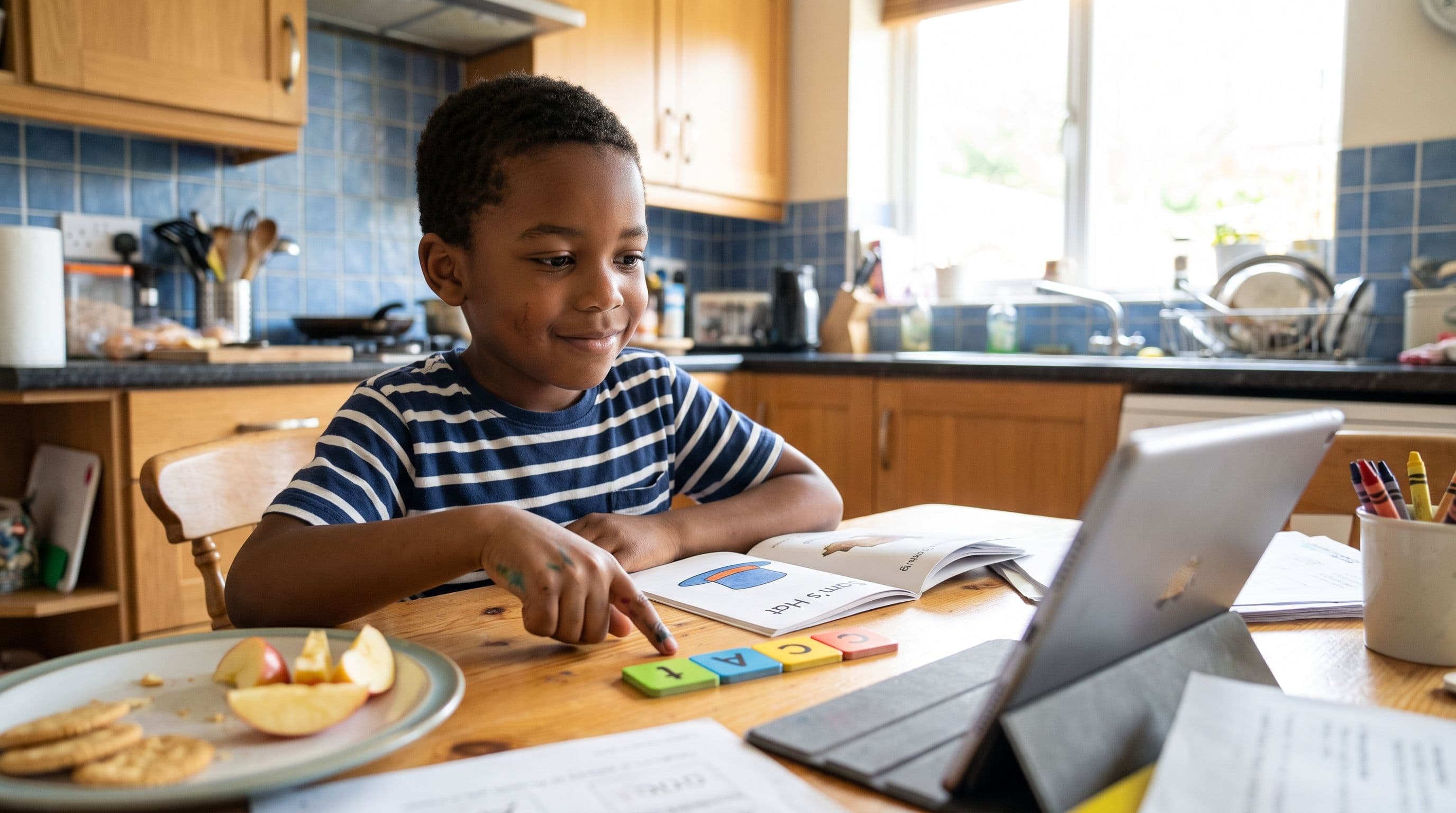
HOMER vs Reading Eggs for 5-Year-Olds: Best Fit?
Choosing between HOMER and Reading Eggs for a 5-year-old? I’m breaking down phonics quality, guessing risks, rewards, pricing, and the app I’d put first for decoding mastery.
Read More →