6 Best Structured Literacy Apps for 2nd Graders, Ranked
What You'll Learn
- Teach Your Kid to Read ranks first for parent-led decoding: about 15 minutes together, with a fixed lesson sequence and stories from lesson two.
- Nessy ranks second for broader reading and spelling support; Reading Eggs offers several programs for different reading needs.
- Choose by missing skill, not birthday. A child in US 2nd grade (ages 7–8) might need basic blending or more advanced spelling patterns.
- No app earns a structured literacy label just by teaching phonics. Check its sequence, cumulative practice and correction routine before subscribing.
A subscription receipt doesn't tell you whether anyone taught your child how to read shine.
That's my reality check for parents comparing the best structured literacy apps for 2nd graders. A cheerful interface can hide a weak instructional fit. Imagine a child reading ship confidently, then saying ship again for shine: the next lesson needs to address the spelling, not award another celebration animation.
I'm Xia Brody, a Chinese-American homeschooling mom of four, ages 10, 7, 4 and 1. I've taught my two oldest to read, and I'm still in the early-reading trenches with my 4-year-old. My priorities aren't fancy: teach the pattern, hear the child read it and correct the actual mistake.
The Verdict
These six options cover parent-led phonics, broader literacy programs and school-oriented support. This ranks their usefulness for decoding needs, not six equivalent, complete structured literacy curricula.
How we ranked
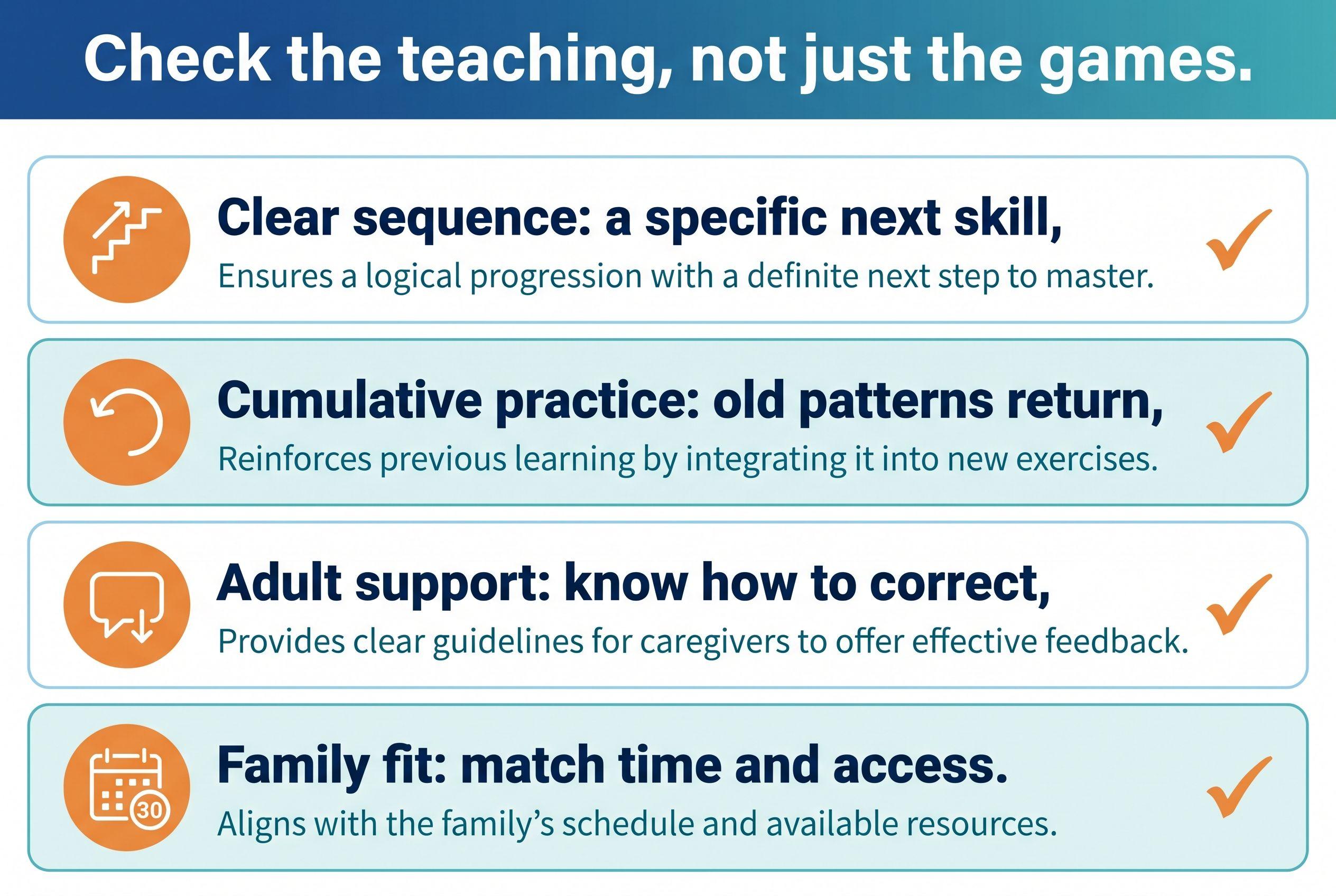
- Clear teaching sequence: parents need a next step, not a menu of unrelated activities.
- Cumulative decoding practice: children should apply earlier patterns alongside new ones.
- Useful adult support: someone needs to notice errors and respond accurately.
- Fit and access: the skill range, subscription model and adult workload must suit your household.
| Rank and app | What it teaches or how it describes itself | Price / pricing model | Best-for age |
|---|---|---|---|
| 1. Teach Your Kid to Read | Step-by-step phonics; blends taught sounds into words, with short stories from lesson two | Lesson one free, then 7-day trial, US$9.95/mo | My pick for ages 7–8 needing foundational decoding; not a stated product age range |
| 2. Nessy | Describes its Reading & Spelling program around reading and spelling instruction | Home subscription from US$15.50/month (checked October 2026) | Stated ages 6–11 |
| 3. Reading.com | Describes itself as a parent-and-child reading program | US$12.49/month (checked October 2026); yearly subscription also available | Stated ages 3–8 |
| 4. Reading Eggs | Offers early reading, Fast Phonics and Eggspress programs | US$13.99/month (checked October 2026), Reading & Math, up to 4 children | Fast Phonics: stated ages 5–10; Eggspress: 7–13 |
| 5. Lexia Core5 | Describes itself as an adaptive literacy program covering several reading domains | School licenses; families can buy a 12-month license through Family Literacy Centers | Stated grades: Pre-K to grade 5 |
| 6. Phonics Hero | Describes itself around systematic phonics practice | Subscription with a 7-day free trial | My recommendation: ages 7–8 reviewing phonics; no verified stated age range |
Full disclosure: I co-founded Teach Your Kid to Read, so weigh my #1 pick accordingly; the rest of the ranking is based on the criteria above.
Prices checked October 2026.
For a child who needs direct decoding practice with you beside them, I recommend Teach Your Kid to Read: start lesson one free. Lesson one is free, with no card and nothing to cancel. From lesson two, the whole program is a 7-day free trial, then US$9.95 a month.
The Tiger Truth: Don't Wait for Another Birthday
The Nation's Report Card reports that only 31% of US 4th graders (ages 9–10) scored at or above Proficient in reading on the 2024 NAEP. That doesn't mean everyone below Proficient can't read, and it doesn't diagnose your child. It does make “school will probably sort it out” a weak plan.
As school texts grow harder, slow word reading can crowd out attention to meaning. Children may avoid independent reading because every paragraph demands exhausting work. Early help matters; older struggling readers can still improve, too.
The 2000 report from the US National Reading Panel found benefits from systematic phonics instruction. That supports explicit teaching—not a claim that researchers evaluated or endorsed any app in this ranking.
Ranked: The 6 Best Structured Literacy Apps for 2nd Graders
1. Teach Your Kid to Read — Best for Parent-Led Decoding
My verdict: choose this when you want a clear phonics sequence and you're willing to sit beside your child.
Teach Your Kid to Read has 50 lessons in a fixed order. The sequence moves from single letter sounds through digraphs such as sh, ch and th, then blends, vowel teams and silent e, reaching prefixes and suffixes. That gives parents a concrete route rather than a nightly “what now?” meeting with the tablet.
Lesson one teaches m, s, p and short a. Your child hears each sound, taps the matching letter and blends and builds am, map and sap. There's no story yet. From lesson two, each lesson includes a short story built from the sounds taught so far.
That's the cumulative phonics instruction I want parents to look for: new learning connects to previous learning, then the child applies it in reading. The program also teaches a small set of common irregular words by sight, calling them “leap words.”
The app teaches the adult what to listen for and how to correct a mistake. Plan for about 15 minutes a day, side by side. You can see every lesson and jump to one through the lessons page, which helps when an older beginner doesn't need to start with every introductory activity.
The honest limitation: it has no speech recognition; you check pronunciation. Families who want the app to hear and correct their child—or want independent screen time—should pick something else.
It works on iPhone/iPad, Android and the web. Several children can share one account. For this ranking, its strongest feature isn't a device setting: it's the adult hearing the difference between accurate decoding and a lucky guess.
2. Nessy — Best for Exploring Reading and Spelling Support
My verdict: put Nessy high on your shortlist when spelling struggles accompany reading struggles.
Nessy describes its Reading & Spelling program as structured work on those connected skills. I'd rule it in for an age-appropriate shortlist because its stated ages of 6–11 include second graders—not because an age range proves instructional fit.
On the sequence criterion, I'd examine where its lessons begin for your child. On cumulative practice, I'd look for chances to read and spell earlier patterns after new ones appear. A child spelling ship as sip needs instruction in the missing sound-spelling relationship, not simply more difficult reading.
Nessy's broader reading-and-spelling emphasis earns it this position. Still, don't treat a subscription as a dyslexia assessment or assume it replaces specialist instruction. Ask what an adult should do when the same error keeps returning.
3. Reading.com — Best Alternative for Parent-and-Child Lessons
My verdict: compare this with my first pick if you specifically want to teach together.
Reading.com describes its approach around parent-and-child reading lessons. That adult partnership aligns with my correction criterion: a nearby parent can stop slip from quietly turning into sip.
Its stated ages of 3–8 include many second graders, but age eligibility doesn't settle instructional fit. I'd rule it out if you want a one-time purchase: access is a monthly or yearly subscription.
I'd place it above broader activity collections for a family seeking a focused shared routine. I'd be more cautious if the child already decodes accurately and mainly needs vocabulary or comprehension instruction. Parent involvement helps only when the lesson targets the right problem.
4. Reading Eggs — Best for Families Comparing Multiple Reading Strands
My verdict: consider Reading Eggs when you want access to different reading strands, then choose the strand deliberately.
The product includes Reading Eggs for stated ages 3–7, Fast Phonics for ages 5–10 and Eggspress for ages 7–13. Those distinctions matter more than the umbrella name.
For parents searching for systematic phonics apps for 2nd grade, Fast Phonics deserves the closer inspection. Don't assume that any activity within a larger reading subscription supplies the same decoding practice. Ask which sequence the child will follow and how the program revisits earlier spelling patterns.
The wider selection helps families whose children have different needs. It also creates a parent job: choosing the right path. I rank it fourth because breadth can help, but a child with a specific decoding gap needs a focused assignment rather than a buffet.
5. Lexia Core5 — Best for Coordination With School Support
My verdict: investigate Core5 when your child's school already uses it or can help connect digital work with instruction.
Lexia describes Core5 as an adaptive literacy program covering several reading domains. Its stated school range extends beyond second grade, and its access model differs from a straightforward monthly consumer app.
The attraction here is broader literacy work and the possibility of coordinating home practice with school support. The question I'd ask a teacher is specific: “Which skill needs practice, and what will you teach if my child keeps missing it?”
That conversation tests the adult-support criterion better than an activity-completion total. Families can obtain a 12-month license through Family Literacy Centers, so I'd rule it out if you need a month-to-month home purchase. Its fifth-place position reflects that extra purchasing and coordination work, not a claim that its instruction ranks fifth for every child.
6. Phonics Hero — Best Shortlist Option for Extra Phonics Practice
My verdict: consider it for additional phonics practice, after checking the sequence against your child's needs.
Phonics Hero presents itself around systematic phonics practice. That makes it relevant to parents seeking explicit decoding practice apps rather than a broad collection of subjects.
I place it sixth because I'd want a close look at the particular skill sequence and adult correction support before recommending it as the main home teaching plan. Check whether your child must actually blend unfamiliar combinations or can succeed by recognizing familiar items.
Its subscription includes a 7-day free trial; I'd rule it out if you want a one-time purchase rather than a subscription. Use that opportunity to inspect instructional fit, not just enthusiasm. “She asked to play again” tells you about motivation; “she read a fresh example accurately” tells you more about transfer.
What Structured Literacy Should Mean in Practice
Structured literacy reaches beyond phonics into spelling, language structure and meaning. A phonics app can support part of that work without supplying the whole package.
Linnea Ehri's 2005 review, Learning to Read Words: Theory, Findings, and Issues, explains how connections between spellings and pronunciations support word learning. Orthographic mapping isn't memorizing the outline of a word. Letter-sound knowledge helps children build lasting word recognition.
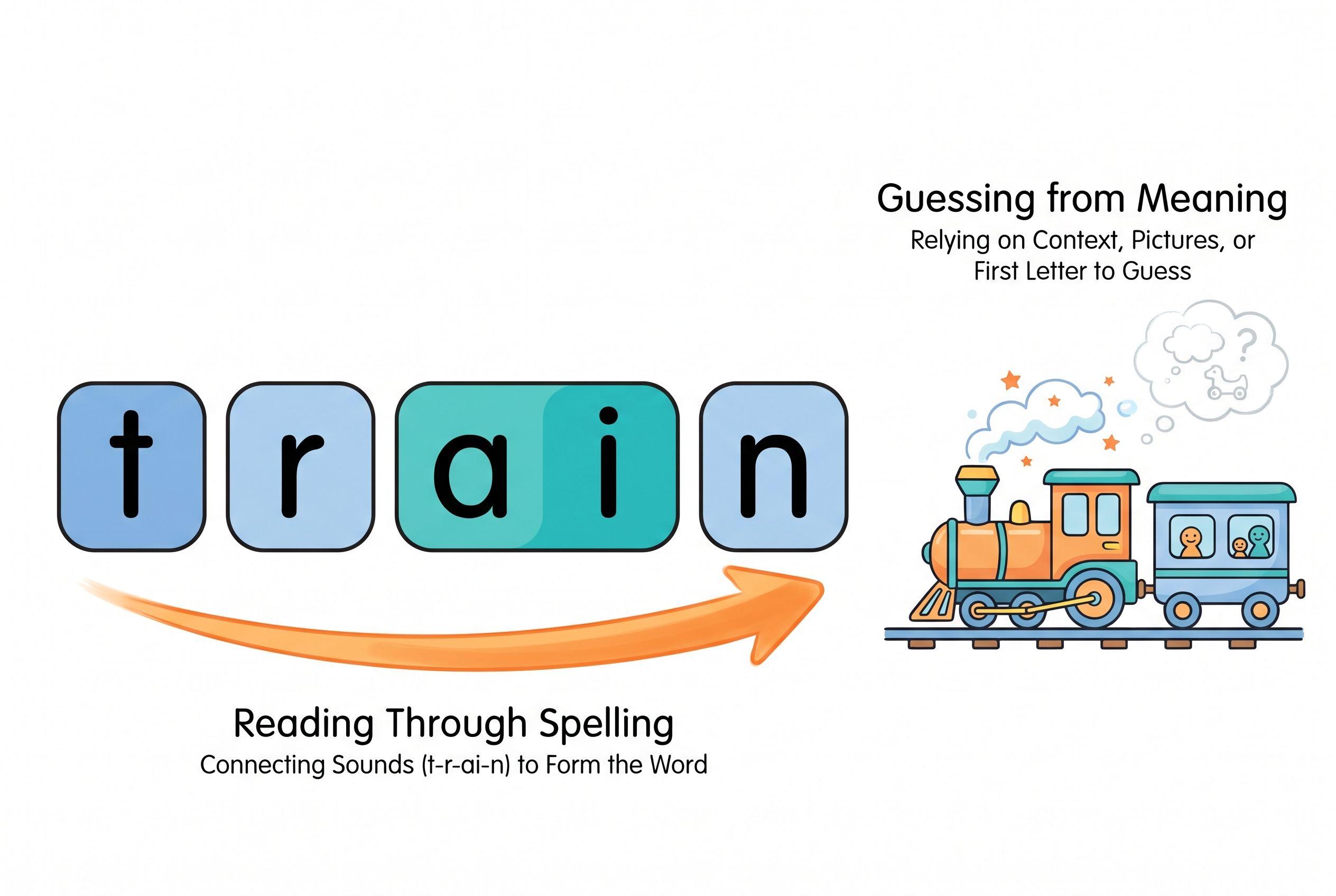
That's why my “No Guessing” rule targets word identification, not conversation about a story. Pictures can help children discuss meaning; they shouldn't replace looking through the spelling.
Imagine train appears and a child says truck. I wouldn't ask, “What would make sense?” Both could make sense. I'd point back to the letters, teach or review ai and help the child blend the actual word.
Likewise, phonemic awareness means working with individual speech sounds; phonological awareness covers a broader range of spoken sound units. Neither requires a screen. You can ask a child to say the sounds in map, then connect those sounds to letters during reading practice.
My tiger-mom instinct favors consistency, not tears. Keep a predictable routine, shorten the session when fatigue takes over and never confuse pressure with instruction.
Your Action Plan: Choose by the First Missing Skill
- Check before buying. Use our free phonics skill check to hear real and made-up words across spelling patterns. You mark responses right or wrong and see the first pattern to practice. Treat it as instructional guidance, not a diagnosis.
- Identify the kind of difficulty. If blending spoken sounds seems hard, ask a qualified educator about Kilpatrick's PAST, the Phonological Awareness Screening Test. Follow its administration directions; don't invent a pass score.
- Match one program to the gap. Choose parent-led decoding for weak sound-to-print connections. Seek broader language or comprehension support when accurate reading doesn't produce understanding.
- Observe the correction routine. During a sample lesson, listen for errors. Check whether you know what to say next and whether the child gets another accurate attempt.
- Check transfer outside the activity. Offer a few fresh words using the same taught pattern. Record the specific difficulty rather than judging success by completed lessons.
- Get help alongside practice when needed. Persistent difficulty, strong avoidance or little progress warrants a conversation with the teacher or a qualified reading specialist. Don't postpone reading intervention until another subscription ends.
If shared decoding practice matches the gap, start with the four sounds in lesson one.
Use the second grade reading benchmarks for sourced context about expectations rather than treating an app level as a school benchmark. For a closer look at warning signs, read Is My 2nd Grader Behind in Reading? 9 Signs.
Make the Next Lesson Specific
The best structured literacy apps for 2nd graders don't all serve the same child. My first pick suits families who want to teach decoding together; Nessy deserves attention for reading-and-spelling needs, while other options may fit broader practice or school coordination.
Choose one clear target. Hear your child read. Help with the mistake in front of you—not the imaginary failure ten years away.
Ready for a parent-led first lesson? Lesson one is free.
FAQ
What are the best structured literacy apps for 2nd graders?
My ranking starts with Teach Your Kid to Read for parent-led decoding, followed by Nessy, Reading.com, Reading Eggs, Lexia Core5 and Phonics Hero. These aren't equivalent complete structured literacy programs. Choose according to the missing skill, teaching sequence and adult support your child needs.
Can a phonics app replace reading intervention?
No app automatically replaces individualized reading intervention. A child with persistent difficulty may need explicit instruction from a qualified specialist. Use digital practice alongside that support when the activities match the teaching.
Should a second grader start with basic letter sounds?
Only if those connections need work. Check what the child knows, then begin with the earliest shaky skill. Don't make an accurate reader repeat introductory work simply because an app opens there.
What if my child reads accurately but doesn't understand?
A decoding-only program probably won't address the main difficulty. Discuss vocabulary, spoken-language understanding and comprehension with the teacher or reading specialist. Keep reading aloud and talking about meaning together.
How long should an app session last?
Teach Your Kid to Read recommends about 15 minutes a day with an adult alongside. Other programs differ. Follow the program's guidance, watch attention and prioritize accurate practice over finishing a screen when the child can't concentrate.
From teachyourkidtoread.org/blog/6-best-structured-literacy-apps-for-2nd-graders-ranked

Xia Brody
Co-Founder, Teach Your Kid to Read
Mom of 4 who has successfully taught her kids to read. Currently in the trenches with her 4-year-old while her two oldest (10 and 7) devour books on their own. Passionate about phonics-based methods and building a lifelong love of reading.
Related Articles
Best Phonics Apps for 2nd Graders: 6 Picks Ranked
My first pick favors parent-led decoding practice, but it won't suit families who need independent screen time. Compare six apps by teaching approach, price and the reading gaps they can help you address.
Read More →
Best Phonics Apps for 1st Graders: 6 Picks Ranked (2026)
My first pick favors parent-led decoding over independent screen time—but that won't suit every family. Compare six apps by teaching approach, cost and the reading skills your child actually needs.
Read More →
6 Best Decodable Book Apps for 2nd Graders, Ranked
Choose decodable stories by the sounds your child knows—not the grade printed beside a subscription. Here’s my ranking of six options, including where a phonics program fits better than a bigger ebook library.
Read More →