Teach Your Monster to Read vs Reading Eggs: 2026 Honest Comparison
What You'll Learn
- The specific phonics gap both apps have — and why neither one alone will get your kid reading fluently
- Which app actually teaches blending and decoding versus which one mostly rewards guessing and tapping
- The real cost breakdown for 2026 (one's free, one's not — but "free" isn't always the win you think it is)
- What I use instead — and the exact benchmarks I check to know it's working
Let's Get the Uncomfortable Part Out of the Way
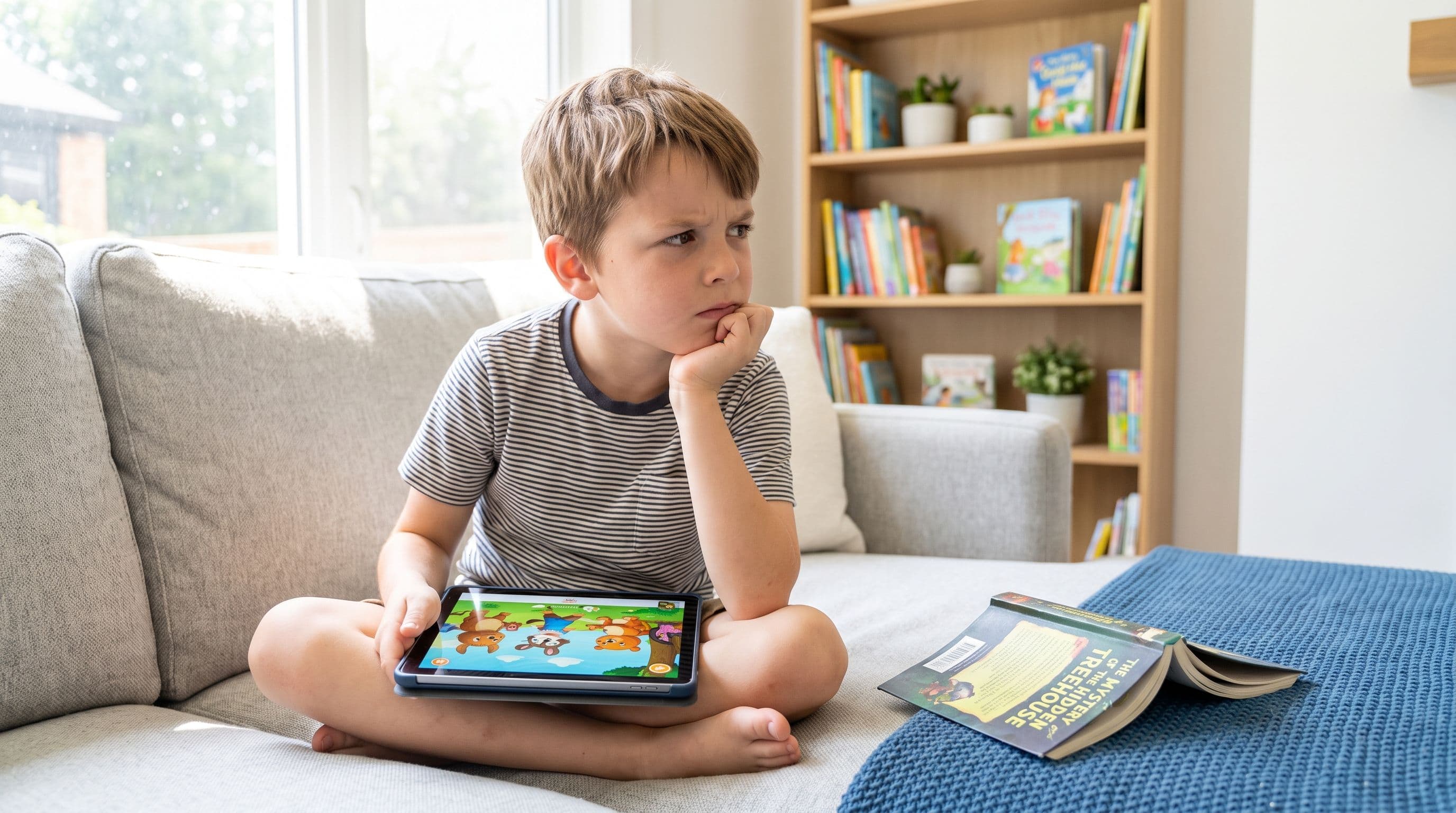
Your kid loves their reading app. They beg to play it. They earn coins and hatch eggs and dress up little monsters. They look like they're learning.
But can they read the word "splint"?
I'm serious. Go ask them right now. I'll wait.
I was at a playground in Raleigh last spring when another mom told me her kid's school had just switched from Lucy Calkins to a Science of Reading curriculum because of North Carolina's SB 387 — the Excellent Public Schools Act. She was confused and honestly a little annoyed. "He was doing fine before," she said. I asked if her son could read the word "splint." He's in second grade. He could not. He looked at it, squinted, and said "...split?" then "...spent?" He was guessing. That's not reading — that's a coin flip with consonants.
I spent 20 minutes on that playground bench explaining why the switch was happening — Emily Hanford's APM Reports investigation "Sold a Story" that blew the lid off Balanced Literacy, the NAEP data showing only 33% of 4th graders reading at proficient level, the neuroscience from Stanislas Dehaene's lab proving the brain doesn't learn to read naturally (his 2009 book Reading in the Brain lays it all out — the visual cortex has to be retrained for letter recognition). She went home and watched the "Sold a Story" podcast that night. Texted me at 11pm: "I had no idea. Why didn't anyone tell us this sooner?"
That question haunts me. And it's exactly why I can't just say "both apps are great!" and call it a day.
Because the app your kid uses matters. The methodology behind it matters. And most parents pick reading apps the way they pick cereal — whatever has the brightest box.
The Stakes: Why "Good Enough" Isn't Good Enough
Here's the tiger truth, and I won't soften it.
Children who aren't reading proficiently by 3rd grade are about four times more likely to leave school without a diploma. That's from the Annie E. Casey Foundation's 2010 report — and the figure is even starker for kids growing up in poverty, where lack of reading proficiency compounds with other risk factors. The 2023 NAEP scores showed reading dropped 3 points since 2019 — the largest decline in 30 years. We're going backward.
The average remedial reading program — Lindamood-Bell, Barton Reading & Spelling, a Wilson Reading System tutor — can run to thousands of dollars a year. Insurance doesn't cover it. Most school districts don't offer it until a kid is already two years behind.
So when a parent asks me "should I use Teach Your Monster to Read or Reading Eggs?" what I hear is: "Which tool will actually protect my kid from falling off the 3rd Grade Cliff?"
That changes how I answer.
Teach Your Monster to Read: The Quick Breakdown
Cost in 2026: Free on web browser. $8.99 one-time on iOS/Android as of October 2026.
Target age: 3-6 years old.
Where it came from: Developed by the Usborne Foundation in the UK. Originally launched as a browser game, then moved to apps.
The approach: Your kid creates a monster, then goes on a quest where they learn letter sounds, blend them into words, and read short sentences. It follows a synthetic phonics sequence — letters first, then blending, then full words.
What It Gets Right
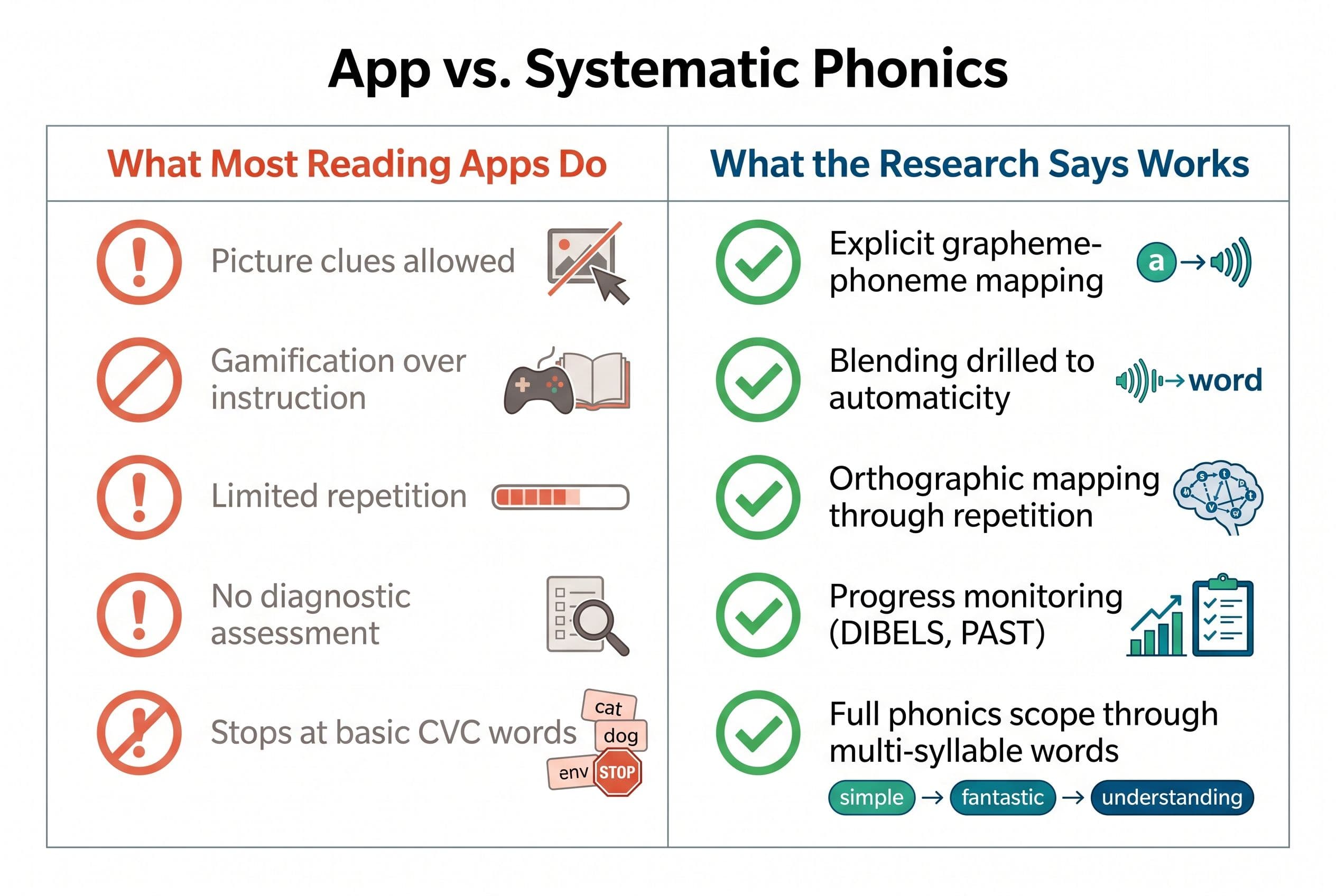
- It teaches blending explicitly. Your kid doesn't just tap letters — they have to drag sounds together to form words. That's actual phonics instruction.
- The sequence is logical. It starts with single letter-sound correspondences (grapheme-phoneme mapping, if you want the fancy term), moves to CVC words, then digraphs, then longer words.
- It's free. The web version costs nothing. For a family on a tight budget, this is a no-brainer.
- Low screen-time guilt. Sessions are short. That's honestly fine for a preschooler's attention span.
What It Gets Wrong
- It stops too early. The app covers early-to-mid phonics skills — common spellings, digraphs, and some more complex graphemes — but it won't take most kids through the full K–2 code (vowel teams, r-controlled vowels, multisyllable words, morphology). If your kid is 5 or 6 and already knows basic CVC words, there's not much runway left.
- Limited practice volume. Kids need repetition to build orthographic mapping — that's the process David Kilpatrick describes in Equipped for Reading Success (2016) where a word moves from "sounded out" to "instantly recognized." Teach Your Monster doesn't give enough repetitions per word.
- No assessment built in. You can't see where your kid is breaking down. There's no equivalent of a DIBELS nonsense word fluency check or Kilpatrick's PAST test.
- The game elements sometimes distract. A kid can end up spending more time customizing their monster's outfit than actually reading. (Sound familiar?)
Reading Eggs: The Quick Breakdown
Cost in 2026: $13.99/month or $99.99/year for Reading & Math (up to 4 children), as of October 2026.
Target age: 2-13 years old (Reading Eggs for younger, Reading Eggspress for older).
Where it came from: Developed by Blake eLearning, an Australian company. Launched in 2008.
The approach: Structured lessons with a mix of phonics, sight words, and reading comprehension. Kids earn golden eggs, hatch pets, play mini-games between lessons. It covers a much broader age and skill range than Teach Your Monster.
What It Gets Right
- Way more content. Over 200 lessons spanning pre-reading through about 3rd grade level. If your kid sticks with it, there's a lot of material.
- It includes decodable readers. The e-books inside the app are (mostly) decodable — meaning they use words your kid has actually been taught to sound out, not random vocabulary.
- Parent dashboard exists. You can log in and see which lessons your kid completed and how they scored. It's not the same as a diagnostic assessment, but it's something.
- Broader phonics coverage. It goes beyond CVC into vowel teams, r-controlled vowels, and multi-syllable words.
What It Gets Wrong
- It mixes phonics with sight-word memorization in ways that worry me. Some lessons ask kids to memorize words by shape or by repeating them — that's a Whole Language hangover. Linnea Ehri's research on word reading phases (her 2005 meta-analysis) shows that even "sight words" are best learned through their letter-sound patterns, not through rote visual memorization.
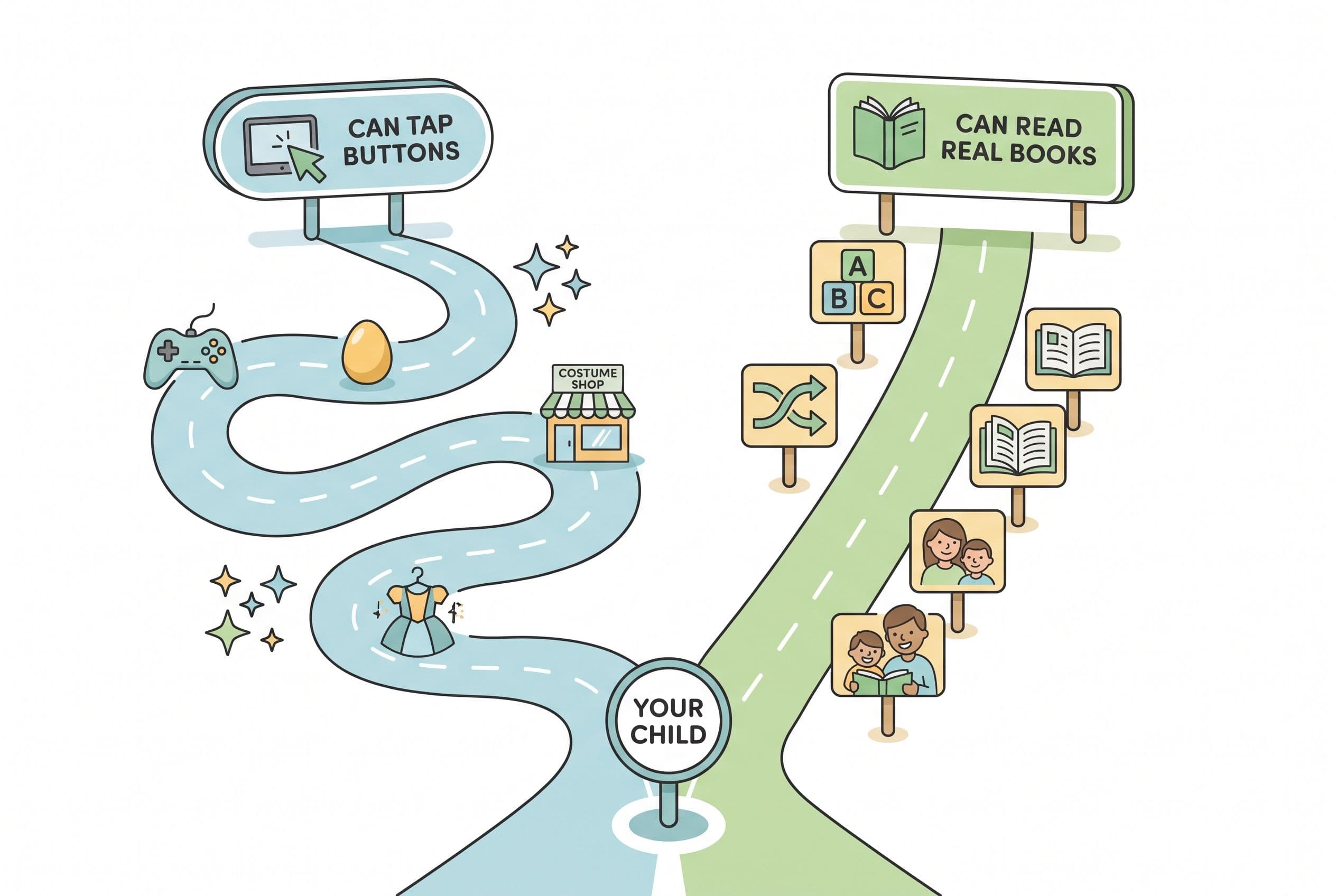
- The gamification is intense. I mean intense. Golden eggs, shopping, dressing up characters, arcade-style mini-games between lessons. A kid can spend a solid chunk of "reading time" shopping in the virtual store. That's not reading. That's Roblox with vowels.
- Some lessons allow guessing from pictures. This one drives me crazy. If a lesson shows a picture of a dog next to the word "dog," your kid isn't decoding — they're doing what Louisa Moats warned about in her 1999 paper Teaching Reading IS Rocket Science. They're using context clues instead of grapheme-phoneme correspondence.
- It's not free. And the upsell pressure is real. Free trial, then paywall.
Head-to-Head: The Comparison That Actually Matters
Forget the star ratings. Here's what I care about as a parent who's taught two kids to read and is in the trenches with a third.
| Feature | Teach Your Monster to Read | Reading Eggs |
|---|---|---|
| Systematic phonics sequence | Yes — synthetic phonics | Mostly yes, but mixes in memorization |
| Teaches blending explicitly | Yes — drag-and-blend mechanic | Sometimes — varies by lesson |
| Allows picture-guessing | Rarely | Yes, in some lessons |
| Decodable readers included | No (a few sentences, that's it) | Yes — 100+ e-books |
| Assessment/progress tracking | Minimal | Parent dashboard with scores |
| Age range covered | 3-6 (narrow) | 2-13 (wide) |
| Cost | Free (web) / $8.99 (app, Oct 2026) | $99.99/year (Oct 2026) |
| Gamification level | Moderate | High (borderline excessive) |
| Enough repetition for mastery? | No | More than Monster, still not enough |
Here's the kicker: neither app alone is sufficient.
I'll say it louder for the parents in the back.
No app replaces systematic, daily phonics instruction with a real human.
Apps are supplements. They're the vegetables on the side, not the main course. The National Reading Panel — the one Congress actually commissioned back in 2000 — found that systematic phonics instruction produces significant benefits for reading achievement. But "systematic" means a structured, sequential, explicit program. Not a game where a kid taps on eggs.
OK, So Which One Should You Pick?
Real talk — if I have to choose between these two and only these two, here's my decision tree:
Pick Teach Your Monster to Read if:
- Your kid is 3-5 and just starting to learn letter sounds
- You want a free, low-stakes introduction to phonics
- You're already doing structured phonics instruction yourself and just want a fun supplement
- You're disciplined enough to keep sessions short and focused
Pick Reading Eggs if:
- Your kid is 5-7 and needs more content and decodable reading practice
- You want progress tracking (even if it's basic)
- You're willing to pay and can limit the gamification time
- You monitor lessons and redirect when you see picture-guessing happening
Pick neither as your primary reading tool if:
- You're serious about your kid reading at grade level by age 6
- You want a program grounded in Orton-Gillingham principles
- You need real diagnostic data on where your kid's phonological processing is breaking down
Bottom line? Teach Your Monster works best as a 10-minute warm-up on days when your kid is cranky and needs something low-pressure before you sit down for actual phonics work. That's it. It's the appetizer.
What I Actually Use (And Why)
I built my daily phonics routine around the app on [INTERNAL_LINK:teachyourkidtoread] — and I'm biased, obviously, since I co-founded it. But let me tell you why I'm biased.
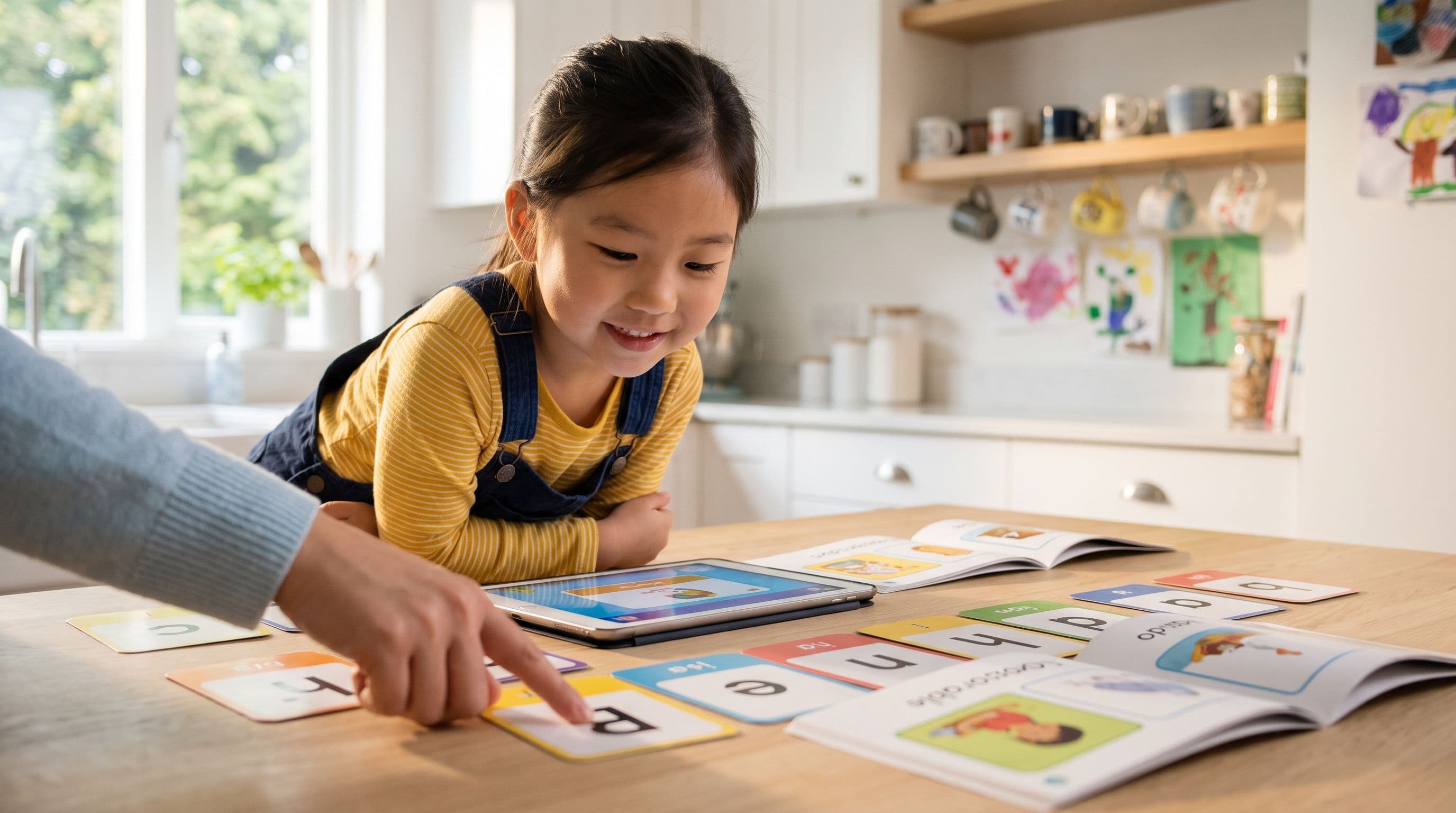
The app follows systematic synthetic phonics based on Orton-Gillingham principles. It doesn't let kids guess from pictures. It doesn't reward them with virtual shopping sprees. It teaches grapheme-phoneme correspondences in a logical sequence, drills blending until it's automatic, and uses decodable text so every word your kid encounters is one they've been explicitly taught to decode.
That's what the research says works. Not me saying it — the NICHD research led by Reid Lyon, the Clackmannanshire study out of Scotland (Johnston & Watson, 2005) that tracked kids for 7 years, Mark Seidenberg's Language at the Speed of Sight (2017) where he called out the entire reading education establishment. The evidence is clear: systematic, explicit phonics is the best bet for getting most kids decoding — especially in K–1. Then you still have to build fluency, vocabulary, and comprehension on top.
Your Action Plan: What to Do This Week
Don't just read this article and bookmark it. Do something. Here's your plan:
Step 1: Test your kid right now. Grab a piece of paper. Write these words: mat, ship, blend, splint, chunk. Ask your kid to read them without any pictures, hints, or context. If they can't decode "splint" or "chunk," they have phonics gaps — period. (If you want a real assessment, look up Kilpatrick's PAST test — the Phonological Awareness Screening Test. It takes about 5 minutes and tells you exactly where the phonological breakdown is.)
Step 2: Set a non-negotiable daily phonics time. Fifteen minutes a day. Every day. Birthdays, Christmas, vacation. We call it Tiger Rules in my house: We Never Skip. My 10-year-old, Jade, still reads aloud to me three times a week. Mastery isn't a destination — it's maintenance.
Step 3: Use apps as supplements, not substitutes. If your kid loves Teach Your Monster, great — let them play it for 10 minutes as a reward after their real phonics lesson. Same with Reading Eggs. But the structured instruction comes first. Always.
Step 4: Get a systematic phonics program. Try [INTERNAL_LINK:teachyourkidtoread]. It's built on the science. No guessing. No picture clues. No virtual shopping malls. Just phonics that works.
Step 5: Check DIBELS benchmarks. Ask your kid's school which version of DIBELS they use (most districts have moved to DIBELS 8th Edition) and request your child's Nonsense Word Fluency (NWF) scores — that's the subtest where kids decode made-up words like "vap" as /v/ /a/ /p/, which tells you if they're actually sounding out words or just memorizing. Every DIBELS edition has its own benchmark table for beginning, middle, and end of year, so ask the teacher: "Is my kid on track for this testing window?" If your kid's school doesn't assess with DIBELS, ask them what they use — and if the answer is Fountas & Pinnell levels, know that F&P is whole-language aligned and won't tell you what you need to know about decoding.
Frequently Asked Questions
Is Teach Your Monster to Read actually free?
The web browser version at teachyourmonstertoread.com is genuinely free — no paywall, no hidden subscriptions. The iOS and Android app versions cost $8.99 as a one-time purchase (as of October 2026). There are no in-app purchases. For a free reading app, it's hands down one of the best options available. But "free" doesn't mean "complete" — it covers letter sounds through basic blending and stops before kids get to the trickier parts of the English code like vowel teams and r-controlled vowels.
Is Reading Eggs worth the money?
It depends on what you're using it for. At $99.99/year (as of October 2026), Reading Eggs offers a lot of content — over 200 lessons, decodable e-books, and coverage through about 3rd grade. The problem isn't the quantity. The problem is that some lessons allow picture-guessing and sight-word memorization strategies that contradict what the Science of Reading research tells us works. If you use it alongside a strong systematic phonics program and you actively monitor which lessons your kid is doing, it can be a useful supplement. If it's your kid's only reading instruction? I'd be worried.
What's the best reading app for a 5-year-old in 2026?
The best app for a 5-year-old is one that teaches systematic synthetic phonics — explicit letter-sound correspondences, blending, and decoding — without allowing guessing from pictures or context. [INTERNAL_LINK:teachyourkidtoread] is built on these Orton-Gillingham principles. Teach Your Monster to Read is a decent free supplement for early phonics. Reading Eggs has more content but mixes its methods. The real answer, though? No app should be your child's primary reading instruction. Fifteen minutes of structured, human-led phonics daily beats any app on the market.
Can my kid learn to read using only an app?
No. And I say that as someone who co-founded a reading app. Apps can reinforce skills, provide practice, and make phonics drill more engaging. But reading acquisition requires explicit instruction, error correction in real time, and practice with connected text (actual books). Scarborough's Reading Rope model shows that fluent reading requires weaving together phonics, vocabulary, background knowledge, syntax, and comprehension — no single app covers all of those strands. Use apps as one tool in your kit, not the whole kit.
My kid's school uses Reading Eggs in the classroom. Is that enough?
Almost certainly not. If Reading Eggs is the primary reading instruction tool in your kid's classroom, I'd have a direct conversation with the teacher about what systematic phonics curriculum they're using alongside it. Schools in the 40+ states that have now passed Science of Reading legislation since 2019 are required to use evidence-based core reading programs — apps like Reading Eggs and Teach Your Monster are supplements, not curricula. Ask specifically: "What is your core phonics program?" Good answers include UFLI Foundations, Fundations, or Logic of English. If the answer is vague, start supplementing at home immediately.

Xia Brody
Co-Founder, Teach Your Kid to Read
Mom of 4 who has successfully taught her kids to read. Currently in the trenches with her 4-year-old while her two oldest (10 and 7) devour books on their own. Passionate about phonics-based methods and building a lifelong love of reading.
Related Articles
Teach Your Monster vs Reading Eggs UK: Phonics Winner
Choosing between Teach Your Monster to Read UK and Reading Eggs UK? Here’s the no-fluff phonics verdict for Reception and Year 1 parents who want real decoding, not guessing games.
Read More →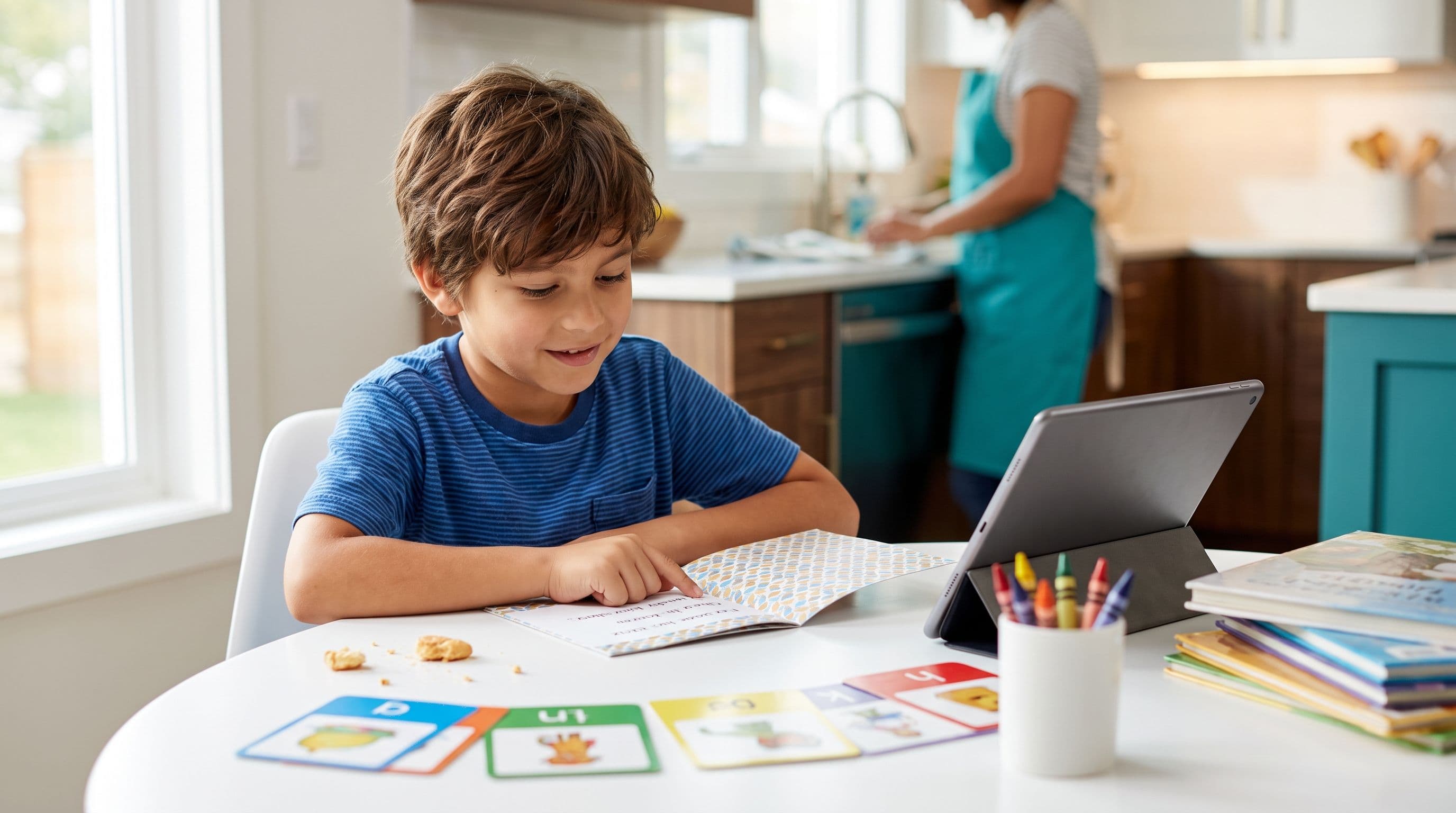
Reading Eggs vs ABCmouse Cost: 2026 Price Breakdown
Comparing Reading Eggs vs ABCmouse cost? Here’s the 2026 price breakdown, what each app teaches, and why I’d choose phonics-first instruction over reward-heavy screen time.
Read More →
Reading.com vs Teach Your Monster to Read: Parent Pick
Choosing between Reading.com and Teach Your Monster to Read? Here’s the no-fluff parent pick from Xia Brody: what each app teaches, where it falls short, and which reading app I’d use for kindergarten phonics.
Read More →