Reading Readiness Checklist for 5-Year-Olds: Free Printable + Parent Guide

What You'll Learn
- The 12 specific pre-reading skills your 5-year-old needs — and how to check each one in under 15 minutes at home
- Why "knowing the alphabet" isn't even close to enough for kindergarten reading readiness (the real bar is higher than you think)
- The one phonological awareness gap that predicts reading failure more accurately than any other early sign
- A free, printable reading readiness checklist you can use right now — no login, no email, no app download required
Your Kid Starts Kindergarten Soon. Can They Actually Read?
Let me be blunt: most parents think their 5-year-old is ready to read because the kid can sing the ABCs and recognize a few letters on cereal boxes.
That's not reading readiness. That's the bare minimum. And it's the reason two-thirds of American kids can't read at grade level by the end of third grade.
I've taught three of my four kids to read (my 1-year-old gets a pass — for now). When my oldest was 5, I thought I had it figured out. She knew her letters, she loved books, she could "read" Goodnight Moon from memory. I was proud. Then I asked her to read the word "mop" — a word she'd never memorized — and she stared at me like I'd asked her to solve calculus.
She wasn't reading. She was memorizing. And the difference between those two things is the difference between a kid who thrives and a kid who crashes into the 3rd-grade cliff.
The Tiger Truth: What Happens If You Skip This Step
Here's what nobody at kindergarten orientation tells you.
Only 33% of 4th graders read at proficient level on the 2022 NAEP — the Nation's Report Card. That means roughly two out of three 9-year-olds can't read well enough to learn from a textbook. And those 2023 NAEP scores? They dropped another 3 points from 2019 — the largest decline in 30 years.
Kids who can't read by the end of third grade are four times more likely to drop out of high school. That stat comes from the Annie E. Casey Foundation's 2010 study, and it still holds. Four times.
Private reading intervention — something like Lindamood-Bell or a Barton Reading & Spelling tutor — can run to thousands of dollars a year. Insurance doesn't cover it. Most school districts don't catch struggling readers until second or third grade, and by then you've lost years of compounding practice. Here's the thing: the brain gets more efficient at whatever it practices. So a kid who's been guessing at words for two years has two years of guessing habits wired in. Stanislas Dehaene's research in Reading in the Brain (2009) showed that the brain doesn't learn to read naturally — it has to be trained, deliberately, through systematic instruction. Earlier is better because skills compound and gaps widen — but older kids can absolutely learn to read with explicit, systematic instruction. The point is: every month you wait is a month of bad habits getting more entrenched and good habits not getting built.
So when I say a reading readiness checklist matters, I'm not being dramatic. I'm being mathematical.
"But His Teacher Said He's Doing Fine"
Let me tell you a story.
I was at a playground in Raleigh last spring when another mom — I'll call her Sarah — told me her son's school had just switched from Lucy Calkins' Units of Study to a Science of Reading curriculum because of North Carolina's SB 387, the Excellent Public Schools Act. She was confused. A little annoyed, honestly. "He was doing fine before," she said.
I asked one question: "Can he read the word 'splint'?"
Her son was in second grade. He could not.
He couldn't read "splint" because nobody had ever taught him to blend consonant clusters, segment the phonemes in a CCVCC word, or decode systematically. He'd been taught to look at pictures, check the first letter, and guess. That's what Balanced Literacy does. It teaches kids to be really good guessers and calls it reading.
I spent 20 minutes on that playground bench explaining why the switch was happening — Emily Hanford's Sold a Story investigation that blew the lid off Balanced Literacy, the NAEP data, the neuroscience from Dehaene's lab proving the brain has to be trained to read. Sarah went home and listened to the Sold a Story podcast that night. She texted me at 11pm: "I had no idea. Why didn't anyone tell us this sooner?"
Nobody told her because the system failed her. And a reading readiness checklist at age 5 — a real one, based on actual reading science — would have shown her two years earlier that her son was missing foundational skills.
Don't be Sarah. Check now.
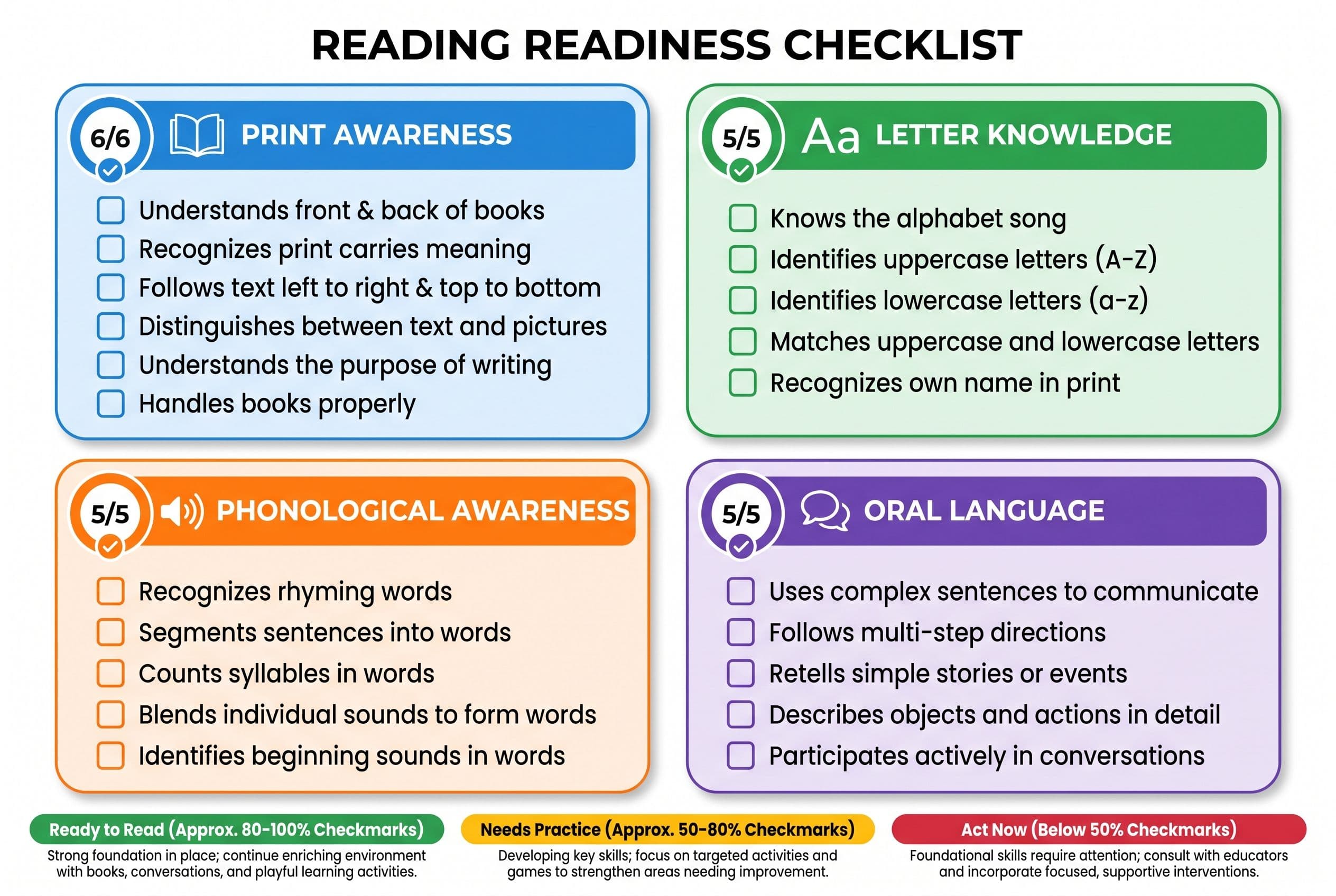
The Reading Readiness Checklist for 5-Year-Olds
This checklist is built on what reading researchers actually know about pre-reading development. I'm pulling from Linnea Ehri's phases of word reading development (her 2005 meta-analysis), David Kilpatrick's orthographic mapping research in Equipped for Reading Success (2016), and the National Reading Panel report from 2000 — the one Congress actually commissioned.
Here's how it works: sit down with your kid for 10-15 minutes. No pressure, no grades — just observation. Check off what they can do. Be honest. The skills are grouped into four categories.
Category 1: Print Awareness
These are the "does my kid understand what books even are" skills. They're the easiest to hit and most kids nail them by 5. If your child is missing these, it's a yellow flag — not a red one, but worth addressing immediately.
- ☐ Holds a book correctly (right-side up, front cover facing forward)
- ☐ Turns pages left to right and understands we read top-to-bottom
- ☐ Points to words (not pictures) when asked "where do we read?"
- ☐ Knows the difference between a letter and a word — can point to each when asked
- ☐ Understands that print carries meaning — knows the squiggles on the page say something
Tiger Mom benchmark: All 5 should be checked. Every single one. If your kid can't hold a book right at age 5, that tells me they haven't been read to enough. Read aloud 20 minutes a day. Non-negotiable.
Category 2: Letter Knowledge
This is where most parents stop — and it's where the real gaps start to show.
- ☐ Identifies all 26 uppercase letters by name
- ☐ Identifies all 26 lowercase letters by name (this one trips up a LOT of kids — lowercase "b" vs "d" vs "p" vs "q" is a landmine)
- ☐ Knows the sounds of at least 20 letter-sounds — not just names, SOUNDS. "B" says /b/, not "bee."
- ☐ Can write at least 15 letters from memory (messy is fine — I'm not grading penmanship)
The kicker: Letter names are not enough. Knowing that a letter is called "double-u" tells a kid nothing about reading. They need to know its sound — /w/. The 2000 National Reading Panel report found that systematic phonics instruction — teaching the letter-sound correspondences explicitly — produces significant benefits for reading achievement. Letter names are a nice-to-have. Letter sounds are survival.
When I was working with my 4-year-old last month, I realized she could name every uppercase letter but only knew the sounds for about 12. That's a gap. So we drilled sounds — 5 minutes at breakfast, every morning, no exceptions. We Never Skip.
Category 3: Phonological Awareness (This Is the Big One)
Listen to me carefully.
Phonological awareness — specifically phonemic awareness — is one of the strongest predictors of early reading success. Not intelligence. Not vocabulary. Not how many books you own. The ability to hear and manipulate the sounds in spoken language is what separates kids who learn to read easily from kids who struggle for years. Pair it with letter-sound knowledge and you've got the rocket fuel combo for decoding.
Quick clarification, because even teachers mix this up: phonological awareness is the umbrella term — it covers rhyming, syllables, all that. Phonemic awareness is the phoneme-level stuff (blending, segmenting individual sounds) that most directly powers decoding. The items below cover both, but the phonemic awareness items are the ones that matter most for reading.
David Kilpatrick's PAST (Phonological Awareness Screening Test) can tell you exactly where the breakdown is in about 5 minutes. If you do nothing else from this checklist, assess these skills:
- ☐ Rhyming: Can produce a rhyme ("Tell me a word that rhymes with 'cat'") — not just recognize one
- ☐ Syllable clapping: Can clap out the syllables in words like "elephant" (3 claps) and "banana" (3 claps)
- ☐ Initial sound isolation: Can tell you the first sound in a word ("What sound does 'fish' start with?" → /f/)
- ☐ Final sound isolation: Can tell you the last sound in a word ("What sound does 'mop' end with?" → /p/)
- ☐ Phoneme blending: When you say /c/ - /a/ - /t/ slowly, they can blend it into "cat"
- ☐ Phoneme segmenting (bonus): Can break "sit" into /s/ - /i/ - /t/ — this is harder and some 5-year-olds aren't there yet, but if they can, your kid is ahead of the curve
Red flag: If your 5-year-old can't isolate the first sound in a word (that's phonemic awareness), stop everything else and work on this. I mean it. Drop the sight word flashcards, pause the reading apps, and do phonemic awareness drills. This is the foundation under the foundation.
Here's a tip only a practitioner would give you: DIBELS nonsense word fluency benchmarks (the exact numbers vary by edition — DIBELS 6th vs. 8th — and by testing window, so ask your school which version they use) expect kids to hit a certain number of correct letter sounds per minute by mid-kindergarten. If your kid can't even isolate initial sounds, they're not getting anywhere near that benchmark without intervention.
Category 4: Oral Language & Comprehension
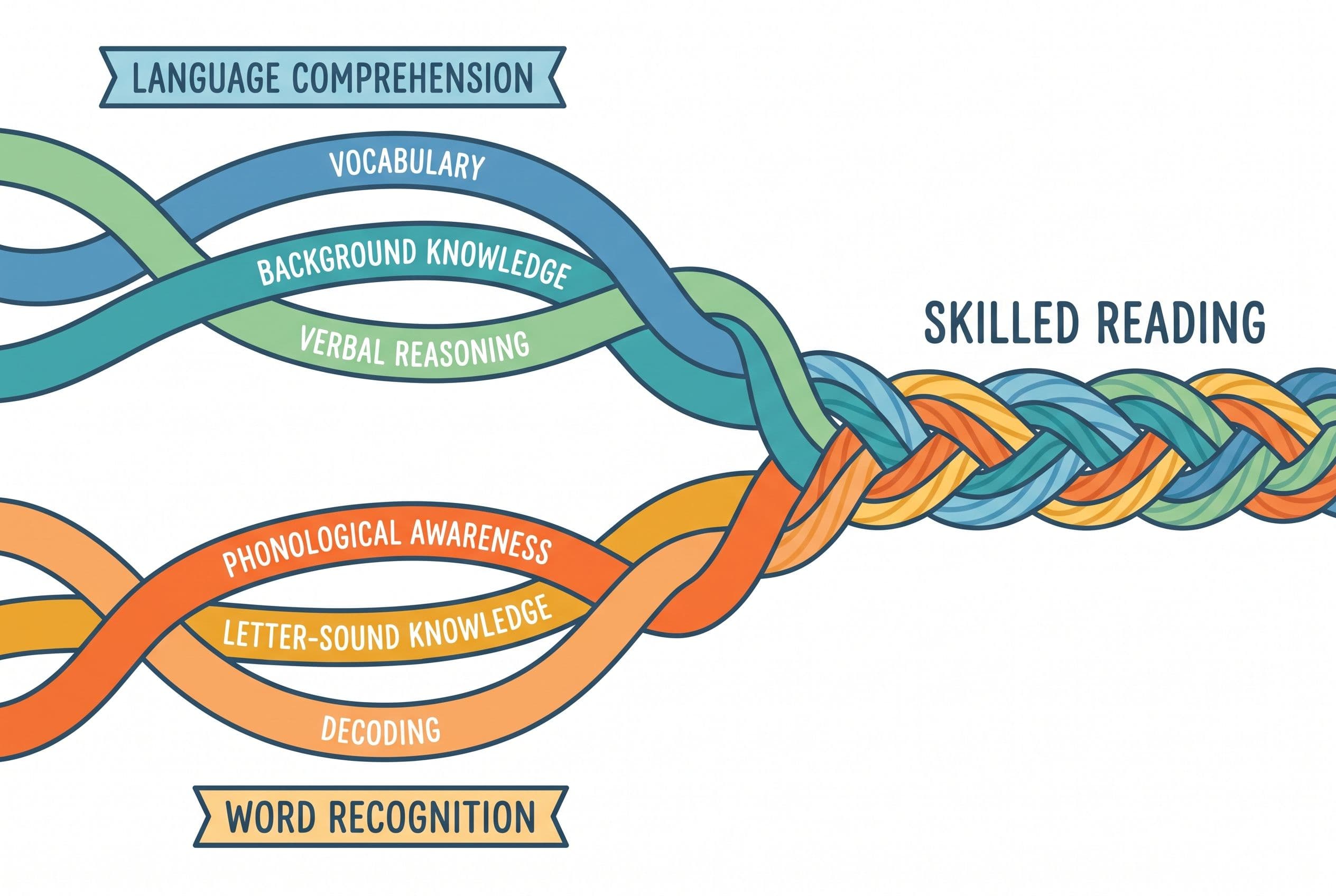
Reading isn't just decoding — the Simple View of Reading (Gough & Tunmer, 1986) says Reading = Decoding × Language Comprehension. Both matter. A kid who can sound out words but doesn't understand them isn't really reading either.
- ☐ Speaks in complete sentences of 5+ words
- ☐ Can retell a simple story in order (beginning, middle, end) after hearing it once
- ☐ Asks and answers "who," "what," "where," and "why" questions about a story
- ☐ Knows 2,000+ words of spoken vocabulary (you can't test this precisely, but if your kid has normal conversations and uses words like "actually" and "disgusting" and "definitely," they're probably fine)
- ☐ Follows 2-3 step directions without needing them repeated ("Get your shoes, put them on, and meet me at the door")
Real talk: Vocabulary is one of those things that's hard to drill but easy to build. Talk to your kid constantly. Narrate your day. Use big words and explain them. My 4-year-old knows the word "exasperated" because I say it roughly 47 times per day. (She's the reason I say it.)
How to Score the Checklist
Here's the bottom line. No complicated rubric — just an honest count.
Print Awareness (5 items): Your 5-year-old should check all 5. If they're missing more than 1, increase read-aloud time immediately.
Letter Knowledge (4 items): All 4 should be checked, with the letter-sounds item being the most important. If they know letter names but not sounds, you have work to do — and it's completely fixable with 5-10 minutes of daily practice.
Phonological Awareness (5-6 items): This is the make-or-break category. A reading-ready 5-year-old should hit at least 4 of the first 5 items. If they're scoring below 3, your child needs targeted phonological awareness intervention now — not in six months, not "when they're ready."
Oral Language (5 items): At least 4 of 5. If your child has significantly limited vocabulary or can't retell a story, talk to your pediatrician — this could indicate a language delay that needs professional assessment.
The "Wait and See" Lie
If your kid is missing chunks of this checklist, someone — a well-meaning teacher, a pediatrician, your mother-in-law — will tell you: "Don't worry, they'll catch up. Kids develop at different rates."
This drives me crazy.
Yes, kids develop at different rates. But reading is not a developmental milestone like walking. Babies will walk whether you teach them or not. Reading requires explicit instruction. Louisa Moats spelled this out in her 1999 paper Teaching Reading IS Rocket Science for the American Federation of Teachers: the brain is not wired for reading the way it's wired for spoken language. You have to teach it.
The "Wait and See" approach has a name in the research literature. It's called the "wait to fail" model. And the states that have recognized this — Mississippi with its Literacy-Based Promotion Act of 2013, Ohio with its Third Grade Reading Guarantee, the 40+ states that have passed Science of Reading legislation since 2019 — are finally saying: no more waiting.
Mississippi went from 49th to 21st in national reading scores in 6 years after they passed that law. Six years! Because they stopped waiting and started screening.
Your home is your classroom. Don't wait.
What to Do If Your Kid Isn't Ready
OK, so you ran through the checklist and your stomach dropped a little. Maybe they can't blend phonemes. Maybe they know letter names but not sounds. Maybe they can't rhyme to save their life.
Don't panic. But do act. Today.
Here's your action plan:
Step 1: Identify the Specific Gap
Don't just say "my kid can't read." Get specific. Which category is weakest? In my experience, the answer is almost always phonological awareness — it's the skill schools have been neglecting for 30 years because of the Balanced Literacy movement.
If you want a precise assessment, Kilpatrick's PAST test is free, takes 5 minutes, and tells you exactly where the phonological breakdown is. You can find it online. Print it. Give it. Know your baseline.
Step 2: Start Systematic Phonics Instruction
Your kid doesn't need more read-alouds right now. They don't need a sight word list. They need systematic, explicit phonics instruction that follows the Orton-Gillingham principles: start with the simplest letter-sound correspondences, teach blending, practice with decodable texts, and build systematically from simple to complex.
Programs that do this well:
- UFLI Foundations — free, developed at the University of Florida, and it's what a lot of schools are switching to
- Logic of English — thorough, slightly intense, and perfect for homeschoolers who want structure
- Explode the Code — workbook-based and affordable
- Bob Books — the decodable readers are a great supplement (not a full curriculum, but a solid practice tool)
- Teach Your Kid to Read — this is my program, built on systematic synthetic phonics and designed for parents, not teachers start lesson one free
Ditch the Fountas & Pinnell leveled readers. I know they're everywhere — your school probably uses them, your library probably organizes by F&P levels. But they're whole-language aligned and they encourage guessing from pictures and context. Look for decodable readers from publishers like Flyleaf Publishing or High Noon Books instead.
Step 3: Practice Every Day — Yes, Every Day
Tiger Rule #1: We Never Skip.
I had my 4-year-old practicing CVC words at the kitchen table last Tuesday — on her birthday. She got a cupcake afterward, but the phonics came first. Five to ten minutes a day. Birthdays, holidays, vacation. The consistency is what builds the neural pathways.
Linnea Ehri's research on word reading development shows that kids move through phases: pre-alphabetic, partial alphabetic, full alphabetic, and consolidated alphabetic. You can't skip phases. You can't rush them with shortcuts. But you can move through them efficiently with daily, systematic practice.
Step 4: No Guessing. Ever.
Tiger Rule #2: No Guessing.
Imagine your kid stares at the word "sun" and says "outside" because they looked at the picture. That's not reading. That's guessing. And every time you let it slide, you're reinforcing a guessing habit that will tank decoding and comprehension as the texts get harder (hello, third-grade cliff).
When your kid gets stuck on a word, point to the letters. Say: "Sound it out." Wait. If they can't, help them with each phoneme. Then have them blend. Then have them read the whole word. Then re-read the sentence. If the word has a pattern you haven't taught yet — like a vowel team or a silent-e word — just tell them the word and move on. No guessing allowed, but no demanding knowledge they don't have yet either.
It takes longer. It's frustrating. It works.
The "Kindergarten Reading Expectations" Reality Check
Parents ask me all the time: "What should a kindergartener be able to read by the end of the year?"
Here are the actual benchmarks most states align to, based on Common Core and Science of Reading standards:
- By mid-kindergarten: Know all letter names and most letter sounds. Blend and segment CVC words orally. (Ask your school what DIBELS version they use and what the benchmark targets are for your testing window — they vary by edition.)
- By end of kindergarten: Read simple CVC words (cat, pig, sun) independently. Read decodable sentences. Recognize some high-frequency sight words.
- By end of first grade: Read connected text with short vowel patterns and common digraphs. Read 60+ words per minute in grade-level text.
If your kid enters kindergarten unable to isolate phonemes or identify letter sounds, they're already behind the pace. Not doomed — behind. And catching up is harder than keeping up.
That's why this checklist matters.
Frequently Asked Questions
"My 5-year-old knows the alphabet but can't blend sounds. Is that normal?"
It's common. But "common" and "normal" aren't the same thing. Knowing letter names without knowing letter sounds is like knowing a car has pedals without knowing which one is the brake. Your kid needs explicit phonemic awareness instruction — start with blending two sounds ("What word do /m/ and /e/ make?") and build to three-sound CVC words. Programs like UFLI Foundations and Teach Your Kid to Read are designed exactly for this. start lesson one free
"Should I be worried if my kid reverses letters like 'b' and 'd'?"
At age 5, letter reversals are extremely common and are NOT a sign of dyslexia. Most kids sort this out by age 7. If reversals persist past mid-first grade, that's when I'd flag it for evaluation. For now, use a physical anchor: "b" starts with a bat (stick first, then the ball) and "d" starts with a drum (circle first, then the stick). Multisensory cues from the Orton-Gillingham method work wonders here.
"Is my 5-year-old ready to read if they can memorize books?"
Short answer: no. Memorizing books means they have great auditory memory and love stories — that's wonderful. But it tells you nothing about whether they can decode. Ask them to read a word they've never seen before, like "dip" or "rug." If they can, they're decoding. If they can't, they're memorizing. Two very different skills.
"Can't I just use a reading app instead of doing all this myself?"
Apps can help — but only the right ones. Most reading apps (I won't name them, but you know the ones with the cartoon owls) focus on gamification and sight word memorization, not systematic phonics. The Teach Your Kid to Read program is built on evidence-based phonics methodology, and it gives parents a structured, step-by-step plan. An app should be a supplement to you teaching, not a replacement for it. Your kid doesn't need an iPad. They need you, 10 minutes a day, with a clear plan. start lesson one free
"What's the difference between phonological awareness and phonics?"
This trips up even teachers. Phonological awareness is the ability to hear and manipulate sounds in spoken language — no letters involved. Rhyming, clapping syllables, blending spoken sounds. It's all auditory. Phonics is the mapping of those sounds to written letters (grapheme-phoneme correspondence). You can build phonemic awareness before print and you should keep building it while you teach phonics — these skills grow together. Think of it this way: phonological awareness is the ear training, phonics is the eye training. Both are components of Scarborough's Reading Rope.
Stop Wondering. Start Checking.
You now have a research-backed reading readiness checklist sitting in front of you. Print it out. Sit down with your 5-year-old tonight — after dinner, before screen time, wherever you can get 15 quiet minutes.
Go through each item. Be honest about what you see. No wishful thinking, no "well, she sort of can..." Either they can isolate the first sound in "fish" or they can't. Either they know the sound that "m" makes or they don't.
If they pass with flying colors, congratulations — your kid is ready. Keep building.
If they've got gaps, you're not behind. You're aware. And awareness is the first step to mastery.
The reading crisis in this country isn't caused by bad kids or dumb kids. It's caused by adults who didn't check, didn't know what to check for, and waited too long to act.
You're not going to be one of those adults.
Grab the Teach Your Kid to Read program and start filling those gaps today — systematic phonics, daily practice, no guessing. That's the formula. It's not complicated. It's just non-negotiable.
contact us today Have questions about your child's reading readiness? Call us at (407) 707-6850 or visit TeachYourKidToRead.org to get started.
Part of these guides

Xia Brody
Co-Founder, Teach Your Kid to Read
Mom of 4 who has successfully taught her kids to read. Currently in the trenches with her 4-year-old while her two oldest (10 and 7) devour books on their own. Passionate about phonics-based methods and building a lifelong love of reading.
Related Articles
Reading Readiness Quiz for 4-Year-Olds: 12 Signs
Wondering if your 4-year-old is ready to read? Here are 12 reading readiness signs I look for as a homeschooling mom, plus what to do if your child isn't there yet.
Read More →
Is My 5 Year Old Behind in Reading? Age-by-Age Signs
Wondering if your 5-year-old should already be reading? Here’s the no-panic, no-waiting checklist for age 5 reading milestones, warning signs, and next steps.
Read More →
Reading Readiness Checklist for Kindergarten: Free PDF
Wondering if your child is ready to read in kindergarten? Here’s the no-fluff reading readiness checklist I use at my own kitchen table, plus what to do if your child isn’t there yet.
Read More →