My Kindergartner Isn't Reading Yet: When to Worry (And When to Act)
What You'll Learn
- The honest truth about kindergarten reading expectations in 2026 — and why "they'll catch up" is the most dangerous advice you'll hear
- The specific reading benchmarks your kindergartner should be hitting right now (with real numbers from DIBELS)
- Why your child's school might be part of the problem — even if the teacher is wonderful
- A concrete, step-by-step action plan you can start tonight at your kitchen table
The Question You're Really Asking
Let's cut the fluff. You didn't Google "my kindergartner isn't reading yet" because you're casually curious. You Googled it at 10:47 PM because something feels off and you need someone to tell you the truth.
So here it is.
Should you worry? Maybe. Should you act? Absolutely. Today. Right now. Those are two very different things, and the fact that most people confuse them is exactly why so many kids fall through the cracks.
I'm Xia, and I've taught two of my four kids to read from scratch. I'm currently in the trenches with my 4-year-old, drilling CVC words at the kitchen table while my 1-year-old throws Cheerios at us. I know what it feels like to wonder if you're pushing too hard or not hard enough. And I know what the research says — which is very different from what your kid's teacher might be telling you.
The "They'll Catch Up" Lie
Here's what drives me absolutely crazy. You mention to another parent, or your pediatrician, or even the kindergarten teacher, that your child can't read yet. And they all say the same thing:
"Don't worry. Kids develop at different rates. They'll catch up."
That sentence has done more damage to more children than I can quantify. Because yes, kids develop at different rates. That's true. But "different rates" doesn't mean "sit back and wait." It means "figure out where YOUR kid is and meet them there with the right instruction."
The Annie E. Casey Foundation published a landmark study in 2010 that found kids who can't read proficiently by the end of third grade are at dramatically higher risk of dropping out of high school — up to four times more likely, particularly among children from low-income households. (Read the full report here.) That's not a scare tactic. That's data, and the specific risk varies by demographics, but the trend holds across every group they studied.
And the 2022 NAEP — the Nation's Report Card — showed that only 33% of fourth graders scored at or above the "Proficient" level in reading. (NAEP defines "Proficient" as solid academic performance — it's a high bar, above "Basic.") One in three. The rest are struggling, guessing, or functionally behind.
That cliff doesn't appear in fourth grade out of nowhere. It starts right now. In kindergarten. While everyone is telling you to relax.
What Should a Kindergartner Actually Be Able to Do?
OK so let's get specific, because vague advice is useless advice.
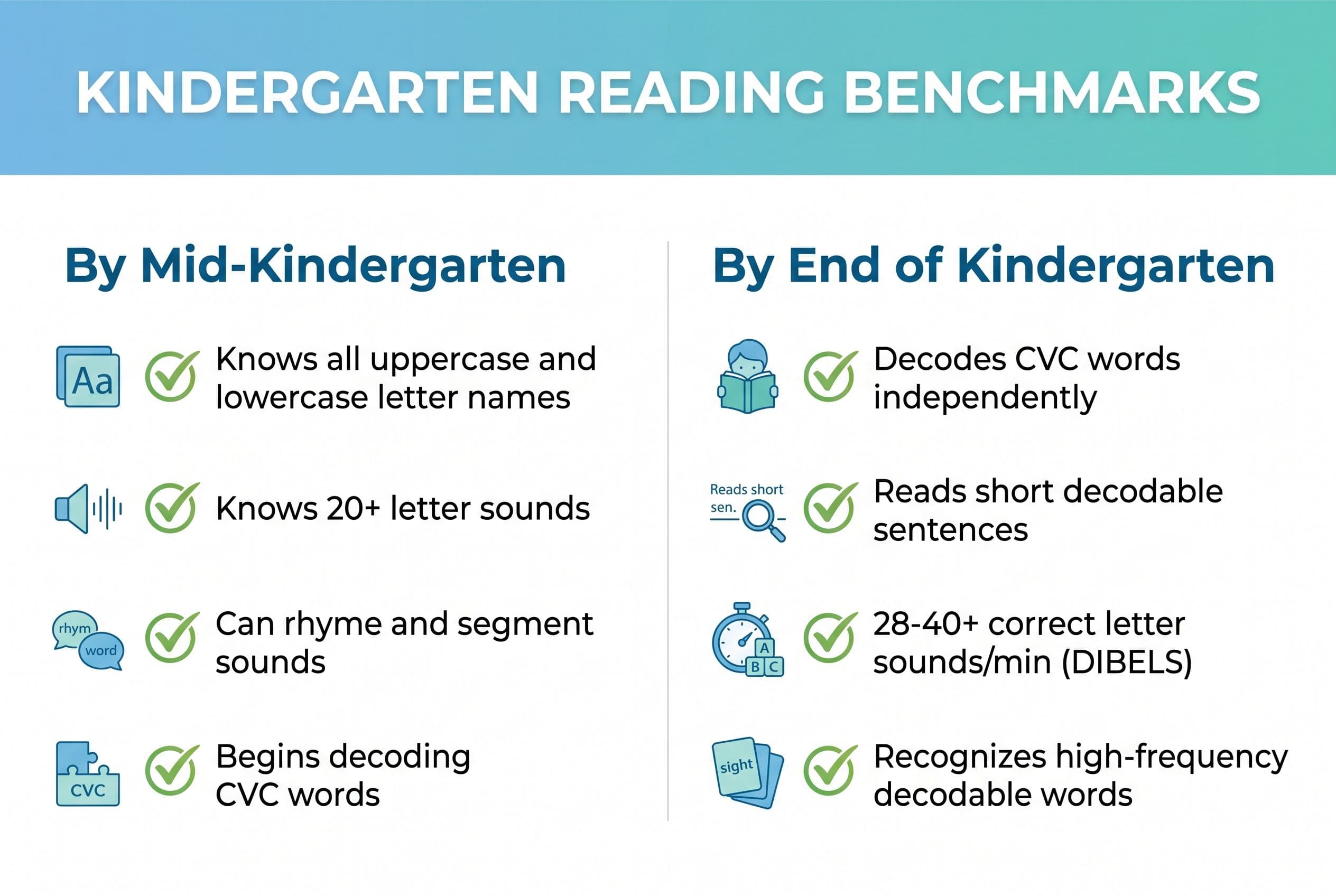
Here's a reading readiness checklist based on what cognitive science and the International Dyslexia Association actually recommend for kindergarten-age kids:
By mid-kindergarten, your child should:
- Know most (ideally all) uppercase and lowercase letter names
- Know at least 20-26 letter sounds (not just names — sounds)
- Be able to rhyme ("Does 'cat' rhyme with 'hat'?" "YES!")
- Segment a word into its individual sounds ("What sounds do you hear in 'dog'?" "/d/ /o/ /g/")
- Blend sounds together when you say them slowly ("/s/ /i/ /t/ — what word?" "Sit!")
- Start decoding simple CVC (consonant-vowel-consonant) words like "mat," "pig," "fun"
By the end of kindergarten:
- Decode CVC words independently and consistently
- Read short, decodable sentences ("The cat sat on the mat")
- Show strong performance on DIBELS 8th Edition Nonsense Word Fluency — Correct Letter Sounds (NWF-CLS). The DIBELS 8 benchmark for mid-kindergarten is around 33 CLS, and by end of kindergarten you're aiming for 47+ CLS. (Check the official DIBELS 8 benchmark tables here — benchmarks shift by edition and time of year, so always confirm against the current version.)
- Recognize some high-frequency words that follow phonics rules they've learned
Now. Is your kindergartner hitting these marks?
If they're not, that's not a reason to panic. But it IS a reason to stop waiting and start teaching. There's a massive difference.
Why Your Child's School Might Be the Problem
I need to tell you a story, because it changed how I think about all of this.
After Emily Hanford's Sold a Story investigation came out, my neighbor called me almost in tears. She's a first-grade teacher — had been for 18 years at that point. A good teacher. The kind who stays late, buys supplies with her own money, genuinely loves her students.
She'd been using Lucy Calkins' Units of Study curriculum her entire career. Three-cueing, MSV, the whole approach. You know what that looks like? A kid stares at the word "horse" and the teacher says, "Look at the picture. What makes sense?" The kid sees a picture of a horse and says "horse" and everyone thinks reading happened.
Reading did NOT happen. Guessing happened.
My neighbor told me, voice cracking, "I've been teaching kids to guess for two decades and I didn't even know it."
She switched her classroom to UFLI Foundations mid-year. It was messy — she had to basically relearn how to teach reading herself before she could teach her students. She was studying phonics scope and sequence on her couch at midnight, the same way her kids were learning it the next morning. But by spring, her students' DIBELS scores had jumped an average of 15 points on nonsense word fluency. She told me that was the first time in her career where every single kid in her class could decode CVC words by February.
Every. Single. Kid.
So when I say your child's school might be part of the problem, I'm not blaming the teacher. Most teachers were never taught the science of reading in their education programs. Mark Seidenberg laid this out in Language at the Speed of Sight (2017) — he's a cognitive scientist at the University of Wisconsin who basically said that reading education programs in universities are disconnected from the actual science of how the brain learns to read.
Over 40 states have now passed some form of "Science of Reading" legislation since 2019. Mississippi's Literacy-Based Promotion Act of 2013 is the most famous example — between 2013 and 2019, Mississippi's 4th-grade NAEP reading scores climbed from near the bottom of state rankings to around 21st, one of the biggest jumps any state has seen. The gains likely involved multiple factors (teacher training, retention policies, funding), but the shift to systematic phonics was at the center. That's what happens when you stop guessing and start teaching.
But legislation takes years to trickle down to the classroom. Your kindergartner is in school right now. You can't wait for the system to fix itself.
The Tiger Truth: What Happens If You Do Nothing
Real talk — this is the part where I'm going to be harsh, because I'd rather hurt your feelings now than watch your child struggle for a decade.
If your kindergartner isn't reading yet and you take the "wait and see" approach, here's what the research says is likely to happen:
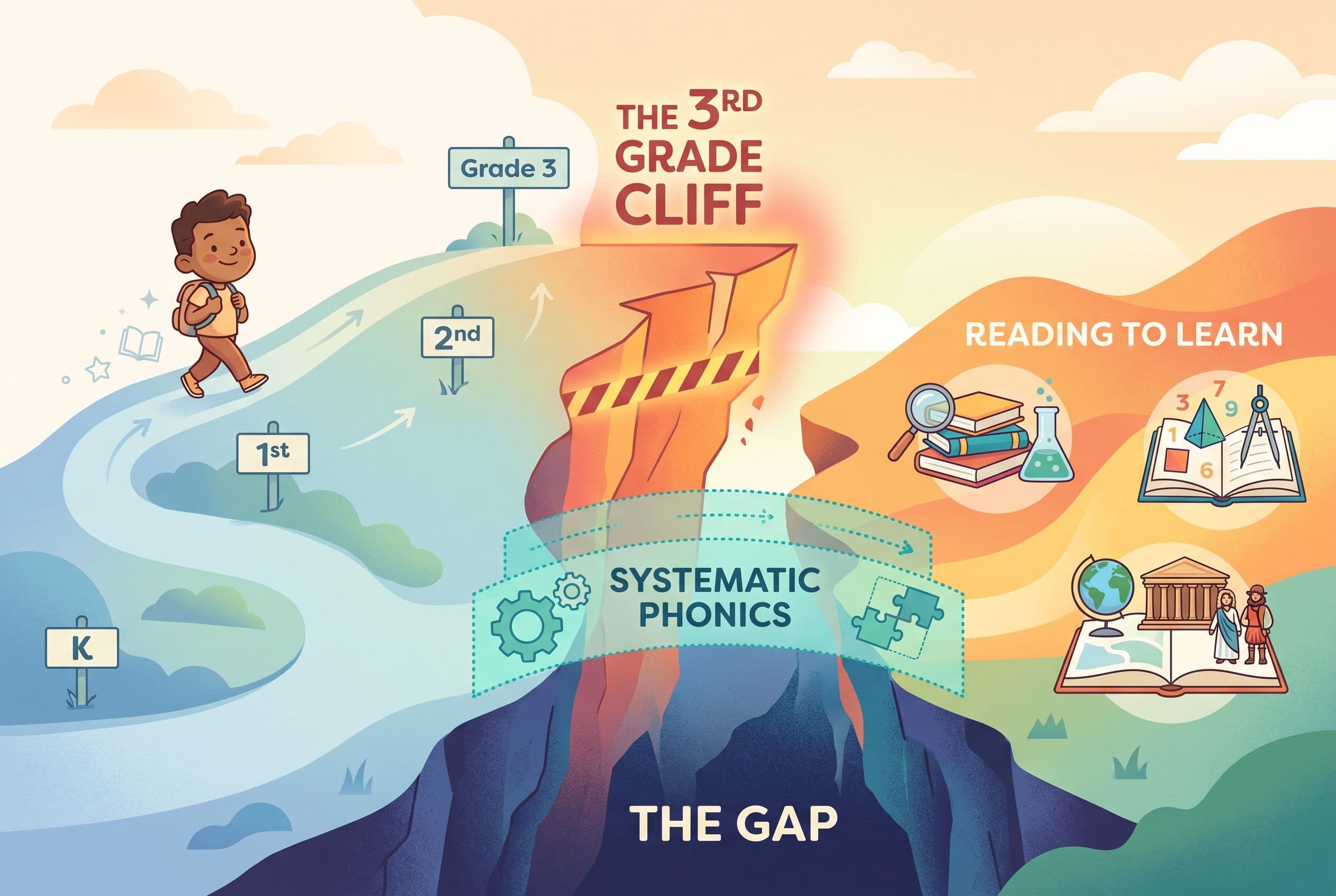
The 3rd Grade Cliff is real. After third grade, kids stop learning to read and start reading to learn. Every subject — science, social studies, math word problems — requires reading. A kid who can't decode fluently by then doesn't just fall behind in reading. They fall behind in everything.
Remediation is expensive and hard. An intensive reading intervention program — like Wilson Reading System or Lindamood-Bell — can run to thousands of dollars a year. Insurance doesn't cover it. Most school districts have waitlists months long for their reading specialists.
Self-esteem damage is permanent. I had my oldest, now 10, tell me once that a kid in her class said "I'm just dumb" about reading. That kid was seven. Seven years old, already writing himself off. Reid Lyon, who led the NICHD reading research for years, testified before Congress that a staggering number of fourth graders can't read at even a basic level — and the psychological damage of reading failure is one of the most under-discussed crises in education.
The gap widens, it never narrows. Stanislav Dehaene — a French neuroscientist — proved in Reading in the Brain (2009) that reading is NOT natural. The brain doesn't learn to read the way it learns to talk. It has to be explicitly trained. Without that training, the neural pathways for reading don't develop on their own. Waiting doesn't help. The gap between readers and non-readers gets bigger with every passing month.
I'm not saying this to scare you into paralysis. I'm saying it because the solution exists, it works, and it's something you can start doing at home tonight.
How to Know Exactly Where Your Kid Is Right Now
Before you fix the problem, you need to know the problem. Here's what I do with my own kids, and what I recommend to every parent who asks me.
Step 1: Run a quick phonemic awareness check.
Quick vocab note: phonological awareness is the big umbrella — it includes recognizing words, syllables, and rhymes. Phonemic awareness is the sharpest skill under that umbrella — it's about individual sounds (phonemes) in words. That's what we're testing here.
David Kilpatrick's PAST test (Phonological Awareness Screening Test) takes about 5 minutes and tells you exactly where the phonemic breakdown is. You can find it in his book Equipped for Reading Success (2016). It tests whether your child can manipulate sounds in words — deleting sounds, substituting sounds, blending, segmenting.
If your kid can't segment the sounds in "cat" into /k/ /a/ /t/, that's where you start. Not with books. Not with flashcards. With the sounds.
Step 2: Check letter-sound knowledge.
Grab a piece of paper. Write all 26 lowercase letters in random order (not alphabetical — that tests the song, not the sounds). Point to each one and ask, "What sound does this make?" Track which ones they know and which they don't.
My 4-year-old knows 19 out of 26 right now. We're working on the remaining seven. I know exactly which seven because I tested her last week.
Step 3: Try CVC decoding.
Write out five simple CVC words: "bat," "sit," "mop," "fun," "red." Can your child sound them out? Not guess from memory — actually touch each letter, say each sound, and blend them together?
If yes: great. They're decoding. Move forward. If no: that's your starting line. And that's OK.
The Action Plan: What to Do Starting Tonight
Here's the thing — you don't need to become a reading specialist. You don't need a $200 curriculum (though some of the good ones are worth it). You need 15 minutes a day, a systematic approach, and the stubbornness to never skip.
In my house, we call it the Tiger Rule: We Never Skip. Phonics happens on birthdays. Phonics happens on Christmas morning (after presents, I'm not a monster). Phonics happens on vacation. Fifteen minutes. Non-negotiable.
Here's your step-by-step:
-
Master letter sounds first. Not letter names — letter sounds. The letter B says /b/, not "bee." Use flashcards, magnetic letters on the fridge, whatever works. Drill until they're automatic. I had my 7-year-old do this with foam letters in the bathtub — she still remembers it.
-
Build phonemic awareness. Play sound games throughout the day. "What's the first sound in 'dog'?" "Can you change the /m/ in 'mat' to /s/?" "What word do you get if you put /p/ /i/ /g/ together?" You can do this in the car, at the grocery store, during dinner. No materials needed.
-
Start systematic phonics instruction. This is where Teach Your Kid to Read comes in. Our app is built on Orton-Gillingham principles — the same systematic, sequential, multisensory approach that programs like Wilson Reading System and Barton Reading use for kids with dyslexia. Except you don't need to pay thousands of dollars or sit on a waitlist. It walks you through exactly what to teach, in what order, with practice built in.
-
Use decodable readers, NOT leveled readers. This is the hill I will die on. Leveled readers (like the ones from Fountas & Pinnell) are whole-language aligned — they use predictable sentence patterns and picture clues that train kids to guess. Decodable readers only include words with phonics patterns the child has already learned. Look for decodable texts from Flyleaf Publishing, High Noon Books, or the ones built into our app. When my oldest was learning, I literally took the leveled readers her school sent home and replaced them with decodable texts. The school wasn't thrilled. My daughter learned to read. Worth it.
-
Track progress with real benchmarks. Don't go on vibes. Use DIBELS 8 benchmarks: by mid-kindergarten, your child should score around 33 Correct Letter Sounds (CLS) per minute on Nonsense Word Fluency (NWF). By end of kindergarten, aim for 47+ CLS. (Confirm current benchmarks here.) You can practice nonsense words at home — they're actually great because kids can't memorize them, so you KNOW they're truly decoding.
"But My Kid Hates It" — Yes, and?
I hear this all the time. "She cries when we practice." "He says reading is boring." "I don't want to push her and make her hate books."
Look. My 4-year-old doesn't love practicing letter sounds every day either. You know what she does love? The moment she decodes a word by herself and her face lights up like she just discovered fire. That moment is worth every whiny Tuesday morning.
You don't ask your kid if they want to brush their teeth. You don't let them decide whether to wear a seatbelt. Reading isn't optional either. It's a survival skill.
The "fun" trap — the idea that learning must always be enjoyable or you're doing it wrong — is how we ended up with an entire generation of kids who can't decode. Linnea Ehri's research on phases of word reading development (from her 2005 meta-analysis) shows that kids go through specific stages: pre-alphabetic, partial alphabetic, full alphabetic, and consolidated alphabetic. You can't skip stages just because the current one is tedious.
Mastery isn't always fun. But it's always worth it.
And honestly? Once kids start succeeding — once they can actually read a word on a page — the "fun" takes care of itself. Competence breeds confidence. Confidence breeds enjoyment. But it starts with drill. With practice. With those 15 non-negotiable minutes.
The Specific Red Flags That DO Mean "Worry"
Is it normal for a kindergartner not to read yet? It depends on what you mean by "read." Not reading fluent chapter books? Totally normal. Not recognizing any letters or sounds at all by age 5.5? That's a red flag.
Here are the specific warning signs that mean you should act fast — like, this week:
- Can't identify at least 15 letter sounds by mid-kindergarten. This isn't a developmental difference — it's a gap that needs direct instruction.
- Can't rhyme. If your child can't tell you that "cat" and "hat" rhyme, that's a phonological awareness deficit. It needs intervention, not time.
- Substitutes words based on pictures. If your kid looks at the word "ship" and says "boat" because there's a picture of a boat, they're guessing. This is the exact three-cueing strategy that Hanford exposed in Sold a Story, and it's not reading.
- Family history of dyslexia or reading difficulties. Dyslexia is highly heritable. If you or your partner struggled to read, your child has a significantly higher probability. Get screened early — the Kilpatrick PAST test is a good starting point, and Understood.org has screening resources.
- Avoids anything letter-related. Some avoidance is normal. Total, consistent refusal to engage with letters, sounds, or books can signal frustration from an undiagnosed issue.
If you're seeing multiple red flags, don't wait for the school to flag it. Schools often don't identify reading problems until second or third grade — by which point you've lost years of critical intervention time. Florida's Just Read, Florida! initiative and Ohio's Third Grade Reading Guarantee both exist because schools were promoting kids who couldn't read, year after year, until it was too late.
Get your own data. Run the assessments. And start systematic phonics at home now.
Why "Teach Your Kid to Read" Exists
I built start lesson one free Teach Your Kid to Read because I got tired of watching parents get bad advice and kids pay the price.
The app uses systematic synthetic phonics — the same methodology endorsed by the National Reading Panel in their 2000 report (the one Congress actually commissioned). That report found that systematic phonics instruction produces statistically significant benefits for children in kindergarten through 6th grade, and that those benefits are strongest when instruction starts early.
Our approach is built on Orton-Gillingham principles: explicit, sequential, cumulative, and multisensory. Your child learns one phonics pattern at a time, practices it until it's automatic, and then layers the next pattern on top. No guessing from pictures. No memorizing word shapes. Just sound-by-sound decoding that builds real, transferable reading skill.
And it's designed for parents — not trained reading specialists. You don't need a teaching degree. You need 15 minutes a day and a willingness to stick with it.
Because here's what I've learned from teaching my own kids: the method matters more than the amount of time. Fifteen focused minutes of systematic phonics beats an hour of random "reading activities" every single time.
FAQ: What Parents Actually Ask Me
Is it normal for a kindergartner not to read yet?
It's common, but "common" and "fine" aren't the same word. Many kindergartners can't read yet — but many of them also aren't getting the right instruction. The research is clear: most children can begin decoding simple CVC words by mid-kindergarten when they receive systematic phonics instruction. If your child can't, the question isn't "is this normal?" The question is "what instruction are they getting, and is it working?"
When should a kindergartner be able to read?
By the end of kindergarten, children should be able to decode simple CVC words, read short decodable sentences, and show strong Nonsense Word Fluency scores on DIBELS 8 (aim for around 47+ Correct Letter Sounds per minute by end of year — check current benchmarks here). They won't be reading novels — but they should be able to sound out words they've never seen before. That's the benchmark that predicts future reading success.
My child knows all their letters but can't read words. What's wrong?
Probably nothing "wrong" — they're just stuck at the letter-recognition stage and haven't been taught to blend sounds together. This is the gap between knowing letter sounds in isolation ("B says /b/") and blending them into words ("/b/ /a/ /t/ = bat"). Blending is a skill that needs to be explicitly taught. It rarely develops on its own. Start with two-sound blending (/a/ /t/ = "at") and work up to three-sound CVC words.
Should I get my kindergartner tested for dyslexia?
If you're seeing multiple red flags — can't rhyme, can't segment sounds, strong family history of reading difficulties, total avoidance of letter activities — then yes, pursue screening. The Kilpatrick PAST test is a quick starting point you can do at home. For a formal evaluation, contact your school district (they're legally required to evaluate if you request it in writing) or find a private evaluator through the International Dyslexia Association. Early identification is everything — the brain is most responsive to reading intervention between ages 5 and 7.
How much time should I spend on reading practice with my kindergartner?
15 minutes a day of focused, systematic phonics instruction. That's it. Consistency beats duration every time. I do 15 minutes with my 4-year-old every single day — weekends, holidays, all of it. The key word is "systematic." Random letter games and app time don't count. You need a structured sequence that moves from letter sounds to blending to CVC words to more complex patterns. Our app at start lesson one free Teach Your Kid to Read does this for you.
Bottom line: If your kindergartner isn't reading yet, the worst thing you can do is nothing. The second worst thing you can do is assume the school will handle it. Take 15 minutes tonight. Test their letter sounds. Start blending practice. Download a systematic phonics program. And commit to showing up every day.
Your kid doesn't need to be "ready." They need you to get them ready.
That's the job. And you can do it.
Ready to start? Try Teach Your Kid to Read — our app gives you the exact systematic phonics sequence, day by day, so you never have to wonder what to teach next. Visit start lesson one free TeachYourKidToRead.org or call us at (407) 707-6850.

Xia Brody
Co-Founder, Teach Your Kid to Read
Mom of 4 who has successfully taught her kids to read. Currently in the trenches with her 4-year-old while her two oldest (10 and 7) devour books on their own. Passionate about phonics-based methods and building a lifelong love of reading.
Related Articles
Is My 5 Year Old Behind in Reading? Age-by-Age Signs
Wondering if your 5-year-old should already be reading? Here’s the no-panic, no-waiting checklist for age 5 reading milestones, warning signs, and next steps.
Read More →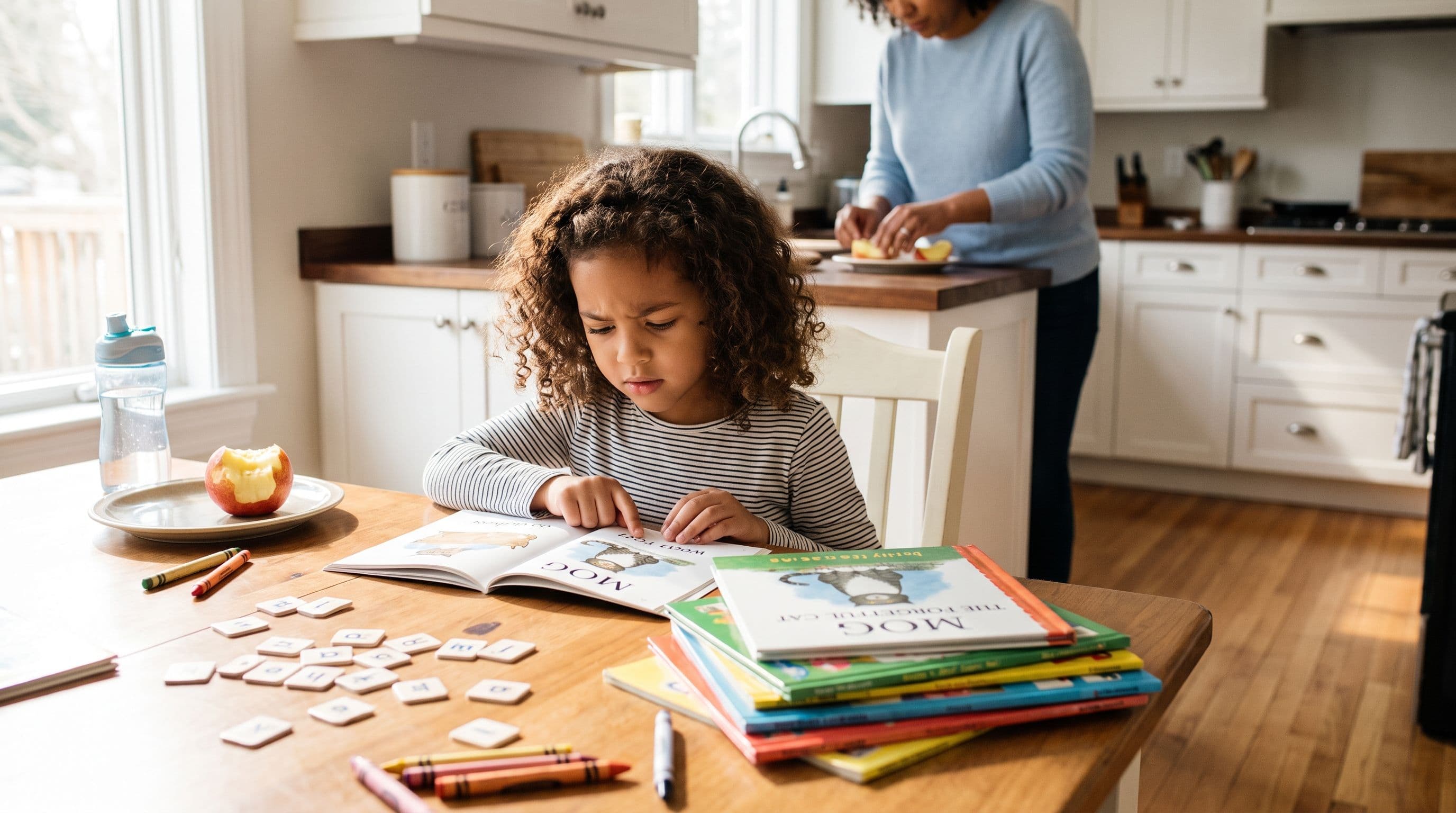
My 5 Year Old Can't Read: What to Do This Week
If your 5-year-old can't read yet, don't panic — but don't wait and see either. Here's what age-5 reading should look like, when to worry, and the phonics plan I'd start this week.
Read More →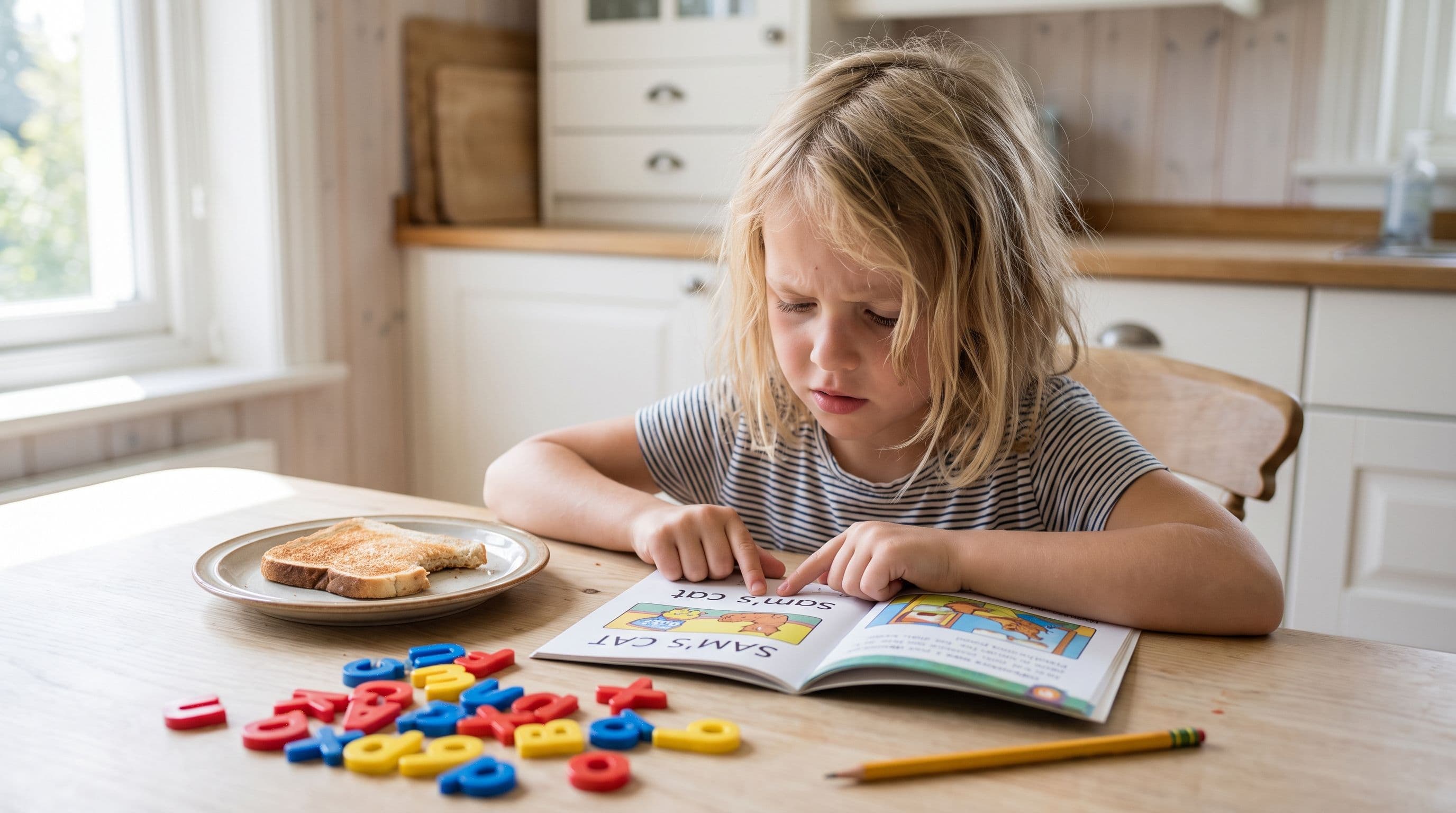
My 5 Year Old Can't Read Reception: When to Act
If your Reception child isn't reading yet, don't panic — but don't drift. Here's how to tell normal early reading from a real phonics gap, and what to do this week.
Read More →