My 6-Year-Old Can't Read: A Step-by-Step Rescue Plan for 2026

What You'll Learn
- Why a 6-year-old not reading yet is a red flag, not a phase — and the specific data that proves it
- The one free screening test that tells you in 5 minutes exactly where your child's reading broke down
- A 12-week rescue plan with daily phonics steps you can run at your kitchen table — no teaching degree required
- How to tell the difference between a child who's "just a little behind" and a child who needs professional intervention right now
Let's Cut the Comfort Talk
Your 6-year-old can't read. You typed it into Google at 10pm. Maybe 11pm. Probably after a homework meltdown where your kid stared at the word "the" like it was written in Mandarin.
I know because I've gotten this exact message from dozens of parents — friends, neighbors, strangers who found our site at midnight in a panic. And the first thing I always say is: stop listening to anyone who tells you "they'll catch up."
That's the most dangerous sentence in education.
Look, I get it. Your pediatrician said kids develop at different rates. Your kid's teacher said "he's just not ready yet." Your mother-in-law said Uncle Gary didn't read until he was 8 and he turned out fine. And maybe he did. But Uncle Gary grew up in 1985 when you could get a factory job without reading a manual. That world is gone.
Here's the question nobody wants to ask: Is it normal for a 6-year-old not to read?
The honest answer? It's common. About a third of American kids arrive at that point. But common and normal are not the same thing. It's common for adults to have cavities, too — that doesn't mean your teeth are fine.
The Tiger Truth: What Happens If You Wait
I'm about to hit you with some numbers that are going to sting. Good. They should.
The 2022 NAEP — that's the Nation's Report Card, the only truly nationwide reading test we have — showed that only 33% of 4th graders read at a proficient level. Let that sink in. Two out of every three kids in America can't read well enough to learn from a textbook by 4th grade.
And it gets worse. The Annie E. Casey Foundation's 2010 study found that children who can't read proficiently by 3rd grade are 4 times more likely to drop out of high school. Not twice. Not three times. Four times.
That's the 3rd Grade Cliff, and your 6-year-old is standing at the edge of it right now.
Here's how the math works. In first grade, kids learn to read. By third grade, they read to learn. Every subject — science, social studies, even math word problems — depends on reading. A child who can't read in first grade doesn't just fall behind in reading. They fall behind in everything. The gap compounds every single year like bad debt.
I had a mom message me last spring saying her 8-year-old had been getting "extra support" at school for two years. Know what that support was? A teaching assistant sitting with him during independent reading time, helping him guess words from the pictures. Two years of that. He was further behind at 8 than he'd been at 6.
Private reading intervention — something like Lindamood-Bell or the Wilson Reading System — can run to thousands of dollars a year. Insurance doesn't cover it. Most school districts have waiting lists that stretch 6-12 months. And every month you wait, the hole gets deeper.
So no. We're not waiting.
Why Your Kid Can't Read (It's Probably Not What You Think)
When parents say "my 6-year-old can't read," they usually assume one of two things:
- My kid isn't smart enough.
- My kid isn't trying hard enough.
Both are almost always wrong.
The real answer, for a huge share of struggling readers? Your kid was never properly taught the code. Sometimes it's an instruction gap, sometimes it's a learning difference like dyslexia — but either way, the first move is the same: teach the code systematically and see how the child responds.
English is a code. Letters represent sounds. Groups of letters represent groups of sounds. Reading is decoding that system. And for decades, American schools didn't teach decoding. They taught guessing.
Stanislas Dehaene — he's a French neuroscientist at the Collège de France — proved in his book Reading in the Brain (2009) that the human brain is NOT wired to read. Speaking is natural. Reading is not. The brain has to be trained to connect letters to sounds through a process that takes deliberate, systematic instruction. There's no "reading readiness" switch that flips on its own.
I was at a playground in Raleigh last year when another mom told me her kid's school had just switched from Lucy Calkins' Units of Study to a Science of Reading curriculum. North Carolina's SB 387 — the Excellent Public Schools Act — was forcing the change, and she was confused and honestly kind of annoyed about it. "He was doing fine before," she said. Her son was in second grade. I asked her if he could read the word "splint." She called him over. He stared at it. Tried "split." Then "plant." Then looked at me and shrugged.
A second grader. Couldn't decode a one-syllable word with a consonant blend.
I spent 20 minutes on that bench explaining why the switch was happening — Emily Hanford's Sold a Story investigation that blew the lid off Balanced Literacy, the NAEP data showing flat or declining scores for 30 years, the neuroscience from Dehaene's lab showing the brain doesn't just "pick up" reading through exposure. She went home and listened to the whole Sold a Story podcast that night. Texted me at 11pm: "I had no idea. Why didn't anyone tell us this sooner?"
That's the thing. Nobody tells you. Your kid's school sends home a leveled reader with a picture of a dog on every page and your kid "reads" the book by looking at the pictures and guessing. The teacher checks the box. Everyone smiles. And your child has learned absolutely nothing about how written English works.
So if your 6-year-old can't read in first grade, before you panic about learning disabilities or intelligence, ask yourself this: Has anyone actually taught my child systematic phonics? Letter sounds, blending, decoding — in order, every day, with no guessing allowed?
If the answer is no (or "I'm not sure"), that's your starting point. And honestly? That's the best-case scenario, because it means the fix is straightforward.
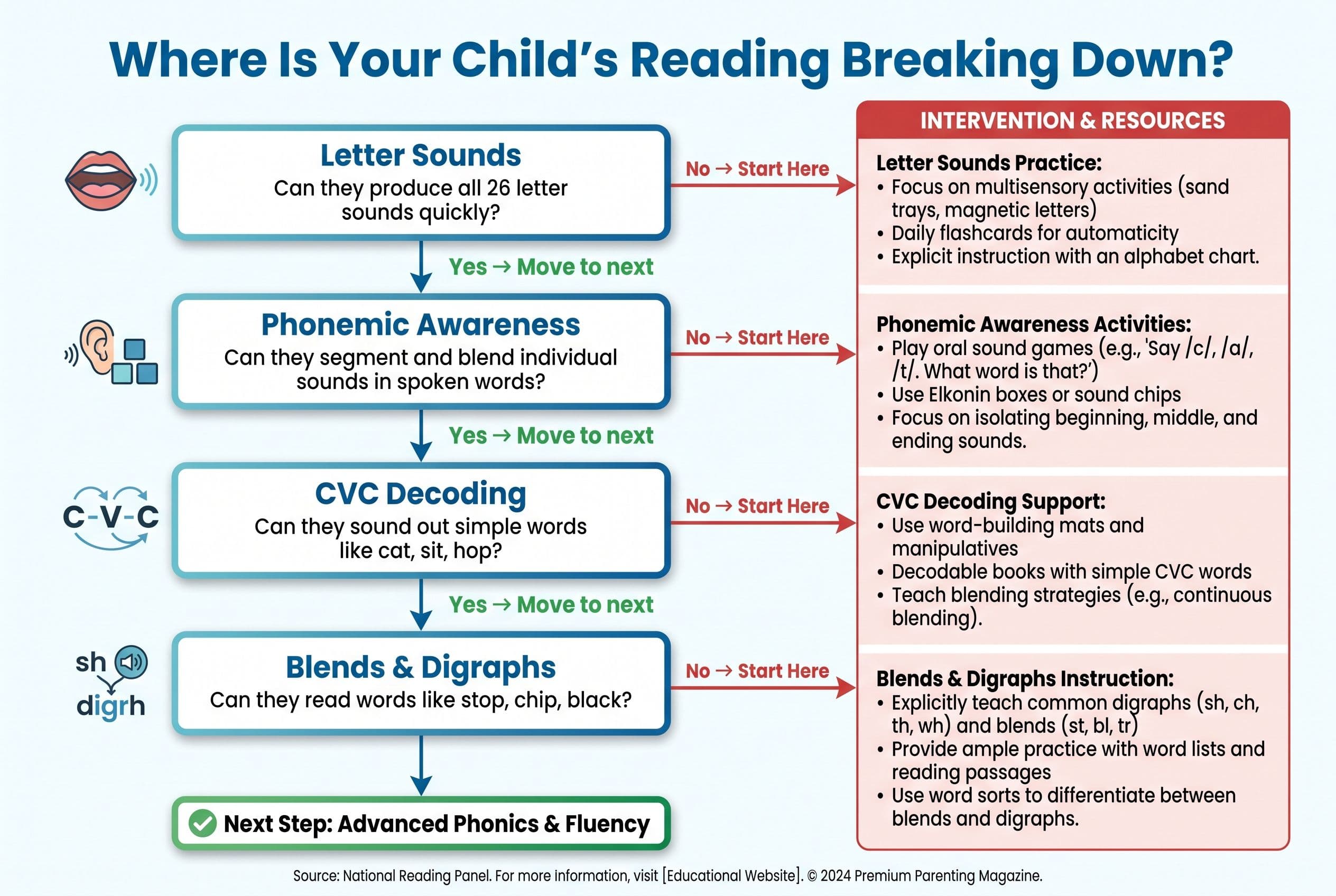
Step 1: Figure Out Exactly Where the Breakdown Is
You can't fix what you can't diagnose. And "can't read" isn't a diagnosis — it's a symptom. A child who can't read might be stuck at any of several points in the reading pipeline.
David Kilpatrick's Equipped for Reading Success (2016) lays this out beautifully. He's a school psychology professor at SUNY Cortland, and his work on orthographic mapping shows that reading breaks down in predictable stages. Miss one, and everything after it crumbles.
Here's what to check, in order:
Does your child know letter sounds (not just letter names)?
Letter sounds matter more for reading than letter names. Letter names are fine — and for consonants, the name can actually hint at the sound — but if your kid only knows names and not sounds, decoding won't happen. Test all 26 letter sounds. Use flashcards. Go fast. If your child hesitates more than 2-3 seconds on a letter, they don't know it.
Benchmark: Typical mid-kindergarten benchmarks on DIBELS screenings are around the high-20s or higher for correct letter sounds per minute (check your district's specific cut scores, since they can vary by edition). If your 6-year-old is significantly below that range, start here.
Can your child hear individual sounds in words (phonemic awareness)?
This is different from phonics. Phonemic awareness is the ear skill — can your child hear that "cat" has three separate sounds: /k/ /a/ /t/? Can they tell you what word you get if you take the /s/ off "stop"?
Kilpatrick's PAST test — the Phonological Awareness Screening Test — takes about 5 minutes and tells you exactly where the phonological breakdown is. You can find it in his book or through your school's reading specialist. It's the single most useful assessment I've ever used with my own kids.
Can your child blend sounds together?
Some kids know all their letter sounds but can't blend. They'll say "/k/... /a/... /t/" and then guess "car." Blending is a skill that has to be taught explicitly. I drilled this with my oldest using a technique called "continuous blending" — you hold the first sound and slide into the next one: "caaaat" instead of choppy individual sounds.
Can your child decode CVC words (consonant-vowel-consonant)?
Words like "sit," "mop," "bed," "fun." These are the proving ground. If your 6-year-old can't read CVC words, you've found your starting line. No shame. Real talk — I had my 4-year-old practicing CVC words at the kitchen table last Tuesday and she was mad at me about it. She wanted to play ponies. We did CVC words first. Tiger Rules: We Never Skip.
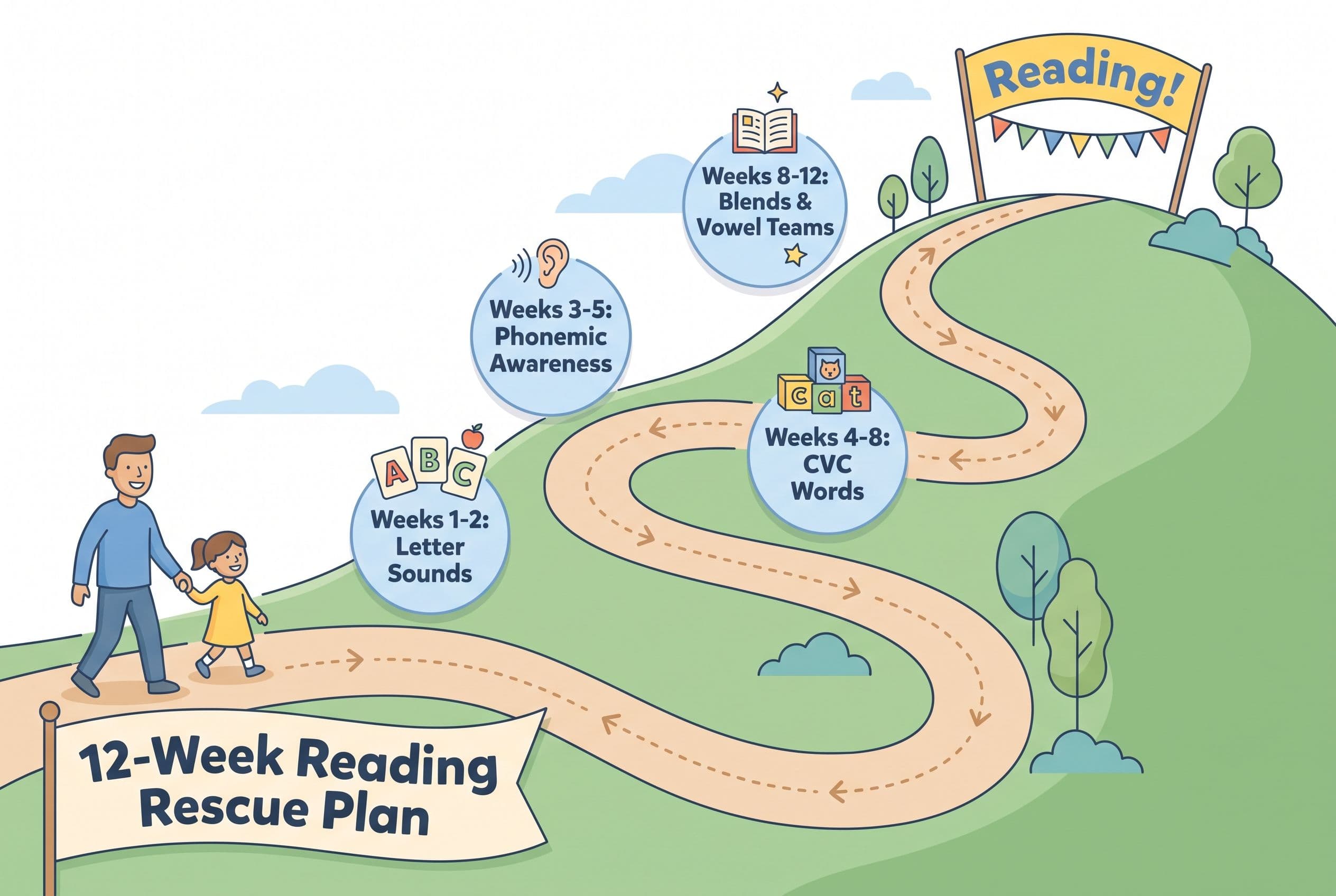
Step 2: Start the 12-Week Rescue Plan
OK so here's the plan. This is what I'd do if one of my kids were 6, in first grade, and couldn't read. This is also what I tell every parent who emails me in a panic.
Time commitment: 20-30 minutes per day. Every day. Birthdays, holidays, vacation. We Never Skip.
Weeks 1-2: Lock Down Letter Sounds
- Drill all 26 letter sounds using flashcards. Physical cards, not an app (more on that in a sec).
- Focus on the sounds that trip kids up most: short vowels (a, e, i, o, u), and commonly confused consonants (b/d, m/n, p/q).
- Mastery standard: Your child should produce the correct sound within 1 second of seeing the letter. If they have to think about it, they don't own it yet.
- Practice 10 minutes a day, twice a day if possible.
Weeks 3-5: Phonemic Awareness Boot Camp
- Segmenting: Say a word, have your child tap out the individual sounds. "Dog" → /d/ /o/ /g/ (3 taps).
- Blending: You say sounds slowly, child blends them into a word. "/m/ /a/ /p/" → "map!"
- Manipulation: "Say 'cat.' Now say it without the /k/." → "at!" This is the hardest skill and the most predictive of reading success.
- Do this in the car, at dinner, in the bathtub. No materials needed. Just your voice.
Weeks 4-8: CVC Word Decoding (This Is Where Reading Starts)
- Start with word families: -at words (cat, bat, sat, mat), then -an, -ig, -op, -ub, -ed.
- Use a whiteboard. Write the word. Have your child sound out each letter and blend. No guessing from context. No looking at pictures. Sound it out or don't say it.
- Introduce Bob Books Set 1 or UFLI Foundations decodable readers. These books contain ONLY the letter patterns your child has learned. No sneaky multi-syllable words. No pictures that give away the answer.
- Critical rule: If your child guesses a word, stop them immediately. Cover the picture. Point to the first letter. "What sound does this make? OK, now the next one. Now blend them." Every. Single. Time.
Weeks 6-10: Consonant Blends and Digraphs
- Blends: bl, cr, st, tr, fl, sn, etc.
- Digraphs: sh, ch, th, wh, ck
- Practice reading words like "chip," "stop," "thin," "black"
- This is where that second-grader on the Raleigh playground got stuck — he'd never been taught to decode blends systematically. He was guessing based on the first letter and the picture. That's not reading.
Weeks 8-12: CVCe Words and Vowel Teams
- The "magic e" rule: "cap" becomes "cape," "bit" becomes "bite"
- Begin introducing vowel teams one at a time: start with consistent patterns like "ai" (rain, wait, paid) and "oa" (boat, coat, road) before moving to trickier teams. Fair warning — "ea" is a tricky one because it makes different sounds in different words (eat vs. head vs. break), so save that for later or be ready to teach multiple pronunciations.
- Move into longer decodable readers — Flyleaf Publishing makes excellent ones, and so does High Noon Books
- Start building fluency: re-read mastered books for speed and expression
Now here's where it gets interesting. This timeline assumes your child has no underlying learning disability. Most kids — we're talking 85-90% — will make significant progress on this plan if you execute it consistently. The kicker is that word: consistently.
Step 3: Bring in the Right Tools
You don't need to go this alone. And honestly, you shouldn't have to build every lesson from scratch when proven tools already exist.
Teach Your Kid to Read was designed for exactly this situation — a parent at home who needs a systematic, phonics-based program that follows the science and doesn't require a teaching degree to use. It's aligned with structured literacy principles and explicit, systematic phonics instruction — the same approach used in clinical reading interventions — and moves through the exact sequence I described above: letter sounds → blending → CVC words → blends and digraphs → advanced vowel patterns.
The reason I co-founded this program is because I watched too many parents try to piece together a reading intervention from YouTube videos and Pinterest printables. They'd do letter sounds for a week, then jump to sight words, then try a reading app, then buy a workbook that started at a completely different skill level. No sequence. No system. No progress.
A struggling reader in first grade needs systematic synthetic phonics delivered in a logical scope and sequence. That's what the National Reading Panel found in their 2000 report — the one Congress actually commissioned. Systematic phonics instruction produces significant benefits for reading and spelling, especially for kids in kindergarten through first grade and for children at risk of reading failure.
That's not my opinion. That's what the largest federal reading study in U.S. history concluded.
Step 4: Know When to Escalate
Here's where the tiger mom gets real with you.
If you run this rescue plan consistently for 8-12 weeks and your child is making zero progress — still can't blend three sounds together, still reverses letters constantly, still can't remember letter sounds from day to day — you need to get a formal evaluation.
I'm not talking about the school's reading specialist pulling your kid for 15 minutes twice a week. I'm talking about a comprehensive psychoeducational evaluation that screens for:
- Dyslexia — affects roughly 1 in 5 kids according to the International Dyslexia Association, and it's wildly underdiagnosed
- Auditory processing disorder
- Vision issues (not acuity — tracking and convergence problems that an eye chart won't catch)
- ADHD — which doesn't cause reading problems directly but makes sustained phonics practice almost impossible without support
Don't wait for the school to suggest this. Schools are required to evaluate under IDEA (the Individuals with Disabilities Education Act), but the process can take months and many districts will slow-walk it. You have the right to request an evaluation in writing. Do it.
If money is an issue — and I hear you, private evaluations run $1,500-$3,000 — your local university's psychology or education department often offers assessments at reduced cost through their training clinics.
But I want to be clear about something. Do not skip the 12-week phonics rescue plan and jump straight to evaluation. Most 6-year-olds who can't read don't have a disability. They have an instruction gap. Fill the gap first. If the gap doesn't close with good instruction, then investigate further.
That's exactly the approach David Kilpatrick recommends — intervene first, assess if the intervention doesn't work. It's called Response to Intervention (RTI), and it's how you separate an instruction problem from a learning disability.
The "But He Hates Reading" Problem
Yeah, of course he hates reading. He can't do it.
Imagine someone handed you a violin and said "play this" with zero instruction. You'd hate it too. That's what reading feels like to a child who doesn't have the decoding skills. Every page is a fresh humiliation.
Here's what I tell parents: your child doesn't need to love phonics practice right now. They need to do it. Mastery creates motivation, not the other way around. I've watched it happen with all three of my reading-age kids. There's a moment — usually around week 5 or 6 of consistent practice — where something clicks. They decode a word they've never seen before, completely independently, and their face lights up like a Christmas tree. THAT is when they start wanting to read.
But you'll never get to that moment if you quit after day 3 because your kid cried about it.
Tiger Rule: No Guessing. If your child looks at a word and guesses based on the picture or the first letter, stop them. Cover the picture. Point to the letters. "Sound it out." This will cause friction. Do it anyway. You're not being mean. You're teaching them the actual skill instead of letting them fake it.
What About Apps and Screens?
I'm going to say something unpopular: most reading apps are garbage.
They're designed to keep your child swiping, not to teach systematic phonics. They reward wrong answers with cute animations. They let kids skip hard parts. They never require the kind of sustained, frustration-tolerant practice that actually builds reading skill.
Are there exceptions? Yes. The Teach Your Kid to Read program is deliberately built to avoid these traps. And there are a handful of others — like the Explode the Code online component — that follow a genuine phonics scope and sequence.
But the bottom line is this: a screen should never be your child's primary reading instruction. A parent or teacher sitting with the child, pointing to letters, demanding accurate decoding, correcting errors in real time — that's what works. The Clackmannanshire study out of Scotland (Johnston & Watson, 2005) tracked kids for 7 years and found that children who received direct, systematic synthetic phonics instruction significantly outperformed those who didn't. That instruction was teacher-led. Human-to-human. Eyes on the page.
An app can supplement. It can't replace you.
Reading Intervention at Home: Your Daily Schedule
Here's exactly how I'd structure 25 minutes of daily reading intervention for a 6-year-old who can't read. I've used this schedule with my own kids and I've shared it with hundreds of parents.
Minutes 1-5: Letter Sound Speed Drill Flash through letter cards. Child says the sound, not the name. Track speed. Celebrate improvement. ("You got 20 right in one minute! Yesterday it was 17!")
Minutes 5-10: Phonemic Awareness Warm-Up Oral only — no letters needed. Segmenting and blending games. "What word is /sh/ /i/ /p/?" "Break apart the word 'jump' into sounds."
Minutes 10-20: Decoding Practice This is the main event. New skill introduction (5 min) followed by practice reading decodable words and sentences (5 min). Use a whiteboard, UFLI Foundations lesson materials, or Teach Your Kid to Read's daily lesson.
Minutes 20-25: Decodable Book Reading Read a short decodable text that uses ONLY patterns the child has been taught. Re-read familiar books for fluency. End on a success. Always end on a success.
That's it. 25 minutes. Five days a week minimum — seven is better. We do seven. My kids know the drill. Phonics before screen time. Phonics before playdates. Phonics on Christmas morning, between presents (yes, really).
What About the School? Should I Say Something?
Absolutely. But go in with information, not emotion.
Ask your child's teacher these specific questions:
- "What reading curriculum does the school use?" — If they say Fountas & Pinnell, Lucy Calkins Units of Study, or anything involving "three-cueing" or "MSV" (Meaning, Structure, Visual), your child is being taught to guess. Those are whole-language approaches dressed up in modern packaging.
- "Has my child been given a DIBELS or AIMSweb screening?" — If yes, ask for the scores. If no, ask why not.
- "What specific phonics instruction does my child receive, and how many minutes per day?" — If the answer is vague ("we embed phonics throughout our literacy block"), that means there's no systematic phonics program.
Over 40 states have now passed Science of Reading legislation since 2019. Mississippi's Literacy-Based Promotion Act of 2013 is the poster child — they went from 49th to 21st in national reading scores in 6 years by mandating evidence-based reading instruction. Your state may have similar laws on the books. Check. And if your school isn't complying, say so — politely, with documentation.
But here's my honest advice: don't wait for the school to fix this. Even in the best-case scenario, your child gets maybe 90 minutes of literacy instruction per day, shared with 20-25 other kids. A struggling reader in first grade needs one-on-one attention. You can provide that at home in 25 minutes a day and make more progress than the school will make in a month.
The Emotional Side (Because It Matters)
I want to acknowledge something. When your 6-year-old can't read, it's terrifying. You start catastrophizing. You imagine your child failing 3rd grade, dropping out of high school, never going to college.
Stop.
You are here. You are reading this article. You are looking for a plan. That means your child already has an advantage that millions of kids don't — a parent who gives a damn.
A child who can't read at 6 is NOT a child who will never read. The research from NICHD — led by Reid Lyon, who testified before Congress on reading — shows that with appropriate, intensive intervention, the vast majority of struggling readers can reach grade-level proficiency. The window is still wide open at 6.
But it's closing. Every year you wait, intervention takes longer and costs more. The brain's neuroplasticity — its ability to rewire itself for reading — is at its peak right now, during these early elementary years. Use it.
Your job isn't to be a perfect teacher. Your job is to show up every day with the flashcards, sit at the table, and refuse to let your child guess. That's it. That's the whole plan.
Frequently Asked Questions
Is it normal for a 6-year-old not to read?
It's common — but NAEP doesn't actually test first graders, so let me give you the numbers that matter. By 4th grade, only 33% of kids score Proficient on NAEP, which tells you how many children are already behind before they even get there. At the K-1 level, district DIBELS and AIMSweb screenings routinely flag around a third of students as "at risk" for reading failure. Linnea Ehri's research on phases of word reading development shows that by age 6, most children should be in at least the "partial alphabetic" phase, meaning they can use some letter-sound knowledge to decode simple words. If your 6-year-old can't do that, they need systematic phonics instruction now, not a "wait and see" approach.
How long does it take a 6-year-old to learn to read with intervention?
With consistent daily phonics practice (20-30 minutes per day, 5-7 days per week), most 6-year-olds with no underlying learning disability will make significant progress within 8-12 weeks. Some kids catch up faster. Some need 4-6 months. The variable isn't your child's intelligence — it's the consistency of instruction. Skip days and the timeline stretches. Show up daily and the progress compounds.
Should I get my child tested for dyslexia?
Not as your first step. Try 8-12 weeks of systematic phonics intervention first. If your child makes little or no progress despite consistent, daily, structured phonics practice, then pursue a formal evaluation. The International Dyslexia Association estimates 15-20% of the population has some degree of dyslexia, so it's absolutely worth investigating if good instruction isn't working. But the majority of struggling readers have an instruction gap, not a disability.
What's the difference between phonics and phonemic awareness?
Phonemic awareness is an ear skill — the ability to hear, identify, and manipulate individual sounds in spoken words. It requires no letters at all. Phonics is the eye-to-ear skill — connecting written letters (graphemes) to their spoken sounds (phonemes). You need both. Phonemic awareness is the foundation; phonics is the house built on top of it. If your child can't hear the three separate sounds in "dog," they won't be able to decode the word on paper.
Can I use the Teach Your Kid to Read program for reading intervention at home?
Yes — that's exactly what it's designed for. The program is aligned with structured literacy principles and follows a systematic synthetic phonics scope and sequence. It starts with letter-sound correspondence and moves through blending, CVC words, blends, digraphs, and advanced vowel patterns — the same progression used in clinical reading interventions that cost $100+ per hour. It's built for parents with no teaching background who need a clear, daily plan.
Part of these guides

Xia Brody
Co-Founder, Teach Your Kid to Read
Mom of 4 who has successfully taught her kids to read. Currently in the trenches with her 4-year-old while her two oldest (10 and 7) devour books on their own. Passionate about phonics-based methods and building a lifelong love of reading.
Related Articles
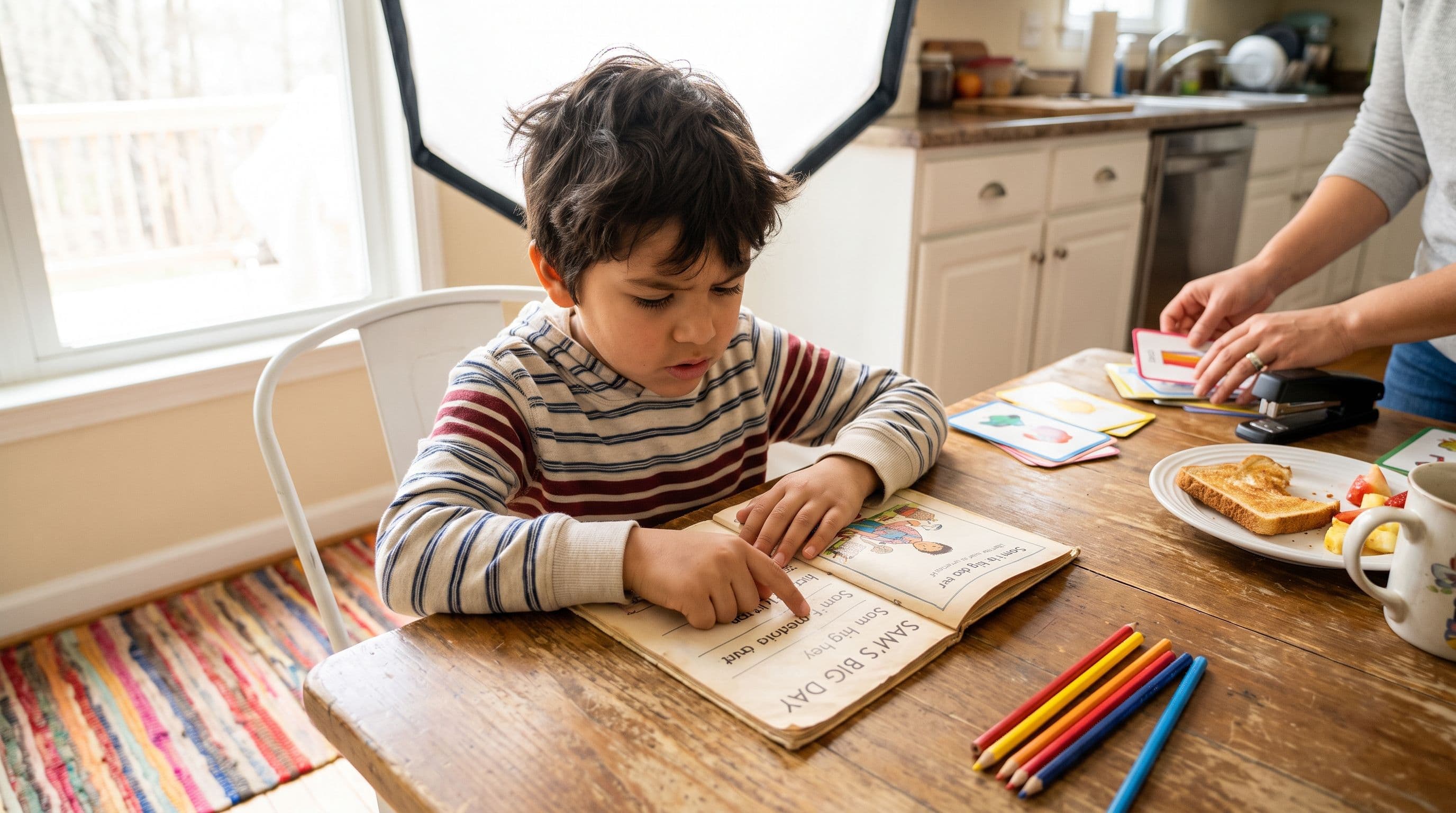
My 7 Year Old Can't Read: 9 Steps to Act Now
If your 7-year-old still can't read, don't panic—but don't wait. Here's how to check the gap, stop guessing habits, and start a real phonics plan at home.
Read More →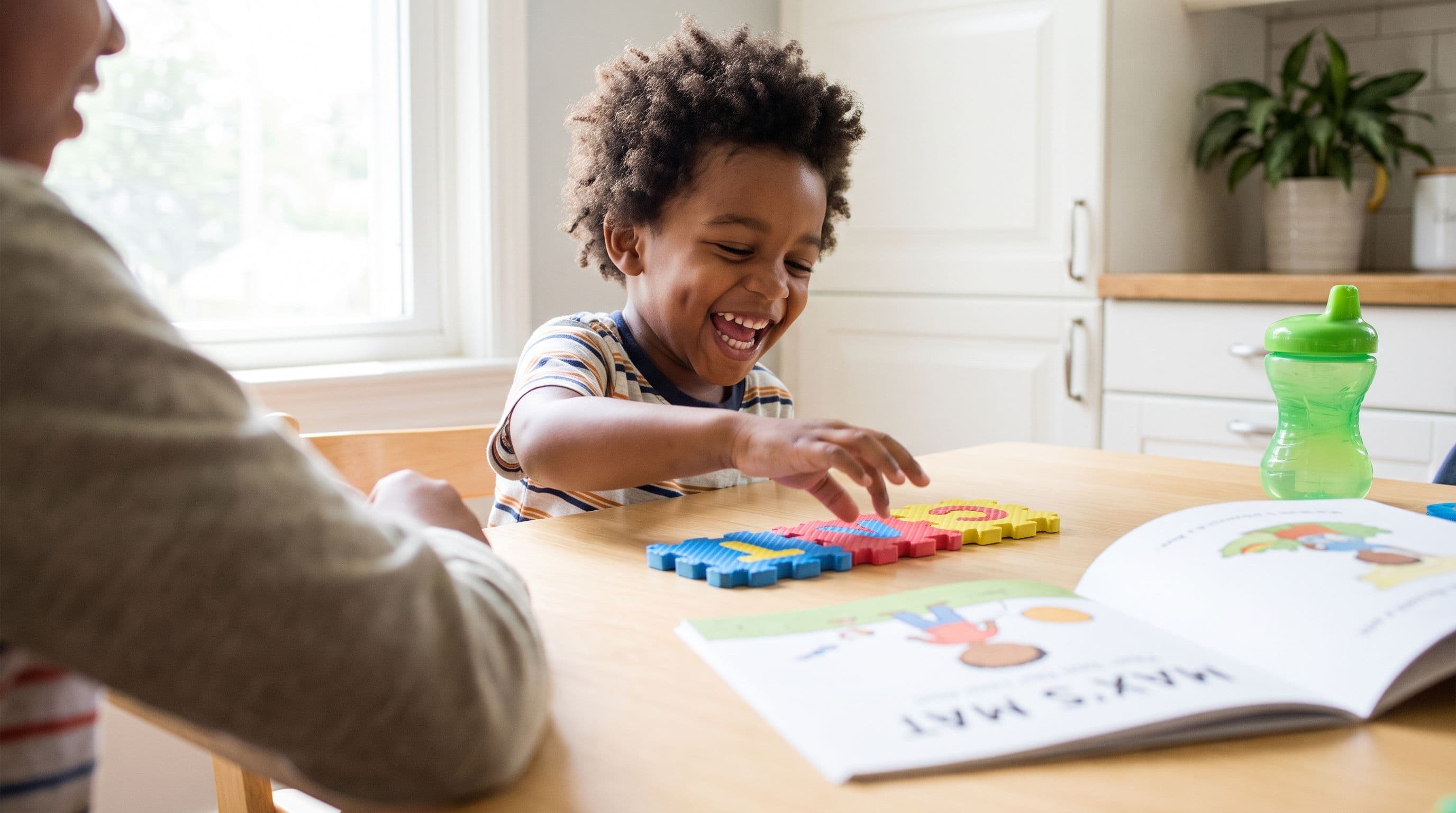
My First Grader Can't Read? The 90-Day Catch-Up Plan
If your 6-year-old is guessing at words, memorizing books, or melting down at the page, you don't have a motivation problem — you have an instruction problem. Here's the exact 90-day catch-up plan I'd run, starting tonight.
Read More →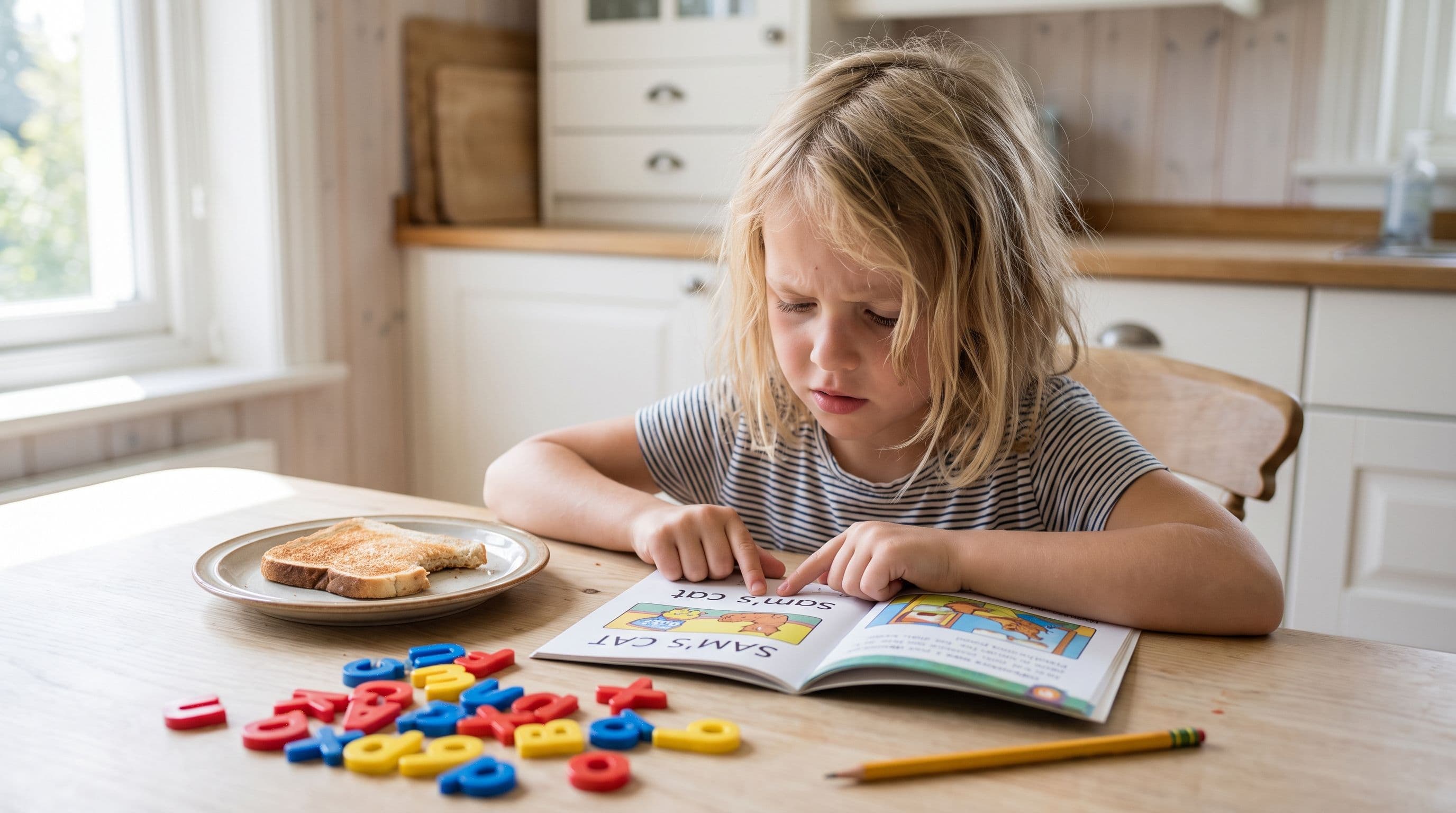
My 5 Year Old Can't Read Reception: When to Act
If your Reception child isn't reading yet, don't panic — but don't drift. Here's how to tell normal early reading from a real phonics gap, and what to do this week.
Read More →