My 5-Year-Old Can't Read: A Step-by-Step Plan to Fix It Fast
What You'll Learn
- Why "he's just not ready yet" is the most dangerous advice a parent of a 5-year-old can get — and what the research actually says about reading readiness
- The specific skills your 5-year-old needs right now (hint: it's not memorizing sight words from flashcards)
- A step-by-step phonics plan you can start this week at your kitchen table — no teaching degree required
- How to tell the difference between a kid who's a little behind and a kid who needs professional screening
Let's Start With the Truth Nobody Wants to Hear
Your 5-year-old can't read. You Googled it. You're here.
Good. That means you're already ahead of most parents who just shrug and say, "Boys develop later" or "She'll get it when she's ready." Those parents? They're the ones blindsided at the third-grade parent-teacher conference when the school finally admits there's a problem.
Here's the thing — a 5-year-old not reading yet isn't automatically a crisis. But a 5-year-old with no phonics foundation whatsoever? That's a four-alarm fire you need to put out right now.
I'm not saying your kid should be reading chapter books. I'm saying your kid should be able to hear the word "cat," break it into /k/ /a/ /t/, and blend those sounds back together. If that's not happening, we've got work to do.
And I've got the plan.
The "Wait and See" Lie That Ruins Kids
Let me tell you about a conversation I had at a playground in Raleigh last year. I was watching my 4-year-old attempt to climb a rope structure (she's fearless, that one) when another mom sat down next to me. Her son's school had just switched from Lucy Calkins' curriculum to a Science of Reading program because of North Carolina's Excellent Public Schools Act. She was confused. A little annoyed, honestly.
"He was doing fine before," she told me.
So I asked a simple question: Can he read the word "splint"?
Her son was in second grade. He could not.
I spent twenty minutes on that playground bench explaining why the switch was happening. I told her about Emily Hanford's APM Reports investigation Sold a Story — the podcast series that started dropping in 2022 and blew the lid off decades of Balanced Literacy failures. I walked her through the NAEP data showing only 33% of 4th graders read at proficient level on the 2022 Nation's Report Card. I told her about Stanislas Dehaene's research in Reading in the Brain (2009) — he's a French neuroscientist who proved the brain has to be trained to read. It doesn't happen naturally, like learning to talk. Reading is a code, and someone has to teach your kid to crack it.
She went home and listened to Sold a Story that night. Texted me at 11 pm: "I had no idea. Why didn't anyone tell us this sooner?"
Nobody told her because the "wait and see" approach is comfortable. It lets everyone off the hook — the school, the teacher, and yes, the parent. But comfortable doesn't teach kids to read.
If your 5-year-old can't read, "wait and see" is not a strategy. It's neglect with a smile.
What Actually Happens If You Do Nothing
I'm going to be aggressive here because someone has to be.
The Annie E. Casey Foundation published a study in 2010 showing that kids who can't read proficiently by the end of third grade are four times more likely to drop out of high school. Four times. That's not a small bump in risk — that's a cliff.
And the 3rd Grade Cliff is real. After third grade, kids stop "learning to read" and start "reading to learn." Every subject — science, social studies, even math word problems — assumes reading fluency. Kids who don't have it don't just fall behind in reading. They fall behind in everything.
Here's what the timeline actually looks like when parents wait:
- Age 5-6: "He's just not ready yet. Boys develop later."
- Age 7: "The school says he's a little behind but they're monitoring it."
- Age 8: "He's been referred for testing. There's a 6-month waitlist."
- Age 9: "He qualifies for services but they only pull him out twice a week for 30 minutes."
- Age 10: Your kid hates reading. Hates school. Calls himself stupid.
The kicker? Private remediation with a program like Wilson Reading System or Lindamood-Bell can run to thousands of dollars a year. Insurance doesn't cover it. Most families can't afford it. And by then, you're not just teaching reading — you're undoing years of bad habits and shattered confidence.
I don't say this to scare you. I say it because the window to act is open right now, and it won't stay open forever.
Should My 5-Year-Old Be Reading? Here's What the Research Says
Let me give you a straight answer: By age 5, your child should be working toward reading, even if they're not there yet.
That's not my opinion. That's based on Linnea Ehri's phases of word reading development, which she's described across multiple publications — including her well-known work on sight word learning and orthographic mapping. Here's the short version:
- Pre-Alphabetic Phase — The kid recognizes logos (McDonald's, STOP signs) but has zero letter-sound knowledge. Many kids move past this by age 3-4, though it depends on exposure and instruction.
- Partial Alphabetic Phase — They know some letter sounds and can use the first or last letter to guess at words. This is where a lot of 4-5 year olds land, especially with some letter exposure at home or preschool.
- Full Alphabetic Phase — They can map every grapheme to a phoneme and sound out unfamiliar words. This is the target for late kindergarten through mid-first grade.
- Consolidated Alphabetic Phase — They chunk common patterns (like "-tion" or "-ight") automatically. This is fluent reading.
A 5-year-old not reading yet? Totally within the normal range — if they're in the Partial Alphabetic Phase and making progress. They should know most letter sounds, be able to rhyme, and be starting to blend sounds together.
A 5-year-old who can't identify letter sounds, can't hear rhymes, and shows no phonological awareness (the ability to notice and work with sound parts in spoken language — rhymes, syllables, individual phonemes)? That's not "late blooming." That's a kid who needs intervention yesterday.
The Kindergarten Reading Milestones Your Kid Should Be Hitting
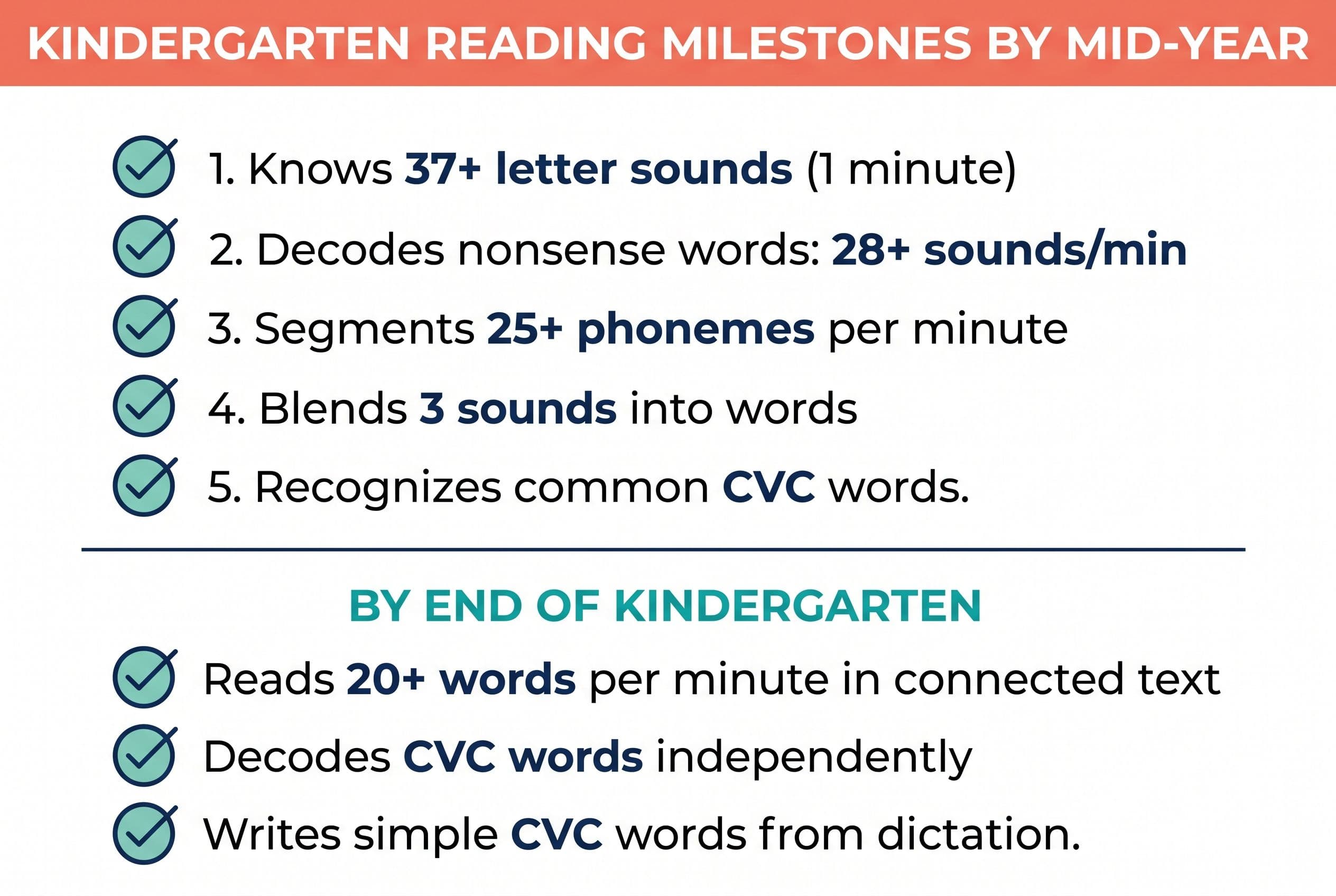
Forget the vague stuff your pediatrician said about "developing at their own pace." Here are concrete benchmarks based on DIBELS 8 (Dynamic Indicators of Basic Early Literacy Skills, 8th Edition) — one of the most widely used early literacy assessments in schools. Your school might use a different edition or a different assessment altogether, so ask which one they use and what their benchmark goals are. But these numbers give you a solid ballpark:
By mid-kindergarten (January of the school year):
- Identify approximately 37+ letter sounds (upper and lowercase) in one minute on the Letter Sounds Fluency measure
- Score around 28+ correct letter sounds per minute on Nonsense Word Fluency (NWF-CLS) — this means they can decode fake words like "bif" and "rog" using phonics, not memory
- Segment approximately 25+ phonemes per minute on Phoneme Segmentation Fluency (break spoken words into individual sounds)
By end of kindergarten (May/June):
- Read 20+ correct words per minute on a connected text passage
- Decode CVC words (consonant-vowel-consonant: cat, pin, bug) independently
- Blend 3-4 phonemes together without help
If your 5-year-old is in kindergarten and nowhere near these benchmarks, don't panic — but don't wait, either. You can close the gap fast with the right approach. I've seen it happen with my own kids.
Step-by-Step: How to Teach a 5-Year-Old to Read
OK, here's the plan. This is basically what I do with my own kids, adapted from Orton-Gillingham principles (the methodology behind most evidence-based reading programs). You don't need fancy materials. You need 15-20 minutes a day and zero tolerance for guessing.
Step 1: Lock Down Letter Sounds (Not Letter Names)
I know your kid can sing the alphabet song. That's not what I'm talking about.
I need your kid to see the letter b and say /b/ (the sound, not "bee"). See m and say /mmm/. Every single letter, instant recall, no hesitation.
How to do it: Grab a set of plain letter cards — you can make them with index cards and a Sharpie. Hold up a letter. Your kid says the sound. If they get it wrong, YOU say the correct sound, they repeat it, and you move on. No long explanations. Drill it. Every day.
Target: All 26 letter sounds mastered in 2-4 weeks.
My Tiger Rule applies here: We Never Skip. Birthdays, holidays, vacation — 5 minutes of letter sound review. Non-negotiable.
Step 2: Build Phonemic Awareness (No Letters Needed)
This is the step most parents skip, and it's the step that matters most.
Quick distinction here, because it trips people up: Phonological awareness is the big umbrella — it covers hearing rhymes, clapping syllables, all the bigger sound chunks. Phonemic awareness is one specific piece under that umbrella — it's the ability to hear and manipulate individual phonemes (the smallest sounds) in spoken words. No print involved. It's 100% auditory. And David Kilpatrick's research in Equipped for Reading Success (2016) shows that advanced phonemic awareness tasks are among the strongest predictors of reading success — right alongside letter-sound knowledge and decoding skill.
Do these exercises daily, out loud, anywhere — in the car, at dinner, in the bathtub:
- Sound isolation: "What's the first sound in 'fish'?" (/f/) "What's the last sound in 'map'?" (/p/)
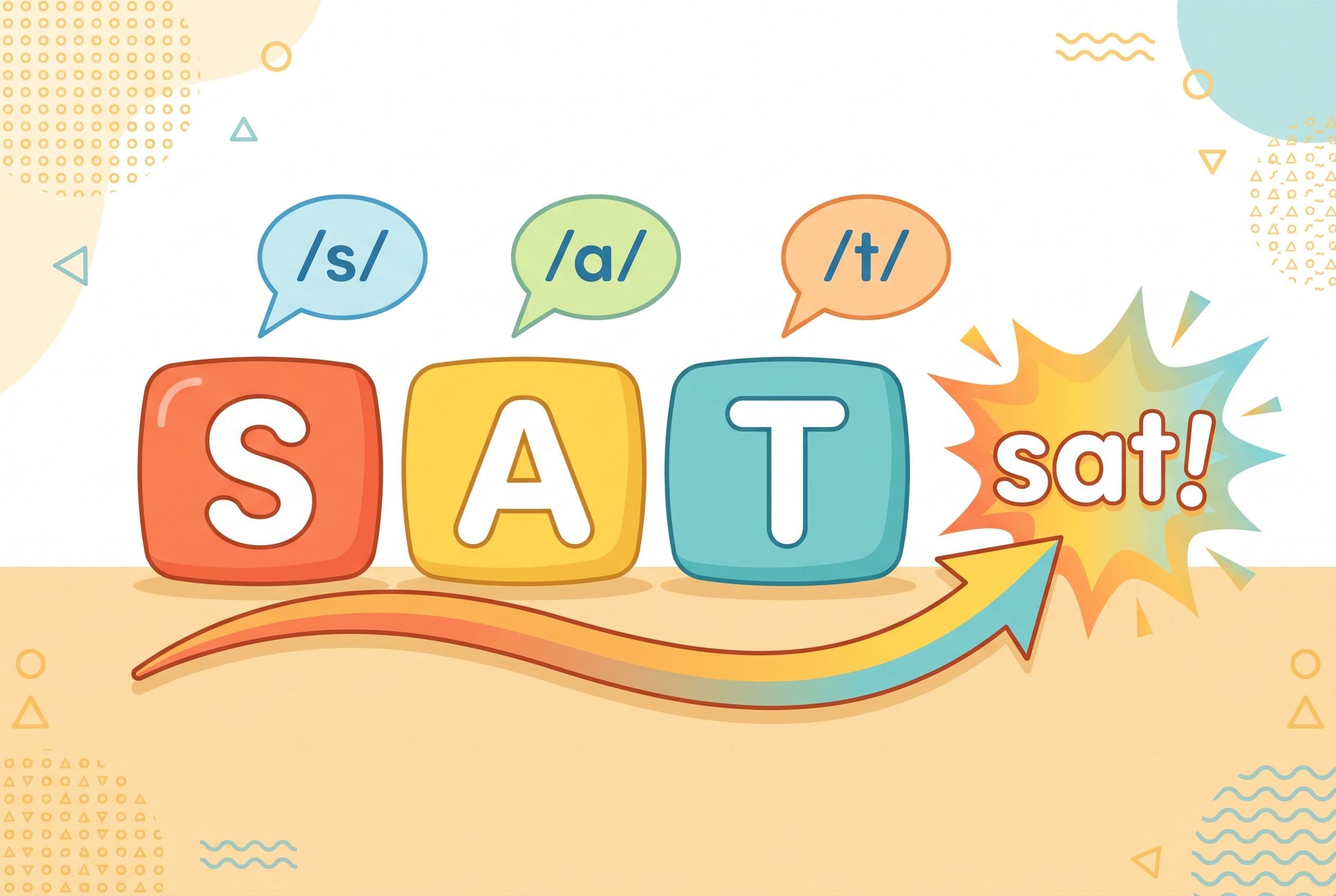
- Blending: "I'm going to say sounds. You tell me the word: /s/ /i/ /t/." (sit)
- Segmenting: "Break the word 'dog' into its sounds." (/d/ /o/ /g/)
- Deletion: "Say 'stop.' Now say it without the /s/." (top)
Start easy. Three-sound words only. When they nail those, move to four sounds.
If your kid can't do ANY of these — can't isolate a first sound, can't blend three sounds into a word — you might want to run Kilpatrick's PAST test (Phonological Awareness Screening Test). It takes about 5 minutes and tells you exactly where the phonological breakdown is. You can find the instructions in his book or through your school's reading specialist.
Step 3: Teach Blending With CVC Words
Now we combine letter sounds with phonemic awareness. This is where reading actually begins.
Start with simple CVC words: sat, pin, bug, hot, led.
Here's my exact process:
- Write the word on a whiteboard or piece of paper (big letters).
- Point to each letter. Kid says the sound: /s/ ... /a/ ... /t/.
- Now sweep your finger under the whole word. Kid blends the sounds together: "ssssaaaat... sat!"
- If they guess — if they look at you instead of the letters, or say a random word — stop them. "No guessing. Look at the letters. Sound it out." This is my second Tiger Rule: No Guessing.
Start with short-a words (cat, bat, man, tap). Master those before moving to short-i, then short-o, then short-u, then short-e.
A program like UFLI Foundations lays this out lesson by lesson if you want a structured scope and sequence. Bob Books Set 1 gives your kid decodable readers that use only the sounds they've learned — no guessing required, no picture clues to lean on.
Step 4: Introduce Decodable Readers (Not Leveled Readers)
This one drives me crazy. Most schools send home "leveled readers" — Fountas & Pinnell levels A through Z — that are designed around Balanced Literacy principles. These books intentionally include words the kid can't decode yet and teach them to guess from context and pictures.
That's not reading. That's a party trick.
Decodable readers only include words your kid can actually sound out based on the phonics patterns they've been taught. When your kid reads a decodable book and gets every word right using phonics — not guessing — that's real reading. And the confidence boost is massive.
Look for decodable readers from:
- Flyleaf Publishing (high quality, beautiful illustrations)
- High Noon Books (great for slightly older struggling readers)
- Bob Books (simple, affordable, progressive)
- The Teach Your Kid to Read app — which sequences decodable text directly with your kid's phonics instruction
Step 5: Practice Every Single Day
I know. You're tired. You've got dinner to make, a 1-year-old pulling everything off the shelf, and a 7-year-old who needs help with math. I get it — that's my house.
But 15 minutes a day of focused phonics practice is non-negotiable. Not 15 minutes three times a week. Not "when we have time." Every. Single. Day.
Here's what a daily session looks like in my house:
- 2 minutes: Letter sound drill (flashcards, rapid fire)
- 3 minutes: Phonemic awareness game (in the car counts!)
- 5 minutes: Blending/reading CVC words or a short decodable reader
- 5 minutes: Writing/spelling practice (kid writes the words they just read — this reinforces orthographic mapping, which is how words get permanently stored in long-term memory)
That's it. Fifteen minutes. Set a timer if you need to.
How to Spot a Bigger Problem: 5-Year-Old Reading Problems That Need Screening
Not every 5-year-old who can't read has a learning disability. Most don't. Most just haven't been taught properly.
But some kids have legitimate phonological processing difficulties, and the earlier you catch it, the better the outcome. Here are the red flags I tell every parent to watch for:
- Can't hear rhymes. If you say "cat, bat, hat" and your kid doesn't notice the pattern, that's a phonological awareness gap.
- Can't isolate the first sound in a word after weeks of practice. Not days — weeks.
- Persistent letter reversals (b/d, p/q) past age 6. Some reversal at 5 is normal. Constant reversal at 6+ is a flag.
- Family history of dyslexia or reading difficulty. Dyslexia is highly genetic. If you or your spouse struggled to read, your kid's risk is 40-60% higher.
- Extreme frustration or avoidance during any reading activity — not typical "I don't wanna" resistance, but genuine anxiety or shutdown.
If you're seeing multiple red flags, your public school district has Child Find obligations under IDEA to locate and evaluate children with suspected disabilities. How this works for homeschooled kids varies by state, though — so call your district's special education office and ask specifically about Child Find for homeschoolers in your state. You can also find a private evaluator who uses evidence-based tools. Ask specifically about the CTOPP-2 (Comprehensive Test of Phonological Processing) and Kilpatrick's PAST test.
Don't wait for the school to notice. Schools are overwhelmed and understaffed. You are your child's best advocate. Full stop.
Why I Built Teach Your Kid to Read Around This Exact Problem
Real talk — the reason my husband Ben and I built Teach Your Kid to Read is because we watched too many parents go through exactly what I described above. The Googling, the worry, the conflicting advice, the schools using methods that don't work.
Our app is built on systematic synthetic phonics — the same Orton-Gillingham principles behind programs like Wilson Reading System and Barton Reading & Spelling. It teaches letter sounds, blending, segmenting, and decoding in a structured sequence. No guessing from pictures. No memorizing word shapes. Just real phonics, in the right order, with built-in review so nothing gets skipped.
Is it the only way to teach your kid? No. But if you want a daily structured plan that does the lesson sequencing for you — especially when you're juggling multiple kids and life is chaos — it's exactly what we built it for.
The Bottom Line for Parents of 5-Year-Olds Who Can't Read Yet
Look, I'm not going to pretend this is easy. Teaching a kid to read is hard work. It requires patience, consistency, and the willingness to say "sound it out" four hundred times a day without losing your mind.
But here's what I know from teaching my own kids and talking to hundreds of parents: the earlier you start, the faster it goes. A 5-year-old who gets 15 minutes of daily phonics instruction can make more progress in 8 weeks than a 7-year-old makes in 8 months — because you're building the foundation fresh instead of trying to undo years of guessing habits.
Mississippi proved this at a state level. After passing the Literacy-Based Promotion Act in 2013 — which required evidence-based phonics instruction and held back third graders who couldn't read proficiently — Mississippi showed some of the largest NAEP 4th-grade reading gains in the country over the following years. If an entire state can turn it around, you can turn it around for one kid.
Your kid isn't broken. Your kid just needs someone to teach them the code.
Be that someone. Start today.
Frequently Asked Questions
Is it normal for a 5-year-old to not be reading yet?
It's within the normal developmental range — but "normal" doesn't mean "no action needed." By age 5, your child should know most letter sounds, be able to hear and manipulate sounds in spoken words (phonemic awareness), and be starting to blend sounds together. If none of that is happening, don't wait for it to magically click. Start teaching phonics today. The National Reading Panel — the one Congress commissioned in 2000 — found that systematic phonics instruction produces significant benefits for kids in kindergarten through 6th grade. The earlier you start, the better.
How long does it take to teach a 5-year-old to read?
Every kid is different, so I won't give you a magic number. But with 15-20 minutes of daily systematic phonics instruction, most 5-year-olds can move from zero letter-sound knowledge to reading simple CVC words in 6-10 weeks. Getting to fluent, independent reading of simple books typically takes 6-12 months of consistent daily practice. The key word is daily. Sporadic practice doubles or triples the timeline.
Should I be worried about dyslexia if my 5-year-old can't read?
Not necessarily — most 5-year-olds who can't read simply haven't had effective instruction yet. But you should be aware of the possibility, especially if there's a family history of reading difficulty. Watch for red flags: inability to rhyme, persistent trouble isolating sounds in words, and extreme avoidance of anything letter-related. If you're concerned, ask for a phonological awareness screening using the PAST test (Kilpatrick's Phonological Awareness Screening Test) or the CTOPP-2. Early identification changes outcomes dramatically.
What's the best program to teach a 5-year-old to read at home?
Look for any program built on systematic synthetic phonics — meaning it teaches letter-sound relationships in a structured sequence and has kids blend sounds together to read words (not guess from pictures). Good options include UFLI Foundations (free, university-developed), Explode the Code (workbook-based), Bob Books (simple decodable readers), and our own Teach Your Kid to Read app, which sequences everything for you. Avoid anything that emphasizes "three-cueing" or tells kids to look at the picture and guess.
My kid's school says not to worry. Should I trust them?
Trust but verify. Ask the school specifically: "What reading curriculum do you use? Is it based on systematic phonics or Balanced Literacy?" If they mention Lucy Calkins' Units of Study, Fountas & Pinnell, or any program that teaches kids to use picture clues and context to guess at words, your kid is not getting evidence-based instruction — regardless of what the teacher says. Over 40 states have now passed Science of Reading legislation since 2019 precisely because schools were using methods that don't work. You may need to supplement at home even if your child is in a good school.
Part of these guides

Xia Brody
Co-Founder, Teach Your Kid to Read
Mom of 4 who has successfully taught her kids to read. Currently in the trenches with her 4-year-old while her two oldest (10 and 7) devour books on their own. Passionate about phonics-based methods and building a lifelong love of reading.
Related Articles
My 7 Year Old Can't Read: 9 Steps to Act Now
If your 7-year-old still can't read, don't panic—but don't wait. Here's how to check the gap, stop guessing habits, and start a real phonics plan at home.
Read More →
My 5 Year Old Can't Read: What to Do This Week
If your 5-year-old can't read yet, don't panic — but don't wait and see either. Here's what age-5 reading should look like, when to worry, and the phonics plan I'd start this week.
Read More →
My 5 Year Old Can't Read Reception: When to Act
If your Reception child isn't reading yet, don't panic — but don't drift. Here's how to tell normal early reading from a real phonics gap, and what to do this week.
Read More →