Best Reading App for 2nd Graders in 2026: 6 Compared
What You'll Learn
- Why most "top-rated" reading apps actually reinforce the guessing habits that are destroying your kid's reading — and the one red flag that exposes them instantly
- The specific 2nd grade reading benchmarks your child should be hitting right now (with real numbers from DIBELS and the NAEP)
- 6 popular reading apps compared side-by-side — which ones use actual phonics science and which ones are just pretty screens
- The single app feature I refuse to compromise on after watching my oldest struggle with a whole-language-aligned program for three painful months
The Problem Nobody Wants to Talk About
Here's a number that should make every parent of a 2nd grader lose sleep: only 33% of 4th graders read at a proficient level on the 2022 NAEP — that's the Nation's Report Card, the gold standard of student achievement data in the United States. And the 2023 scores? They dropped another 3 points from 2019, marking the largest decline in 30 years.
Your kid is in 2nd grade right now. That 4th grade test is twenty months away. Maybe less.
And if your child is using a reading app that rewards guessing, relies on picture cues, or treats phonics like an afterthought buried behind mini-games — they're not learning to read. They're learning to fake it.
I know this because I watched it happen in my own house.
When my oldest was 6, I downloaded one of those "#1 Kids Reading App!" things with the cute animations and the 4.8-star App Store rating. She loved it. She'd tap through lessons, collect virtual stickers, and "read" stories by memorizing patterns and looking at illustrations. Her confidence was sky-high. Her actual decoding ability? Flatlined.
I didn't catch it until I handed her a decodable text with no pictures and asked her to read the word "plump." She stared at it. Guessed "purple." She was using context and images — not letter-sound knowledge — because that's exactly what the app had trained her to do.
That was my wake-up call. And it's why I've spent the last four years obsessively evaluating every reading app that crosses my screen.
The 3rd Grade Cliff Is Not a Metaphor
Let me paint the picture nobody wants to see.
In the Annie E. Casey Foundation's 2010 study, "Double Jeopardy," students who weren't reading proficiently by the end of 3rd grade — especially those from low-income families — were about four times more likely to drop out of high school. The data is brutal and it hasn't gotten better.
Second grade is the last full year your child has before the 3rd Grade Cliff. This is the year they should be transitioning from "learning to read" to "reading to learn." By spring of 2nd grade, your kid needs to be reading connected text with accuracy AND comprehension. Not guessing. Not memorizing. Actually decoding.
Here's what the benchmarks look like in real numbers:
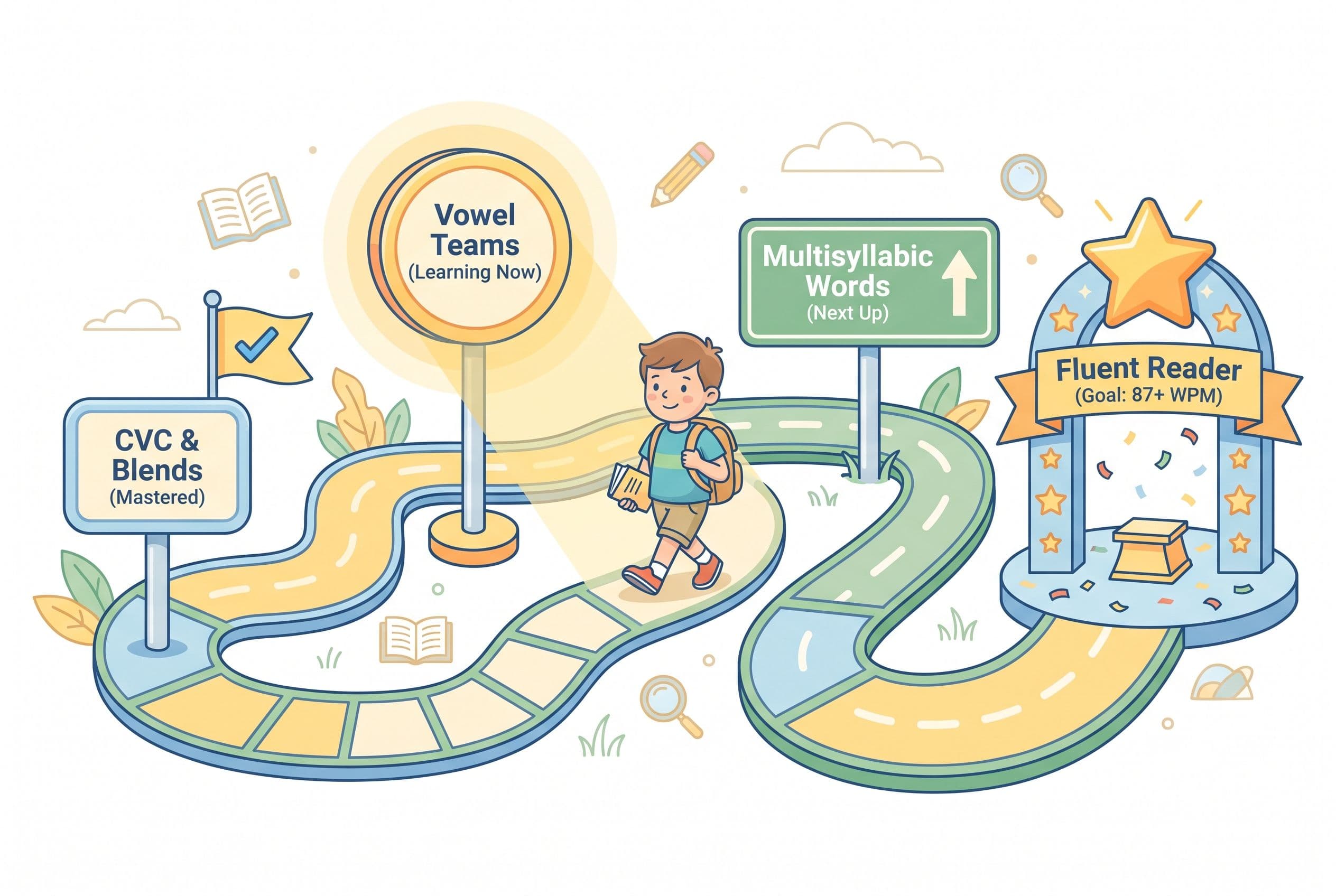
- Oral Reading Fluency (DIBELS): Around 87+ correct words per minute by the end of 2nd grade (note: exact benchmarks vary by DIBELS edition and testing window — check the DIBELS benchmark goals for the version your school uses)
- Phonics Skills: Decoding multisyllabic words, applying vowel teams (ea, oa, ai), r-controlled vowels, and common endings (-ing, -ed, -tion)
- Comprehension: Answering literal and inferential questions about grade-level text independently
If your child isn't hitting those marks, you don't have the luxury of "wait and see." And if the app they're using isn't systematically building toward those benchmarks? Uninstall it.
I was at a playground in Raleigh last spring when another mom — let's call her Jen — told me her son's school had just switched away from Lucy Calkins Units of Study to a Science of Reading curriculum. North Carolina's SB 387, the Excellent Public Schools Act, basically forced the shift. Jen was confused and honestly a little annoyed. "He was doing fine before," she told me.
So I asked her: can he read the word "splint"?
Her son is in second grade. He could not.
I spent twenty minutes on that playground bench walking her through why the switch was happening — Emily Hanford's "Sold a Story" investigation that blew the lid off Balanced Literacy, the NAEP data showing two-thirds of kids can't read proficiently, the neuroscience from Stanislas Dehaene's lab proving the brain doesn't just magically learn to read the way it learns to talk. Reading has to be explicitly taught. The brain has to be trained through systematic phonics instruction. Dehaene's "Reading in the Brain" (2009) lays this out in excruciating scientific detail.
Jen went home that night and listened to the entire "Sold a Story" podcast. She texted me at 11pm: "I had no idea. Why didn't anyone tell us this sooner?"
That's the question, isn't it? Why didn't anyone tell us?
Well, I'm telling you. Right now. And the reading app your 2nd grader is using matters more than you think.
How I Evaluated These 6 Reading Apps
Before I break down each app, let me tell you exactly what I looked for. This isn't a "which app has the cutest design" roundup. I evaluated every app against the science of how kids actually learn to read.
Here's my scoring framework:
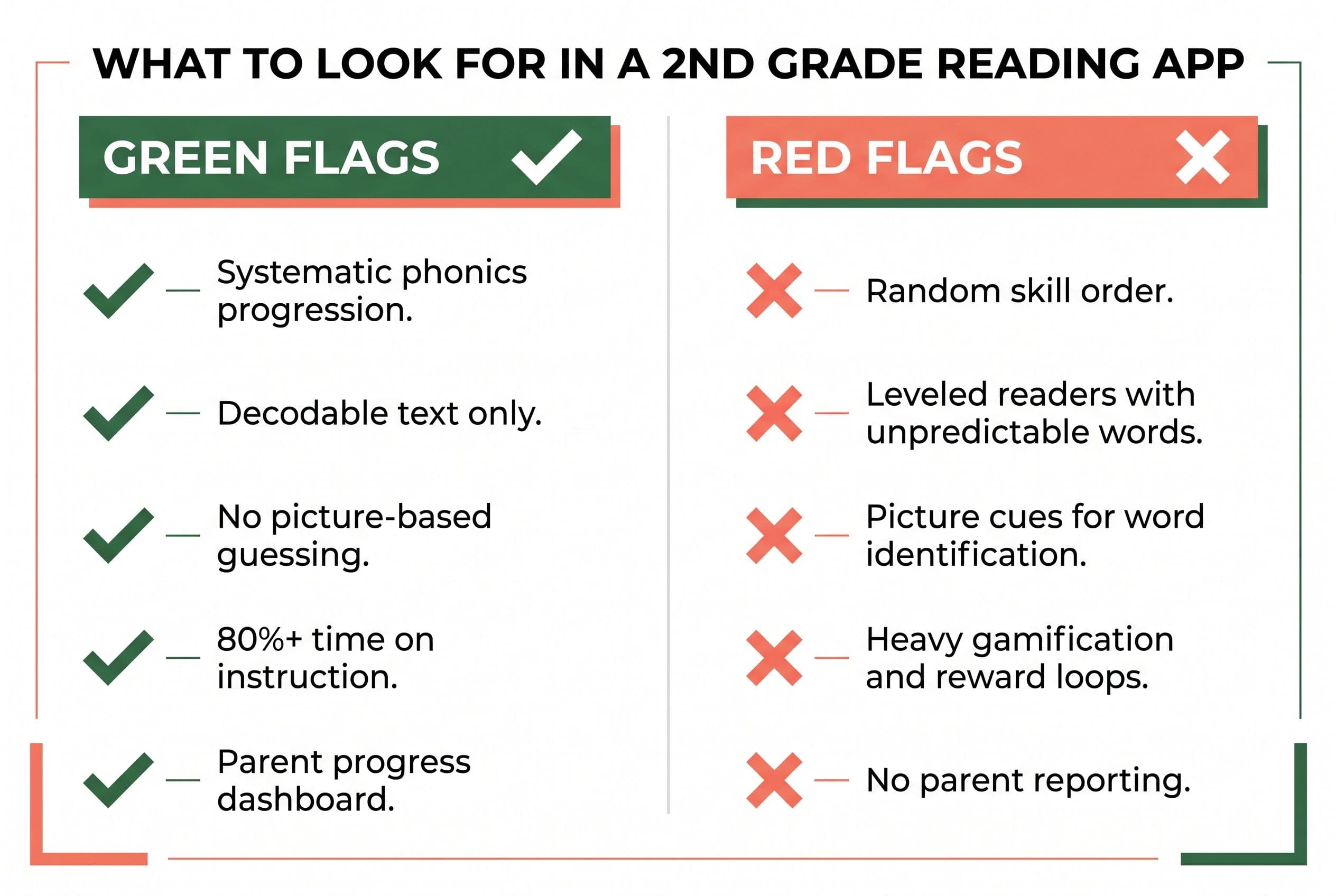
1. Systematic Synthetic Phonics Progression Does the app teach phonics in a logical, sequential order — or does it scatter skills randomly? I'm looking for Orton-Gillingham-aligned progression: single consonants → short vowels → CVC words → blends → digraphs → vowel teams → multisyllabic words. If it skips steps or front-loads sight word memorization, it loses points immediately.
2. No Guessing Allowed Does the app ever encourage the child to guess a word from a picture? From context? From the first letter? If yes, that's a dealbreaker. David Kilpatrick's "Equipped for Reading Success" (2016) makes it clear: guessing undermines orthographic mapping, the cognitive process that lets kids store words permanently in memory. Every time a child guesses instead of decoding, they're building a bad habit that gets harder to break.
3. Decodable Text (Not Leveled Readers) Does the app use decodable readers — texts where 90%+ of the words follow phonics patterns the child has already learned? Or does it use leveled readers (like the Fountas & Pinnell system) where kids encounter words they haven't been taught to decode? Decodable text forces the child to use their phonics skills. Leveled text that's paired with multi-cueing prompts — "look at the picture," "what word would make sense here?" — turns reading into a guessing game. That's the real danger, especially for beginning and struggling decoders.
4. Actual Skill Building vs. Game Rewards Does the app spend 80%+ of the child's time on reading instruction, or is it 40% reading and 60% dress-up-your-avatar? My 7-year-old would happily spend an hour "reading" if it meant she got to build a virtual treehouse. That's not learning. That's Candy Crush with letters.
5. Comprehension Integration A 2nd grader needs more than decoding. The Simple View of Reading (Gough & Tunmer, 1986) says it plainly: Reading = Decoding × Language Comprehension. Both matter. Does the app build vocabulary, ask comprehension questions, and develop background knowledge? Or does it just drill letter sounds in isolation?
6. Parent Visibility Can I see exactly what my child is working on, where they're stuck, and what they've mastered? If the app is a black box, I can't do my job as the parent.
The 6 Reading Apps, Compared and Ranked
I compared each of these apps against the framework above, based on how each one says it teaches. Here's how they stack up.
1. Teach Your Kid to Read — Best Overall for 2nd Graders
The verdict: This is the app I keep coming back to, and it's the one I'm actively using with my own kids in 2026.
Teach Your Kid to Read is built on systematic synthetic phonics principles aligned with Orton-Gillingham methodology. The progression is tight — it doesn't skip steps, it doesn't let kids guess, and it uses decodable text that matches exactly what the child has been taught. Every word in the reading passages is phonetically controlled.
For 2nd graders specifically, the app covers the phonics territory that matters most at this stage: vowel teams, r-controlled vowels, diphthongs, multisyllabic word decoding, and morphological awareness (prefixes and suffixes). These are the skills that separate a kid who can stumble through a simple story from a kid who can actually read "instruction" and "replacement" without breaking a sweat.
What I love:
- Zero guessing. The app never shows a picture as a word-reading cue. My "No Guessing" tiger rule? This app enforces it for me.
- Parent dashboard that shows me exactly which phonics patterns my child has mastered and which need more drill.
- Short daily lessons (10-15 minutes) that fit into our homeschool routine without a fight. I had my 7-year-old doing her lesson at the kitchen table before breakfast last week, and she was done before her oatmeal cooled.
- Comprehension questions embedded directly after decodable passages — not as an afterthought, but as part of the lesson flow.
The kicker: it's designed by parents who actually teach reading, not a Silicon Valley team that read one article about phonics.
2. HOMER — Flashy but Flawed
HOMER gets recommended constantly. It's colorful and it's engaging. And that's actually part of the problem.
A lot of the "reading" time in HOMER goes to interactive stories, drawing activities, and creative play. Fun? Absolutely. Systematic phonics instruction? Not really. The app touches on phonics skills but doesn't follow a strict scope and sequence. A 7-year-old could spend twenty minutes in HOMER and decode exactly zero new words.
The bigger issue: HOMER uses illustrated stories where kids are clearly encouraged to use picture context. A child who meets an unfamiliar word can look at the picture and name it without sounding out a single letter. That's not reading. That's the exact guessing behavior Kilpatrick warns about.
Bottom line: It's a decent vocabulary and comprehension supplement, but it shouldn't be your primary reading app. It doesn't do the heavy lifting of phonics instruction.
3. Reading Eggs — Solid Phonics, Heavy on Gamification
Reading Eggs has been around for a while, and it does include systematic phonics instruction. The scope and sequence is reasonable through the early levels. For a 2nd grader, the "Reading Eggspress" component targets comprehension and fluency at grade level.
The problem? The reward-to-instruction ratio is off. A child can spend a significant chunk of time decorating a virtual house, shopping for avatar outfits, and playing spelling games that are more arcade than education.
To be fair, the phonics content that is there is decent. The app follows a logical progression and includes some decodable reading passages. But a 2nd grader who's behind on reading benchmarks can't afford to spend that much app time playing dress-up.
Bottom line: Better than HOMER for phonics, but the gamification bloat is real. If your kid is already at or near grade level and you want a supplement, it's fine. If they're behind? Not aggressive enough.
4. Hooked on Phonics — The Legacy Name
This one has brand recognition for days. The app version carries some of that DNA but has been modernized.
The phonics progression exists and is generally sequential. The app includes decodable readers, which is a huge plus. For 2nd graders, there's content targeting multisyllabic words and more complex phonics patterns.
But the instructional density is thin. Lessons are short — sometimes too short. A quick "lesson" can be followed by a practice game that doesn't reinforce the specific pattern just taught. The practice feels disconnected from the instruction.
Also, the parent reporting is minimal. It's hard to get a clear picture of which specific phonics skills a child has mastered vs. which are still shaky.
Bottom line: Not bad. Not great. The Hooked on Phonics name carries more weight than the current app warrants. It's a B-minus effort riding on an A-plus reputation.
5. Epic! — A Library, Not a Teacher
Let me be clear: Epic! is not a reading instruction app. It's a digital library. And it's a pretty good one — thousands of books, audiobooks, and read-alongs across every topic imaginable.
But I see parents listing Epic! as their kids' "reading app," and that drives me up the wall.
A library without instruction is like giving a kid a piano and no lessons. Sure, they might bang out some notes. But they're not learning to play. Epic! gives your 2nd grader access to books — many of them leveled readers, not decodable texts — without any systematic phonics instruction, without decoding practice, without comprehension accountability.
Browsing Epic! is like browsing a bookstore. It's wonderful enrichment. It is not reading instruction.
Bottom line: Great as a supplement for a child who already reads at grade level. Not a replacement for actual phonics-based instruction — because without decoding skills and with no one prompting them to sound words out, kids will default to guessing on unfamiliar words.
6. Khan Academy Kids — Free but Incomplete
I have a soft spot for Khan Academy Kids because it's completely free, it's ad-free, and it covers a wide range of early learning skills. The phonics component exists, and for a free app, it's surprisingly decent through the pre-K and kindergarten levels.
Here's where it falls apart for 2nd graders: the phonics instruction tops out too early. I don't see structured lessons on vowel teams, complex syllable division, or morphological awareness — the stuff that makes or breaks 2nd grade reading. The app is strongest for 3-to-5-year-olds and gets progressively thinner as the reading demands increase.
The comprehension activities are also more surface-level than what a 2nd grader needs. Simple recall questions, basic sequencing. Scarborough's Reading Rope reminds us that language comprehension strands — vocabulary, background knowledge, verbal reasoning — must grow right alongside decoding. Khan Academy Kids doesn't give that growth enough room at the 2nd grade level.
Bottom line: Outstanding for younger kids. Not sufficient as a standalone reading app for 2nd graders. Use it for math and science — it's fantastic there.
The Feature That Matters Most (And Almost Every App Gets Wrong)
Here's what separates a reading app that actually teaches reading from one that just looks like it does: decodable text.
I can't stress this enough.
When your 2nd grader reads a passage in a reading app, every word in that passage should be decodable using phonics patterns the child has already been taught. That's how orthographic mapping works. The child sees the word, sounds it out using known patterns, and the act of successfully decoding it maps that word into long-term memory. That's the process Kilpatrick describes. That's how fluent readers are built.
If the app throws in words the child hasn't been taught to decode — and prompts them to guess from pictures or context instead of sounding out — the child has two options: guess, or skip. Both are terrible. Both build habits that will haunt them through 3rd grade and beyond.
Teach Your Kid to Read uses controlled decodable text at every stage. That's the no-brainer reason it's at the top of my list.
What 2nd Grade Reading Should Actually Look Like
Let me give you the benchmarks so you know where your kid stands. These come from DIBELS and align with what the International Dyslexia Association recommends.
By the end of 2nd grade, your child should be able to:
- Read around 87+ correct words per minute on grade-level connected text (DIBELS ORF benchmark — check your specific DIBELS edition for exact targets)
- Decode words with vowel teams (rain, boat, meat), r-controlled vowels (car, fern, bird), and common diphthongs (oil, cow)
- Read two-syllable words by applying syllable division rules (rab/bit, sun/set, po/lite)
- Read and understand grade-level text well enough to answer both literal questions ("What did the character do?") and inferential questions ("Why did the character feel sad?")
- Spell phonetically regular words accurately and attempt irregular words using known patterns
If your child isn't there yet — or is wobbling — a reading app built on systematic phonics can close the gap. But it has to be the right app. Not a game with a reading label slapped on it.
I used Kilpatrick's PAST test (Phonological Awareness Screening Test) with my 7-year-old last month. It takes about five minutes, and it pinpoints exactly where the phonological breakdown is happening. If your child is struggling with any of the benchmarks above, running a quick PAST assessment can tell you whether the issue is phonemic awareness, decoding, or something else entirely. You can find the PAST in Kilpatrick's Equipped for Reading Success — and some districts and trained providers use it as well. Your reading app should be targeting that specific weakness.
My Recommendation: Stop App-Hopping and Commit
Real talk — the biggest mistake I see parents make isn't choosing the wrong app. It's downloading five apps, using each one for a week, and never sticking with any of them long enough to see results.
Pick one. Use it every single day. Tiger Rule #1: We Never Skip. That means phonics on birthdays, on vacation, on snow days. Ten minutes. Every. Single. Day.
I've compared every app on this list closely, and Teach Your Kid to Read is the one that earns its spot in our daily routine. It's the app my 7-year-old uses every morning. It's the app I recommend to every parent in my homeschool co-op. And it's the app that actually aligns with what the National Reading Panel found in 2000 when Congress commissioned them to figure out how kids learn to read: systematic phonics instruction produces significant benefits for kids in kindergarten through 6th grade.
That was twenty-six years ago. The science hasn't changed. It's just taken this long for the apps to catch up.
Your Action Steps (Do These This Week)
-
Assess where your child actually stands. Pick up Kilpatrick's Equipped for Reading Success and run through the PAST test with your 2nd grader. Time their oral reading fluency on a grade-level passage. Compare to the DIBELS benchmark of around 87+ words per minute by end of 2nd grade (check your DIBELS edition for exact numbers).
-
Audit their current app. Open whatever reading app your child is using right now. Watch them use it for 10 minutes without helping. Ask yourself: Are they sounding out words or guessing? Are they reading decodable text or looking at pictures? How much time is spent on instruction vs. games?
-
Try Teach Your Kid to Read. start lesson one free Set up the app, run through the placement assessment, and commit to 10-15 minutes of daily practice. No skipping.
-
Check your state's reading legislation. Over 40 states have passed Science of Reading legislation since 2019. Mississippi posted one of the biggest 4th-grade NAEP reading gains in the country after its Literacy-Based Promotion Act of 2013. Know what your state requires — and what your child's school is (or isn't) doing.
-
Re-assess in 30 days. Run the PAST test again. Time their fluency again. You should see measurable improvement. If you don't, something's wrong — and you need to investigate whether it's a phonological processing issue that might need a more intensive intervention like the Wilson Reading System or Barton Reading & Spelling.
Frequently Asked Questions
What reading level should a 2nd grader be at?
By the end of 2nd grade, your child should be reading at approximately a DRA level 28 or Lexile range of 420-650L. But honestly, I care less about levels and more about skills: can they decode multisyllabic words, read around 87+ correct words per minute on grade-level text (per DIBELS benchmarks), and answer comprehension questions about what they've read? Those are the real markers.
How much time should my 2nd grader spend on a reading app each day?
10 to 15 minutes of focused, high-quality instruction is the sweet spot. That's what the research supports, and it's what fits into real life without meltdowns. More important than duration is consistency — every single day, no exceptions. I'd take 10 minutes daily over 45 minutes three times a week.
Can a reading app replace tutoring for a struggling 2nd grader?
It depends on how far behind your child is. If they're within striking distance of grade-level benchmarks and just need more practice, a solid phonics-based app like Teach Your Kid to Read can absolutely close that gap. If they're significantly behind — say, reading below a 1st grade level in 2nd grade — they may need a more intensive intervention. Get a formal assessment first. The PAST test is a good starting point, and your pediatrician or school can refer you for a more comprehensive evaluation through your district.
Are free reading apps good enough?
Some are decent for younger kids — Khan Academy Kids is legitimately good for pre-K through kindergarten. But for 2nd grade, most free apps lack the depth of phonics instruction your child needs. The advanced phonics patterns (vowel teams, syllable types, morphology) require carefully sequenced curriculum that free apps tend to shortchange. You get what you pay for, and your child's literacy is not the place to cut corners.
How do I know if my child's reading app is using real phonics?
Here's the quick test: watch your child encounter an unfamiliar word in the app. Does the app prompt them to sound it out letter by letter? Or does it show a picture, give a context clue, or just tell them the word? If it's anything other than "decode it," it's not teaching phonics. Also look at whether the reading passages are decodable (only containing patterns already taught) or uncontrolled (containing words the child hasn't learned to decode). Decodable = phonics-based. Uncontrolled text plus guessing prompts = a recipe for fake reading.
Ready to give your 2nd grader a reading app that actually works? Try Teach Your Kid to Read today — the same app I use with my own kids, built on the phonics science that 40+ states are now mandating in schools. Visit start lesson one free or call (407) 707-6850 to get started.
Part of these guides

Xia Brody
Co-Founder, Teach Your Kid to Read
Mom of 4 who has successfully taught her kids to read. Currently in the trenches with her 4-year-old while her two oldest (10 and 7) devour books on their own. Passionate about phonics-based methods and building a lifelong love of reading.
Related Articles
Is My 2nd Grader Behind in Reading? 9 Signs
Wondering if your 2nd grader is behind in reading? Here are the real warning signs, what 2nd graders should be able to do, and what to do next if your child is guessing, slow, or stuck.
Read More →
Best Reading App for 4th Graders Behind + Free Plan
Your 9-year-old is guessing at words and hiding books in his backpack. Most reading apps are built for 5-year-olds and will waste his time. Here's what a real 4th grade reading intervention app has to do — and the exact daily plan I use.
Read More →
Reading Eggs vs ABCmouse for 5-Year-Olds: Best Pick
Choosing between Reading Eggs and ABCmouse? Here’s the no-fluff mom verdict on which app actually teaches a 5-year-old to read — and where both fall short.
Read More →