Best HOMER Alternative in 2026: 5 Apps Compared (Honest Review)
What You'll Learn
- Why HOMER's approach has a fundamental flaw that most parents don't notice until their kid hits a wall in first grade
- The single question that instantly tells you whether any reading app is worth your money (hint: it involves the word "splint")
- 5 apps compared side-by-side on the only criteria that actually matter — systematic phonics, decodable readers, and zero guessing
- The one app that nails synthetic phonics using structured literacy principles — and costs less than your daily coffee habit
The Problem With Most "Reading" Apps (Including HOMER)
Let me be blunt. Most reading apps for preschoolers aren't teaching reading. They're teaching kids to play a reading-themed video game.
Your kid taps a glowing letter. A cartoon fox dances. Stars explode across the screen. Your child giggles. You think, "Wow, she's learning to read!" She's not. She's learning to tap glowing things.
I've been down this road. When my oldest was 4, I downloaded every app with 4+ stars and the word "reading" in the title. HOMER included. He loved it. He'd sit there for 20 minutes, totally engaged, swiping through stories and tapping letters. And I thought we were golden.
Then I handed him a book — an actual, physical book — and asked him to read the word "sit." He stared at it. Then he looked at the picture of a dog on a chair and said "chair."
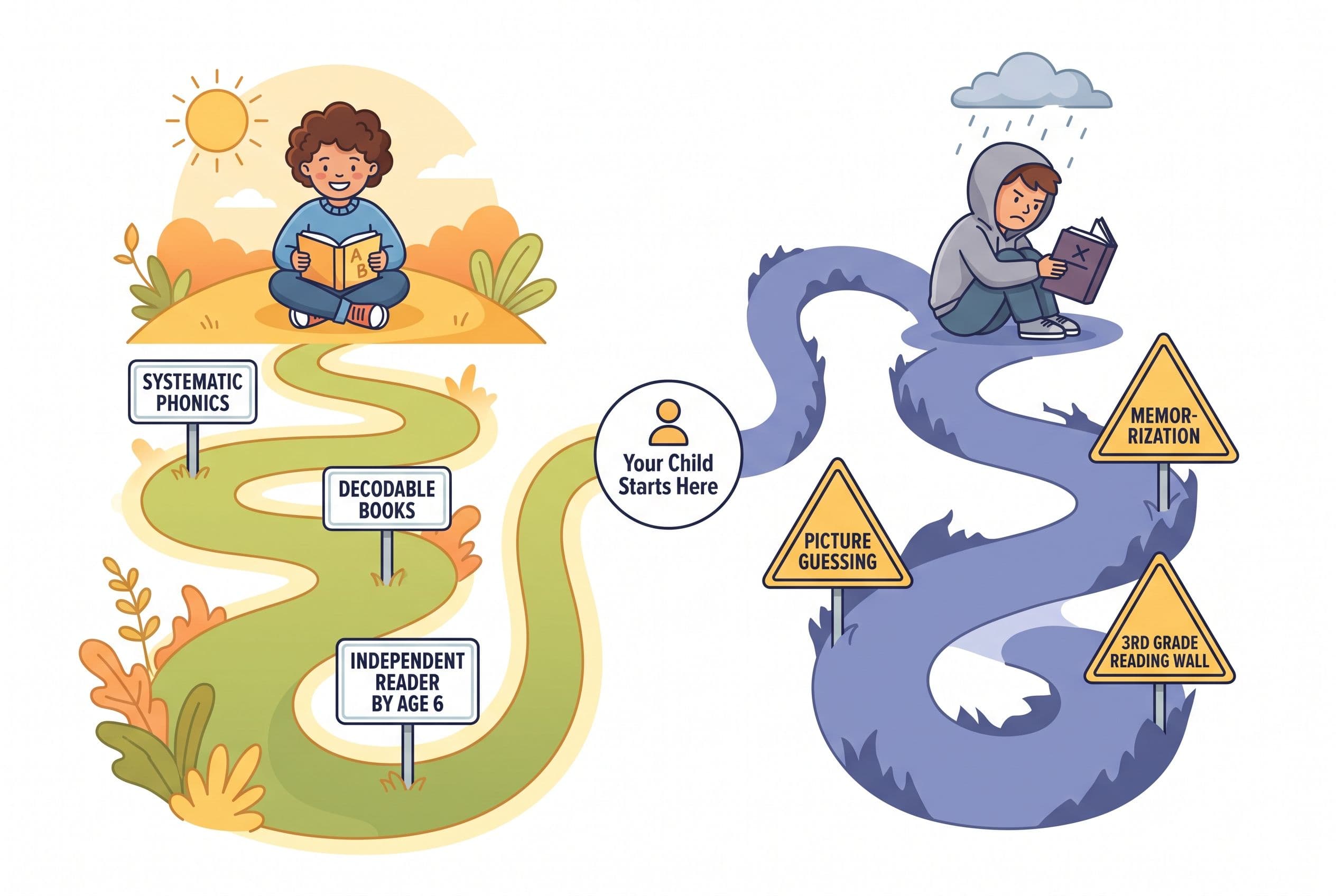
That's not reading. That's guessing. And that guessing habit? It's exactly what Stanislas Dehaene warned about in Reading in the Brain (2009). His neuroimaging research at the Collège de France proved that the brain doesn't learn to read naturally — it has to be systematically trained to map letters to sounds. When apps let kids use picture cues and context clues to "figure out" words, they're building the wrong neural pathways.
Here's the thing — HOMER isn't a bad app. It's beautifully designed. My kids genuinely enjoy the stories. But it uses a mixed-methods approach that blends phonics with whole-language strategies. And if you've been paying attention to reading science since Emily Hanford's "Sold a Story" investigation blew the lid off Balanced Literacy, you know that's a problem.
So if you're searching for the best HOMER alternative in 2026, you're already asking the right question. Let's find you a real answer.
The Tiger Truth: What Happens When Apps Teach Guessing
I was at a playground in Raleigh last year when another mom — I'll call her Sarah — told me her son's school had just switched from Lucy Calkins to a Science of Reading curriculum because of North Carolina's HB 521, the Excellent Public Schools Act. She was confused and honestly a little annoyed. "He was doing fine before," she said.
So I asked her a simple question. Can your kid read the word "splint"?
He's in second grade. He could not.
I spent 20 minutes on that playground bench explaining why the switch was happening — Hanford's reporting, the NAEP 2022 Grade 4 Reading results showing only 33% of 4th graders scoring at or above the "Proficient" level (and keep in mind, NAEP's "Proficient" is a high bar — meaning actual reading competency is even shakier than that number suggests), the neuroscience from Dehaene's lab showing the brain doesn't learn to read naturally the way it learns to speak. Sarah went home and listened to the Sold a Story podcast that night. She texted me at 11pm: "I had no idea. Why didn't anyone tell us this sooner?"
Nobody told her because the education establishment spent 30 years pushing methods that don't work. And here's the kicker — most reading apps are built on those same broken methods. They look modern, but the pedagogy is straight out of 1990s Balanced Literacy.
The consequences of getting this wrong aren't abstract.
- The Annie E. Casey Foundation's 2011 Double Jeopardy report (based on Donald Hernandez's research) found that kids who can't read proficiently by 3rd grade are 4 times more likely to drop out of high school.
- Remedial reading intervention — the kind you'll need if your kid falls behind — costs $10,000-$15,000 per year. Your insurance won't cover it.
- The 3rd Grade Cliff is real. After 3rd grade, kids stop learning to read and start reading to learn. If they can't decode by then, every subject suffers — science, social studies, even math word problems.
So yeah. The app you choose matters. A lot.
How I Evaluated These Homer Reading App Alternatives
Before I get into the comparison, here's exactly what I looked for. These aren't arbitrary criteria — they come straight from the National Reading Panel report (2000), the research Congress actually commissioned, which found that systematic phonics instruction produces significant benefits for reading achievement.
My 5 non-negotiable criteria:
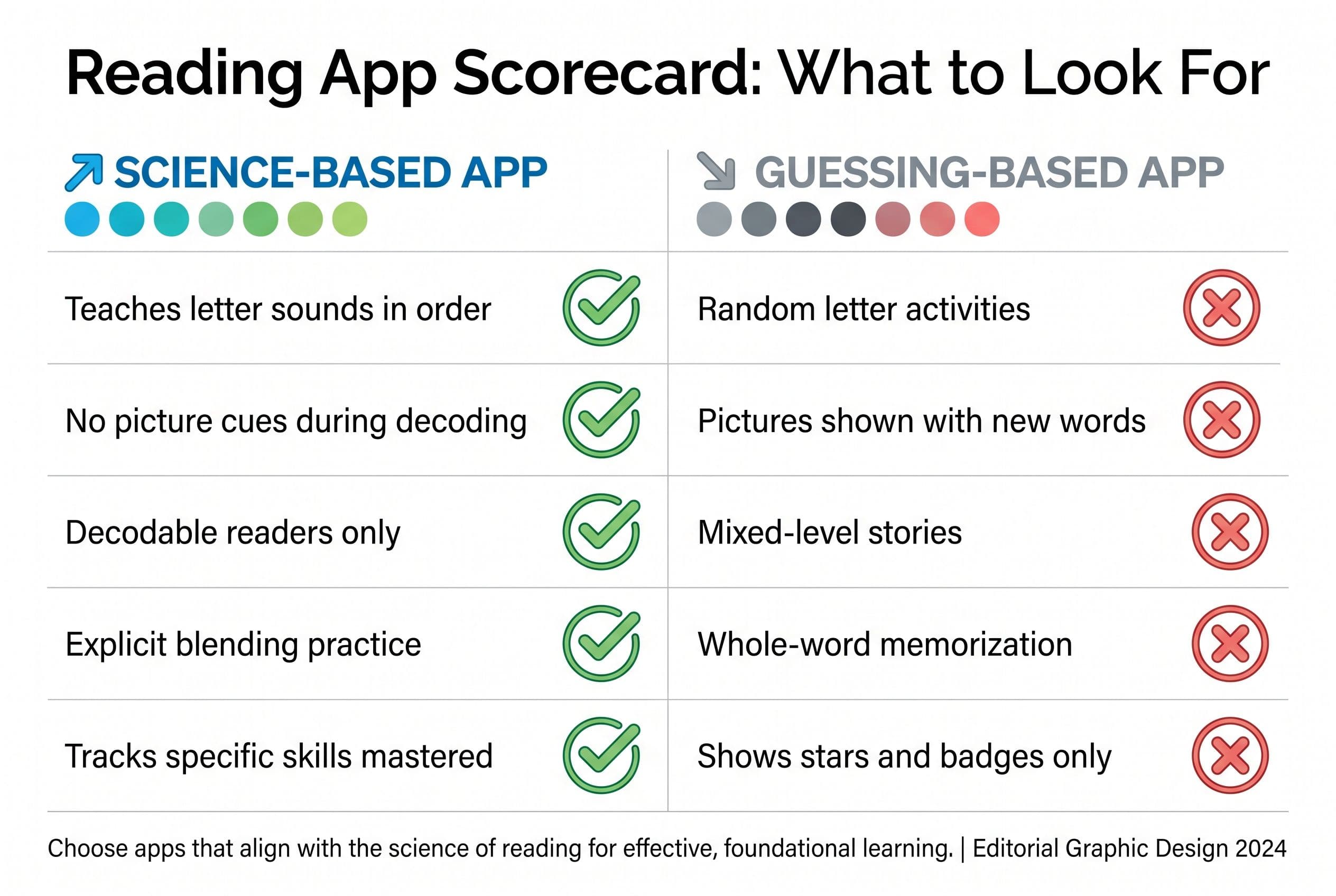
- Systematic Synthetic Phonics — Does the app teach letter-sound correspondences in a logical, sequential order? Or does it jump around randomly?
- No Guessing Allowed — Does the app ever encourage kids to guess words from pictures or context? If yes, automatic penalty. (I'm not talking about a picture that appears after decoding for comprehension — I mean apps where the picture shows up first, or where the prompt says "look at the picture — what word makes sense?" or where the app accepts a tap without any sounding-out. That's cueing, and it's poison.)
- Decodable Text — Does it include practice readers that only use sounds the child has already learned? Or does it throw in words they haven't been taught yet?
- Blending Practice — Does it explicitly teach kids to blend sounds together (c-a-t → cat)? This is the core skill.
- Progress Tracking — Can I actually see what my kid knows and doesn't know? Not just a vague "your child completed 12 lessons!" dashboard, but real data on specific skills mastered and skills that need review.
I tested each app with my 4-year-old, Mei. She's right in the sweet spot — she knows most of her letter sounds and is starting to blend CVC words. She's my third kid, so I know exactly what real phonics progress looks like versus fake engagement metrics.
Let's get into it.
The 5 Best HOMER Alternatives in 2026, Ranked
1. Teach Your Kid to Read — The One I Actually Use
Score: 9.5/10
OK, full disclosure — I co-founded this app. But here's why that matters: I built it because nothing else met my standards.
Teach Your Kid to Read uses systematic synthetic phonics grounded in structured literacy principles — the same kind of approach behind programs like Wilson Reading System and Lindamood-Bell, which cost $80-$150/hour with a trained specialist. Specifically, it's explicit, systematic, and cumulative. Every lesson builds on the last. There are mastery checks before moving on. Corrective feedback is immediate. And the multisensory routines (hear it, see it, say it, blend it) mirror what a trained reading specialist would do one-on-one. We put all of that in an app that costs less than a latte.
Here's what makes it different from HOMER and every other app on this list:
- Zero guessing. There are no picture cues. No context clues. Your kid either sounds out the word or they don't. Tiger rule: no guessing, ever.
- 100% decodable readers. Every story only uses phonics patterns your child has already mastered. You won't see the word "beautiful" showing up in a lesson about short-a CVC words.
- Explicit blending instruction. The app models the blending process — /s/ /i/ /t/ → "sit" — and has the child practice it until it's automatic.
- Parent dashboard with actual data. Not "Timmy earned 45 stars!" I'm talking about which specific grapheme-phoneme correspondences your child has mastered and which ones need review. The kind of data a reading specialist would track.
I had Mei doing her phonics lesson on this app last Tuesday at the kitchen table while I was making dinner (multitasking is survival with four kids). She decoded "step" independently — a CCVC word with a blend. She's four. No guessing. No picture. Just sounding it out.
That's what this app does.
What it lacks: It's not as flashy as HOMER. There are no cartoon foxes. No mini-games about dinosaurs. If your kid is used to gamified apps, there's a brief adjustment period where they'll complain it's "boring." Hold the line. Reading isn't supposed to be entertainment. It's supposed to be a skill.
2. Reading Eggs — Solid Phonics, Heavy Gamification
Score: 7/10
Reading Eggs gets a lot right. It follows a systematic phonics sequence, covers all five pillars of reading (phonemic awareness, phonics, fluency, vocabulary, comprehension), and the lessons are well-structured. When people search for "homer vs reading eggs," this is usually the top alternative that comes up.
The phonics instruction is genuinely sequential. They start with letter-sound correspondence, move to blending, then introduce digraphs, blends, and vowel teams in a logical order. The decodable readers are decent — not perfect, but better than HOMER's mixed-method stories.
The problem: It's SO gamified that my kids spent half their time collecting golden eggs, unlocking pets, and decorating virtual apartments instead of, you know, reading. Mei's older brother (now 7) used Reading Eggs for about three months. He could tell me exactly how many pets he'd unlocked. He could not reliably read the word "when."
The gamification isn't just a distraction — it changes what the child is motivated by. They're working toward the reward, not toward reading mastery. And that's a problem David Kilpatrick identified in Equipped for Reading Success (2016): kids need enough practice with phonological processing that it becomes automatic — what he calls orthographic mapping. If every 30 seconds of phonics practice is interrupted by a reward animation, that deep processing never happens.
Bottom line: Reading Eggs is a solid homer app replacement in 2026 if you can limit your kid's access to the game features. But good luck with that.
3. Hooked on Phonics — The Classic, Updated
Score: 6.5/10
Hooked on Phonics has been around since the late '80s. Your parents probably saw those infomercials. The app version keeps the core phonics sequence and adds interactive elements.
What I like: it's explicitly phonics-first. The lesson structure is clear — learn a sound, practice blending it, read a short story using that sound. No ambiguity about the methodology. The decodable stories are actually readable — they have real plots, not just "The cat sat on the mat" repeated four times.
What I don't like: the app sometimes presents words alongside illustrations before the child has decoded them. That's a subtle whole-language move — the picture appears, and the kid's brain starts guessing before the phonics even kicks in. It's not as bad as HOMER, but it's there.
The progress tracking is also weak. You get a completion percentage. That's it. I can't tell if Mei has mastered the "sh" digraph or if she just tapped through the lesson. Compare that to running Kilpatrick's PAST test (Phonological Awareness Screening Test) — that takes about 5 minutes and tells you exactly where the phonological breakdown is. The app gives you none of that precision.
Best for: Parents who want a trusted brand name and don't want to think too hard about methodology. It's fine. Not great. Fine.
4. Khan Academy Kids — Free but Unfocused
Score: 5.5/10
Khan Academy Kids is free, which is its biggest selling point. And look, Sal Khan has done incredible things for education. But the reading instruction in this app is a scattered buffet, not a structured meal.
It covers phonics. It also covers math, social-emotional learning, creative arts, and about 15 other things. The reading content is mixed in with everything else, and there's no clear systematic phonics sequence that a parent can follow from lesson 1 to lesson 100.
Some activities focus on letter sounds (good). Others ask kids to identify words using picture cues (bad). Some introduce sight words before the child has mastered basic decoding (really bad — this is the MSV cueing system that Hanford exposed in Sold a Story, where kids are taught to use Meaning, Structure, and Visual cues to guess at words instead of decoding them).
Best for: Supplementing a structured phonics program. NOT as a standalone reading app. If you're using Teach Your Kid to Read as your primary phonics instruction and want something extra for your kid to do on a road trip, sure, throw on Khan Academy Kids. But if it's your only reading app? You're rolling the dice.
5. Starfall — Beloved but Outdated
Score: 5/10
Starfall has been around since 2002, and honestly? It looks like it. The interface feels like it was designed when we were all still using dial-up.
But the bigger issue is pedagogical. Starfall uses a mix of systematic phonics and sight-word memorization that doesn't align with current reading science. It introduces high-frequency words like "the" and "was" as whole units to be memorized before kids have learned the phonics patterns that explain those words. Mark Seidenberg called this out in Language at the Speed of Sight (2017) — teaching words as whole units trains the visual memory system instead of the phonological processing system, and that breaks down as words get more complex.
My oldest used Starfall briefly when he was 3. He memorized a handful of sight words and could "read" a few Starfall stories. But he wasn't actually decoding. He'd memorized the sequence. Take him off Starfall and hand him an unfamiliar book? Blank stare.
Best for: Very young children (ages 2-3) getting initial exposure to letters and sounds. After that, you need something with more rigor.
The Side-by-Side Comparison
| Feature | Teach Your Kid to Read | Reading Eggs | Hooked on Phonics | Khan Academy Kids | Starfall |
|---|---|---|---|---|---|
| Systematic Phonics Sequence | ✅ Yes | ✅ Yes | ✅ Yes | ⚠️ Partial | ⚠️ Partial |
| No Picture-Cue Guessing | ✅ Zero tolerance | ⚠️ Occasional | ⚠️ Occasional | ❌ Frequent | ❌ Frequent |
| Decodable Readers | ✅ 100% decodable | ✅ Mostly | ✅ Mostly | ❌ Mixed | ❌ Mixed |
| Explicit Blending | ✅ Modeled + practiced | ✅ Yes | ✅ Yes | ⚠️ Some | ⚠️ Some |
| Real Progress Data | ✅ Granular | ⚠️ Basic | ❌ Minimal | ❌ Completion only | ❌ None |
| Structured Literacy Aligned | ✅ Yes | ⚠️ Partially | ⚠️ Partially | ❌ No | ❌ No |
| Price | 💲 Low | 💲💲 Medium | 💲💲 Medium | Free | Free/Low |
Why This Decision Matters More Than You Think
Let me connect the dots here. Mississippi passed the Literacy-Based Promotion Act in 2013 and went from 49th to 21st in national reading scores in 6 years. Know what they did? They mandated systematic phonics instruction and trained every K-3 teacher in the science of reading.
More than 40 states have now passed Science of Reading legislation since 2019. North Carolina's HB 521. Colorado's READ Act. Ohio's Third Grade Reading Guarantee. Florida's Just Read, Florida! initiative. The entire education system is pivoting toward explicit, systematic phonics.
And yet most reading apps are still stuck in 2015.
When you choose an app for your preschooler, you're not just choosing a fun activity. You're choosing a methodology. You're choosing whether your child builds the neural pathways for real decoding — what Linnea Ehri's research on phases of word reading development calls moving from the "pre-alphabetic" phase to the "full alphabetic" phase — or whether they develop a guessing habit that feels like reading but isn't.
The best reading app for preschoolers in 2026 isn't the prettiest one. It's the one built on actual science.
Your Action Step: The 5-Minute Test
Here's exactly what to do right now.
Step 1: Open whatever reading app your child currently uses.
Step 2: Find a lesson that introduces a new word. Watch whether the app shows a picture alongside the word before your child decodes it — and pay attention to the prompt. Does it say something like "look at the picture" or "what word makes sense"? Does the app accept a tap or answer without requiring any sounding-out? If so, that's a guessing cue. Red flag. (A picture that appears after your child decodes the word for comprehension purposes? That's different — and fine.)
Step 3: Hand your child a piece of paper with three CVC words they haven't seen before: vin, mup, tig. These are nonsense words — the same principle behind the DIBELS Nonsense Word Fluency measure. If your child can sound them out, their phonics instruction is working. If they stare blankly or try to turn them into real words ("vine?" "mop?"), their current app is teaching recognition, not decoding.
Step 4: If they fail Step 3, switch to Teach Your Kid to Read today. Not next week. Today. Every day you wait is a day your child practices the wrong strategy.
Step 5: Set a non-negotiable daily routine. 15 minutes. Every day. Yes, on birthdays. Yes, on vacation. My tiger rule: We Never Skip. Mei does her phonics lesson before she's allowed screen time. Period.
By mid-to-late kindergarten, reading screeners like DIBELS expect kids to blend and read simple CVC words with increasing speed and accuracy. That's a real, measurable target — and it's exactly the kind of progress our app tracks so you can see it happening week by week.
Frequently Asked Questions
Is HOMER a bad app?
HOMER isn't terrible — it's beautifully designed and kids love it. The problem is its mixed-methods approach. It blends phonics with whole-language strategies like picture cues and context clues. Research from the National Reading Panel (2000) is clear: systematic synthetic phonics outperforms mixed methods. HOMER teaches some phonics, but it also teaches guessing. And once a kid develops a guessing habit, it's very hard to undo.
What age should my child start using a phonics app?
Most kids can start working on letter-sound correspondence around age 3-4. My 4-year-old Mei started Teach Your Kid to Read at 3.5, and she's now blending CVC and CCVC words independently. That said, every kid is different. If your child can hold attention for 10-15 minutes and knows even a handful of letter names, they're ready to start mapping those letters to sounds.
Can an app really teach my kid to read, or do I need a tutor?
A well-built systematic phonics app can absolutely teach decoding skills — that's the foundational layer. The key is that the app must follow the same principles a trained structured literacy specialist would use: systematic sequence, explicit instruction, immediate corrective feedback, and decodable practice text. What an app can't fully replace is the read-aloud time, vocabulary building, and comprehension discussions that a parent provides. So use the app for phonics drill and spend 20 minutes a day reading real books aloud to your child. Both matter.
How long does it take to see results with a phonics app?
With consistent daily practice (15 minutes/day, no skipping), most kids show measurable progress within 2-4 weeks. I'm not talking about "completed 10 lessons" — I mean they can decode new words they've never seen before using the phonics patterns they've learned. With Teach Your Kid to Read, parents typically report their child independently blending CVC words within the first month. Full decoding fluency — reading simple sentences and early chapter books — usually takes 6-12 months of consistent work, depending on the child's age and starting point.
My kid's school uses Fountas & Pinnell leveled readers. Should I supplement with an app?
Yes. And I say that with zero hesitation. Fountas & Pinnell's leveling system is whole-language aligned — it groups books by "difficulty" using predictable sentence patterns and picture support, not by decodability. Your child may appear to be "reading" at Level D, but they might be memorizing patterns and guessing from pictures. Supplement with a systematic phonics app and swap leveled readers for truly decodable ones — look for Flyleaf Publishing or High Noon Books. Run Kilpatrick's PAST test at home (it takes 5 minutes) to see if your child can actually manipulate phonemes. That's the real test of reading readiness, not what Fountas & Pinnell level they've been assigned.
The Bottom Line
Look, I get it. You downloaded HOMER because it seemed great. Your kid liked it. The reviews were positive. Nobody told you that pretty animations and cute characters don't equal reading instruction.
Now you know.
The best HOMER alternative in 2026 is the app that does what the science says: systematic synthetic phonics, decodable text, explicit blending, no guessing. That's Teach Your Kid to Read. I built it because I needed it for my own kids, and I'm offering it to you because every child deserves to actually learn to read — not just learn to look like they're reading.
Your kid's brain is ready. The research is settled. The only question is whether you'll act on it.
Try Teach Your Kid to Read free today at TeachYourKidToRead.org. Questions? Call us at (407) 707-6850. I answer parent questions personally.

Xia Brody
Co-Founder, Teach Your Kid to Read
Mom of 4 who has successfully taught her kids to read. Currently in the trenches with her 4-year-old while her two oldest (10 and 7) devour books on their own. Passionate about phonics-based methods and building a lifelong love of reading.
Related Articles
Best HOMER Alternative in 2026: 5 Apps Compared Honestly
HOMER is popular, but is it actually teaching your kid to read — or just keeping them busy? I compared 5 HOMER alternatives head-to-head, graded them on real phonics methodology, and picked the one that actually works. No affiliate links, no fluff, just a tiger mom's honest take.
Read More →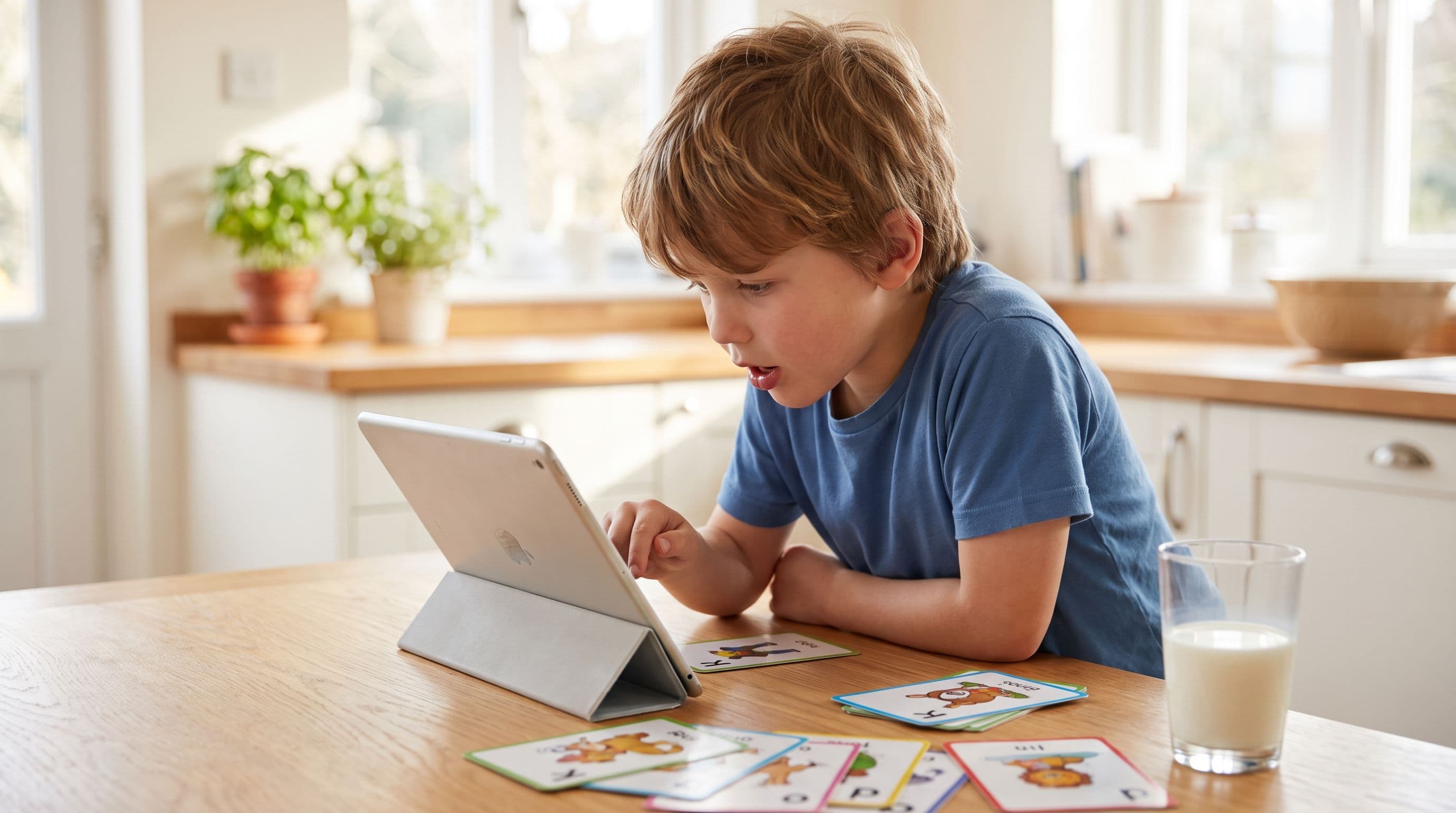
Best Homer Alternative for Kids in 2026: Honest Review + What Actually Works
Homer looks fun, but is it actually teaching your kid to read — or just keeping them busy? Here's my honest breakdown of the best Homer alternatives in 2026, what the reading science actually says about app-based phonics, and the one thing most parents get wrong when choosing a reading app for their preschooler.
Read More →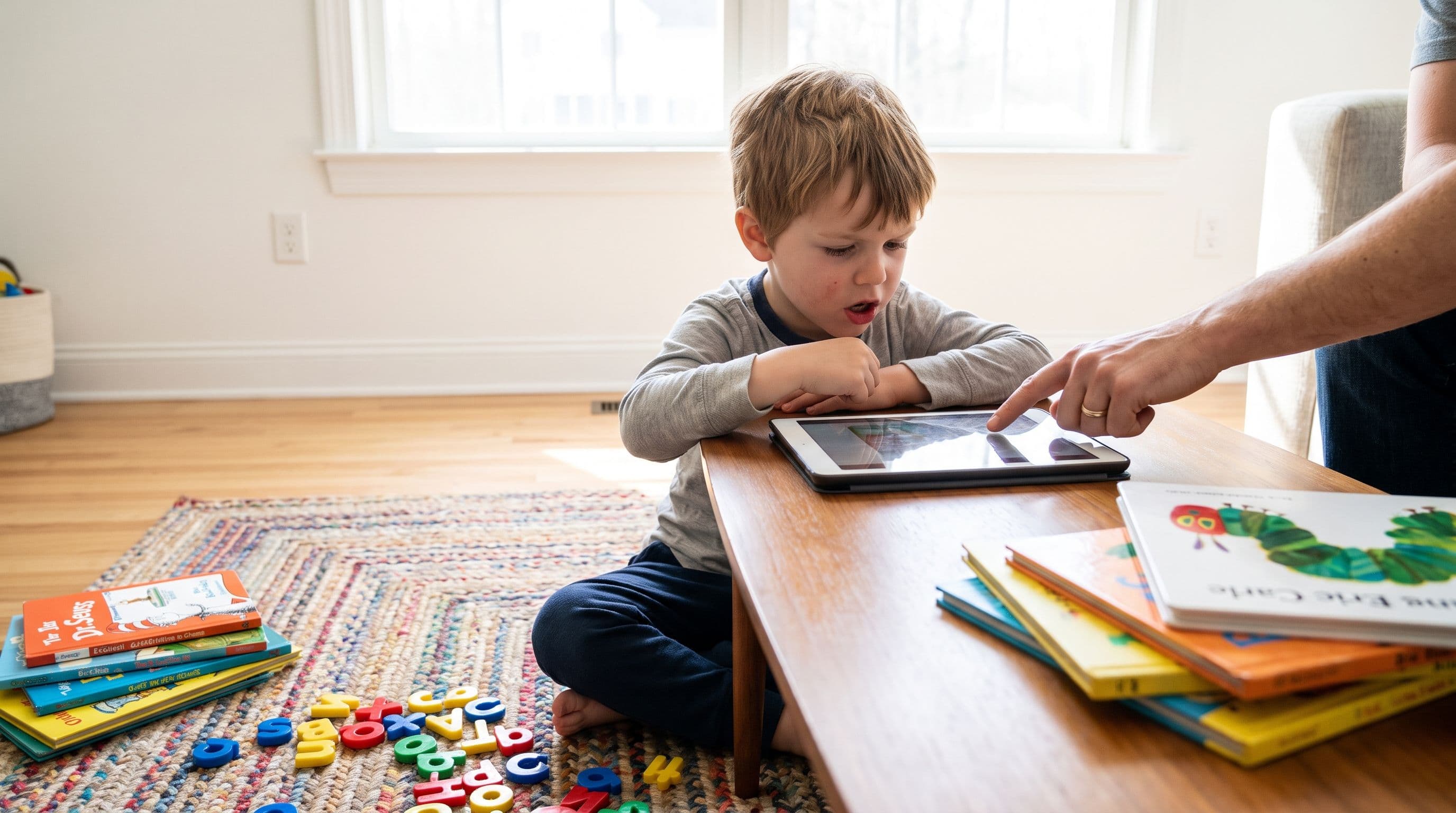
Best Reading App for Kindergartners in 2026 (6 Tested)
Not all kindergarten reading apps are created equal. I tested 6 of the most popular options with my own kids and broke down which ones actually teach phonics — and which ones just keep your child busy while pretending to be educational.
Read More →