Best Homer Alternative for Kids in 2026: Honest Review + What Actually Works
What You'll Learn
- Why Homer's approach misses a critical piece of how kids actually learn to decode words — and what to look for instead
- The one feature 90% of reading apps skip that determines whether your child becomes a real reader or a really good guesser
- How to tell if a reading app uses systematic synthetic phonics vs. dressed-up Whole Language (hint: the pretty graphics aren't the giveaway)
- A concrete, step-by-step plan for choosing — and actually using — a Homer alternative that aligns with reading science in 2026
Let's Be Honest About Homer
Homer isn't a bad app. I need to say that upfront because I'm about to be very direct about its limitations, and I don't want you thinking I'm some tech-hating Luddite yelling at clouds.
Homer (now called Homer Learn & Grow, because apparently every edtech company needs a rebrand every 18 months) is colorful, engaging, and your kid will happily tap away at it for 20 minutes while you make dinner. The animations are cute. The voice acting is solid. The "personalized learning path" sounds impressive on the App Store page.
Here's my problem with it. And it's not small.
Homer mixes a little phonics with a LOT of sight-word memorization, picture-based context guessing, and what I call "edutainment fluff." The app teaches some letter sounds, sure. But its design leans into the kind of strategies the three-cueing system is built on — the same discredited approach that APM Reports' "Sold a Story" investigation by Emily Hanford exposed as the root cause of America's reading crisis. Activities where kids tap the picture that matches a word, choose words that "make sense" in a sentence with image support, or get prompted to use first-letter-plus-picture strategies to identify words — this kind of design functions like three-cueing because it trains meaning-first and picture-first strategies instead of decoding.
Three-cueing tells kids: look at the picture, think about what word would make sense, check the first letter. Sound familiar? That's not reading. That's guessing with training wheels.
I was at a playground in Raleigh last year when another mom told me her son's school had just switched from Lucy Calkins to a Science of Reading [INTERNAL_LINK:what-is-the-science-of-reading] curriculum because of North Carolina's SB 387 — the Excellent Public Schools Act of 2021. She was confused and honestly a little annoyed. "He was doing fine before," she said. I asked if her kid could read the word "splint." He's in second grade. He could not. He stared at it, looked at me, and said "split?" Close — but close only counts in horseshoes and hand grenades, not literacy. I spent 20 minutes on that playground bench explaining why the switch was happening — Hanford's reporting, the NAEP data, the neuroscience from Stanislas Dehaene's lab showing the brain doesn't learn to read naturally. She went home and watched the "Sold a Story" podcast that night. Texted me at 11pm: "I had no idea. Why didn't anyone tell us this sooner?"
That mom's son had been using Homer at home to "supplement" his school reading instruction. Both the school curriculum AND the app were built on the same broken foundation. He wasn't learning to read. He was learning to perform reading.
And that's the problem I want to solve for you today.
The Tiger Truth: What Happens When Your Kid "Reads" but Can't Actually Decode
Let me scare you a little. You need it.
About one-third of 4th graders scored at or above Proficient on the 2022 NAEP 4th-grade reading assessment — that's the Nation's Report Card, not some fringe blog. Compared to 2019, 4th-grade reading scores fell by 3 points, the largest decline in over 30 years. Two out of three kids in this country cannot read at grade level by 4th grade.
Kids who can't read by 3rd grade are four times more likely to drop out of high school. That stat comes from the Annie E. Casey Foundation's "Double Jeopardy" study, and it hasn't gotten better since.
Know what's wild? Many of those struggling readers looked "fine" in kindergarten and first grade. They could "read" simple books. They recognized common words. Their parents thought the apps and the school had it covered.
Then 3rd grade hits. The 3rd Grade Cliff is real.
Suddenly the books have words like "instruction" and "temperature" and "invisible." No pictures to guess from. No pattern to memorize. The kids who were taught to decode — to actually map sounds to letters and blend them — sail through. The kids who were taught to guess? They crash.
In many metro areas, I've seen remedial reading programs run $100–$175 per hour, which adds up to $10,000 to $15,000+ per year for twice-weekly sessions. Insurance doesn't cover it. Waitlists for Orton-Gillingham-based tutors in most metro areas are 6-12 months long. I'm not exaggerating.
So when I say choosing the right reading app matters? I'm not being dramatic. I'm being a mom who refuses to gamble with this.
What a Good Homer Alternative Actually Needs (The Non-Negotiables)
Before I tell you what to use instead, you need to know what to look for. Most "best reading app" lists are just affiliate link farms. They'll recommend anything that pays a commission. I'm going to give you the actual criteria based on reading science [INTERNAL_LINK:what-is-the-science-of-reading].
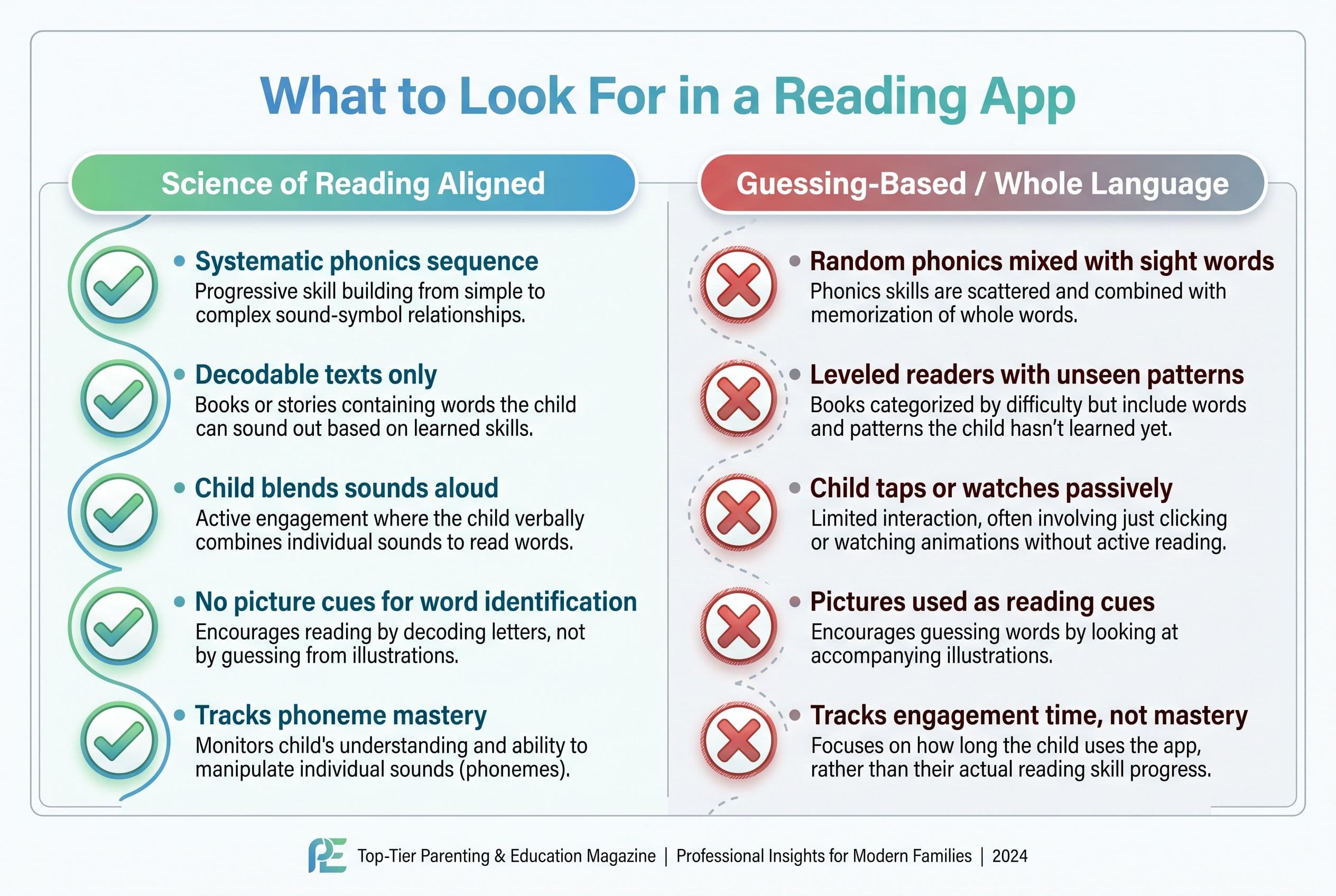
1. Systematic Synthetic Phonics — In Order, With No Skipping
The National Reading Panel report from 2000 — the one Congress actually commissioned — found that systematic phonics instruction produces significant benefits for reading accuracy and comprehension compared to non-systematic or no-phonics approaches. "Systematic" means the app teaches letter-sound correspondences in a planned, sequential order. Not randomly. Not based on what theme the app is doing that week.
Homer introduces some phonics, but it doesn't follow a strict systematic sequence. It bounces between phonics activities, stories, and games in a way that feels fun but lacks the scaffolded progression that Linnea Ehri's phases of word reading development (2005) tell us kids need — moving from pre-alphabetic to partial alphabetic to full alphabetic to consolidated.
2. Decodable Texts — Not Leveled Readers
This one drives me crazy. A good reading app should give your child practice reading texts that use ONLY the letter-sound patterns they've already been taught. These are called decodable readers [INTERNAL_LINK:decodable-books-for-kids].
Homer uses leveled texts — which means the difficulty is based on word frequency and sentence length, NOT on whether the child has actually been taught the phonics patterns in the text. That's a Fountas & Pinnell-style approach, and it's whole-language aligned. It encourages guessing because the child inevitably encounters words with patterns they haven't learned yet.
Look for apps that use decodable texts like those from Flyleaf Publishing or the UFLI Foundations approach.
3. No Picture Guessing
If the app shows a picture of a dog next to the word "dog" and counts it as "reading" when your kid taps it? That's not reading. That's a matching game.
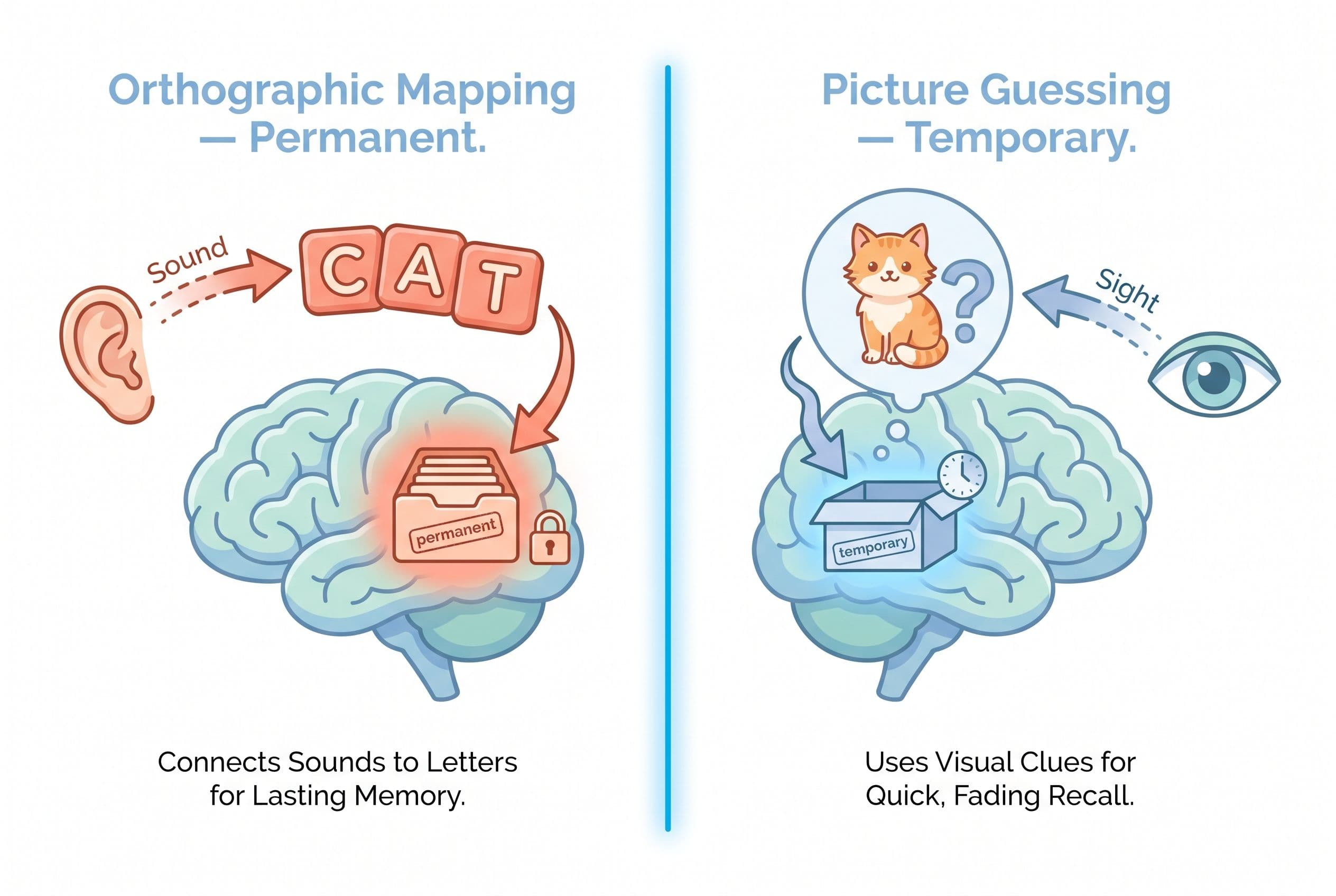
David Kilpatrick's "Equipped for Reading Success" (2016) explains the process of orthographic mapping — how the brain stores words permanently by connecting the sounds in a word to its letter patterns. Picture guessing completely bypasses this process. The word never gets stored. The child just memorized a visual association that will break down the moment there's no picture.
4. Actual Practice — Not Just Watching
A lot of apps, Homer included, have the child watching animations and tapping things. That's passive. Real reading instruction requires the child to actively produce sounds, blend them together, and read words aloud.
The Best Homer Alternatives in 2026 (Honest Reviews)
OK, so here's what I actually recommend. I've used most of these with my own kids, and I've recommended them to hundreds of parents through TeachYourKidToRead.org. I'm going to be honest about the strengths AND weaknesses of each.
Teach Your Kid to Read — The One I Built (Yes, I'm Biased, But Hear Me Out)
I co-founded Teach Your Kid to Read because I couldn't find an app that did ALL four of the non-negotiables I listed above. Every app I tried would nail two or three of them and then blow it on the others.
Teach Your Kid to Read uses systematic synthetic phonics [INTERNAL_LINK:systematic-synthetic-phonics] based on Orton-Gillingham principles. It follows a strict scope and sequence — no skipping, no jumping around based on "engagement algorithms." Every lesson builds on the last.
The app uses decodable texts [INTERNAL_LINK:decodable-books-for-kids] that match exactly what your child has been taught. No picture guessing. The child has to actually sound out and blend every word. There's no way to game it by looking at illustrations.
Real talk — it's not the flashiest app on the market. It doesn't have dancing cartoon animals or a virtual pet you can feed. You know what it has? Results. My 7-year-old reads chapter books independently. My 4-year-old is blending CVC words at the kitchen table. The method works because it respects how the brain actually learns to read — through orthographic mapping, not memorization tricks.
UFLI Foundations (Free, but Not an App)
UFLI Foundations out of the University of Florida is hands down one of the best systematic phonics programs available, and it's free. But here's the kicker — it's not a kid-facing app. It's a teacher/parent-facing curriculum. You have to deliver the lessons yourself.
If you're a homeschooling parent (like me) and you have the time to sit with your child for 15-20 minutes a day and teach from the UFLI manual, this is incredible. The scope and sequence is tight. The decodable texts are excellent.
But if you're looking for something your kid can do somewhat independently — on a tablet during your work call or while you're making dinner — UFLI alone won't cut it. It needs a human instructor.
Explode the Code (App + Workbook)
Explode the Code has been around forever. The workbooks are a staple of homeschooling families, and there's now a digital version. It's systematic, it's phonics-based, and it follows a clear progression.
The downside? The digital version feels dated. It's not terrible, but if your kid has been using slick modern apps, Explode the Code's interface will feel like it's from 2014. Because parts of it are. The content is solid, though. I used the workbooks with my oldest and they're no-nonsense.
Reading Eggs (Popular but Proceed with Caution)
Reading Eggs gets recommended everywhere, and I understand why — it's polished, kids love it, and it does include phonics instruction. But it also includes a significant amount of sight-word memorization and uses leveled readers rather than strictly decodable texts [INTERNAL_LINK:decodable-books-for-kids].
It's better than Homer in terms of phonics coverage, but it still makes compromises I'm not comfortable with. If you use Reading Eggs, supplement it with actual decodable readers and phonemic awareness drills. Don't let it be the whole program.
Bob Books Reading Magic (Good for Beginners, Limited Scope)
Bob Books has a companion app that's cute and phonics-based. Great for the very beginning — letter sounds through simple CVC words. But it runs out of runway fast. Your kid will outgrow it in a few months, and then you'll need something else.
I think of Bob Books as a good appetizer but not a meal.
Homer vs. Teach Your Kid to Read: A Direct Comparison
Since you're specifically looking for a Homer alternative, let me lay this out clearly.
| Feature | Homer | Teach Your Kid to Read |
|---|---|---|
| Systematic phonics sequence | Partial — mixed with other approaches | Yes — strict scope and sequence |
| Decodable texts | No — uses leveled readers | Yes — matched to taught patterns |
| Picture-guessing eliminated | No — images used as reading cues | Yes — no guessing allowed |
| Three-cueing approach | Yes | No |
| Based on Orton-Gillingham principles | No | Yes |
| Child produces sounds/blends actively | Sometimes | Every lesson |
| Fun for kids | High engagement | Engaging but learning-first |
| Aligned with Science of Reading | Partially | Fully |
Look, Homer will keep your kid entertained. Teach Your Kid to Read will teach your kid to read. Those are two different goals, and you need to decide which one you're after.
How to Tell If Your Current App Is Actually Working
Here's a quick gut-check you can do right now. Tonight. Takes 5 minutes.
Grab a piece of paper. Write down 5 CVC words your child has never seen in the app: "hut," "fig," "mop," "wet," "rug." Make sure there are no pictures anywhere near the paper.
Ask your child to read them.
If they can sound out each one — /h/ /ŭ/ /t/ ... "hut!" — your app is doing something right.
If they stare at you blankly, guess wildly, or say "I don't know that one," then your app has been teaching them to recognize familiar words in familiar contexts. Not to read.
For a more rigorous check, Kilpatrick's PAST test (Phonological Awareness Screening Test) takes about 5 minutes and tells you exactly where the phonological breakdown is. You can find it in his book "Equipped for Reading Success." It's free to administer. And it's the most useful 5 minutes you'll spend on your kid's reading development.
Another benchmark worth knowing: DIBELS nonsense word fluency standards say a child should produce 28+ correct letter sounds per minute by mid-kindergarten. If your kid has been using a reading app for 6 months and can't hit that number, the app isn't working. Full stop.
The "But My Kid Loves Homer" Objection
I hear this constantly. "But she loves it! She asks to use it every day!"
Yeah. My kids love gummy bears too. That doesn't make them a food group.
Engagement is not the same as learning. An app can be incredibly engaging while teaching almost nothing useful. Game designers have known this for decades. Variable reward schedules, shiny animations, progress bars that fill up no matter what you do — these are engagement mechanics, not educational ones.
Mark Seidenberg — he's a University of Wisconsin cognitive scientist and author of "Language at the Speed of Sight" (2017) — called out the reading education establishment for prioritizing what feels good over what works. That criticism applies to apps too. Just because your child is smiling at the screen doesn't mean neural pathways for reading are being built.
I'm not saying the app has to be miserable. My kids enjoy Teach Your Kid to Read. But they enjoy it because they feel the satisfaction of actually getting better at something hard. That's a different kind of engagement — the kind that produces readers.
Your Action Plan: Switching from Homer to Something That Works
Here's exactly what I'd do if I were you. Step by step.
Step 1: Assess where your child actually is right now. Use the CVC word test I described above. Better yet, run through Kilpatrick's PAST test. Know the starting point before you pick a tool.
Step 2: Pick one systematic phonics program and commit to it. Don't juggle three apps. Pick one. I'd recommend Teach Your Kid to Read if you want an app your child can use with moderate independence. I'd recommend UFLI Foundations if you're a hands-on homeschooler who wants to teach the lessons yourself.
Step 3: Set a daily schedule and never skip. Tiger Rule #1: We Never Skip. Ten to fifteen minutes a day, every day. Birthdays. Christmas. Vacation. Consistency beats intensity. I had my 4-year-old doing CVC blending drills on the 4th of July last year. Were there fireworks? Yes. Did we also do phonics? Also yes.
Step 4: Ditch the leveled readers and switch to decodable texts [INTERNAL_LINK:decodable-books-for-kids]. If your kid's school sends home Fountas & Pinnell-leveled books, read those for fun as read-alouds — but for independent reading practice, use decodable readers that match their phonics level. Flyleaf Publishing and High Noon Books make good ones.
Step 5: Monitor progress monthly. Re-run your assessment. Track letter sounds per minute. Track the number of CVC words they can decode cold (no pictures, no context). If progress stalls for more than 2-3 weeks, something needs to change — the pacing, the lesson difficulty, or the amount of daily practice.
Step 6: Cut the guessing habit cold turkey. When your child encounters an unfamiliar word and looks up at you, do NOT say "look at the picture" or "what word would make sense?" Say: "Sound it out. What's the first sound? What's the next sound? Now blend them." Tiger Rule #2: No Guessing. This is non-negotiable.
The Bigger Picture: Why This Matters Beyond Your Kid
Over 40 states have passed Science of Reading [INTERNAL_LINK:what-is-the-science-of-reading] legislation since 2019. Mississippi's Literacy-Based Promotion Act of 2013 led to some of the largest NAEP 4th-grade reading gains of any state over the following six years. That's not a coincidence. It's proof that systematic phonics works at scale.
But here's what I need you to understand: schools are still catching up. Many districts are mid-transition. Some teachers are still using Balanced Literacy because they haven't been retrained yet. Your child's teacher might be amazing and still be using a curriculum that contradicts the reading science. It's not their fault — they were taught wrong too.
That's why what happens at home matters so much. You can't outsource this to an app that looks good but teaches guessing. You can't wait for the school to fix it. The 3rd Grade Cliff doesn't wait.
You've got maybe 2-3 years to build the foundation. Use them.
Frequently Asked Questions
Is Homer a bad app?
Homer isn't terrible — it's just not sufficient for teaching a child to actually decode text. It mixes some phonics with sight-word memorization and picture-based guessing, which contradicts what the Science of Reading [INTERNAL_LINK:what-is-the-science-of-reading] tells us about how the brain learns to map sounds to letters. If your child uses Homer for fun and you supplement with a systematic synthetic phonics program, that's fine. But Homer alone won't build a strong reader.
What age is best to start a reading app?
Most kids can begin learning letter sounds around age 3-4 and start blending simple CVC words (cat, sit, mop) by age 4-5. The key isn't a specific birthday — it's phonological awareness readiness. Can your child hear and produce individual sounds in words? Can they rhyme? Can they clap out syllables? If yes, they're ready for a systematic phonics app. Don't wait for kindergarten. The "wait and see" approach is how kids fall behind.
How much screen time should my kid spend on a reading app?
Ten to fifteen minutes of focused, systematic phonics instruction per day is enough for most preschoolers and kindergarteners. That's a real lesson — not 15 minutes of tapping animations. The American Academy of Pediatrics distinguishes between passive screen time (watching videos) and active, educational screen time. A well-designed phonics app that requires the child to produce sounds and decode words falls into the active category. Keep sessions short, consistent, and daily.
Can a reading app replace a reading tutor?
For most kids — especially those without learning disabilities like dyslexia — a good systematic phonics app combined with 10-15 minutes of daily parent involvement can absolutely build strong reading skills without a tutor. However, if your child shows signs of dyslexia or has been struggling despite consistent phonics instruction, you should seek an evaluation and consider an Orton-Gillingham-based program like the Wilson Reading System or Barton Reading & Spelling with a trained specialist. About 5-10% of children have a neurological difference that requires specialized, intensive intervention beyond what any app can provide.
How do I know if my child is actually learning to read vs. just memorizing?
The gold standard test: write a nonsense word — like "blim" or "frop" — and ask your child to read it. A child who has learned to decode will sound it out successfully because the process works on any combination of letters. A child who has only memorized whole words will be stuck. This is exactly what the DIBELS Nonsense Word Fluency assessment measures in schools, and you can replicate the concept at home in 30 seconds.

Xia Brody
Co-Founder, Teach Your Kid to Read
Mom of 4 who has successfully taught her kids to read. Currently in the trenches with her 4-year-old while her two oldest (10 and 7) devour books on their own. Passionate about phonics-based methods and building a lifelong love of reading.
Related Articles
Best Phonics App for Kindergarten: 6 Tested & Ranked (2026)
Most 'phonics apps' for kindergarten aren't teaching phonics at all — they're digital guessing games with pretty animations. I tested 6 of the most popular learn-to-read apps with my own kids and broke down exactly which ones use real systematic phonics and which are wasting your child's time.
Read More →
Best Reading App for 5-Year-Olds: 6 Tested in 2026 (Honest Reviews)
Most 'reading' apps for 5-year-olds are glorified games that teach kids to guess, not read. I tested 6 popular apps against the Science of Reading and ranked them by what actually matters: systematic phonics, decodable text, and zero guessing. Here's what I found.
Read More →
Best Reading App for Kids with Dyslexia (2026): 7 Options Reviewed
Most 'reading apps' for kids are glorified guessing games that make dyslexia worse. Here's what actually works in 2026 — apps built on Orton-Gillingham principles and systematic synthetic phonics — and how to tell the difference before you waste months.
Read More →