ABCmouse vs Reading Eggs for 4-Year-Olds: 2026 Honest Breakdown
What You'll Learn
- The single biggest red flag that tells you a reading app is wasting your child's time — and how to spot it in under 60 seconds
- How ABCmouse and Reading Eggs actually stack up on the thing that matters most: systematic, sequential phonics instruction
- Why neither app alone will teach your 4-year-old to read — and what the research says you need to pair with any digital tool
- The free assessment that tells you exactly where your child's phonemic awareness skills stand right now (most parents have never heard of it)
Let's Get Real About Reading Apps
Your 4-year-old is tapping a glowing screen. Animated characters are dancing. Stars are exploding. Your kid is giggling.
And you're thinking: Is this actually teaching them anything?
Look, I get it. I've got four kids — ages 10, 7, 4, and 1 — and I've been through this exact internal debate more times than I want to admit. When my oldest was 4, every mom in my homeschool co-op was raving about ABCmouse, and a friend swore Reading Eggs was "more academic." I wanted to believe that 20 minutes of app time could count as a phonics lesson.
Here's the thing: most reading apps are dressed-up entertainment with a thin phonics veneer. They'll teach your kid to tap the right button. They won't teach your kid to decode the word "splint."
And that distinction? It's the whole ballgame.
The Tiger Truth: What Happens When Apps Replace Real Instruction
I need you to hear this part, because it's the part nobody selling you a $9.99/month subscription wants to say out loud.
Only about 33% of 4th graders in America scored at or above the Proficient level on the 2022 NAEP — the Nation's Report Card. Now, "Proficient" on NAEP is a rigorous benchmark — it doesn't mean "can't read at all" — but it does mean that roughly two-thirds of our kids aren't reading at the level the NAEP board considers solid, competent reading. The 2022 results showed average reading scores dropped 3 points from 2019, one of the largest declines in the assessment's history.
That should scare you.
And here's the kicker: research from the Annie E. Casey Foundation's 2010 report found a strong association between not reading proficiently by the end of 3rd grade and dropping out of high school — kids who couldn't read well were four times more likely to leave school without a diploma. Correlation isn't the whole story, but the pattern is consistent enough that every parent should pay attention.
So when I say that choosing the wrong reading approach at age 4 has real consequences, I'm not being dramatic. I'm being specific. A child who spends ages 3-5 "playing" reading games that rely on picture guessing, memorization, and zero systematic phonics arrives at kindergarten behind. And catching up isn't cheap — in many metro areas, twice-a-week sessions with private tutors using programs like Barton Reading & Spelling or Lindamood-Bell can easily run to thousands of dollars a year, depending on where you live and how intensive the program is. And the school's reading intervention probably isn't enough on its own.
The "Wait and See" approach is a lie. The "It's just an app, how much harm can it do?" approach is also a lie. If the app is actively training your child to guess at words from context and pictures instead of decoding letter by letter, it's doing harm.
Real talk — I was at a playground in Raleigh last year when another mom told me her kid's school had just switched from Lucy Calkins to a Science of Reading curriculum because of North Carolina's SB 387, the Excellent Public Schools Act. She was confused and honestly kind of annoyed. "He was doing fine before," she said. I asked if her son could read the word "splint." He's in second grade. He could not. He looked at the word, looked at me, and guessed "split." Close — but not reading. That's pattern-guessing, not decoding.
I spent 20 minutes on that playground bench explaining why the switch was happening — Emily Hanford's "Sold a Story" investigation through APM Reports, the NAEP data, the neuroscience from Stanislas Dehaene's lab showing the brain doesn't learn to read naturally. She went home and watched the "Sold a Story" podcast that night. Texted me at 11pm: "I had no idea. Why didn't anyone tell us this sooner?"
Nobody told her because reading apps and flashy curricula have great marketing. The science? Not so much.
So with that context — let's actually compare ABCmouse and Reading Eggs.
ABCmouse: The Full Breakdown
What It Is
ABCmouse (by Age of Learning) is a broad early-learning platform covering reading, math, science, art — you name it. It's massive. Over 10,000 activities. Aimed at ages 2-8.
What It Gets Right
ABCmouse does include phonics content. Letter recognition, letter sounds, some blending activities. It has a "Step-by-Step Learning Path" that sequences content in a logical order. For letter recognition specifically — learning that the squiggly shape B says /b/ — it's decent. Colorful and engaging.
The breadth of content means your child can also explore science, math, and art, which is genuinely nice. It's a one-stop shop for early learning entertainment.
What It Gets Wrong
Here's where I get pointed.
ABCmouse's phonics instruction doesn't look like systematic synthetic phonics. It doesn't follow the Orton-Gillingham scope and sequence that the Science of Reading research supports. What it offers instead is a mix of phonics with whole-language strategies — activities where kids can tap the word matching a picture without sounding it out, leveled readers with words the child hasn't been taught to decode, and high-frequency words presented as shapes to memorize rather than patterns to decode. That's exactly the kind of approach that the National Reading Panel flagged back in 2000 when Congress commissioned them to figure out how kids actually learn to read.
The NRP's conclusion was unambiguous: systematic phonics instruction produces significant benefits over non-systematic or no-phonics approaches. ABCmouse's phonics isn't systematic enough. It's scattered across thousands of activities, and there's no mechanism to ensure your child masters one grapheme-phoneme correspondence before moving to the next.
Here's the risk: a child can "complete" an ABCmouse phonics lesson, earn stars and tickets, and still be unable to blend when you hand her a decodable reader — seeing "sat" and guessing "sit" because a picture showed someone sitting. An app that rewards picture-matching trains a child to look for context clues instead of sounding out.
That's a problem. A big one.
The Bottom Line on ABCmouse
ABCmouse is a solid entertainment and enrichment app. It is not a reading program. If you use it, treat it like educational TV — fine in moderation, but it's not teaching your kid to read.
Reading Eggs: The Full Breakdown
What It Is
Reading Eggs (by Blake eLearning, an Australian company) is a reading-focused app aimed at ages 2-13. It's narrower than ABCmouse — it's designed specifically around literacy. The preschool section is called "Reading Eggs Junior," and the core program covers the equivalent of pre-K through about 2nd grade reading skills.
What It Gets Right
Reading Eggs is closer to systematic phonics than ABCmouse. I'll give it that. It teaches letter-sound correspondences in a mostly sequential order. It includes blending practice. It has built-in assessment checkpoints that prevent kids from skipping ahead until they demonstrate mastery. That's huge — mastery-based progression is exactly what you want.
The decodable books inside Reading Eggs are actually decodable. That means they use only the letter-sound patterns the child has already been taught. This is the right approach. UFLI Foundations and Fundations work the same way — controlled text that matches the child's phonics knowledge.
Reading Eggs also includes phonemic awareness activities — segmenting, blending, rhyming — which is the foundation beneath phonics. David Kilpatrick's research in Equipped for Reading Success (2016) makes it crystal clear: without strong phonemic awareness, phonics instruction can't stick. Orthographic mapping — the process by which the brain permanently stores words — requires phonemic proficiency. Reading Eggs at least acknowledges this.
What It Gets Wrong
OK so here's where it falls short.
Reading Eggs still leans on some whole-language strategies. The "sight word" eggs teach high-frequency words as memorized wholes, without breaking them into decodable parts. Words like "said" and "was" get taught as "just memorize this" — but the Science of Reading tells us that even irregular words should be taught through their regular parts first. In the word "said," the /s/ and /d/ are perfectly regular. Only the /ai/ → /ɛ/ is irregular. You teach the regular parts and flag the "tricky" part. Reading Eggs doesn't consistently do this.
The gamification can also overwhelm the instruction. A 4-year-old can get so focused on the rewards that she stops paying attention to the actual phonics content — tapping for rewards, not for reading. That means sitting next to her and redirecting — which kind of defeats the purpose of an "independent" app.
And here's the real deal: the app doesn't teach handwriting. There's no pencil-to-paper letter formation. Louisa Moats' 1999 paper "Teaching Reading IS Rocket Science" for the American Federation of Teachers stressed that reading and writing are intertwined processes. Encoding (spelling/writing) reinforces decoding (reading). An app that only asks kids to tap a screen is missing half the equation.
The Bottom Line on Reading Eggs
Reading Eggs is the better reading app of the two. It's closer to evidence-based phonics instruction, it uses decodable texts, and it includes phonemic awareness activities. But it's still an app. It still has whole-language elements. And it cannot replace explicit, teacher-led (or parent-led) phonics instruction.
Head-to-Head: ABCmouse vs Reading Eggs for Your 4-Year-Old
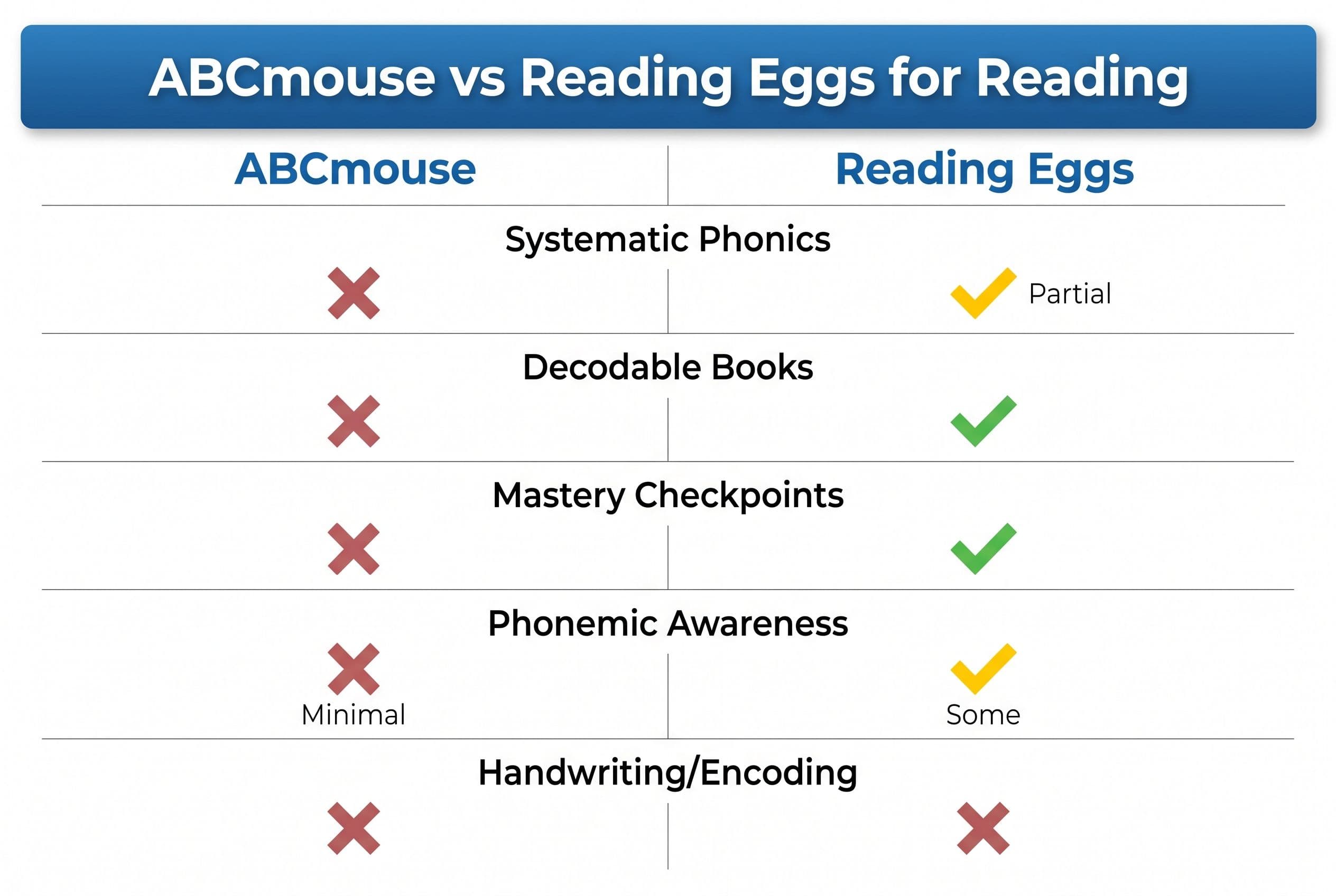
Let me break this down on the things that actually matter for reading.
Systematic Phonics Scope & Sequence
- ABCmouse: Weak. Phonics is scattered, non-sequential, mixed with whole-language.
- Reading Eggs: Moderate. More sequential, but still includes memorize-the-whole-word strategies.
Phonemic Awareness Training
- ABCmouse: Minimal. Some rhyming games.
- Reading Eggs: Better. Includes segmenting, blending, and some manipulation tasks.
Decodable Text
- ABCmouse: No. Uses leveled readers that include undecodable words.
- Reading Eggs: Yes. Built-in decodable books that match the phonics sequence.
Mastery-Based Progression
- ABCmouse: No. Kids can skip around the learning path.
- Reading Eggs: Yes. Must pass checkpoints to advance.
Handwriting / Encoding
- ABCmouse: Letter tracing on screen (limited value).
- Reading Eggs: Minimal letter tracing. No real encoding.
Breadth of Content Beyond Reading
- ABCmouse: Massive — math, science, art, social studies.
- Reading Eggs: Narrow — focused on literacy. Has a math companion app (Mathseeds).
Price
- ABCmouse: Check the ABCmouse site for current pricing.
- Reading Eggs: $13.99/month or $99.99/year (Reading & Math plan) as of October 2026.
So what's my pick?
If you're only choosing between these two for reading instruction, Reading Eggs wins. It's not even close on the phonics fundamentals. But — and this is a giant but — neither app is sufficient as your child's primary reading instruction.
Why No App Can Teach Your 4-Year-Old to Read Alone
I know that's not what you wanted to hear. Trust me, I wish it were different. With four kids under 11, I would love to hand my 4-year-old a tablet and have her emerge reading chapter books.
But the research is clear. The Simple View of Reading (Gough & Tunmer, 1986) tells us that reading comprehension = decoding × language comprehension. An app can work on the decoding piece — imperfectly — but language comprehension requires conversation, vocabulary exposure, read-alouds, and back-and-forth dialogue. That doesn't happen through a screen.
Mark Seidenberg, the University of Wisconsin cognitive scientist who wrote Language at the Speed of Sight (2017), called out the entire reading education establishment for relying on approaches that don't align with how the brain actually processes text. His critique applies to apps too. Tapping a screen is not the same neurological process as blending sounds with your mouth, writing letters with your hand, and building words with physical tiles.
The 40+ states that have passed Science of Reading legislation since 2019 haven't gotten their results from apps. Take Mississippi: after passing the Literacy-Based Promotion Act in 2013, the state's 4th-grade NAEP reading rankings climbed dramatically — from near the bottom to around 21st by 2019. Now, that wasn't just one thing. It was a combination of explicit phonics instruction, decodable texts, teacher coaching, ongoing assessment, and yes, a retention policy. But the throughline was clear: systematic, human-led instruction made the difference. Not screens.
Your 4-year-old needs a human being sitting next to them. That's you.
The Teach Your Kid to Read Approach: What Actually Works
Here's what I do with my 4-year-old, and here's what we built Teach Your Kid to Read to help you do.
Step 1: Assess Where Your Child Is Right Now
Before you download any app or buy any curriculum, you need a baseline. Kilpatrick's PAST (Phonological Awareness Screening Test) is a quick screening you can administer at home with a guide — it focuses specifically on phonemic awareness skills like blending, segmenting, and manipulating sounds. It takes about 5 minutes and tells you exactly where the breakdown is. Does your child hear individual sounds in words? Can they blend /c/ /a/ /t/ into "cat" when you say the sounds aloud? If not, you don't start with phonics — you start with phonemic awareness.
DIBELS benchmarks say 28+ correct letter sounds per minute by mid-kindergarten. If your 4-year-old is pre-K, the target is lower — but you should know roughly how many letter-sounds they've mastered.
Step 2: Use Systematic Synthetic Phonics — Every Single Day
Teach Your Kid to Read follows Orton-Gillingham principles: explicit, sequential, multisensory, and mastery-based. That means your child learns one grapheme-phoneme correspondence at a time, practices it with blending, segmenting, AND encoding (writing), and doesn't move on until they've nailed it.
Our program pairs with you — the parent — as the teacher. Not a cartoon character. Not an algorithm. You.
We keep sessions to 15-20 minutes. That's it. My Tiger Rule is "We Never Skip" — we do phonics on birthdays, on Christmas morning (after presents, I'm not a monster), and on vacation. Consistency beats duration every time.
Step 3: Use Decodable Readers — Not Leveled Readers
This is where ABCmouse falls apart completely. Leveled readers (like the Fountas & Pinnell system) throw words at kids that they haven't been taught to decode, which trains guessing. Decodable readers from publishers like Flyleaf Publishing or High Noon Books only use the patterns your child has mastered.
Teach Your Kid to Read includes decodable texts matched to each lesson. When my 4-year-old reads "Sam sat" after learning /s/, /a/, /m/, /t/ — she's actually reading. Not guessing. Not looking at the picture of Sam sitting. Reading.
My other Tiger Rule: "No Guessing." If my daughter looks at the picture for clues, I cover the picture. Sound it out. Every time.
Step 4: If You Use an App, Use It as a Supplement — Never the Main Course
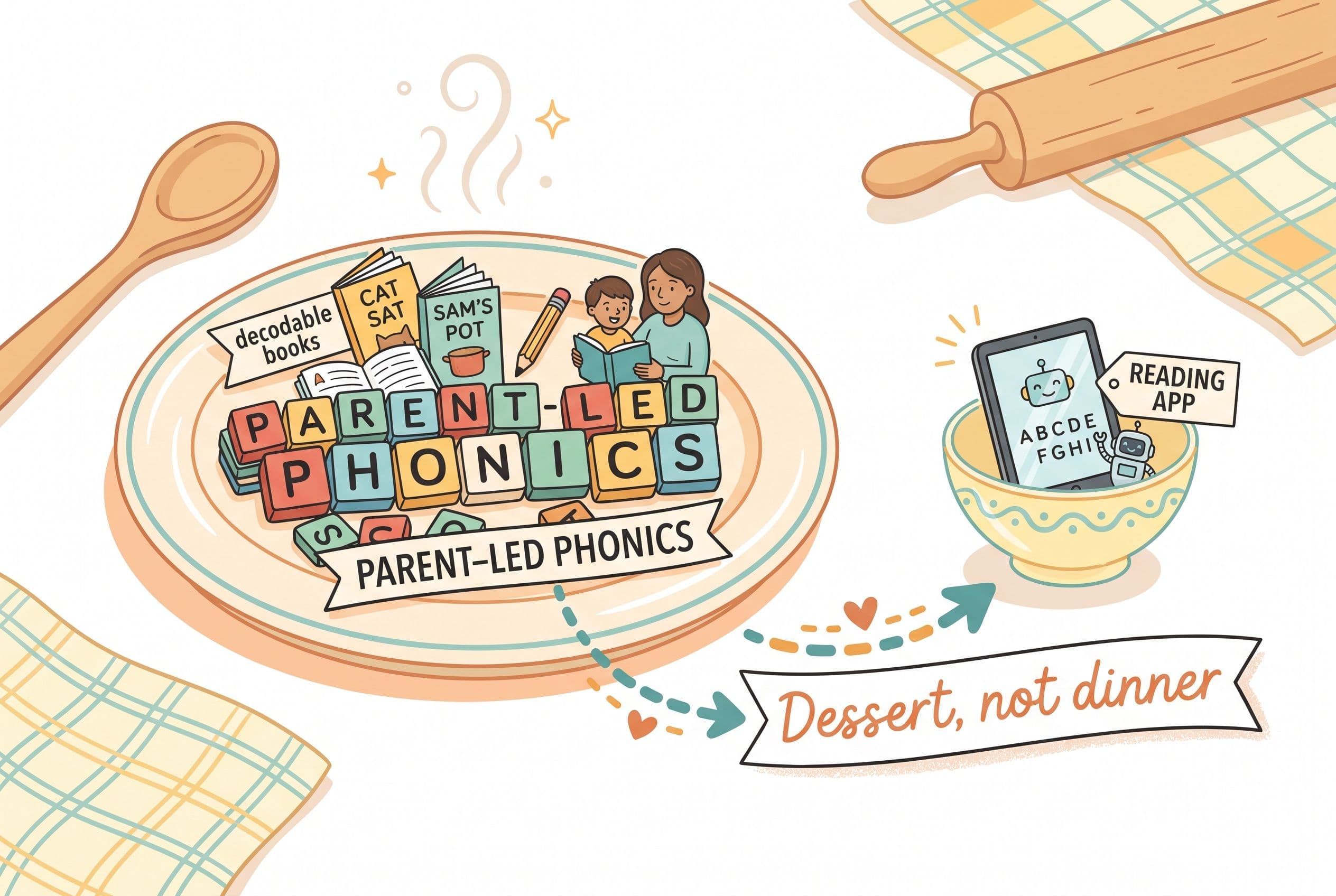
Can Reading Eggs reinforce what you're teaching? Sure. It's like phonics dessert after the real meal. Let your kid play it for 10-15 minutes after their actual lesson. But don't confuse the dessert for dinner.
ABCmouse? Keep it for math and science exploration. Don't count it as reading instruction.
A Note on the "Best Reading App for 4-Year-Olds" Question
I get this question constantly. At co-op meetups, in DMs, at the grocery store (yes, really — homeschool moms recognize each other). "What's the best reading app?"
And honestly? The best reading app for your 4-year-old is you, sitting at the kitchen table with letter tiles and a decodable reader. That's not a cute answer. That's what Linnea Ehri's phases of word reading development (2005 meta-analysis) tell us: children move from pre-alphabetic to partial alphabetic to full alphabetic to consolidated alphabetic through explicit instruction and practice with connected text. An app can nudge them along. It can't drive the car.
Teach Your Kid to Read was built to put you in the driver's seat with a clear map. Every lesson is scripted. Every step is sequenced. You don't need a teaching degree. You need 15 minutes and the willingness to show up every day.
Frequently Asked Questions
Is ABCmouse or Reading Eggs better for a 4-year-old who doesn't know any letters yet?
If your child doesn't know any letters, start with letter-sound instruction — not letter-name instruction. Reading Eggs does a slightly better job of connecting letters to their sounds early on, but neither app starts where the Science of Reading says to start: phonemic awareness without letters. Before your child touches either app, spend a week or two doing oral blending and segmenting games. Say "What word do these sounds make: /d/ /o/ /g/?" That's the foundation. Teach Your Kid to Read builds this into the first lessons.
Can I use ABCmouse and Reading Eggs together?
You can, but be strategic. Use Reading Eggs for its phonics lessons and decodable books. Use ABCmouse for math, art, and science enrichment. Don't use both for reading — their approaches partially conflict (ABCmouse encourages guessing strategies that Reading Eggs' phonics tries to avoid). Total screen time should still stay under 30 minutes for a 4-year-old. The American Academy of Pediatrics recommends limiting screen time to 1 hour for ages 2-5, and that includes everything — not just educational apps.
My 4-year-old loves ABCmouse and hates being corrected. How do I switch to real phonics without a meltdown?
The trick is to keep the first few phonics sessions absurdly short — 5 minutes — and absurdly successful. Start with sounds your child already knows. If they know the letter S says /s/, start there. Build one CVC word: "sat." Let them blend it. Celebrate like they just won the Super Bowl. Then stop. Leave them wanting more. Over a week, extend to 10 minutes, then 15. The app becomes the reward after the real lesson, not the lesson itself.
How do I know if my 4-year-old is actually learning to read from these apps?
Test them with a word they haven't seen in the app. Write "rug" on a piece of paper — no pictures, no context, no hints. Can they sound it out? /r/ /ŭ/ /g/. Rug. If yes, they're decoding. If they stare blankly or guess "run" because it starts with R, the app isn't doing what you think it's doing. The Kilpatrick PAST test will also tell you if their phonemic awareness is developing — which is the deeper skill beneath phonics.
Is Teach Your Kid to Read an app too?
Teach Your Kid to Read is a parent-led program. It gives you the lesson scripts, the sequence, and the decodable practice materials. You're the teacher. That's by design. The research from the NICHD by Reid Lyon — who testified before Congress that 38% of fourth graders can't read at a basic level — makes it clear that responsive, human-led instruction outperforms automated delivery for beginning readers. Your child needs someone who notices when they confuse /b/ and /d/, who can slow down on tricky blends, who can say "try again" with a hug instead of a buzzer sound. That's you. And we give you everything you need to do it right.
Ready to stop guessing about whether an app is teaching your child to read? Teach Your Kid to Read gives you the research-backed plan, the daily lesson scripts, and the confidence to teach your 4-year-old yourself. Visit start lesson one free or call (407) 707-6850 to get started today.
Part of these guides

Xia Brody
Co-Founder, Teach Your Kid to Read
Mom of 4 who has successfully taught her kids to read. Currently in the trenches with her 4-year-old while her two oldest (10 and 7) devour books on their own. Passionate about phonics-based methods and building a lifelong love of reading.
Related Articles
Reading Eggs vs ABCmouse for 5-Year-Olds: Best Pick
Choosing between Reading Eggs and ABCmouse? Here’s the no-fluff mom verdict on which app actually teaches a 5-year-old to read — and where both fall short.
Read More →
ABCmouse vs Reading Eggs for 7-Year-Olds: Best Fit?
Choosing between ABCmouse and Reading Eggs for a 7-year-old? Here’s the no-fluff parent breakdown: who each app fits, where they fall short, and what I’d use first for a struggling reader.
Read More →
HOMER vs Reading Eggs for 6-Year-Olds: Best Fit?
Choosing between HOMER and Reading Eggs for a 6-year-old? Here’s the no-nonsense parent breakdown: which app teaches decoding, which one fits which child, and where Teach Your Kid to Read beats both for focused phonics.
Read More →