ABCmouse vs Khan Academy Kids for Reading: 2026 Side-by-Side Comparison

What You'll Learn
- Why the most popular reading apps skip the most important part of phonics — and the one red flag to watch for in any app your kid uses
- The real difference between ABCmouse and Khan Academy Kids when it comes to systematic, sequential phonics (spoiler: one is significantly better, and it's the free one)
- What happened when an 18-year veteran teacher ditched her guessing-based curriculum mid-year — and how it connects to what these apps do (and don't do)
- The specific daily routine I use with my 4-year-old that combines the best of app-based learning with the phonics drill that actually moves the needle
The Uncomfortable Truth About Reading Apps
Let me save you some time. Neither ABCmouse nor Khan Academy Kids will teach your child to read.
I know that's not what you want to hear. You downloaded this article hoping I'd tell you which paid subscription or free app to park your 4-year-old in front of so they'd emerge reading chapter books. I get it. I have four kids. I desperately want easy answers too.
But here's what I've learned from teaching two kids to read and being in the thick of it with my third: apps are supplements. They're the multivitamin, not the meal. And if you're choosing between these two apps as your child's primary reading instruction? You're building a house on sand.
That said — supplements matter. A good app reinforces what you're teaching. A bad app actively undermines it by teaching your kid to guess at words instead of decode them. And that's where ABCmouse and Khan Academy Kids diverge in ways most parents never notice.

The "Is This Even Phonics?" Problem
Before I break down each app, you need to understand the single most important thing about reading instruction in 2026: the method matters more than the medium.
Stanislas Dehaene — a French neuroscientist who literally mapped what happens in the brain when we learn to read — argued convincingly in his 2009 book Reading in the Brain, based on brain-imaging and cognitive research, that the brain has to be systematically trained to connect letters with sounds. Reading doesn't happen naturally like speech does. It's a code, and your kid needs explicit instruction to crack it.
The National Reading Panel said the same thing back in 2000 — the report Congress actually commissioned — and found that systematic phonics instruction produces significant benefits over non-systematic or no-phonics approaches. That was 26 years ago. And yet most apps (and most classrooms, honestly) still use methods that rely on memorization, picture cues, and guessing.
So when I evaluate ABCmouse vs Khan Academy Kids, I'm not asking "which one has cuter animations." I'm asking: does this app teach grapheme-phoneme correspondence in a systematic, sequential order, or is it just dressed-up guessing?
ABCmouse: The Good, the Bad, and the Subscription Fee
What ABCmouse Gets Right
ABCmouse (by Age of Learning) is massive. We're talking 10,000+ activities covering reading, math, science, art — you name it. The reading curriculum has a clear "Learning Path" that sequences content from letter recognition through early readers. I'll give credit where it's due:
- Letter recognition activities are solid. The songs are catchy (annoyingly catchy — you'll be singing the letter P song in the shower), and there's enough variety that kids don't get bored.
- It introduces letter sounds, not just letter names, which is better than a lot of competitors.
- The motivational system is strong. Tickets, rewards, virtual pets — it's built to make kids want to come back, which, hey, beats begging for YouTube.
What ABCmouse Gets Wrong
Here's where I get fired up.
ABCmouse introduces phonics concepts, but it doesn't drill them with the kind of systematic intensity that actually builds decoding skills. The activities bounce around. One minute your kid is tracing the letter B, the next they're doing a jigsaw puzzle, then they're coloring a picture of a bear. It feels educational. But it's scattered.
The bigger problem? The early reading books inside ABCmouse lean heavily on predictable text patterns and picture cues. You know the type: "I see a cat. I see a dog. I see a bird." The kid memorizes the pattern, glances at the picture, and "reads" the sentence without decoding a single word.
This is the exact guessing strategy that APM Reports' "Sold a Story" investigation exposed in 2023. Emily Hanford documented how decades of Balanced Literacy and three-cueing (MSV) instruction taught millions of kids to look at pictures and guess instead of sound out words.
I saw this play out in real life, too. After that investigation came out, my neighbor — a first-grade teacher for 18 years — called me almost in tears. She'd been using Lucy Calkins' Units of Study curriculum her entire career. Three-cueing, MSV, the whole system. She told me, "I've been teaching kids to guess for two decades and I didn't even know it."
She switched her classroom to UFLI Foundations mid-year. It was a mess at first — she had to relearn everything herself before she could teach it. But by spring, her kids' NWF scores had jumped noticeably per her DIBELS progress monitoring. She told me that was the first time in her career where every single kid in her class could decode CVC words by February.
That story sticks with me every time I evaluate a reading app. If a trained teacher with 18 years of experience can accidentally teach kids to guess, imagine what an app can do when the underlying method is wrong.
ABCmouse isn't as bad as Lucy Calkins. But it's not UFLI Foundations either. It lives in a mushy middle ground where phonics is present but not systematic, and guessing strategies sneak in through the reading materials.
The Cost Factor
ABCmouse is a paid subscription — check the ABCmouse site for current pricing. For what you get — thousands of activities across all subjects — that's honestly not a bad value as a general enrichment tool. But as reading instruction? You're paying for edutainment, not evidence-based phonics.
Khan Academy Kids: The Free Option That Surprised Me
What Khan Academy Kids Gets Right
OK so here's where I eat some humble pie. When my oldest was little, I dismissed Khan Academy Kids as "the free one that can't possibly be as good." I was wrong.
Khan Academy Kids is 100% free. No ads. No in-app purchases. No premium tier. It's funded by donors, which means your kid isn't the product. That alone makes it worth a look.
But here's what actually impressed me when I looked closely at it:
- The phonics sequence is significantly more systematic than ABCmouse. It teaches letter sounds in a deliberate order, introduces blending early, and uses decodable content that matches what the child has actually learned.
- It explicitly teaches blending. There are activities where the app sounds out C-A-T and then blends it together, modeling exactly what you want your kid to do independently. ABCmouse does some of this, but Khan does it more consistently.
- Phonological awareness activities are built in. Rhyming, syllable counting, initial sound isolation — these pre-reading skills get dedicated screen time.
- The Books section uses some decodable readers, not just predictable text. The kid has to actually use the letter sounds they've learned to read the words. That's a big deal.
What Khan Academy Kids Gets Wrong
It's not perfect. Not even close.
The app still mixes in sight word memorization without enough phonetic grounding. Words like "the" and "said" get introduced as whole units to memorize, which — look, some high-frequency words do need to be taught as irregular, but a good phonics program (like Orton-Gillingham-inspired approaches) teaches the regular parts of those words first and only asks kids to memorize the truly irregular part.
Also, there's no mastery check. Khan Academy Kids moves your child forward on the learning path whether they've actually mastered the previous skill or not. In my house, we don't move on until you've got it. That's a Tiger Rule. The app doesn't enforce that, so you have to.
And the reading instruction, while better than ABCmouse's, still isn't as rigorous or systematic as a dedicated phonics program. It doesn't follow a structured literacy-style scope and sequence — explicit, cumulative, mastery-based — like you'd see in programs such as UFLI, Logic of English, Fundations, or OG-inspired lessons. It doesn't drill to automaticity. It doesn't build orthographic mapping the way David Kilpatrick describes in Equipped for Reading Success (2016) — that process where repeated accurate decoding permanently stores words in long-term memory.

Head-to-Head: ABCmouse vs Khan Academy Kids for Reading
Let me lay this out clearly.
| Feature | ABCmouse | Khan Academy Kids |
|---|---|---|
| Cost | Subscription (check site) | Free (no ads, no purchases) |
| Phonics approach | Present but scattered | More systematic, better sequencing |
| Blending instruction | Minimal | Explicitly taught |
| Decodable readers | Few — relies on predictable text | Some decodable content |
| Phonological awareness | Light coverage | Dedicated activities |
| Mastery gates | No (auto-advances) | No (auto-advances) |
| Scope beyond reading | Huge (math, science, art) | Broad (math, social-emotional, reading) |
| Guessing risk | Higher — picture cues in readers | Lower — but still present |
| Age range | 2-8 | 2-8 |
Bottom line: If you're choosing strictly between these two for reading, Khan Academy Kids is the better option. It's more phonics-aligned, more sequential, and it's free. That's pretty hard to argue with.
But — and this is the kicker — "better" doesn't mean "good enough."
Khan Academy Kids is the best free general-purpose preschool app available in 2026. I'll say that without hesitation. But it's still not a systematic phonics program. Comparing it to something like UFLI Foundations, Fundations, or Logic of English is like comparing a hotel gym to an actual training facility. One will keep you from getting worse. The other will make you strong.
What Actually Teaches a Kid to Read
Real talk — I've taught two kids to read and I'm deep in it with my third right now. Here's what I know works, based on the research and based on watching it happen at my kitchen table.
Systematic synthetic phonics. That means teaching letter-sound correspondences in a specific order, teaching blending from the start, and practicing with decodable text that only includes the sounds the child has mastered. That's what the science says. That's what the National Reading Panel confirmed. That's what the Clackmannanshire study out of Scotland (Johnston & Watson, 2005) demonstrated over 7 years of data — synthetic phonics kids outperformed analytic phonics kids in reading, spelling, and comprehension.
Neither ABCmouse nor Khan Academy Kids delivers that full package. Both apps give your kid some phonics exposure, but neither one follows a systematic scope and sequence with mastery-based progression and true decodable readers.
That's why I built my approach around [INTERNAL_LINK:Teach Your Kid to Read|teach-your-kid-to-read-program] as the core phonics instruction, with apps like Khan Academy Kids as supplemental practice.
The Daily Routine That Actually Works
Here's what a typical day looks like for my 4-year-old, Mei. This isn't theoretical — I did this last Tuesday.
1. Structured phonics lesson (10-15 minutes) This is the non-negotiable. We sit at the kitchen table with [INTERNAL_LINK:Teach Your Kid to Read|teach-your-kid-to-read-program]'s systematic phonics program. Right now, Mei's working on blending CVC words with short vowels. We drill every sound. No guessing. If she looks at the picture, I cover it. "Sound it out, baby girl. What does the first letter say?"
2. Decodable reader practice (5-10 minutes) After the lesson, she reads a decodable book that only uses the sounds she's mastered. Not a leveled reader from Fountas & Pinnell (those are whole-language aligned — look for decodable readers from Flyleaf Publishing or High Noon Books instead). A decodable reader where every word can be sounded out with known phonics patterns.
3. Supplemental app time (10-15 minutes) This is the reward — and where a free app like Khan Academy Kids fits. Stick to the phonics games that reinforce what you've already taught. If the app introduces something you haven't covered yet, step in. "We haven't learned that sound yet. Skip that one."
4. Read-aloud before bed (15-20 minutes) I read to her. This builds vocabulary, background knowledge, and comprehension — the other half of Scarborough's Reading Rope that apps completely ignore.
Total time: about 45-60 minutes spread across the day. Is it a lot? Yeah. But you know what takes more time? Remediation in 2nd grade when your kid still can't decode. Private remediation — think Orton-Gillingham tutoring two or three times a week plus evaluations — can easily run into the thousands per year, and insurance doesn't cover it.
The Tiger Truth: What Happens If You Rely on Apps Alone
I have to say this because nobody else will.
Only 33% of 4th graders read at proficient level on the 2022 NAEP — that's the Nation's Report Card. Two out of three kids in this country can't read well enough to learn from a textbook by 4th grade. The 2023 NAEP scores showed reading dropped another 3 points since 2019 — the largest decline in 30 years.
Kids who can't read by 3rd grade are 4 times more likely to drop out of high school. That's from the Annie E. Casey Foundation's 2010 study. Four times.
Mississippi figured this out. They passed the Literacy-Based Promotion Act in 2013, mandated evidence-based phonics instruction, and on NAEP 4th-grade reading, their standing improved substantially — alongside training, curriculum shifts, and retention policy. They didn't do it with apps. They did it with systematic phonics, trained teachers, and a refusal to pass kids along who couldn't read.
Forty-plus states have now passed Science of Reading legislation since 2019. The tide is turning in schools. But your kid can't wait for their school to catch up. And an app — even a good free one like Khan Academy Kids — is not a substitute for you sitting down with your child and teaching them to crack the code.
That's where [INTERNAL_LINK:Teach Your Kid to Read|teach-your-kid-to-read-program] comes in. It gives you the systematic phonics sequence, the decodable practice materials, and the parent guidance to do this yourself — even if you've never taught anyone to read before.
So Which App Should You Download?
Here's my honest recommendation for 2026:
Download Khan Academy Kids. It's free, it's ad-free, and its phonics instruction is meaningfully better than ABCmouse's. Use it as a supplement — 10 to 15 minutes a day of reinforcement after your real phonics lesson.
Skip ABCmouse for reading purposes. If you want it for math, art, or general enrichment, go for it. But don't count it as reading instruction. The scattered approach and picture-cue readers make it more likely your kid develops guessing habits than actual decoding skills.
Make [INTERNAL_LINK:Teach Your Kid to Read|teach-your-kid-to-read-program] your primary instruction. Use a systematic, evidence-based phonics program as the backbone. Apps fill in the gaps. They don't build the foundation.
And for the love of everything — don't just hand your kid a tablet and walk away. Sit with them. Watch what the app is teaching. If you see your child guessing from a picture instead of sounding out a word, intervene immediately. Cover the picture. Point to the letters. "What sound does this make? Good. Next one. Now blend them together."
That's how you teach a kid to read. Not with an app. With you — armed with the right method.
Frequently Asked Questions
Is Khan Academy Kids actually good for reading?
It's the best free option available in 2026, and its phonics instruction is more systematic than most competitors (including ABCmouse). But it's a supplement, not a curriculum. It doesn't follow a full structured literacy scope and sequence (explicit, cumulative, mastery-based), it doesn't enforce mastery before advancing, and it still sprinkles in some sight-word memorization without enough phonetic grounding. Use it for 10-15 minutes a day after doing a proper phonics lesson with a program like [INTERNAL_LINK:Teach Your Kid to Read|teach-your-kid-to-read-program].
Can ABCmouse actually teach my kid to read?
Not as a standalone, no. ABCmouse introduces phonics concepts but doesn't drill them systematically, and its reading materials rely heavily on predictable text and picture cues — which can actually train your child to guess instead of decode. It's fine for general enrichment across subjects, but I wouldn't rely on it for reading instruction.
What's the best free reading app for preschool?
Khan Academy Kids. Hands down. It's completely free with no ads or in-app purchases, and its phonics content is stronger than paid alternatives like ABCmouse. That said, no app replaces parent-led systematic phonics. Pair it with a structured program and decodable readers for real results.
My kid loves ABCmouse and doesn't want to switch. What do I do?
Keep it for the parts they love — the games, the art activities, the virtual world. But add a structured phonics lesson before app time. Make the app the reward, not the instruction. "First we do our reading lesson, then you can play ABCmouse."
How do I know if my child is actually learning to read vs just memorizing?
Give them a word they've never seen before that uses sounds you've taught. If they can sound it out and blend it, they're decoding. If they freeze, guess, or look at you for help, they're memorizing. David Kilpatrick's PAST test (Phonological Awareness Screening Test) takes about 5 minutes and tells you exactly where the phonological breakdown is. You can also check DIBELS benchmark tables for your child's grade level and time of year — look up NWF (Nonsense Word Fluency) Correct Letter Sounds targets for the specific DIBELS edition your school uses, since benchmarks vary by edition and testing window (BOY/MOY/EOY).

Xia Brody
Co-Founder, Teach Your Kid to Read
Mom of 4 who has successfully taught her kids to read. Currently in the trenches with her 4-year-old while her two oldest (10 and 7) devour books on their own. Passionate about phonics-based methods and building a lifelong love of reading.
Related Articles

Best Free Reading Apps for Kids: 7 Truly Free Picks (2026)
Most "free" reading apps aren't free — they're a 7-day trial with a credit card form at the end. Here are 7 that are genuinely free, which ones actually teach phonics, and the one thing no app can do for your child.
Read More →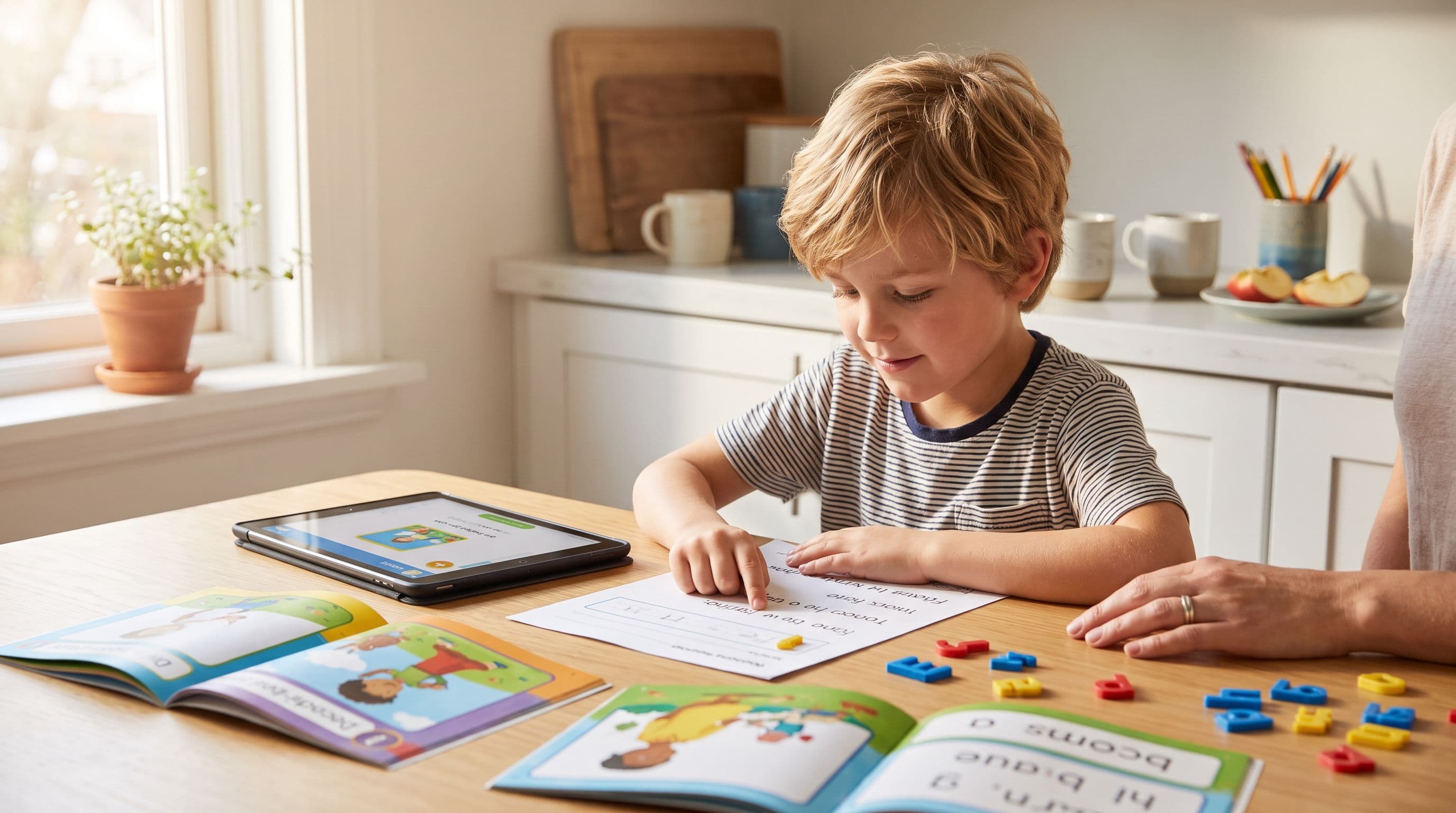
ABCmouse vs Reading Eggs Cost: Which Is Cheaper in 2026?
ABCmouse and Reading Eggs both look cute. But price means nothing if your child is still guessing at words. Here’s the no-nonsense 2026 cost comparison parents actually need.
Read More →
Reading Eggs vs ABCmouse Cost: 2026 Price Breakdown
Comparing Reading Eggs vs ABCmouse cost? Here’s the 2026 price breakdown, what each app teaches, and why I’d choose phonics-first instruction over reward-heavy screen time.
Read More →