Closed Syllables vs Open Syllables: Teach Kids to Decode Big Words
What You'll Learn
- The dead-simple difference between closed and open syllables — and why mixing them up makes kids guess at longer words
- Why your child can read 'go' but not 'goblin' — and what syllable division rules have to do with it
- The one vowel sound rule that clears up most decoding confusion in multisyllabic words
- A step-by-step action plan you can start at your kitchen table tonight — no teaching degree required
The Problem Nobody Warned You About
Your kid reads CVC words like a champ. "Cat." "Dog." "Sit." You're feeling good. Maybe even a little smug.
Then they hit a two-syllable word like "rabbit" and the wheels come off.
They stare at it. They guess "rain." They look at the picture. They look at you. You say "sound it out," and they try to blend all six letters in one breath like it's a single syllable — "rrrraaabbbbiiiit" — and produce something that sounds like a lawn mower choking.
Sound familiar?
Here's what's actually happening: your child has never been taught that longer words are just shorter pieces stacked together. They don't know that "rabbit" is "rab" + "bit." They don't know that each piece follows a predictable vowel sound rule. They don't know the difference between closed syllables vs open syllables.
And honestly? Neither do most parents. Neither do a shocking number of teachers.
The Tiger Truth: What Happens When You Skip Syllable Types
Let me be blunt. If your child doesn't learn syllable types — starting with closed and open syllables — they will hit a wall somewhere around late first grade or early second grade. That's when decodable texts get replaced by chapter books, science textbooks, and social studies passages full of words like "habitat," "discover," and "important."
Kids who can't break apart multisyllabic words don't just struggle with reading. They start avoiding it. They develop what David Kilpatrick calls "compensatory strategies" in his book Equipped for Reading Success (2016) — fancy language for guessing, memorizing word shapes, and using context clues to fake their way through text.
The numbers are brutal. Only 33% of 4th graders read at proficient level on the 2022 NAEP — the Nation's Report Card. That means two out of every three kids in America can't read grade-level material competently by age 9. And the 2023 NAEP showed scores dropping another 3 points since 2019, the steepest decline in 30 years.
Know what the worst part is? The Annie E. Casey Foundation's 2010 study found that kids who can't read proficiently by 3rd grade are four times more likely to drop out of high school. Four times.
The 3rd Grade Cliff is real. And the gap between kids who decode multisyllabic words and kids who guess at them? That gap starts right here — with closed syllables vs open syllables.
So What Actually ARE Closed and Open Syllables?
OK so let me break this down the way I wish someone had broken it down for me before I started teaching my oldest to read.
Every syllable in the English language has exactly one vowel sound. (Not one vowel letter — one vowel sound. That distinction matters, but we'll get there.) And the 6 syllable types are just categories that tell you what sound the vowel makes based on what's happening around it.
Closed and open syllables are the two most common. They're the foundation. Master these two, and your kid can decode the majority of two-syllable words they'll encounter in early readers.
Closed Syllables: The Vowel Gets Trapped
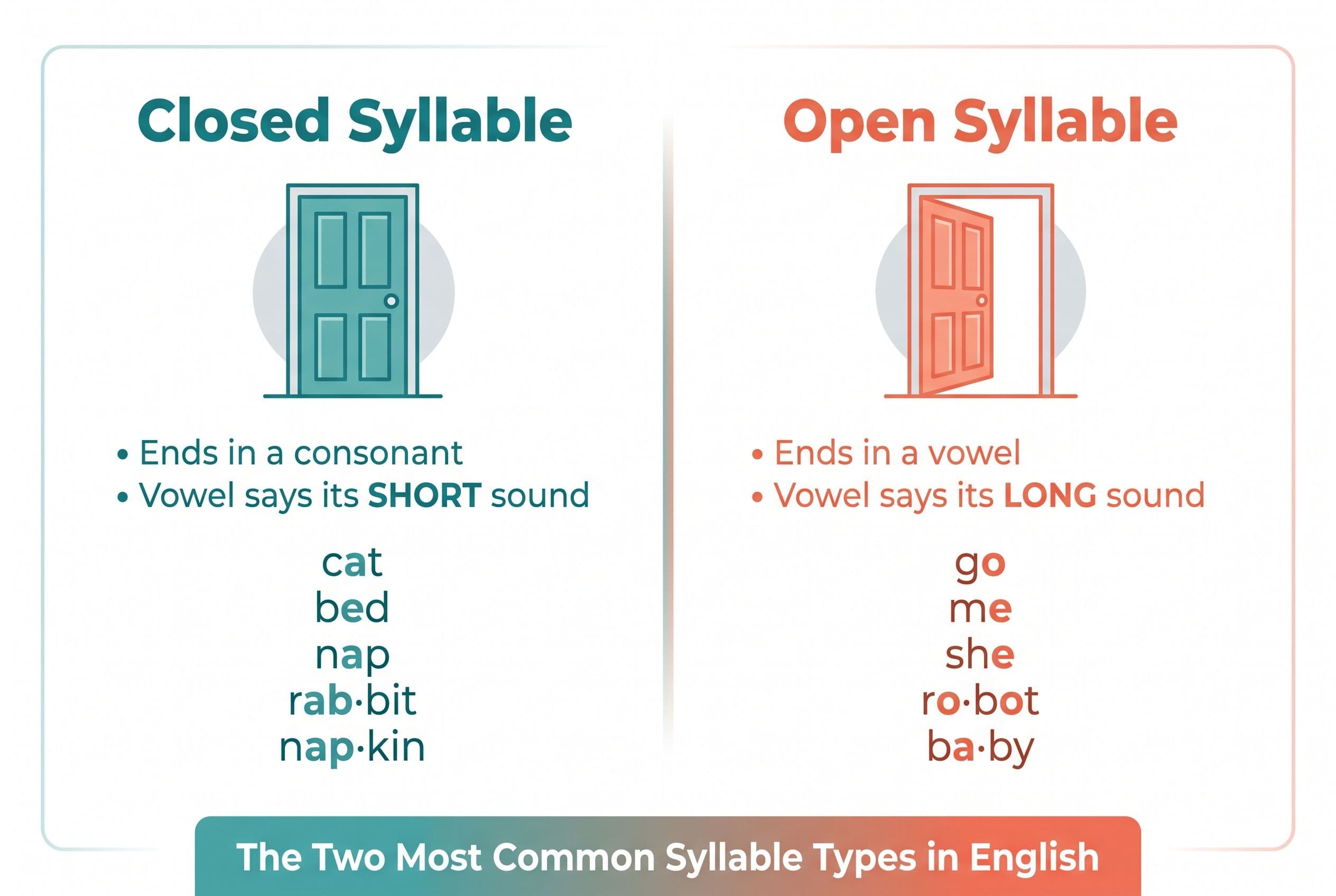
A closed syllable ends in a consonant. The consonant "closes the door" on the vowel, and the vowel says its short sound.
Closed syllable examples for kids:
- cat — the "t" closes the door on the "a" → short /ă/
- sit — the "t" closes the door on the "i" → short /ĭ/
- nap — the "p" closes the door on the "a" → short /ă/
- stump — the "mp" closes the door on the "u" → short /ŭ/
Here's the thing — every CVC word your kid has already mastered? That's a closed syllable. They've been reading closed syllables this whole time. They just didn't know the name for it.
In multisyllabic words, closed syllables show up everywhere:
- rab · bit — both syllables are closed
- nap · kin — both closed
- in · sect — both closed
Open Syllables: The Vowel Runs Free
An open syllable ends in a vowel. Nothing closes the door. The vowel is free, so it says its long sound (its name).
Open syllable examples:
- go — ends in "o" → long /ō/
- me — ends in "e" → long /ē/
- hi — ends in "i" → long /ī/
- ba (as in ba · by) — ends in "a" → long /ā/
That's literally it. That's the rule — most of the time.
Open syllable = vowel at the end = long vowel sound (in stressed syllables). Closed syllable = consonant at the end = short vowel sound.
One heads-up: in unstressed syllables, that open vowel often relaxes into a lazy "uh" sound (called schwa) — like the "a" in "a-bout" or "a-gain." Don't let that throw you or your kid. Teach the main rule first, and when they hit an exception, just say: "That vowel's in a lazy syllable — it says 'uh' instead of its name." They'll roll with it.
When your kid sees a longer word and knows how to split it into syllables, these two rules tell them what sound each vowel most likely makes. No guessing. No looking at pictures. No "what would make sense in the sentence?"
Just rules. Predictable, reliable, teachable rules.
Why This Matters More Than You Think
I was at a playground in Raleigh last year when another mom started venting about her son's school switching curricula mid-year. They'd dropped Lucy Calkins and moved to a Science of Reading program — this was right after North Carolina passed SB 387, the Excellent Public Schools Act, which required evidence-based reading instruction statewide. She was annoyed. "He was doing fine before," she told me.
So I asked a simple question: can he read the word "splint"?
Her son was in second grade. She called him over. He looked at the word on my phone screen and said "...suh...puh..." and then just stopped. He couldn't do it.
"Splint" is a single closed syllable. One vowel, short /ĭ/, with a consonant blend at the beginning and a blend at the end. If a second grader can't decode a single closed syllable with blends, they definitely can't handle "important" or "discover" or "habitat" — the words waiting for them in third grade.
I spent 20 minutes on that playground bench explaining why the switch was happening. I told her about Emily Hanford's Sold a Story investigation from 2023 — the APM Reports podcast that blew the lid off how Balanced Literacy had been failing kids for decades. I told her about the NAEP data. I mentioned Stanislas Dehaene's research in Reading in the Brain (2009) — he's a French neuroscientist who proved that the brain doesn't learn to read naturally the way it learns spoken language. Reading requires explicit instruction in the code. The brain has to be trained.
She went home and listened to Sold a Story that night. Texted me at 11 PM: "I had no idea. Why didn't anyone tell us this sooner?"
Real talk — nobody tells parents this stuff. Not the schools. Not the pediatricians. Not the mommy blogs pushing "reading readiness" like it's something you just wait around for. The reason syllable types matter is that they're the bridge between "my kid can read small words" and "my kid can read real books." And if nobody builds that bridge, your kid falls into the gap.
The 6 Syllable Types (and Why You Start With Two)
Before we go further, let me give you the full picture. English has 6 syllable types. Every syllable in every English word falls into one of these categories:
- Closed — ends in consonant, short vowel (cat, nap, rob)
- Open — ends in vowel, long vowel (go, me, ba-by)
- Vowel-Consonant-E (VCE) — the "magic e" pattern (cake, ride, hope)
- Vowel Team — two vowels working together (rain, boat, feet)
- R-Controlled — vowel + r changes the sound (car, bird, her)
- Consonant-LE — final syllable like -ble, -tle, -ple (ta-ble, lit-tle)
You start with closed and open because they're the most frequent, the most predictable, and the easiest to teach. Linnea Ehri's research on the phases of word reading development (2005 meta-analysis) shows that kids move from partial alphabetic decoding to full alphabetic decoding when they can reliably map every grapheme to a phoneme in a word. Syllable types give them the framework to do that in words longer than one syllable.
Once your kid owns closed and open syllables — I mean really owns them, not "sort of gets it" — you layer on the other four. But don't rush. Foundation first.
How to Teach Closed Syllables vs Open Syllables: The Step-by-Step
Here's exactly what I did with my 7-year-old, and what I'm starting with my 4-year-old now. This isn't theory. This is what works at my kitchen table.
Step 1: Make Sure Single-Syllable Decoding Is Solid
Don't skip this. If your kid can't fluently read CVC words (cat, sit, hop, bug, ten) without hesitation, they're not ready for syllable types. Go back and drill the short vowel sounds until they're automatic.
I use the Kilpatrick PAST (Phonological Awareness Screening Test) to check where my kids are. It takes about 5 minutes and tells you exactly where any breakdown is happening. If your kid can't delete or substitute phonemes in single-syllable words, syllable division instruction will fall flat.
Benchmark to hit: Your child should be able to read a list of 20 CVC nonsense words (made-up words like "rud," "fep," "gom") accurately and smoothly — no labored sounding out of every letter — before you start syllable division. If they can't do that yet, shore up the foundation first.
Step 2: Introduce the Concept of "Closed Door, Short Vowel"
I literally use a door. I drew one on a whiteboard. (You can use a real door in your house — even better.)
"When the door is closed, the vowel is stuck inside. It can only say its short sound. It's small and quiet."
Write the word cat on the board. Circle the "t" and draw an arrow showing it "closing" the syllable.
"The 't' is the door. It closes on the 'a.' So 'a' says /ă/."
Now do 10 more examples. Rapid fire.
- dog — what closes the door? (g) What sound does the o make? (short /ŏ/)
- fin — what closes the door? (n) What sound does the i make? (short /ĭ/)
- stamp — what closes the door? (mp) What sound does the a make? (short /ă/)
Drill until it's boring. Then drill five more. Tiger Rule: We Never Skip. Not on birthdays, not on vacation, not when they whine.
Step 3: Introduce "Open Door, Long Vowel"
Same door. But now it's open.
"When there's no consonant at the end, the door is wide open. The vowel is free! It gets to say its own name — its big, loud, long sound."
Write go on the board.
"No consonant at the end. The 'o' is free. It says /ō/ — its name!"
More examples:
- me → long /ē/
- hi → long /ī/
- no → long /ō/
- she → long /ē/
These are small words, but the concept transfers directly to multisyllabic words. That's the whole point.
Step 4: Sort, Sort, Sort
Grab index cards. Write 15-20 single-syllable words on them — mix of open and closed. Have your kid sort them into two piles.
Closed pile: cat, net, fish, stop, drum, lump, chin, raft Open pile: go, me, she, hi, no, we, so, be
This is where the lightbulb goes on. When they physically move the cards and say the vowel sound out loud for each one, the pattern clicks.
I had my 7-year-old do this sort every day for a week. By day three, she was doing it without thinking. By day five, she was correcting her younger sister's pronunciation on unrelated words. That's mastery.
Step 5: Apply to Two-Syllable Words (This Is Where the Magic Happens)
Now you bring in syllable division rules for reading. Here's the one that matters most at this stage:
The VC/CV rule (Vowel-Consonant / Consonant-Vowel):
When two consonants sit between two vowels, you usually split between the consonants.
rab/bit → two closed syllables → short /ă/ + short /ĭ/ → "rabbit" nap/kin → two closed syllables → short /ă/ + short /ĭ/ → "napkin" bas/ket → two closed syllables → short /ă/ + short /ĕ/ → "basket"
Now the open syllable version — the V/CV rule:
When only one consonant sits between two vowels, you first try splitting before the consonant, leaving the first syllable open.
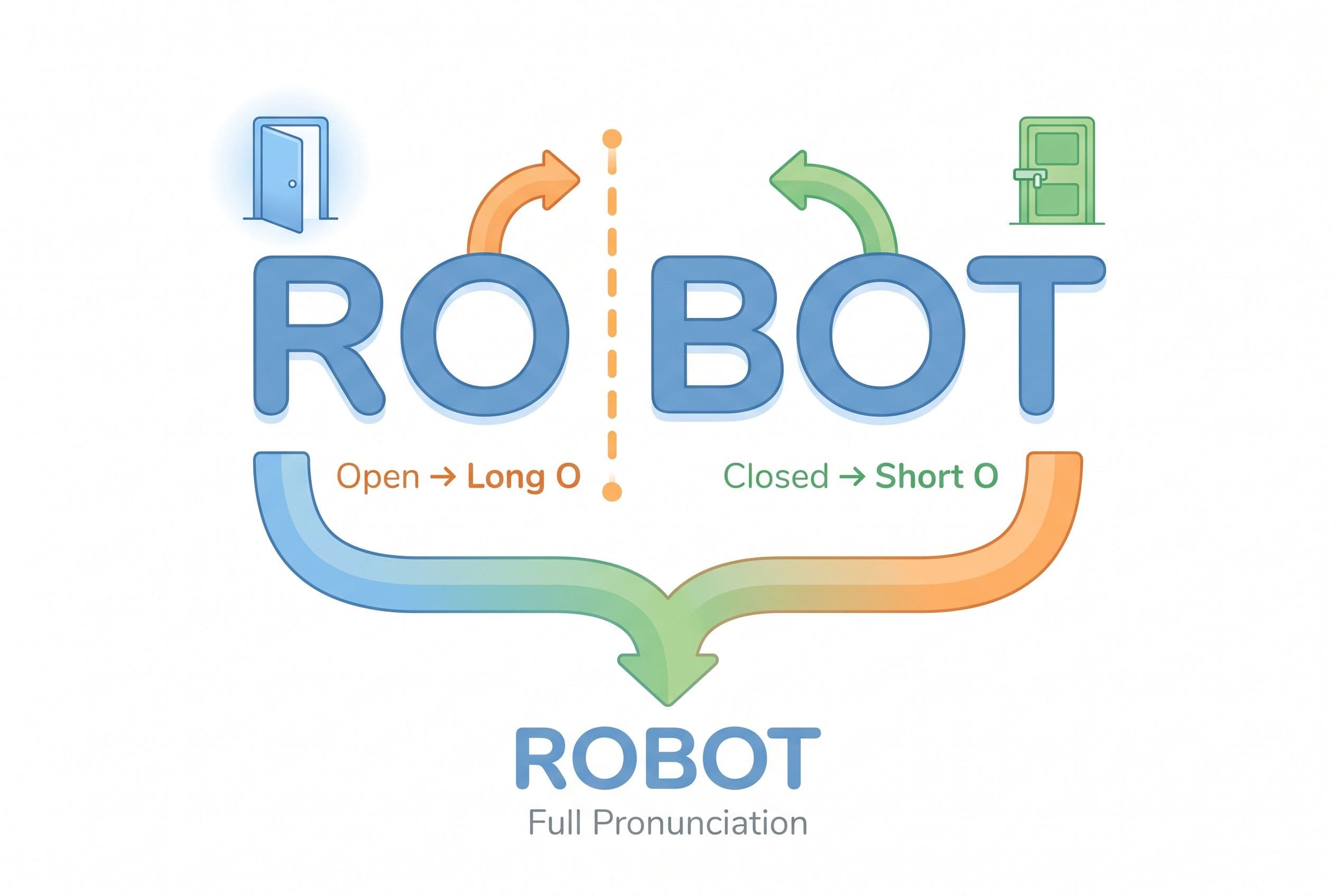
ro/bot → open + closed → long /ō/ + short /ŏ/ → "robot" ba/by → open + open → long /ā/ + long /ē/ → "baby" mu/sic → open + closed → long /ū/ + short /ĭ/ → "music"
See what just happened? Your kid went from staring blankly at "robot" to having a systematic strategy for attacking it. No guessing. No pictures. No context clues. Just the code.
Tiger Rule: No Guessing. If your kid looks at "music" and says "mouse" because it starts with "m" — stop them. Go back to the rules. Split the syllables. Identify open vs closed. Sound it out. Every. Single. Time.
Step 6: Practice With Real Decodable Text
Here's where a lot of parents get tripped up. They teach the concept, then hand their kid a leveled reader from Fountas & Pinnell that's full of irregular words and context-clue dependency. That's like teaching someone to drive stick shift and then putting them in an automatic — the skill never gets reinforced.
Use decodable readers that specifically practice multisyllabic words with closed and open syllables. Flyleaf Publishing and High Noon Books make excellent decodable chapter books for this stage. The UFLI Foundations program out of the University of Florida also has fantastic word lists organized by syllable type.
And of course — this is exactly what Teach Your Kid to Read is built for. Our program uses systematic synthetic phonics rooted in Orton-Gillingham principles, and we introduce syllable types in a structured sequence: closed first, then open, then VCE, building layer by layer so your kid never has to guess. The app gives immediate feedback and tracks progress so you know exactly when your child has hit mastery on each syllable type before moving on.
Common Mistakes Parents Make (and How to Avoid Them)
Mistake #1: Teaching Syllable Types as Vocabulary, Not as a Decoding Tool
Your kid doesn't need to define "closed syllable" on a test. They need to look at an unfamiliar word, split it apart, identify each syllable type, and use that information to produce the correct vowel sound. If they can label syllables on a worksheet but can't apply the rules to a new word in a book, you've taught trivia. Not reading.
Mistake #2: Moving to Open Syllables Before Closed Syllables Are Automatic
I see this constantly in homeschool co-ops. Mom introduces closed syllables on Monday, open syllables on Wednesday, and wonders why the kid is confused by Friday. Closed syllables should be drilled for at least 2-3 weeks before you introduce open syllables. Your kid needs to identify a closed syllable and produce the short vowel sound without thinking — like recognizing their own name.
Mistake #3: Skipping the Two-Syllable Application
Sorting single-syllable words is great practice, but the whole point of learning syllable types is to decode longer words. If you never make the jump to "nap/kin" and "ro/bot," the skill stays theoretical. Get to two-syllable words within the first month. Three-syllable words by month two.
Mistake #4: Allowing Guessing to Persist
Imagine your kid sees "hotel" and says "house." They looked at the "h," skipped the rest, and guessed based on the picture on the page. This is Whole Language in action, and it's the exact opposite of what we're building. If your kid guesses, stop them immediately. Go back to the syllable division. "Where do we split this word? What type is the first syllable? What sound does the vowel make?" Every time.
Mark Seidenberg wrote about this in Language at the Speed of Sight (2017) — he's a University of Wisconsin cognitive scientist who spent decades studying how the brain processes text. His research shows that skilled readers don't guess. They process every letter in a word, incredibly fast, through orthographic mapping. Guessing is what struggling readers do because they haven't built those letter-sound pathways. Don't let your kid build the wrong pathways.
The Teach Your Kid to Read Approach
Look, I built Teach Your Kid to Read because I was frustrated with what was available. Most reading apps are glorified games with cute animations and zero systematic phonics. My kids don't need to earn virtual coins for tapping a screen. They need to decode words.
Our program teaches closed syllables vs open syllables as part of a structured sequence based on the science of reading — the same research base behind Orton-Gillingham, the same principles behind Mississippi's well-documented reading gains after the state passed its 2013 Literacy-Based Promotion Act and invested heavily in teacher training. (Mississippi went from near the bottom of NAEP 4th-grade reading rankings to the middle of the pack — the gains were real, even if the story's more complex than a single law.)
Here's what that looks like in practice:
- Systematic phonics instruction that follows the scope and sequence validated by the 2000 National Reading Panel report — the one Congress actually commissioned, which found that systematic phonics produces significant benefits for word reading and comprehension
- Immediate corrective feedback — no guessing allowed, ever
- Mastery-based progression — your child doesn't move to open syllables until closed syllables are automatic
- Decodable text practice at every stage so skills transfer to real reading
- Parent dashboard so you can see exactly where your child is and what to practice next
The 40+ states that have passed Science of Reading legislation since 2019 — including North Carolina's SB 387, Colorado's READ Act, Ohio's Third Grade Reading Guarantee — are all pushing schools toward exactly this kind of instruction. But schools move slowly. Bureaucracies are like that. You don't have to wait.
Quick Reference: Open and Closed Syllable Words for Kids
Here's a cheat sheet you can print out and tape to your fridge. I literally have one taped to mine right now, next to my 4-year-old's artwork and a grocery list.
Closed Syllable Words (Short Vowel Sound)
Single syllable: cat, bed, fish, lock, jump, shelf, crisp, blank, stump, dusk
In multisyllabic words: rab-bit, nap-kin, kit-ten, bas-ket, pup-pet, in-sect, sub-ject, hel-met, cab-in, den-tist
Open Syllable Words (Long Vowel Sound)
Single syllable: go, me, she, hi, no, we, so, be, he, my
In multisyllabic words: ro-bot, ba-by, mu-sic, ho-tel, ti-ger, pa-per, spi-der, o-pen, hu-man, pi-lot
Mixed (Open + Closed in the Same Word)
- ro (open, long /ō/) + bot (closed, short /ŏ/) = robot
- ti (open, long /ī/) + ger (r-controlled) = tiger
- mu (open, long /ū/) + sic (closed, short /ĭ/) = music
- ba (open, long /ā/) + sin (closed, short /ĭ/) = basin
Notice the pattern? When the first syllable is open, the vowel is long. When it's closed, the vowel is short. That's the whole game. Your kid learns two rules and suddenly hundreds of words open up.
Your Action Plan for This Week
Don't overthink this. Just start.
Days 1-3: Drill closed syllables with single-syllable words. Use flashcards. Go fast. Ask: "Is the syllable open or closed? What sound does the vowel make?" Target 20 words per session, 10 minutes max.
Days 4-5: Introduce open syllables with single-syllable words. Same drill. Same speed. Then mix open and closed into one sorting activity.
Days 6-7: Introduce the VC/CV syllable division rule with two-syllable words that have two consonants in the middle (rabbit, napkin, basket). Have your kid draw a line between the syllables, label each one as open or closed, then read the word.
Week 2: Introduce the V/CV rule with words where one consonant sits between two vowels (robot, music, baby). First try: split before the consonant (open first syllable). If the word doesn't sound right, try splitting after the consonant (closed first syllable). This "flex" strategy is gold — it teaches your kid to try, evaluate, and adjust, which is what skilled readers do automatically.
And if you want all of this structured, sequenced, and interactive? That's exactly what start lesson one free at Teach Your Kid to Read delivers. We've done the lesson planning so you don't have to.
Frequently Asked Questions
At what age should I teach my child about closed syllables vs open syllables?
Most kids are ready to start learning about closed syllables around age 5-6, once they can fluently decode CVC words and have strong phonemic awareness. Open syllables can be introduced a few weeks after closed syllables are solid. I started my oldest at 5.5, and I'm introducing the concept to my 4-year-old now through exposure and sorting games — not formal instruction yet, just building the pattern recognition. Don't wait until second grade. By then, your kid is already encountering multisyllabic words in texts and needs the tools to decode them.
What if my child tries the syllable division rules and the word still doesn't sound right?
This happens, and it's normal. English isn't perfectly regular. The strategy I teach is "try, check, flex." First, try the most common division pattern. Say the word out loud. Does it sound like a real word they know? If not, try the other split. For example, with "cabin" — if they split it as "ca/bin" (open first syllable, long /ā/), they'll get "KAY-bin," which doesn't sound right. So they flex: "cab/in" (closed first syllable, short /ă/), and get "CAB-in." That's the right one. This trial-and-check process is a feature, not a bug. It builds reading flexibility and self-monitoring — skills that Kilpatrick's orthographic mapping research shows are essential for fluent reading.
How is learning syllable types different from just memorizing sight words?
OK so this one trips people up because the term "sight word" gets used two different ways. In reading science (Ehri, Kilpatrick), a "sight word" is actually any word the brain recognizes instantly from memory — regular or irregular. Your kid's brain eventually turns every well-practiced word into a sight word through orthographic mapping. That's the goal.
What most parents mean when they say "sight words" are high-frequency irregular words — words like "said," "was," or "the" — that don't follow standard phonics patterns and need some memorization (the "heart word" approach in many Science of Reading programs).
Here's why that distinction matters: syllable types are a decoding strategy that works across thousands of words. A kid who only memorizes 200 high-frequency words can read 200 words. A kid who masters the 6 syllable types and basic syllable division rules can decode virtually any regular English word they encounter. It's the difference between giving a kid fish and teaching them to fish — except in this metaphor, the fish are words and the ocean is every book ever written.
My child's school uses Fundations. Does that cover syllable types?
Yes — Fundations by Wilson Language Training does teach syllable types as part of its scope and sequence, and it's one of the better programs out there. It's based on the Wilson Reading System, which uses Orton-Gillingham principles. If your kid's school uses Fundations, that's a good sign. You can reinforce at home by practicing the same syllable sorting and division activities I described above. Consistency between school and home instruction accelerates mastery. If your school uses something else — especially a Balanced Literacy program — you may need to do more heavy lifting at home. Check whether your state has passed Science of Reading legislation; over 40 states have since 2019, which means your district may be in the process of switching.
How many syllable types should my child learn in total?
There are 6 syllable types in English: closed, open, vowel-consonant-e (VCE or "magic e"), vowel team, r-controlled, and consonant-LE. Start with closed and open — they're the most common and the most predictable. Once those are automatic (and I mean truly automatic, not "gets it right most of the time"), add VCE. Then vowel teams. Then r-controlled. Consonant-LE usually comes last because it only appears in final syllables. The full sequence takes most kids 6-12 months to master, depending on age, practice frequency, and whether they have any underlying phonological processing difficulties. Don't rush it. Foundation over speed, always.
Part of these guides

Xia Brody
Co-Founder, Teach Your Kid to Read
Mom of 4 who has successfully taught her kids to read. Currently in the trenches with her 4-year-old while her two oldest (10 and 7) devour books on their own. Passionate about phonics-based methods and building a lifelong love of reading.
Related Articles
Best App for Kids Who Guess Words: 2026 Phonics Picks
If your child guesses words from pictures, context, or the first letter, you don't have a reading problem to ignore — you have a decoding problem to fix. Here are the 2026 phonics app picks I’d actually consider as a no-nonsense homeschooling mom.
Read More →
Best Reading App for a 1st Grader Who Guesses Words
If your 1st grader guesses words from pictures, that’s not reading — that’s coping. Here’s the no-nonsense app comparison I’d use with my own kids.
Read More →
Best App for a 6-Year-Old Who Guesses Words: 5 Picks
If your 6-year-old guesses words from pictures, they don't need more leveled books. They need systematic phonics, daily decoding practice, and a parent who stops the guessing cold.
Read More →