How to Teach Morphology to Kids: Prefixes, Suffixes & Roots
What You'll Learn
- The one word-attack strategy that unlocks thousands of vocabulary words — and why most elementary classrooms don't teach it until it's too late
- Why your kid keeps "reading" words without understanding them — and the missing piece that connects decoding to comprehension
- The exact age to start teaching prefixes, suffixes, and root words — it's earlier than you think (and no, your 5-year-old won't combust)
- A step-by-step plan you can start this week — no teaching degree required, just 10 minutes a day and a willingness to say "un-" about 400 times
Your Kid Can Decode Words But Has No Idea What They Mean
Here's a scene I watched play out at my kitchen table last year. My 7-year-old, who is a strong decoder — she can sound out practically anything — read the word "unhappiness" in a chapter book. She read it perfectly. Smooth, no stumbles. So then I asked her what it meant.
She stared at me. "Um... it's like when you're not... nice?"
She could read the word. She had zero clue what it meant.
Sound familiar? This is the gap that swallows kids whole between 2nd and 4th grade. They've got their phonics down — they can decode like little machines — but their vocabulary and comprehension crater because nobody taught them how words are actually built.
That's morphology. And if you're not teaching it to your kids? You're leaving an absolutely massive tool sitting right there on the table.
What Morphology Actually Is (and Why You Should Care)
Morphology is the study of word parts — the meaningful chunks that make up words. We're talking three things here:
- Prefixes — chunks added to the beginning of a word that change its meaning (un-, re-, pre-, dis-)
- Suffixes — chunks added to the end of a word that change its meaning or grammatical function (-ful, -less, -tion, -ly)
- Root words (or base words) — the core meaning unit that prefixes and suffixes attach to (happy, play, port, ject)
When a kid understands that un- means "not," -ness means "the state of being," and happy means... well, happy — they can decode AND understand "unhappiness" without ever having seen that specific word before.
That's not memorization. That's a system. And it scales.
Here's a number that blew my mind when I first read it: researchers estimate that 60% of the new words kids encounter in school texts are morphologically complex — meaning they're built from smaller parts. That comes from work by William Nagy and Richard Anderson at the University of Illinois back in 1984, and it's been cited in reading research for decades since. They found that a typical third grader encounters roughly 10,000 new words per year in school reading. You're not going to drill 10,000 flashcards. But you can teach a kid 20 prefixes, 20 suffixes, and 30 root words — and suddenly they've got the keys to figure out thousands of those new words on their own.
This is what morphological awareness looks like in practice. It's the ability to recognize, analyze, and manipulate the meaningful parts inside words. And the research on it is stacking up fast.
First, Make Sure the Decoding Is Solid
Morphology sits on top of decoding. A kid who can't reliably read "unpack" as three sound chunks has no business analyzing "un-" as a prefix yet — they'll just add another guessing strategy to the pile. So before you teach a single root word, check the foundation: can your child sound out unfamiliar one- and two-syllable words without guessing from the first letter? take the 2-minute reading check if you want a quick score.
If the decoding is shaky, fix that first with systematic phonics. Teach Your Kid to Read runs the sequence — sounds, blending, syllable types, then the prefixes and suffixes this article is about — with decodable text at every step. Lesson one is free with no card, then a 7-day trial, then $9.95 a month. start lesson one free, and the morphology lessons below will land on solid ground.
The Tiger Truth: What Happens If You Skip This
I'm gonna be blunt with you.
The 3rd Grade Cliff is real. Kids who can't read proficiently by 3rd grade are four times more likely to drop out of high school — that comes straight from the Annie E. Casey Foundation's 2010 report, and nobody's seriously disputed those numbers since. And "reading proficiently" doesn't just mean decoding. It means comprehension. It means vocabulary. It means understanding what words mean in context.
The 2022 NAEP — the Nation's Report Card — showed that only 33% of 4th graders read at proficient level. Let that sink in — two-thirds of American 4th graders can't read well enough. And 2022 NAEP scores showed reading scores dropped 3 points from 2019 — the largest decline in over 30 years.
Know what's behind a huge chunk of that comprehension gap? Vocabulary. Kids hit 4th grade and the texts shift from "The cat sat on the mat" to words like prehistoric, disagreement, reconstruction, inequality. If they haven't been taught that pre- means "before" and -ic means "relating to," they're just staring at letter soup. They can sound it out, sure. But they don't have a clue what it means.
And here's the kicker: most elementary schools don't teach morphology systematically until 4th or 5th grade. By then? The damage is done. The vocabulary gap between strong readers and struggling readers has already ballooned. Mark Seidenberg, the University of Wisconsin cognitive scientist who wrote Language at the Speed of Sight (2017), called out this exact failure — schools spending years on basic decoding without ever connecting it to meaning through word structure.
Your kid deserves better. And you can start right now — like, today.
Why Most Schools Get This Wrong
OK so here's where it gets personal.
After Emily Hanford's "Sold a Story" investigation came out through APM Reports in 2023, my neighbor — a 1st grade teacher for 18 years — called me almost in tears. She'd been using Lucy Calkins' Units of Study curriculum her entire career. Three-cueing, MSV prompts, the whole guessing game. She looked me dead in the eye and said, "I've been teaching kids to guess for two decades and I didn't even know it."
She switched her classroom to UFLI Foundations mid-year. Messy doesn't begin to describe it — she had to relearn everything herself first, staying up nights watching the training videos, rebuilding her lesson plans from scratch. But by spring her kids' DIBELS scores had jumped an average of 15 points on nonsense word fluency. She told me it was the first time in her career where every single kid in her class could decode CVC words by February.
But here's what she said next, and this is what stuck with me: "The decoding got fixed. But my kids still can't understand the harder words in our read-alouds. They can sound out 'unhelpful' but they don't know what it means."
That's the morphology gap. UFLI Foundations is a fantastic phonics program — I recommend it constantly. But phonics gives kids the decoding engine. Morphological awareness gives them the comprehension engine. You need both.
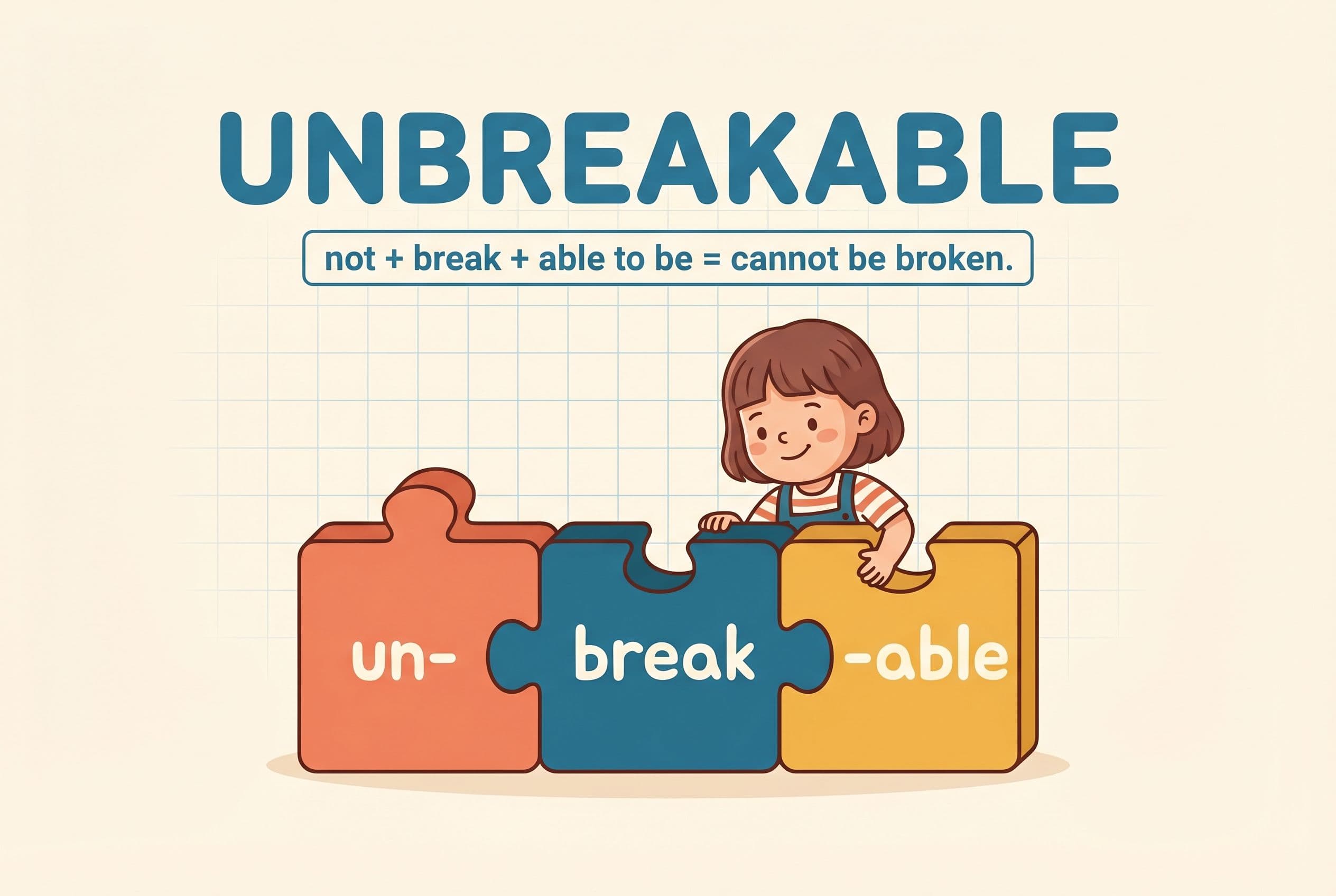
This is exactly what Scarborough's Reading Rope model shows — you've got two strands braiding together. The lower strand is word recognition (phonics, decoding, sight recognition). The upper strand is language comprehension (vocabulary, background knowledge, verbal reasoning). Morphology sits right at the intersection. It bridges decoding and meaning. A kid who can break unbreakable into un- + break + -able doesn't just decode it — they understand it.
And yet? Most reading curricula treat morphology as an afterthought. A vocabulary worksheet in the back of the unit. A five-minute activity on "prefix of the week" that gets skipped when they run out of time.
Real talk — if you're sitting around waiting for the school to cover this thoroughly, you're gonna be waiting a very long time.
When to Start Teaching Morphology (Earlier Than You Think)
I started morphology work with my oldest when she was 6. Looking back, I could have started even earlier with simple concepts.
Here's a rough timeline based on what I've seen work with my own kids and what the research supports:
Ages 4-5: Awareness Stage
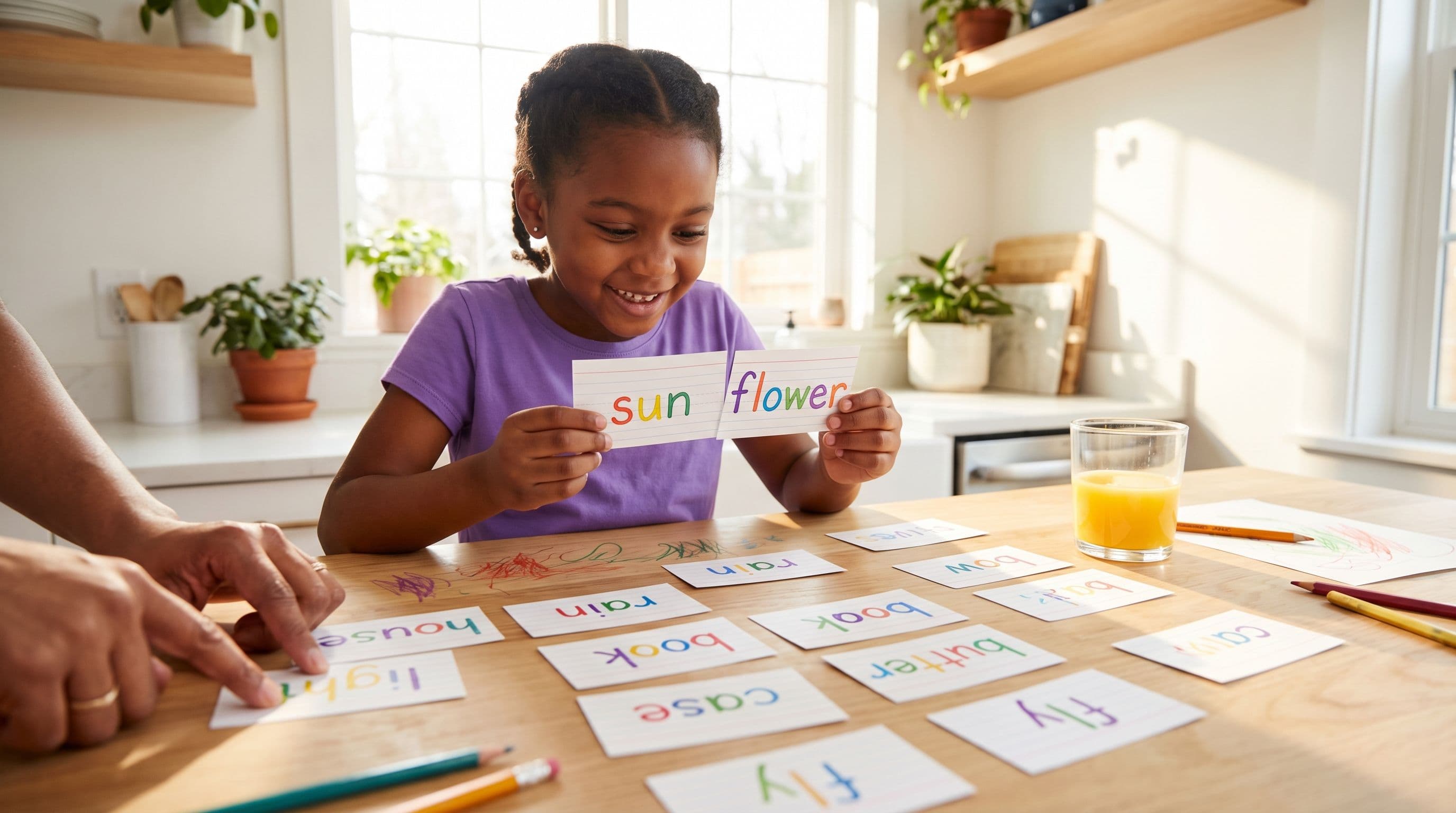
- Play with compound words: sun + flower = sunflower. Cup + cake = cupcake.
- This isn't "morphology instruction" yet — it's building the mental habit of seeing words as being made of parts.
- My 4-year-old thinks this is a game. We do it in the car. "What's rain plus bow?" She shouts the answer like it's a competition.
Ages 5-6: Simple Affixes
- Introduce -s and -ing and -ed. These are suffixes they already use in speech.
- "You know the word jump. What happens when I add -ing?" They already know the answer. You're just making it conscious.
- Start with un-. It's the easiest prefix because it just means "not." Happy / unhappy. Kind / unkind. Fair / unfair.
Ages 6-8: Systematic Morphology
- Teach common prefixes and suffixes explicitly: re-, pre-, dis-, mis-, -ful, -less, -ment, -tion.
- Introduce the concept of base words vs. root words.
- Start building "word sums": re + play = replay. Un + kind + ness = unkindness.
Ages 8-10: Latin and Greek Roots
- This is where it gets powerful. Latin and Greek roots for elementary students — ject (throw), port (carry), rupt (break), struct (build), graph (write), scope (see).
- A kid who knows rupt means "break" can figure out erupt, interrupt, disrupt, rupture, corrupt, and abrupt. That's six words from one root.
Linea Ehri's phases of word reading development — pre-alphabetic, partial alphabetic, full alphabetic, consolidated alphabetic — show us that kids in the consolidated phase (typically late 1st grade through 3rd grade) are already starting to chunk words into larger units. Morphology instruction supercharges this natural process. You're not fighting the brain's development — you're feeding it exactly what it's hungry for.
The Solution: How Teach Your Kid to Read Builds This Foundation
At start lesson one free Teach Your Kid to Read, we build morphological awareness into the reading instruction from the ground up — not as an afterthought, not as a "bonus activity," but as a core part of learning to read.
Here's why this matters: Kilpatrick's work on orthographic mapping — laid out in his book Equipped for Reading Success (2016) — shows that the brain stores written words by bonding their spellings to their pronunciations. Once those word forms are stored, they connect to meaning through vocabulary networks. Morphology strengthens those meaning connections and helps kids decode longer words by recognizing familiar chunks. So a kid who learns that un- means "not" and encounters unfair isn't just storing a random letter string — their brain files that word within a web of related words (unfair, unkind, unable, unwell), making it faster to recall and easier to understand.
Our approach follows Orton-Gillingham principles — systematic, explicit, multisensory — but extends them beyond phonics into morphology. We don't just teach kids to decode. We teach them to understand what they decode.
The Simple View of Reading (Gough & Tunmer, 1986) says it plainly:
Reading Comprehension = Decoding × Language Comprehension
If either one is zero, comprehension is zero. Phonics handles the decoding side. Morphology is one of the most powerful tools for the comprehension side — especially vocabulary building through word parts.
Your Action Plan: How to Teach Morphology to Kids in 10 Minutes a Day
Here's exactly what I do with my own kids, step by step. No special materials required for the first few weeks — just you, your kid, and some index cards.
Step 1: Start With What They Already Know
Don't introduce "morphology" as some scary academic concept. Start with words they use every day.
Say: "You know the word play. Watch what happens when I stick something on the front or the back."
- play → replay (do it again)
- play → playing (doing it now)
- play → playful (full of play)
- play → player (person who plays)
Write each one on an index card. Have your kid physically separate the parts with a pencil line or scissors. re | play. play | ful. Cut the word apart. Now put it back together. This is multisensory — hands, eyes, voice, all engaged.
I had my 7-year-old do this at the kitchen table last month with the word help. She generated helpful, helpless, unhelpful, helper, and helping in about two minutes. Then she noticed that helpful and helpless mean opposite things even though they both start with help. That's morphological reasoning. That's where we're headed.
Step 2: Teach the "Power Prefixes" First
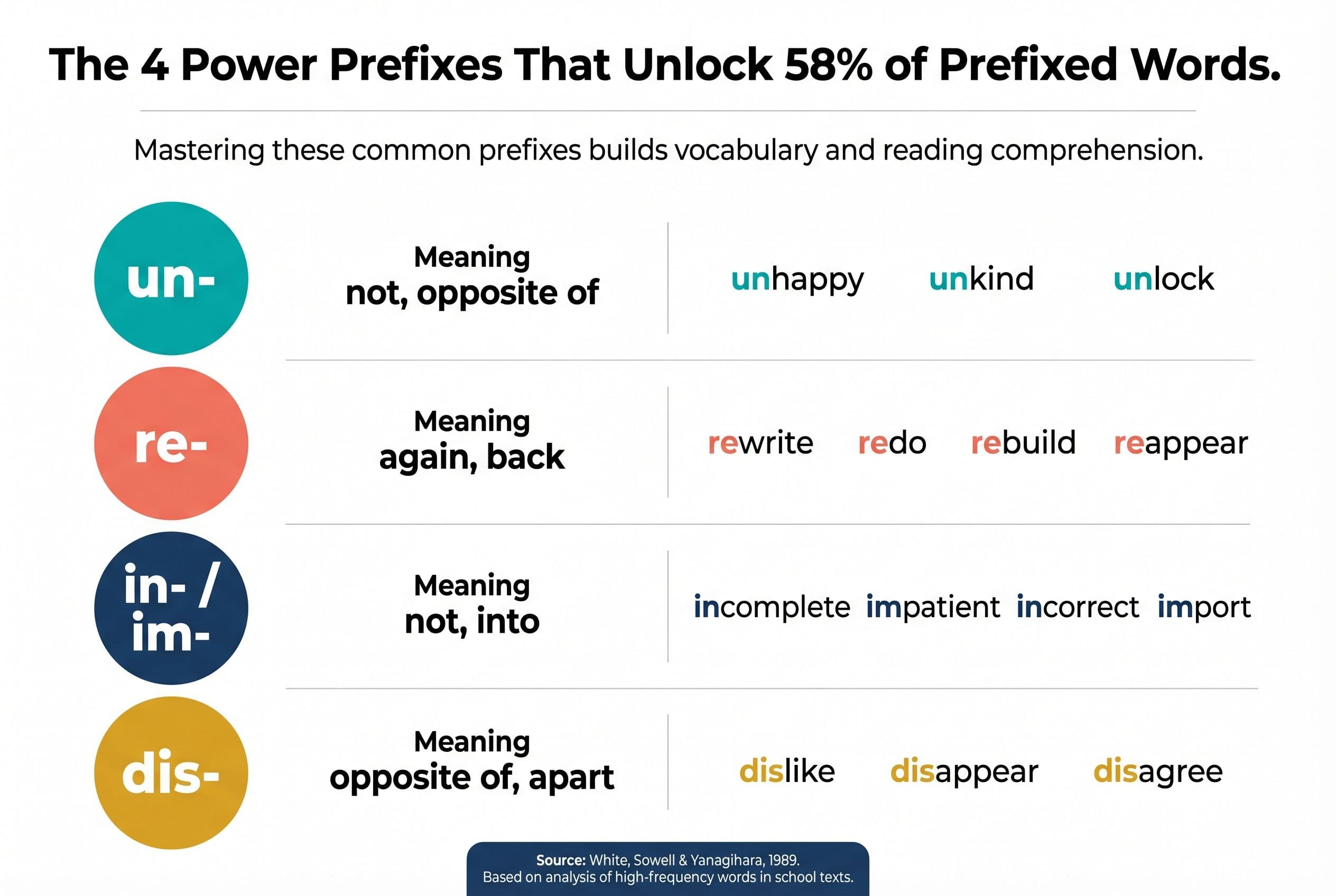
Research by White, Sowell, and Yanagihara (1989) found that just four prefixes account for 58% of all prefixed words in English:
- un- (not): unhappy, unfair, undo, unlock
- re- (again): redo, replay, rewrite, rebuild
- in-/im-/ir-/il- (not): impossible, invisible, irregular, illegal
- dis- (not, opposite of): disagree, disappear, dislike, disconnect
Four prefixes. More than half of all prefixed words. That's efficiency.
Drill these. I mean actually drill them — not "expose" your kid to them, not a cute poster on the wall, not a single worksheet. Drill them like you drill phonics sounds. Flash the prefix. Kid says the meaning. Flash a word with that prefix. Kid breaks it apart and explains what it means.
We never skip. Birthdays, vacation, sick days — 5 minutes of prefix drill. My kids groan about it. They also know what unprecedented means. I'll take the groan.
Step 3: Add the "Power Suffixes"
Once your kid has the top prefixes down cold (give it 2-3 weeks of daily practice), layer in suffixes:
- -ful (full of): careful, thankful, hopeful
- -less (without): careless, thankless, hopeless
- -ness (state of being): kindness, darkness, sadness
- -ment (result of): movement, payment, excitement
- -er / -or (person who does): teacher, player, actor
- -tion / -sion (act of): action, creation, decision
- -able / -ible (able to be): breakable, readable, flexible
- -ly (in a way that is): quickly, sadly, carefully
Now the magic starts. Your kid can combine what they know.
Un- + break + -able = can't be broken. Re- + pay + -ment = paying again (as a result). Dis- + agree + -ment = the result of not agreeing.
I make my kids build these "word sums" out loud. I say the parts, they build the word and tell me the meaning. Then I say a word and they break it apart. Back and forth, quick as we can. It takes 5-10 minutes and it's honestly more engaging than most phonics drills because the meaning piece makes it feel like puzzle-solving.
Step 4: Introduce Latin and Greek Roots (Ages 7-8+)
This is where vocabulary building through word parts goes nuclear.
Start with 5-10 high-frequency roots:
| Root | Meaning | Example Words |
|---|---|---|
| ject | throw | inject, reject, eject, project |
| port | carry | transport, import, export, report |
| rupt | break | erupt, interrupt, disrupt, rupture |
| struct | build | construct, instruct, structure, reconstruct |
| dict | say/speak | predict, dictate, dictionary, contradict |
| vis/vid | see | visible, video, invisible, vision |
| scrib/script | write | describe, prescription, manuscript |
| aud | hear | audience, audio, auditorium |
Here's what I do: I write the root on one index card with its meaning. Then I challenge my oldest (she's 10) to brainstorm every word she can think of that contains that root. We write each word on its own card, break it into parts, and discuss the meaning.
When she figured out that pre (before) + dict (say) = "to say before it happens" — you should've seen her face. "Mom, predict literally means to SAY something BEFORE it happens!" Yes, kid. Words make sense when you know how they're built.
Step 5: Practice in Real Reading Every Single Day
Drills are great. But the real test is transfer — can your kid use morphology when they hit an unfamiliar word in a real book?
Every time my kids encounter a word they don't know during reading time, we have a non-negotiable routine:
- Can you find any parts you recognize? (prefix, suffix, root)
- What do those parts mean?
- Put the meanings together — what do you think the word means?
- Does that make sense in the sentence?
No guessing from pictures. No skipping the word. No "just keep reading and you'll figure it out from context." Break. It. Apart.
Last week my 7-year-old hit the word reappearance in a Magic Tree House book. She broke it down: re- (again) + appear (show up) + -ance (the act of). "It's like... showing up again?" Nailed it. Without morphology, she would've stumbled over a 12-letter word and either guessed or skipped it. Instead she owned it.
Programs and Resources That Actually Teach This
Not all reading programs include morphology instruction. Here's what I've actually found works after testing way too many options:
Programs that integrate morphology well:
- Logic of English — explicitly teaches morphology alongside phonics from the early levels. Hands down one of the most thorough programs I've seen for connecting word parts to meaning.
- Orton-Gillingham-based programs like Wilson Reading System and Barton Reading & Spelling both include morphological components, especially at the intermediate levels.
- Explode the Code books 5-8 introduce prefixes and suffixes systematically.
- Fundations (Wilson's classroom program) introduces morphology concepts in Level 2.
For Latin and Greek roots specifically:
- Word Nerds by Brenda Overturf — great teacher resource with hands-on vocabulary strategies
- Michael Clay Thompson's language arts curriculum — goes deep on Latin and Greek roots for gifted and advanced readers
Assessments to check morphological awareness: There's no single standardized "morphology test" for parents, but Kilpatrick's PAST (Phonological Awareness Screening Test) will tell you if your kid has strong phonological processing — which is the foundation morphology builds on. If your kid can't segment and blend sounds fluently, go back to phonemic awareness before layering morphology on top. The PAST takes about 5 minutes and you can administer it yourself at home.
For vocabulary specifically, if your kid's school uses MAP Growth testing, look at the vocabulary sub-scores. A dip there relative to decoding scores is a red flag that your kid is decoding without comprehending — exactly the gap morphology instruction fills.
The Policy Reality: Why You Can't Wait for Schools
OK so here's something that absolutely drives me up a wall. The 40+ states that have passed "Science of Reading" legislation since 2019 — Mississippi's Literacy-Based Promotion Act, Colorado's READ Act, Ohio's Third Grade Reading Guarantee, Florida's Just Read initiative — they've done incredible work getting phonics back into classrooms. Mississippi went from 49th to 21st in national reading scores in six years after mandating evidence-based reading instruction. That's a real policy success story.
But almost none of that legislation specifically mandates morphology instruction. The focus has been (understandably) on phonics and phonemic awareness — the decoding strand of Scarborough's Reading Rope. The language comprehension strand — vocabulary, morphology, background knowledge — is still largely left to individual teachers and curriculum choices.
Which means your kid might get it. Or might not. Depending on the teacher, the year, the district.
I'm not willing to gamble on "maybe this year they'll get to it." Are you?
The Non-Negotiable Benchmarks
I like having specific targets. Here's what I aim for with my kids, based on grade-level expectations and the research:
By end of Kindergarten:
- Can identify compound words and break them apart (sunflower = sun + flower)
- Understands that -s and -ing change a word
By end of 1st Grade:
- Knows un- and re- and can apply them to known words
- Can add -ed, -ing, -er, -est to base words and explain the change
By end of 2nd Grade:
- Knows the four "power prefixes" (un-, re-, in-/im-, dis-) cold
- Knows 6-8 common suffixes and their meanings
- Can break apart two-affix words (un-kind-ness) and explain the meaning
By end of 3rd Grade:
- Knows 10-15 Latin and Greek roots
- Can use word-part analysis to figure out unfamiliar vocabulary independently
- Can build word sums with multiple affixes
By end of 4th Grade:
- Uses morphological analysis automatically during reading — it's not a "strategy" anymore, it's a habit
- Can explain how word parts change meaning and grammatical function
These aren't arbitrary. They align with what the research says and what I've seen work. My oldest hit these benchmarks roughly on schedule. My 7-year-old is tracking ahead on prefixes and suffixes because we started earlier with her. My 4-year-old smashes compound words in the car and thinks she's a genius. She might be right.
Bottom Line
Phonics teaches your kid to decode words. Morphology teaches your kid to understand them. You need both. And the research — from Nagy and Anderson's vocabulary work to Kilpatrick's orthographic mapping research to the Simple View of Reading framework — all points the same direction: word-part knowledge is one of the most powerful, most efficient tools for building vocabulary and comprehension.
You don't need a teaching degree for this — honestly, you don't even need a curriculum yet. You need 10 minutes a day, some index cards, and the refusal to skip a day.
We never skip.
If you want a systematic, research-backed program that builds phonics AND morphological awareness together — not as separate subjects but as one integrated reading system — check out start lesson one free Teach Your Kid to Read. We built it because I needed it for my own kids, and honestly, I know you need it for yours too. start lesson one free
Stop waiting. Start building.
Frequently Asked Questions
What age should I start teaching morphology to my child?
You can start as early as age 4 with compound word awareness (sun + flower = sunflower). By age 5-6, introduce simple suffixes like -s, -ing, -ed and the prefix un-. Systematic morphology instruction — with multiple prefixes, suffixes, and eventually Latin and Greek roots — works best starting around age 6-7, once your child has basic phonics decoding skills in place. The key is building on what they already know from speech and layering the explicit instruction on top.
Do I need to teach phonics before morphology?
Yes — phonics comes first. Your child needs to be able to decode basic words (at minimum CVC words like cat, run, ship) before morphology instruction makes sense. The good news is you don't need to wait until phonics is "finished" — you can start layering in simple morphology (like adding -s or un-) as soon as your child is blending and reading simple words. Kilpatrick's PAST test can help you figure out if your child's phonological foundation is solid enough to start. Think of phonics as the foundation and morphology as the framing — you need the foundation poured before the framing goes up, but they overlap.
OK, what's the difference between a root word and a base word?
A base word is a complete English word that can stand on its own — like play, kind, or happy. A root word (in the Latin/Greek sense) is a word part that carries meaning but usually can't stand alone in English — like ject (throw), port (carry), or rupt (break). For young kids (ages 5-7), start with base words because they're familiar and concrete. Move to Latin and Greek roots around ages 7-9 when your child's reading stamina and abstract thinking have developed enough to handle the concept.
How many prefixes and suffixes should my child learn?
Start small and go deep. Research by White, Sowell, and Yanagihara (1989) showed that just four prefixes — un-, re-, in-/im-, and dis- — cover 58% of all prefixed English words. Add about 8-10 common suffixes (-ful, -less, -ness, -ment, -tion, -able, -ly, -er) and your child has the tools to decode and understand thousands of words. For Latin and Greek roots — think struct, rupt, port, dict — aim for about 10-15 by the end of 3rd grade and 25-30 by end of 5th. Mastery of a few is infinitely better than shallow exposure to many.
Can morphology help kids with dyslexia?
Yes — and the research supports this. Many Orton-Gillingham-based programs designed for students with dyslexia, like the Wilson Reading System and Barton Reading & Spelling, include morphology instruction specifically because it gives struggling readers an alternative pathway to word meaning. If a child with dyslexia struggles to decode a long word letter-by-letter, recognizing meaningful chunks (un- + break + -able) can lighten the cognitive load. It's not a substitute for systematic phonics intervention, but it's a powerful complement — especially for vocabulary and comprehension development. Talk to your child's reading specialist about integrating morphology into their intervention plan.
Part of these guides

Xia Brody
Co-Founder, Teach Your Kid to Read
Mom of 4 who has successfully taught her kids to read. Currently in the trenches with her 4-year-old while her two oldest (10 and 7) devour books on their own. Passionate about phonics-based methods and building a lifelong love of reading.
Related Articles

CVC Words Activities for Struggling Readers: 12 Drills That Build Real Skill
If your kid is guessing at three-letter words instead of sounding them out, these CVC words activities for struggling readers will change everything. Here are 12 drills that actually build blending skill — no fluff, no worksheets-for-the-sake-of-worksheets, just phonics that works.
Read More →
Reading Readiness Checklist for Kindergarten: Free PDF
Wondering if your child is ready to read in kindergarten? Here’s the no-fluff reading readiness checklist I use at my own kitchen table, plus what to do if your child isn’t there yet.
Read More →
Best Reading App for a 4-Year-Old with Dyslexia Signs: My Top Pick
If your 4-year-old mixes up sounds, guesses from pictures, or avoids letters, don’t wait and see. Here’s my tiger-mom ranking of reading apps that help — and the ones I’d skip.
Read More →