Using Writing to Teach Reading: Why Spelling & Dictation Work
What You'll Learn
- Why writing is the secret weapon most parents completely overlook when teaching their child to read — and the brain science that proves it
- The encoding-decoding connection that explains why kids who spell words out loud read those words faster and more accurately
- Exactly how to run a phonics dictation session at your kitchen table in 10 minutes flat (I'll walk you through it step by step)
- The one journaling mistake that actually sets beginning readers back — and what to do instead
The Biggest Mistake Parents Make When Teaching Reading
Here's what nobody tells you the first time you sit down to teach your kid to read: reading and writing aren't two separate skills. They never were.**
They're two sides of the same print system — different tasks, but they build the same letter-sound and word-mapping circuitry.
You wouldn't believe how many parents tell me "We're working on reading right now — we'll add writing later." And look, I get it. Teaching a kid to read already feels like climbing Everest in flip-flops. Why add writing on top of that?
Because writing and reading share the same code. They reinforce each other in ways that nothing else can. That's exactly why.
We always teach writing along with reading in our house. Always. My 10-year-old, my 7-year-old, my 4-year-old — all three of them started writing words the same week they started reading them. No "we'll get to spelling later." No exceptions. The skills and understanding go hand in hand, and separating them is like trying to learn to swim by only practicing kicking. You need both arms and legs working together.
Stanislas Dehaene, a French neuroscientist who wrote Reading in the Brain (2009), showed that the brain has to be TRAINED to read — it doesn't happen naturally like speech does. And here's the kicker: his research found that when children physically write letters and words, they activate deeper neural pathways for letter recognition than when they just look at letters on a page. The motor act of forming letters cements the letter-sound connections in the brain in a way that passive reading alone can't.
So if you're only doing reading practice and skipping writing? You're leaving the single most powerful tool in the toolbox sitting on the shelf, gathering dust — and Ehri's phases of word reading research tells us that encoding is what cements those grapheme-phoneme connections into long-term memory.
The Tiger Truth: What Happens When You Skip Writing
Let me paint you a quick picture so this really sinks in.
Imagine a kid — let's call him Marcus — who's been doing phonics flashcards and reading decodable books every day. He reads "cat" and "sit" and "hug" just fine when they're printed right there on the page in front of him. His parents think they're crushing it.
Then first grade hits. The teacher asks Marcus to write a sentence. He freezes. Ask him to spell "cat" without looking at it? He freezes up. Totally blank. He writes "kt" for "cat" and "st" for "sit." His parents are confused — "But he can READ those words!"
Here's what happened: Marcus learned to recognize words visually, but he never built the deep phoneme-grapheme connections that come from encoding — from having to pull sounds apart and map them to letters himself. He was reading on the surface. The understanding wasn't in his bones.
And this matters way more than most parents realize.
Only 33% of 4th graders read at proficient level on the 2022 NAEP — that's the Nation's Report Card. The 2022 scores showed reading dropped another 3 points since 2019, the largest decline in 30 years. Many of those struggling readers can sound out simple CVCs but lack automatic word recognition and fall apart as spelling patterns get trickier — when they hit multisyllabic words where suffixes, prefixes, and morphemes start stacking up.
Know what separates the kids who push through from the kids who crash at the 3rd grade cliff?
Orthographic mapping. David Kilpatrick explains this in Equipped for Reading Success (2016) — orthographic mapping is the process by which the brain permanently stores words for instant retrieval. It requires phonemic awareness, letter-sound knowledge, and the ability to connect specific sounds to specific letters in a specific order. Orthographic mapping also links spellings to pronunciations AND meanings — which is why suffixes and prefixes matter more and more as kids grow.
Guess what activity forces a child to connect specific sounds to specific letters in a specific order?
Writing.
Not reading. Writing.
Back in 2010, the Annie E. Casey Foundation dropped a report that should have scared every parent in America — kids who can't read proficiently by 3rd grade are 4x more likely to drop out of high school. Four times! That's correlational and heavily tied to poverty and access, but it shows how high the stakes are. And a year of remedial reading intervention — something like Wilson Reading or Lindamood-Bell — runs $10,000 to $15,000, and good luck getting your insurance to cover a penny of it. I'm not saying all of that lands on whether you did dictation practice at your kitchen table. But I am saying that the parents who teach writing alongside reading from day one are building the kind of deep, permanent word knowledge that prevents those problems.
Encoding vs. Decoding: Same Coin, Two Sides
OK, let me break this down because the terminology trips people up.
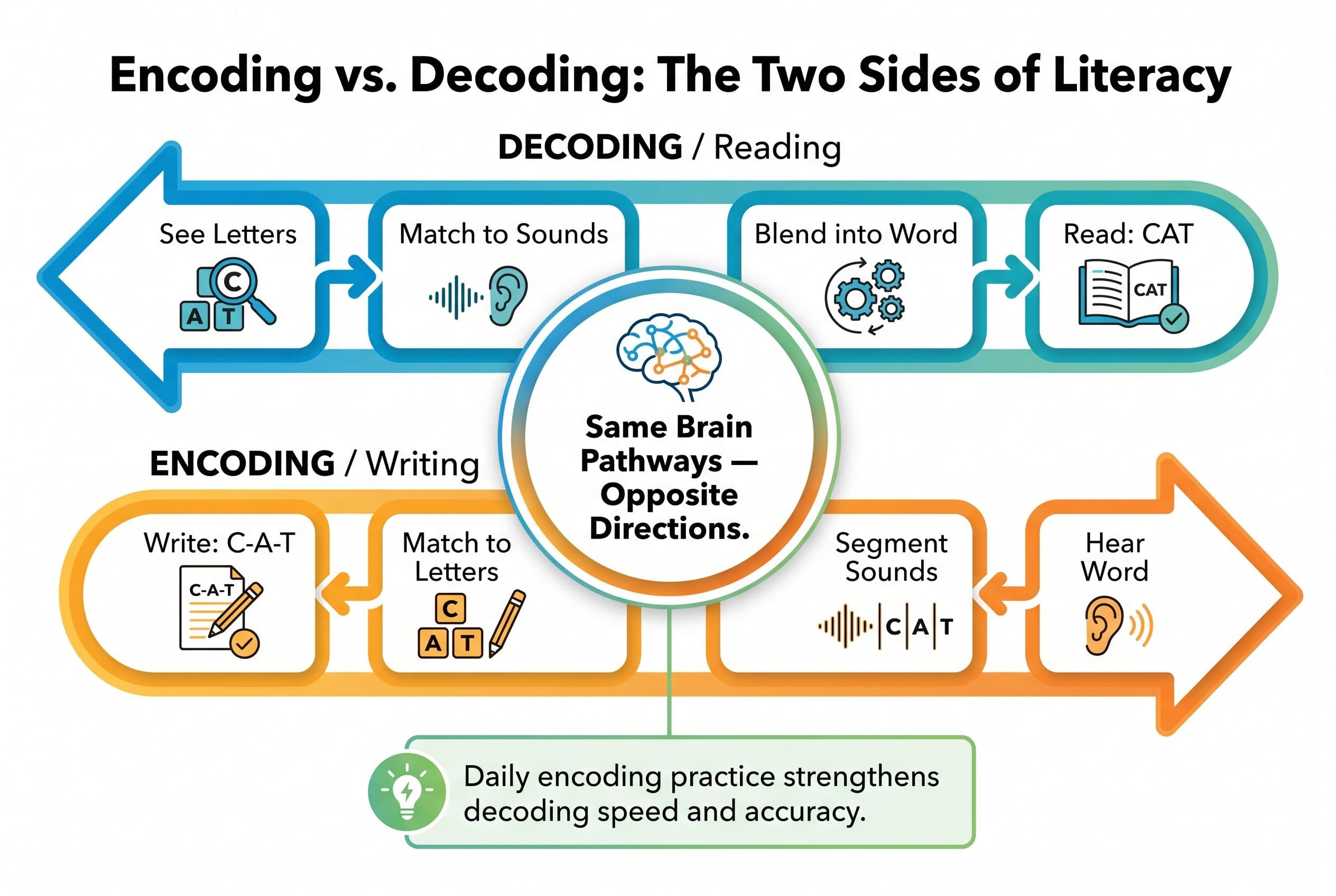
Decoding = seeing letters on a page and converting them to sounds. That's reading.
Encoding = hearing sounds in your head and converting them to letters on paper. That's spelling/writing.
Same underlying code knowledge. Opposite directions.
Honestly, it's a two-way street — and Dehaene's brain imaging studies back this up beautifully. When your kid reads "ship," their brain goes: s-h → /sh/, i → /ĭ/, p → /p/ → "ship." When your kid WRITES "ship," their brain goes: /sh/ → s-h, /ĭ/ → i, /p/ → p → writes S-H-I-P.
The reading direction is easier because the word is right there — the letters are a cue. The writing direction is harder because there's no cue. Your kid has to pull those sounds out of thin air and decide which letters represent them.
And that harder direction? That harder direction? That's where your kid's brain actually locks in the learning.
Linnea Ehri's phases of word reading development (from her 2005 meta-analysis) show that kids move from the pre-alphabetic phase (basically guessing) through partial alphabetic, full alphabetic, and finally consolidated alphabetic. Each phase requires deeper and more precise knowledge of how sounds map to letters. Encoding — writing — forces kids into that precision way faster than reading alone does.
When I taught my oldest to read, I made a rookie mistake. I focused almost entirely on reading for the first few months. Flashcards, decodable books, sounding out words on the whiteboard. She could read "trap" but when I asked her to spell it, she'd write "chrap." That told me something critical: she could recognize the word on the page, but she didn't truly OWN the /tr/ blend in her brain.
So we started doing dictation. Every single day, alongside our reading practice. Within three weeks, she wasn't just spelling better — she was READING faster and more accurately. The writing was training her brain to notice letter patterns she'd been glossing over.
Now with my 4-year-old? We do writing from day one. He's working on CVC words right now, and every time we read a new word, he writes it too. No exceptions. Tiger rules.
How Writing Fixes the Guessing Problem
This one drives me crazy.
Picture a kid — we'll call her Lily — who looks at the word "ship" and blurts out "boat" because there's a picture of a ship sitting right next to it on the page. Sound familiar? Classic three-cueing garbage, by the way. Her teacher nods and says "Good job using your strategies!" That's the three-cueing system (also called MSV — Meaning, Structure, Visual) that Emily Hanford exposed in her 2023 APM Reports investigation Sold a Story. It teaches kids to guess from context and pictures instead of actually decoding.
You know what cures guessing? Writing.
You literally cannot guess when you're writing. There's no picture to look at. There's no context clue. There's just the sound bouncing around in your kid's head and a blank piece of paper staring back at them. Either you know that /sh/ is spelled S-H, or you don't. Either you can segment "ship" into /sh/-/ĭ/-/p/ and map each sound to a letter, or you can't.
Writing is the ultimate accountability tool.
After Sold a Story came out, my neighbor — a first-grade teacher for 18 years — called me almost in tears. She'd been using Lucy Calkins' Units of Study curriculum her entire career. Three-cueing, MSV, the whole thing. She said she'd been teaching kids to guess for two decades and didn't even know it. I was sitting on my porch listening to her tell me all this, coffee getting cold in my hand, and honestly? My stomach just dropped for her. She's a genuinely good teacher, honestly. She just had bad training.
She switched her classroom to UFLI Foundations mid-year. It was messy — she had to relearn everything herself first. But here's the part that matters for THIS conversation: one of the biggest changes she made was adding daily dictation to her phonics block. Five minutes a day. The kids would learn a phonics pattern, read words with that pattern, and then she'd dictate words and simple sentences for them to write.
By spring her kids' DIBELS scores had jumped an average of 15 points on nonsense word fluency. She told me that was the first time in her career where every single kid in her class could decode CVC words by February. Not most kids. Every kid. And she credits the encoding practice as much as the new reading curriculum. Because when those kids had to WRITE the words, they couldn't fake it. They couldn't guess. They had to actually know the sounds.
The Three Writing Activities That Accelerate Reading
OK, let's get into what you can actually do today — like right now, this afternoon, with a pencil and a piece of paper. There are three writing activities I use with all my kids, and they work at every stage of reading development. I'll break each one down.
1. Phonics Dictation (The Non-Negotiable)
This right here? Bread and butter of everything we do. The non-negotiable. We do this every single day — birthdays, Christmas, vacation. Tiger rules: we never skip.
How it works:
-
You say a sound, your kid writes the letter. Start here with pre-readers and early readers. "What letter makes /m/?" They write M. "What letter makes /ă/?" They write A. You're building the encoding habit from the very beginning.
-
You say a word, your kid writes it. OK — this is where it all clicks. Say "mat." Your kid segments it: /m/-/ă/-/t/. They write M-A-T. Start with CVC words (consonant-vowel-consonant). Then move to blends ("stamp"), digraphs ("ship"), and eventually multisyllabic words.
-
You say a sentence, your kid writes it. "The big cat sat." Now they're doing everything at once — segmenting words, remembering spelling patterns, using capitals and periods, AND holding a whole sentence in working memory. This is where fluency starts to click.
The rules:
- No guessing. If they don't know how to spell a sound, you just tell them — straight up. Don't let them guess and write the wrong letter — that cements the wrong mapping in their brain.
- Only dictate patterns they've been taught. If you haven't taught the /oi/ digraph yet, don't dictate "boil." Stick to the sounds and patterns they've already been taught — nothing beyond that scope. This is how programs like Orton-Gillingham and UFLI Foundations structure their lessons — systematic, controlled, cumulative.
- Correct immediately. If they write "shep" for "ship," stop right there. "What vowel sound do you hear in /shĭp/?" Help them hear the /ĭ/ and write the correct letter. Then have them erase and rewrite the whole word correctly. That correction IS the learning.
I had my 4-year-old practicing CVC dictation at the kitchen table last Tuesday. I said "pig" and he wrote P-E-G. So we stopped. I stretched the word out slowly — "/p/..../ĭ/..../g/" — and tapped my finger on the middle sound. "Listen to that middle sound. /ĭ/. What letter?" He nailed it on his second try. Wrote P-I-G. That took maybe 90 seconds, but that 90 seconds built more phonemic precision than reading "pig" in a book 50 times would have.
2. Spelling Practice (Not Memorization — Phonics-Based Spelling)
Let me be real with you: I'm not talking about the old-school "here are 20 words, memorize them by Friday" garbage. That's rote memorization and it does almost nothing for reading development.
I'm talking about phonics-based spelling where your child uses their sound-letter knowledge to BUILD words.
Here's the difference, and it matters more than you think:
- Memorization approach: "The word is 'light.' L-I-G-H-T. Now memorize it." (Teaches nothing about the pattern.)
- Phonics-based approach: "The word is 'light.' What sounds do you hear? /l/-/ī/-/t/. The /ī/ sound in this word is spelled I-G-H. That's the same pattern in 'night,' 'right,' 'sight,' and 'fight.'" (Now they own the pattern.)
Mark Seidenberg, a cognitive scientist at the University of Wisconsin, wrote in Language at the Speed of Sight (2017) that spelling and reading rely on the same underlying knowledge of how written and spoken language connect. He called out the reading education establishment for treating them as separate subjects when the brain doesn't treat them separately at all.
When I work on spelling with my 7-year-old, we group words by pattern. This week we did the -igh pattern: light, fight, night, might, sight, tight, bright, flight, fright. She doesn't just memorize these words — she understands that -igh is one way English spells the long /ī/ sound. So when she encounters "blight" in a book for the first time? She doesn't guess. She doesn't look at a picture. She reads it. Because she's written that pattern dozens of times.
3. Journaling for Beginning Readers (With Rules)
OK so here's where I've gotta give you a warning.
Journaling for beginning readers can be an incredible reading accelerator — or it can be a total disaster. It depends entirely on HOW you do it.
The wrong way: Hand your kid a blank notebook and say "Write whatever you want! Use your best spelling!" This is essentially the "invented spelling" approach that Whole Language advocates love. The theory is that kids will naturally learn correct spelling through exposure over time. The reality? They practice misspelling words over and over, which reinforces the wrong letter patterns in their brains.
The right way: Guided journaling where you control the vocabulary.
Let me walk you through exactly how we do it at our house:
- Your child picks a topic. "I want to write about my dog."
- They say their sentence out loud. "My dog is big."
- They write what they can using phonics knowledge. At the CVC stage, they should be able to write "big" and "is" and "dog" independently.
- YOU supply the words they haven't been taught yet. "My" is a sight word — if they haven't learned it yet, you write it for them or spell it out. No guessing. No "just try your best."
- They read their sentence back to you. This closes the loop — they go from encoding (writing) to decoding (reading) their own words.
Here's my rule though — every single word on that page needs to be spelled correctly before they move on. I mean every. single. one. I honestly don't care if you have to spell half the words for them yourself. A page of correct writing teaches reading. A page of incorrect "invented spelling" teaches... incorrect spelling.
Now look — I know some reading researchers defend invented spelling as a developmental stage, and I won't pretend it's black and white. Very early invented spelling (like a 3-year-old writing "K" for "cat") can reflect growing phonemic awareness, and that's actually a positive sign — it tells you the kid is starting to connect sounds to letters. The problem isn't that developmental phase. The problem is repeated, uncorrected practice — a 5 or 6-year-old writing misspelled words in a school journal week after week that the teacher never corrects. That's how you get a 4th grader who still writes "becuz" and "thay."
If you want a compromise that works: let them attempt the word, then you rewrite the correct spelling underneath and have them rewrite it once correctly. They get the benefit of trying to segment the sounds, AND their brain gets the correct mapping reinforced.
Bottom line: guide the journaling. Control the vocabulary. Correct the spelling.
The Simple View of Reading (And Where Writing Fits In)
Gough and Tunmer proposed the Simple View of Reading back in 1986. It's elegant:
Reading Comprehension = Decoding × Language Comprehension
If either factor is zero, comprehension is zero. You need both. This framework is the backbone of Scarborough's Reading Rope, which breaks reading into lower-level word recognition strands and upper-level language comprehension strands that all weave together.
Here's where writing fits: it strengthens the decoding side of the equation. Every time your child encodes a word — segments the sounds, maps them to letters, writes them in order — they're building the same neural architecture they need for decoding that word when they read.
But writing also strengthens comprehension. When a child writes a sentence, they're not just spelling individual words. They're constructing meaning. They're picking what they want to say, organizing the ideas, choosing their words — all of it happening at once. That's language comprehension in action.
So writing simultaneously trains both sides of the equation. Hands down the most efficient use of your teaching time.
Mississippi figured this out at the policy level. Their Literacy-Based Promotion Act of 2013 — the law that took them from 49th to 21st in national reading scores in 6 years — required evidence-based reading instruction in every elementary classroom. The curricula that schools adopted under that law, programs built on Orton-Gillingham principles and systematic synthetic phonics, all include daily encoding practice. Dictation. Spelling. Writing words and sentences. It wasn't some afterthought tacked on later. It was baked into the instruction from day one.
The 40+ states that have passed Science of Reading legislation since 2019? Most of them are following Mississippi's playbook. And that playbook includes writing as a core component of reading instruction.
Your 10-Minute Daily Writing-for-Reading Routine
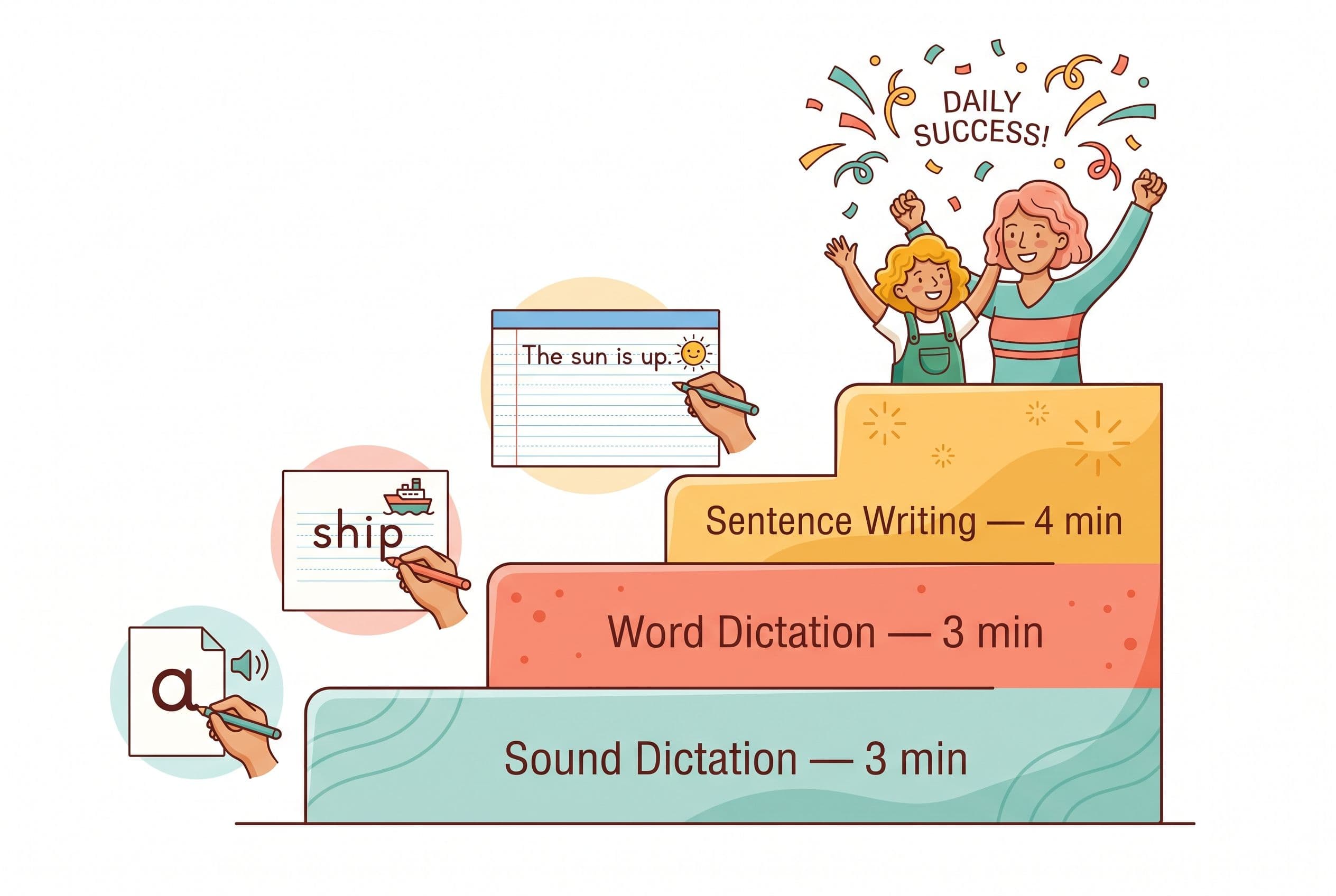
Here's the exact routine I run with my own kids, step by step — stolen straight from Orton-Gillingham principles and tweaked for real life at a kitchen table. Ten minutes. That's it — seriously. Before breakfast, during lunch, after dinner — honestly, I don't care when you squeeze it in. Just do it every single day — no days off.
Minutes 1-3: Sound Dictation Say 5-8 sounds. Your child writes the corresponding letter(s). Start with single sounds (/m/, /s/, /ă/) and progress to digraphs (/sh/, /th/, /ch/) as they learn them.
Minutes 4-7: Word Dictation Say 4-6 words that use phonics patterns your child has already been taught. They write each word. You check immediately. Correct any errors on the spot by having them hear the sound again and write the correct letter.
Minutes 8-10: Sentence Dictation or Guided Journaling Either dictate 1-2 simple sentences ("The fat cat sat on a mat.") or let your child compose their own sentence with your guidance. They write it. They read it back.
Done — pencils down. Ten minutes. Seriously, that's the whole thing right there. That's it. Finished.
If you want to use an assessment to track progress, Kilpatrick's PAST (Phonological Awareness Screening Test) takes about 5 minutes and tells you exactly where the phonological breakdown is. Run it once a month — just takes a few minutes — and you'll actually see, in black and white, how your daily writing practice is moving the needle on your kid's phonemic awareness. Here's what you need to do for fluency benchmarks: go pull up the official DIBELS benchmark tables for your kid's grade. And actually pay attention, because this trips people up constantly — the targets are different depending on which edition your school uses (DIBELS 8th Edition is the most current), which subscore you're looking at (NWF-CLS and NWF-WWR? Totally different animals, I promise you), and whether you're at beginning, middle, or end of year. Don't just grab some random cutoff number from a blog post — look up the exact numbers that match your kid's situation. If your kid is doing daily dictation alongside their reading, they'll hit those benchmarks faster.
What About Handwriting? Does the Physical Act Matter?
Oh, absolutely it does. The research on this is pretty darn clear, too.
Dehaene's brain imaging studies showed that the motor act of forming letters by hand activates the brain's reading circuit more strongly than typing, especially in early learners. When a child writes a letter — not types it, not traces it with a finger on an iPad, but actually picks up a pencil and writes it — their brain builds a motor memory of that letter that reinforces visual recognition.
So please, put down the tablet. I know there are roughly a million "learn to read" apps floating around out there (trust me — I've downloaded and reviewed most of them at this point). And some of them are genuinely useful for specific skills. But for that encoding-decoding connection — the grapheme-phoneme correspondence work that Ehri's phases of word reading are built on — there's honestly no substitute for a pencil and a piece of paper.
Your child doesn't need to have beautiful handwriting. My 4-year-old's letters look like they were written during a minor earthquake. Totally fine by me. The point isn't penmanship — the point is the neurological act of converting a sound to a letter through a physical motor movement. That triangle of sound → letter → hand movement cements the grapheme-phoneme correspondence in a way that's hard to replicate otherwise.
If your child struggles with handwriting so much that it interferes with the spelling practice (some kids with fine motor delays really do), use letter tiles or a moveable alphabet as a bridge. Programs like Fundations include letter tiles for this exact reason. Typing can also work as a bridge for kids with significant motor challenges — just keep the explicit phonics and encoding practice central. But keep working toward handwriting when you can. It matters.
How Our App Teaches Writing Alongside Reading
This right here is why our app, Teach Your Kid to Read, doesn't just flash words on a screen and call it a day — it makes kids build words from scratch, sound by sound, the way Ehri's phases of word reading say they should.
The app uses systematic synthetic phonics based on Orton-Gillingham principles, and encoding is woven into every single lesson. Your child doesn't just see a word and sound it out. They hear a word and construct it. They segment sounds and match them to letters. They practice the same grapheme-phoneme correspondences in BOTH directions — reading and writing — because that's how the brain actually learns.
This isn't a "fun" app that tricks your kid into reading through games and cartoons while they absorb nothing. This is structured, systematic instruction that follows the science. The same science behind Mississippi's reading miracle. The same science behind the Clackmannanshire study (Johnston & Watson, 2005) out of Scotland — 7 years of data showing that synthetic phonics kids who practiced both encoding and decoding outperformed every other group.
We always teach writing along with reading because separating them makes zero sense based on what we know about how the brain processes print. The app does exactly what I do at my kitchen table — it just does it in a format your child can practice with independently so you don't have to run every single session yourself.
Common Mistakes Parents Make With Writing-for-Reading
Real talk — here are the mistakes I see ALL the time:
1. Letting kids practice incorrect spelling. I already ranted about this once, but I'm saying it again because I literally see this exact mistake every single week when I talk to families — and it makes me want to pull my hair out. Every incorrectly spelled word your child writes is a repetition of the wrong pattern in their brain. Correct it immediately or don't let them write it wrong in the first place.
2. Dictating words above the child's phonics level. If your child has only learned short vowels and single consonants, don't dictate "train." They haven't learned the /ai/ vowel team. They'll either guess or get frustrated. Keep dictation within their scope of learned patterns. This is the "controlled" part of systematic phonics and it's non-negotiable.
3. Separating reading and writing into different "subjects." I see homeschool schedules all the time that list "Reading: 9:00 AM" and then way down at the bottom "Writing: 10:30 AM" — as if they're two completely unrelated subjects living on different planets. They're not. Do them together. Read a word, write that word. Read a sentence, write a sentence. The back-and-forth between encoding and decoding is where the deep learning happens.
4. Using worksheets that focus on copying. Copying a word from a model is not encoding. That's transcription. It's a fine motor exercise, not a phonics exercise. Your child needs to hear the word, segment the sounds in their OWN head, and write the letters WITHOUT a model in front of them. That's real encoding.
5. Skipping writing because "they're only 4." My 4-year-old writes CVC words. Not perfectly. Not beautifully. But he does it. If your child can hold a crayon and knows some letter sounds, they can start encoding. It might be one letter at a time. It might be ugly. Do it anyway — ugly or not.
FAQs
Does writing actually help kids learn to read faster?
Yes, and the research backs this up strongly. Encoding (writing/spelling) requires your child to do the HARDER version of what reading asks them to do — instead of recognizing letter patterns on the page, they have to generate those patterns from memory. Stanislas Dehaene's brain imaging research (2009) showed that the motor act of handwriting activates the brain's reading circuit more strongly than passive letter recognition. David Kilpatrick's work on orthographic mapping (2016) explains why: permanent word storage in the brain requires precise phoneme-to-grapheme connections, and spelling practice forces exactly that precision.
At what age should I start dictation with my child?
As soon as they know a handful of letter sounds — typically around ages 3-4 for kids who've started phonics instruction. Start with single sound dictation (you say /m/, they write M) and build from there. By the time your child knows 10-15 letter sounds, they can start writing simple CVC words from dictation. My 4-year-old started CVC dictation after about 6 weeks of learning letter sounds. His handwriting was rough, but the encoding practice accelerated his reading noticeably.
What about invented spelling? People always ask — isn't invented spelling developmentally appropriate?
This is hotly debated, but here's my take grounded in the research: very early invented spelling (a 3-year-old writing "K" for "cat") can reflect growing phonemic awareness, and that's a positive sign — it shows the child is starting to connect sounds to letters. But there's a hard line between acknowledging that developmental stage and actively encouraging kids to practice misspelling words in journals and writing assignments. Mark Seidenberg (2017) is clear that the brain stores what it practices. If your child repeatedly writes "wuz" for "was," that incorrect mapping gets reinforced. A good compromise: let them attempt the word, then rewrite the correct spelling underneath and have them copy it once correctly. They get the segmentation practice, and their brain gets the right mapping. Guide the spelling. Supply the words they don't know yet. Keep the page correct.
How is phonics dictation different from a traditional spelling test?
Traditional spelling tests ask kids to memorize a list of words and reproduce them from memory on Friday. Phonics dictation asks kids to APPLY their phonics knowledge to segment sounds and write corresponding letters — often with words they haven't specifically memorized. The difference is pattern knowledge vs. rote memorization. A kid who passes a spelling test can spell 20 memorized words. A kid who does daily phonics dictation can spell any word that follows patterns they've been taught — including words they've never seen before.
Can I use an app or tablet for writing practice?
For reading instruction in general? Sure, apps like Teach Your Kid to Read have a legitimate role in systematic phonics practice. But for the handwriting component specifically, pencil and paper matters. Dehaene's research shows that the physical motor act of forming letters by hand creates stronger neural connections for letter recognition than tapping or typing, especially for early learners. Use the app for structured encoding activities and phonics practice. But also get out the pencil and a piece of paper and have your child physically write words. Both, not either/or.
The Bottom Line
Using writing to teach reading isn't a bonus activity. It's not some "nice to have" bonus. It's the other half of literacy instruction that most parents — and honestly, most schools — have been leaving on the table for decades.
Every time your child writes a word, they're building the same neural pathways they need to read that word. Every dictation session, every phonics-based spelling practice, every guided journal entry — it all feeds directly into faster, more accurate, more confident reading.
We always teach writing along with reading. No exceptions. No "we'll get to writing later." The two go together like rails on a train track — yank one away and the whole thing derails. No exceptions.
Ten minutes a day. Pencil and paper. Sound it out. Write it down. Read it back.
That's the formula. Now go do it.
Ready to start building your child's reading AND writing skills with a system grounded in the Science of Reading? Visit start lesson one free to learn how Teach Your Kid to Read weaves encoding and decoding together from lesson one — or call us at (407) 707-6850. Your kid's reading future starts with a pencil and a plan.
Part of these guides

Xia Brody
Co-Founder, Teach Your Kid to Read
Mom of 4 who has successfully taught her kids to read. Currently in the trenches with her 4-year-old while her two oldest (10 and 7) devour books on their own. Passionate about phonics-based methods and building a lifelong love of reading.
Related Articles
HOMER Learning App vs ABCmouse: Reading Skills Compared
Choosing between HOMER and ABCmouse? Here’s the no-nonsense reading comparison parents need before handing over the iPad. I compare phonics, decoding, app structure, pricing, and what actually helps kids sound out words.
Read More →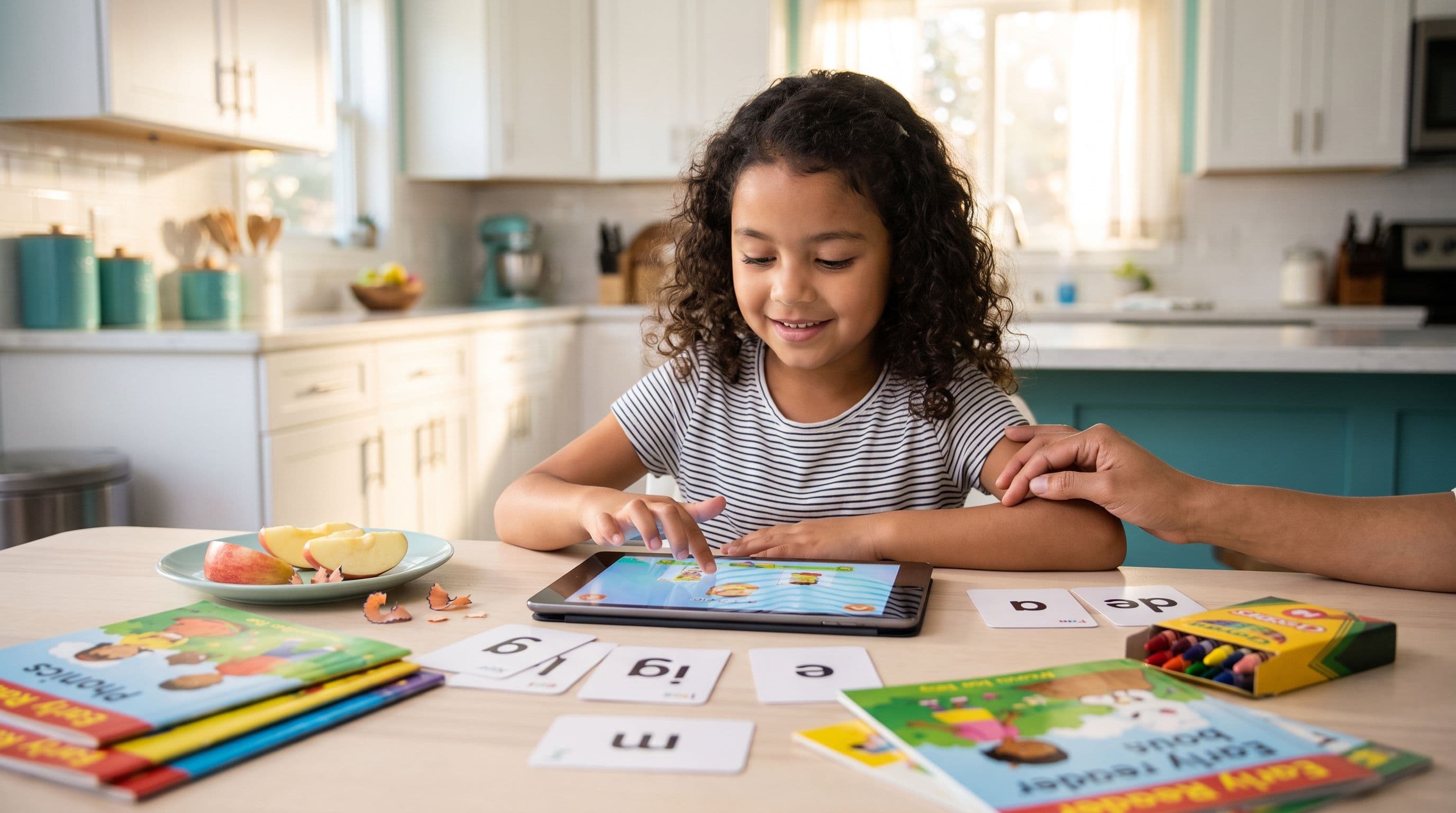
Best Reading App for a Struggling Kindergartner 2026
If your kindergartner is guessing words from pictures, that’s not reading. Here’s my no-nonsense 2026 comparison of kindergarten reading apps, with Teach Your Kid to Read ranked first for systematic phonics.
Read More →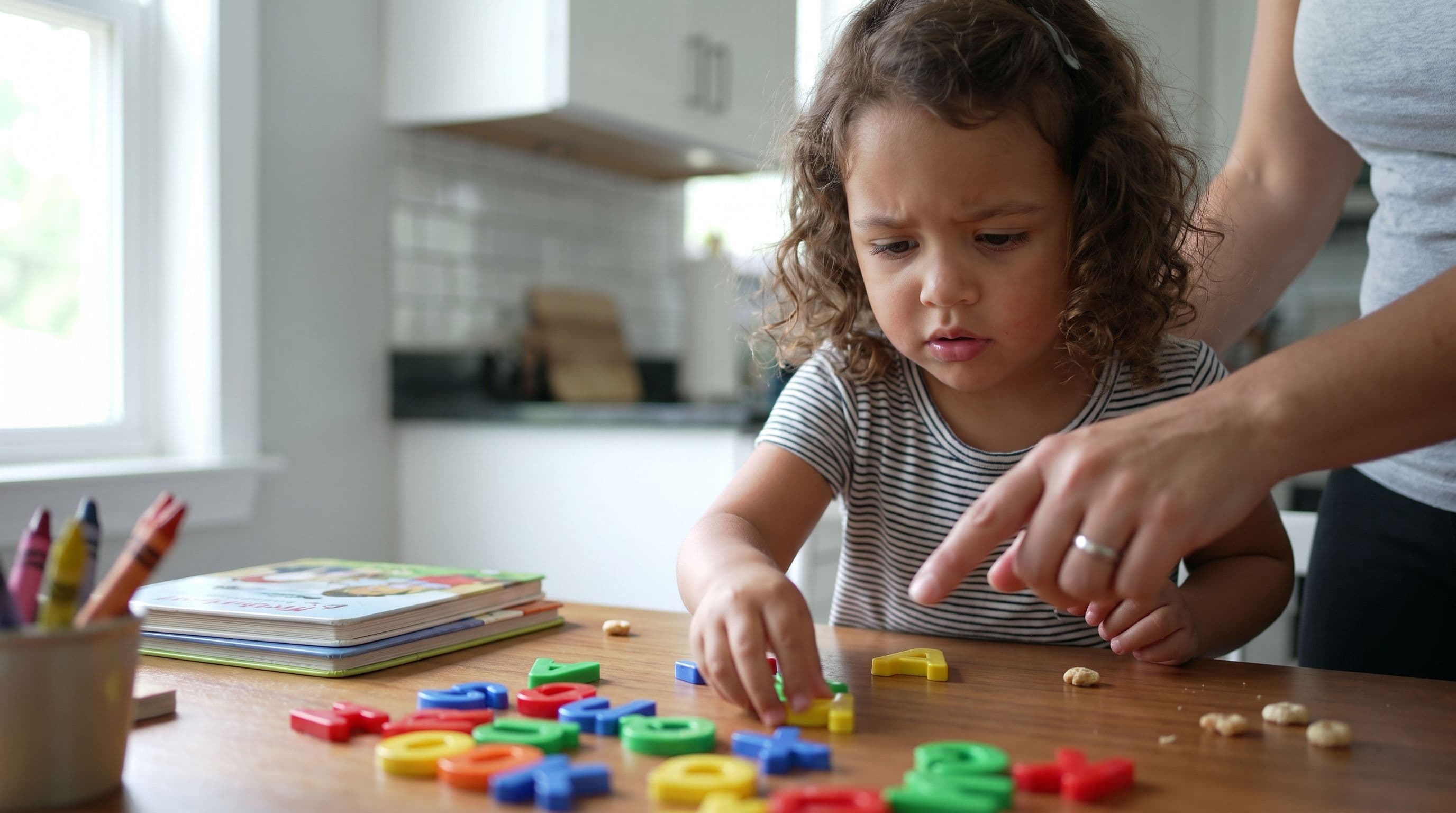
Best Reading App for a 4-Year-Old with Dyslexia Signs: My Top Pick
If your 4-year-old mixes up sounds, guesses from pictures, or avoids letters, don’t wait and see. Here’s my tiger-mom ranking of reading apps that help — and the ones I’d skip.
Read More →