Teach Your Child to Read Punctuation: Periods, Commas & Fluency

What You'll Learn
- The real reason your child sounds like a monotone robot when reading aloud — and why it has nothing to do with intelligence or effort
- Why ignoring punctuation when reading is an early warning sign that most parents completely miss
- The specific drill I use at my kitchen table to teach my kids to pause at periods, lift their voice at question marks, and actually feel commas
- How punctuation connects to reading comprehension — because a kid who blows past a period isn't just reading poorly, they're understanding less
Your Kid Reads Like a Runaway Train. That's a Problem.
Here's a scene I see constantly. A 6- or 7-year-old sits down with a book, opens it up, and starts reading aloud. They decode every word correctly. The parent is thrilled. They're reading!
But listen closer.
The kid plows through periods like they're invisible. Commas? Nonexistent. Question marks get the exact same flat tone as everything else. The whole paragraph comes out as one long breathless stream of words mashed together with zero expression.
That's not reading. That's word-calling.
And honestly? This is one of the most overlooked problems in early reading instruction. Parents spend months (rightly) drilling phonics, teaching letter-sound correspondence, practicing blending — and then when the kid finally starts decoding fluently, everyone celebrates and moves on. Nobody teaches the kid what to do with punctuation marks.
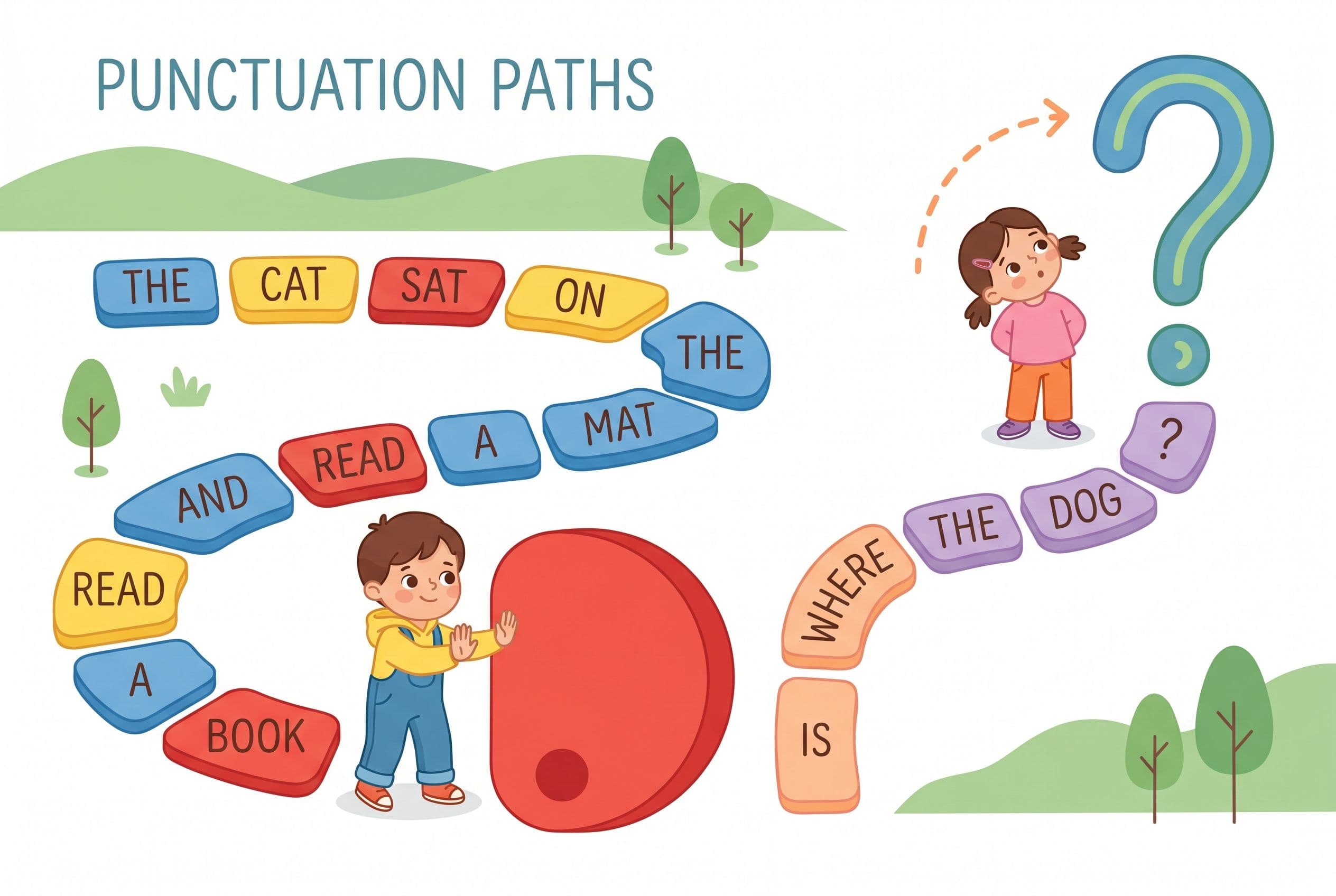
I get it. When my oldest was 5, I was so excited that he could decode "The cat sat on the mat" that I didn't notice he was reading it like "thecatsatonthemat." One flat, expressionless word-dump. No pausing. No inflection. No meaning.
It took me an embarrassingly long time to realize: I never actually taught him what a period means when you're reading.
I just assumed he'd figure it out. He didn't.
The Tiger Truth: What Happens When Kids Ignore Punctuation
Let me be blunt. A child who ignores punctuation when reading isn't just "reading fast" or "being enthusiastic." They're missing a fundamental layer of comprehension.
Here's why this matters so much.
Reading researchers call it prosody — the rhythm, stress, and intonation patterns of speech applied to reading. It's what makes reading sound like talking instead of like a GPS giving directions. And prosody isn't just about sounding nice. It's directly tied to comprehension.
Timothy Rasinski — he's a professor at Kent State and one of the leading researchers on reading fluency — has been saying this for decades. His work shows that prosody is a key component of fluency, and fluency is the bridge between decoding and comprehension. Kids who read without prosody understand less of what they read. Period. (Pun intended.)
Think about it this way. Take this sentence:
"Let's eat, Grandma."
Now take this one:
"Let's eat Grandma."
That comma is the difference between a family dinner and a horror movie. Punctuation carries meaning. When your kid blows past it, they're literally losing information.
And here's the kicker: the damage compounds over time.
The 2022 NAEP — that's the Nation's Report Card — showed only 33% of 4th graders reading at proficient level. One-third. NAEP is primarily a comprehension assessment, so it doesn't score prosody directly — but fluency and prosody matter because they're what support that comprehension. Kids who never learn to read with expression don't just sound bad — they score lower on comprehension tests, they struggle more with complex texts, and by middle school, the gap is enormous.
The Annie E. Casey Foundation's 2010 study found that kids who can't read proficiently by 3rd grade are four times more likely to drop out of high school. Four times. That's a correlation, not destiny — but it's a loud warning sign. And "reading proficiently" doesn't just mean decoding words. It means understanding what you read. It means fluency. It means prosody. It means knowing what a question mark sounds like.
So no, your kid blasting through periods isn't cute. It's a red flag.
Why Schools Don't Teach This Well (Surprise, Surprise)
I was at a playground in Raleigh a couple years back, watching my then-7-year-old monkey-bar his way through recess, when another mom started chatting me up. She mentioned her son's school had just switched from Lucy Calkins' Units of Study to a Science of Reading curriculum because of North Carolina's SB 387 — the Excellent Public Schools Act. She was confused and honestly a little ticked off. "He was doing fine before," she told me. I asked if her kid could read the word "splint." He's in second grade. He could not.
We ended up talking on that playground bench for a solid 20 minutes. I explained what was driving the switch — Emily Hanford's investigative reporting in "Sold a Story" (2023, APM Reports), the NAEP data showing reading scores had dropped 3 points since 2019 (the largest decline in 30 years), the neuroscience from Stanislas Dehaene's lab showing the brain doesn't learn to read naturally the way it learns to speak. Reading has to be taught explicitly. Every piece of it.
And that includes punctuation.
She went home and listened to the "Sold a Story" podcast that night. Texted me at 11pm: "I had no idea. Why didn't anyone tell us this sooner?"
Here's the thing — even in schools that have adopted Science of Reading curricula, punctuation instruction often gets treated like an afterthought. The phonics piece gets the spotlight (as it should). Letter-sound correspondence, blending, segmenting, CVC words, digraphs, vowel teams — all of that gets drilled. Programs like UFLI Foundations and Fundations do a solid job with systematic phonics.
But reading prosody? Teaching kids to actually use punctuation marks when reading aloud? That falls into the fluency bucket, and fluency instruction is wildly inconsistent across schools. Some teachers model expressive reading beautifully. Others just have kids read aloud in round-robin (which research has shown is basically useless — it's anxious kids waiting for their turn instead of actually practicing).
Bottom line: if you want your kid to read punctuation correctly, you're probably going to have to teach it yourself.
Good news? It's not hard. You just have to be intentional about it.
What Kids Actually Need to Know About Punctuation Marks
Before I give you the drill, let's get clear on what we're teaching. When I say "teach your child to read punctuation," I'm talking about three specific skills:
1. Recognition: The kid can see and name the punctuation mark.
2. Action: The kid knows what to DO when they hit that mark — pause, stop, change voice, etc.
3. Automaticity: The kid does it without thinking, the same way they decode a word without sounding out each letter.
Most parents stop at recognition. "That's a period, sweetie!" Great. But does your kid actually stop when they see it? Do they take a breath? Do they drop their voice slightly to signal the end of a thought?
That's where the real teaching happens.
Here's my basic punctuation ruleset that I've taught all my kids. I literally have this written on an index card taped to our reading shelf:
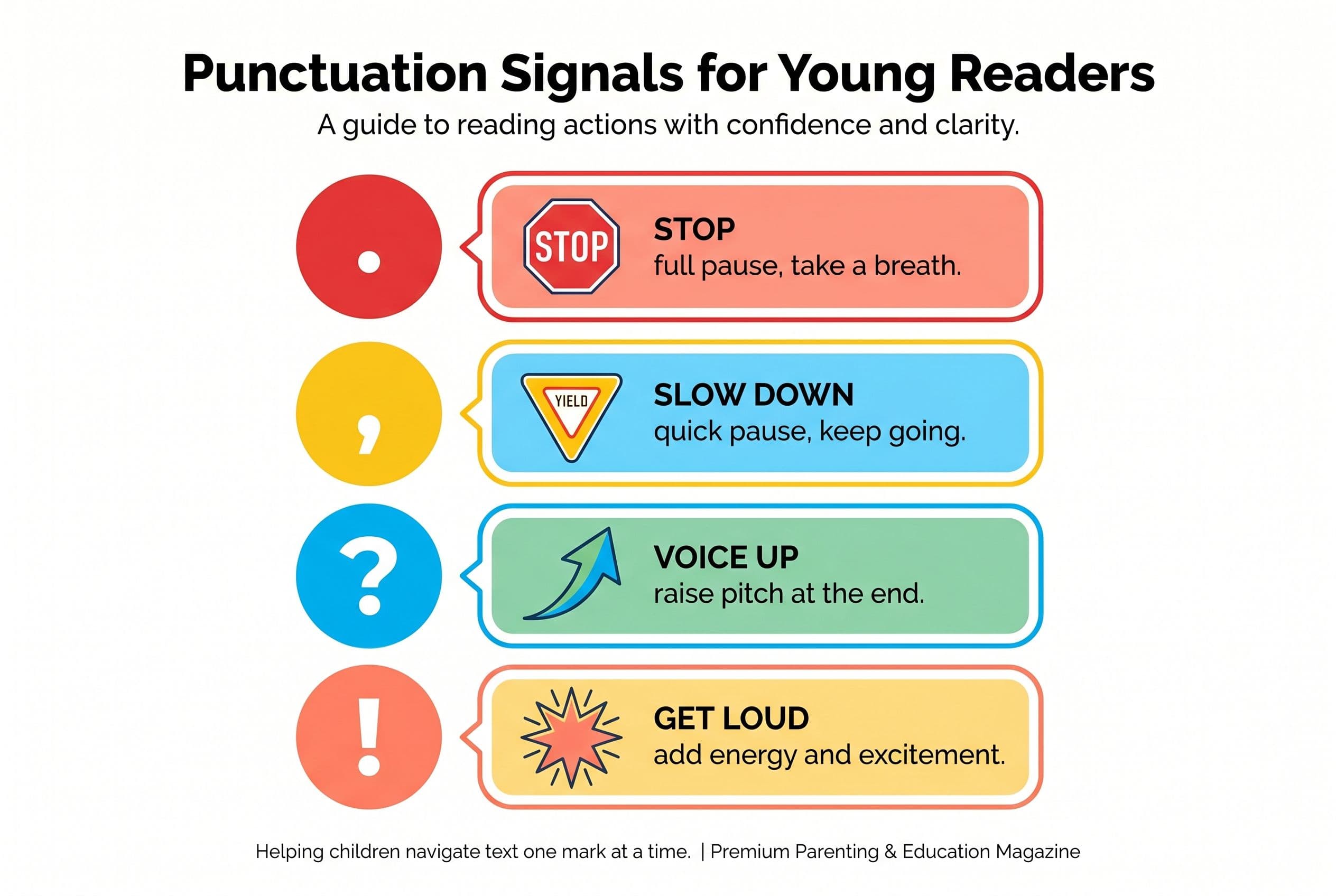
- Period (.) = STOP. Full breath. The thought is done. Start the next sentence fresh.
- Comma (,) = SLOW DOWN. Quick pause — like a speed bump, not a stop sign. Keep the thought going.
- Question mark (?) = STOP + VOICE GOES UP. Your voice should rise at the end, like you're actually asking someone a question.
- Exclamation point (!) = STOP + LOUD/EXCITED. Put some energy into it. Something big just happened.
- Quotation marks ("") = CHANGE YOUR VOICE. Someone is talking. Sound like a person, not a narrator.
That's it. Five rules. My 4-year-old can recite them. (Whether she follows them consistently is another story — she's 4 — but she knows them.)
The Xia Brody Punctuation Drill: Step by Step
OK so here's exactly what I do. This is the drill I've used with my two oldest kids, and I'm starting it now with my 4-year-old as she begins reading simple sentences.
Step 1: Teach the Marks in Isolation First
Before your kid ever encounters punctuation in a book, teach them what the marks look like and what they mean. I use a whiteboard.
I write a period, a comma, a question mark, and an exclamation point. Big. One at a time. We talk about each one. I give them the action: "When you see this dot, you STOP."
Then I quiz them. I point to a mark randomly. They tell me the action. We do this for maybe 3 minutes.
Yes, really. Three minutes. That's all it takes to build the foundation.
Step 2: The "Traffic Signal" Game
This is the one my kids actually love (I know, I know — I said I hate the "fun" trap, but this genuinely works AND teaches something real).
I read a passage aloud. When I hit a period, I hold up a red card (or my hand in a fist — STOP). When I hit a comma, I hold up a yellow card (or an open palm — SLOW DOWN). Question mark? I raise my eyebrows exaggeratedly and tilt my head.
Then they read the same passage, and I hold up the cards as they approach each punctuation mark. The visual cue reminds them to actually do something.
After a few sessions, I stop holding up cards. They internalize it. My 7-year-old needed about 5 sessions of this before periods became automatic. Question marks took a bit longer — maybe 2 weeks of daily practice.
Step 3: Echo Reading
I read one sentence with exaggerated prosody. They read the same sentence back, copying my expression and pausing.
This is based on the principle behind Linnea Ehri's work on phases of reading development — kids move from partial to full to consolidated alphabetic phases. In the same way, prosody goes from imitated to internalized. They have to hear it modeled correctly dozens of times before they can produce it independently.
I do echo reading for about 5 minutes a day during our reading time. That's it. Short. Consistent. Non-negotiable.
Step 4: "Catch the Mistake" Drill
I read a passage intentionally WRONG. I blow past a period without stopping. I read a question in a flat voice. I pause in weird places.
My kid's job? Catch me.
Kids LOVE correcting their parents. My 7-year-old lights up like a Christmas tree when he catches me making a punctuation error. "MOM. THAT WAS A QUESTION MARK. You didn't go UP!"
Perfect. He's paying attention to punctuation now. That awareness transfers directly to his own reading.
Step 5: Independent Practice with Decodable Texts
Once the kid can handle all four marks (period, comma, question mark, exclamation point), I set them loose on decodable readers. Not leveled readers — decodable readers. There's a difference.
Many leveled-reader systems were paired with cueing and guessing prompts — predict from the picture, look at the first letter, skip it and come back. If your child is still learning to decode, decodables are the safer tool because they force print-based decoding. I use decodable readers from publishers like Flyleaf Publishing or the Bob Books series, where every word is phonetically controlled and the kid has to actually decode.
As they read, I listen for prosody. If they blow past a period, I stop them. "What was that mark?" They identify it. "What do we do?" They tell me. "Read it again." They re-read the sentence with the correct pause.
Every. Single. Time.
No guessing. No skipping. No "close enough." Tiger Rules apply to punctuation the same way they apply to phonics.
How Teach Your Kid to Read Handles This
Look, I built Teach Your Kid to Read because I got tired of piecemealing curriculum together at my kitchen table. The app is built on Orton-Gillingham principles — systematic, explicit, multisensory — and it follows the research on synthetic phonics that the Clackmannanshire study (Johnston & Watson, 2005) validated over 7 years of longitudinal data.
But here's what makes it different from most phonics apps: it doesn't treat fluency as an afterthought.
The lessons build toward connected reading, which means your kid isn't just decoding isolated words forever. They move into sentences and passages that require them to practice reading with expression. Punctuation marks are introduced explicitly — not as a grammar lesson, but as a reading skill.
The Simple View of Reading (Gough & Tunmer, 1986) says Reading Comprehension = Decoding × Language Comprehension. Prosody isn't a third factor in that formula — it's a sign that decoding is becoming automatic, and it supports the phrasing and meaning-making that feed comprehension. A kid who can decode but reads in a flat monotone? That automaticity isn't there yet, and comprehension suffers.
Teach Your Kid to Read addresses both sides. Systematic phonics builds the decoding. Expressive reading practice — with explicit punctuation instruction — builds the fluency and prosody that feed comprehension.
If you want to see how it works, check out start lesson one free or call us at (314) 285-9505. Real talk — I built this for parents like me. Parents who don't want to wait for the school to figure it out.
Benchmarks: What Should This Look Like at Each Age?
Parents always ask me, "Is my kid where they should be?" So here's a rough guide. Every child is different, and I never promise specific timelines. But these are reasonable targets based on reading research and my own experience teaching four kids.
Ages 3-4 (Pre-Reader):
- During read-alouds, notices when YOU pause or change your voice
- Starts picking up on the rhythm of sentences — hearing where they end, when your tone shifts
- Can point to "the dot at the end" if you show them, but the real work here is listening, not visual identification
Ages 4-5 (Emergent Reader):
- Can identify a period, question mark, and exclamation point by sight
- Understands that a period means "the sentence is done"
- Pauses at periods when reading simple sentences (even if you have to remind them)
- Attempts to raise voice at question marks with prompting
- Matches your pauses and question-voice on most sentences during echo reading
Ages 5-6 (Beginning Reader):
- Automatically pauses at periods without prompting
- Reads questions with rising intonation
- Handles commas with a brief pause (this one takes the longest — commas are tricky)
- Begins using expression for exclamation points and dialogue
Ages 6-7 (Developing Reader):
- Reads aloud with natural-sounding prosody for grade-level text
- Self-corrects when they blow past a punctuation mark
- Can explain what each punctuation mark "tells the reader to do"
If your kid is behind on these benchmarks, don't panic. But don't wait, either. Start the drill I outlined above. Today. Not next week.
If you want a formal assessment, Kilpatrick's PAST (Phonological Awareness Screening Test) takes about 5 minutes and tells you exactly where the phonological breakdown is. It won't test prosody directly, but if there are underlying phonemic awareness gaps, those need to be fixed first — a kid who's still struggling to decode isn't ready for prosody work. DIBELS (Dynamic Indicators of Basic Early Literacy Skills) oral reading fluency benchmarks can help too — typical end-of-year first-grade targets are often in the high-40s for words correct per minute, though exact numbers vary by DIBELS edition and your school's benchmark chart. Ask your school which version they use. But here's the thing: those numbers are meaningless if the reading is flat and expressionless. Fluency isn't just speed. It's accuracy + rate + prosody, all three.
The Biggest Mistake Parents Make (And How to Fix It)
The number one mistake? Praising speed over expression.
"Wow, you read that so fast!" No. Stop saying that. Speed without prosody is just word-calling. You're training your kid to race through text without actually processing it.
Instead, say this:
"I love how you stopped at that period. That sounded like real reading."
"Did you hear how your voice went up at the question mark? That was perfect."
"Read that sentence again, but this time, show me what the exclamation point sounds like."
You're shifting the reward from speed to expression. From quantity to quality. From decoding to reading.
And for the love of all things literate, do NOT let your kid use a finger to race along the text while ignoring every punctuation mark. The finger-pointing technique is great for tracking words. But if the finger doesn't pause at punctuation, it becomes a speed tool instead of a comprehension tool.
My rule: the finger stops at every period. Full stop. (Literally.)
When to Worry — And When to Get Help
Most kids who ignore punctuation just haven't been taught to pay attention to it. That's fixable in a few weeks with consistent practice. No big deal.
But sometimes, persistent flat reading is a sign of something deeper. If your child is 7+ and still can't read with any expression despite months of explicit instruction, consider:
- An underlying decoding problem. If the kid is spending all their cognitive energy on sounding out words, there's nothing left for prosody. You can't read expressively if you're still struggling to decode. Fix the phonics first.
- A language processing issue. Some kids have difficulty with the rhythm and melody of language in general — not just in reading. If your child also speaks in a flat, monotone way, that's worth discussing with a speech-language pathologist.
- A fluency-specific intervention need. Programs like Read Naturally and Great Leaps are designed specifically for building reading fluency, including prosody. If your home practice isn't moving the needle after 6-8 weeks of daily work, look into these.
Don't do the "Wait and See" thing. I've talked to too many parents who waited. Waited for the school. Waited for "readiness." Waited until 3rd grade, when their kid hit the cliff. Mississippi didn't wait — they passed the Literacy-Based Promotion Act in 2013, mandated evidence-based reading instruction, and went from 49th to 21st in national reading scores in 6 years. Action works. Waiting doesn't.
Ready to start? Visit start lesson one free to see how Teach Your Kid to Read builds phonics AND fluency from day one. Or text/call me at (314) 285-9505. I answer parent questions personally.
FAQ: Teaching Kids to Read Punctuation
At what age should I start teaching punctuation in reading?
As soon as your child starts reading simple sentences — usually around age 4 or 5. But you can lay the groundwork even earlier during read-alouds. When you read to your toddler, exaggerate your pauses at periods and your voice changes at question marks. They absorb more than you think.
My child decodes well but reads in a flat, robotic voice. Is that normal?
It's common, but it's not something to ignore. Many kids who are strong decoders never received explicit instruction on what to DO with punctuation marks. It's like teaching someone to drive a car but never explaining traffic signs. Start the echo reading and traffic signal drills I described above. You should see improvement within 2-3 weeks of daily practice.
Should I correct my child every time they miss a period?
Yes. Every time. I know that sounds harsh, but this is a Tiger Rule: no skipping. If you let it slide sometimes, you're teaching them that punctuation is optional. Stop them gently — "Oops, what was that mark?" — have them identify it, state the rule, and re-read the sentence. It takes 10 extra seconds and it builds the habit permanently.
Does reading punctuation really affect comprehension?
Absolutely. Timothy Rasinski's research at Kent State has consistently shown that prosody — reading with appropriate expression, phrasing, and pausing — is strongly correlated with reading comprehension. Kids who read with expression understand more of what they read. It's not just about sounding good. The pauses and inflections help the brain process the meaning of the text in real time.
What if my child has been reading without expression for years? Is it too late?
It's never too late, but it does get harder to retrain habits the longer they persist. If your child is 8 or older and still reading in a monotone, start with echo reading — it's the fastest way to model correct prosody. Do it daily for at least 6 weeks before deciding whether you need professional help. And rule out underlying decoding issues first — if the kid is still struggling to sound out words, prosody work won't stick until the phonics foundation is solid.
Xia Brody is a Reading Education Specialist, Early Literacy Advocate, and co-founder of start lesson one free. She's a homeschooling mom of 4 who believes reading is a survival skill, not an elective. Follow her work at TeachYourKidToRead.org.
Part of these guides

Xia Brody
Co-Founder, Teach Your Kid to Read
Mom of 4 who has successfully taught her kids to read. Currently in the trenches with her 4-year-old while her two oldest (10 and 7) devour books on their own. Passionate about phonics-based methods and building a lifelong love of reading.
Related Articles
Is My 2nd Grader Behind in Reading? 9 Signs
Wondering if your 2nd grader is behind in reading? Here are the real warning signs, what 2nd graders should be able to do, and what to do next if your child is guessing, slow, or stuck.
Read More →
Reading Eggs vs ABCmouse Cost: 2026 Price Breakdown
Comparing Reading Eggs vs ABCmouse cost? Here’s the 2026 price breakdown, what each app teaches, and why I’d choose phonics-first instruction over reward-heavy screen time.
Read More →
Reading Readiness Checklist for Kindergarten: Free PDF
Wondering if your child is ready to read in kindergarten? Here’s the no-fluff reading readiness checklist I use at my own kitchen table, plus what to do if your child isn’t there yet.
Read More →