Reading Comprehension for 6-Year-Olds: Strategies That Actually Work
What You'll Learn
- Why your child can "read" out loud but can't tell you what just happened in the story — and the one shift that fixes it
- The mistake almost every parent makes that accidentally teaches kids reading is a speed race
- A dead-simple question framework you can use during any story to build real comprehension — starting tonight
- Why phonics comes before comprehension and what happens when you skip that step
Your Kid Can Read the Words. But Can They Tell You What Happened?
Here's a scene I see all the time. A 6-year-old sits on the couch, reads a full page out loud — every word correct — then you ask, "What was that page about?" And they stare at you like you just asked them to explain tax law.
Blank face. Shrug. "I don't know."
That's not reading. That's word-calling.
Reading comprehension for 6-year-olds is the part where the words on the page actually mean something in your child's brain. Where they can picture the story, connect it to their own life, and tell you — in their own words — what just happened. Without that, your kid is basically a human text-to-speech engine.
And look, I get it. When your first grader finally starts sounding out words on their own, it feels like a miracle. You want to celebrate. You should celebrate! But don't stop there. Decoding words is the foundation. Comprehension is the house. Nobody lives in a foundation.
The Tiger Truth: What Happens When You Ignore Comprehension
Let me tell you about the 3rd Grade Cliff. It's real, it's steep, and it's waiting for every kid who can decode but can't understand.
Up through about second grade, kids are "learning to read." Starting in third grade, they flip — they're "reading to learn." Science textbooks. Word problems in math. Social studies passages. If your child hits third grade and still can't tell you what a paragraph was about, they don't just fall behind in reading. They fall behind in everything.
The National Assessment of Educational Progress data is brutal. Two-thirds of American fourth graders read below proficiency. Two-thirds. And the kids who can't comprehend what they read by the end of third grade? They almost never catch up.
So no, this isn't a "they'll get it eventually" situation. Waiting is the worst thing you can do. Your 6-year-old is at the perfect age to start building comprehension skills right alongside their decoding skills. The window is wide open. Don't waste it.
First Things First: Phonics Before Comprehension
Here's the thing — your child can't comprehend what they're reading independently if decoding is shaky. The brain can only do so much at once. If all their mental energy is going toward sounding out words, there's nothing left for meaning. Decoding has to get automatic so the brain has room for the actual story.
Now, you can build comprehension through read-alouds anytime — even before your kid reads a single word on their own. (That's why reading aloud to them matters so much, but we'll get there.) The point is: for your child to understand what they're reading from print, decoding can't be a struggle. It has to be on autopilot.
And here's where I'll probably annoy some people: prioritize letter sounds for reading. Letter names are fine — just don't let them replace sound work.
Knowing that a letter is called "double-u" doesn't help your kid read the word "wet." Knowing the letter makes the /w/ sound? That's useful. Letter names have their place — they help kids talk about letters and can support spelling later — but when it comes to actually reading words off a page, automatic sound recall is what matters. Lead with sounds. Teach names alongside or shortly after, but keep the focus on sounds for decoding.
My second kid, Lian, is the proof. She went from zero letter sounds at age 4 to reading simple chapter books by age 6. Not because she's gifted — she's not (sorry, Lian, you're wonderful but let's be honest). It happened because we did phonics practice every single day. Birthdays. Christmas. Vacation. My husband thought I was insane. Other parents at the park would give me looks when I'd pull out flashcards between the swings and the slide.
She's 7 now and reads for fun. Actual fun — she'll curl up with a book instead of asking for the iPad. Every parent who judged me for the flashcards-at-the-park thing has since asked me how I did it. The answer is boring: consistency. Every. Single. Day.
But here's the part I want you to hear: even with all that phonics work, I still had to actively teach Lian comprehension. She could decode anything I put in front of her. But around age 6, I realized she was racing through pages without absorbing anything. She'd finish a story and couldn't answer basic comprehension questions for early readers like "Who was the main character?" or "What problem did they have?"
Decoding was automatic. Comprehension was not. I had to build it deliberately.
Read to Your Child Every Single Day
This is the most boring piece of advice I'll give you. It's also the most important.
Read to your child every day. Not "when you have time." Not "a few times a week." Every day. From real, physical books.
Why? Because children model their parents. Period. If your kid sees you reading, sees books as a normal part of daily life, sees that stories are something the family does together — they internalize that reading is just what people do. It's not a chore. It's not homework. It's as normal as eating dinner.
I read to all four of my kids every night. My 1-year-old chews on board books (close enough). My 4-year-old sits in my lap. My 7-year-old reads alongside me. My 10-year-old reads his own book on the couch next to us. It's not a Pinterest-perfect scene — someone's always whining, someone's always wiggling — but it happens. Every night.
This daily read-aloud habit does two things for reading comprehension in 6-year-olds:
- It exposes them to vocabulary and sentence structures beyond their own reading level. Your 6-year-old can understand stories far more complex than what they can decode on their own. Read-alouds bridge that gap.
- It gives you a natural opening to ask comprehension questions. (More on that in a sec.)
Real talk — if you do nothing else from this article, do this. Read aloud to your kid every day. It costs zero dollars and takes 15 minutes.
Stop Rewarding Speed. Start Rewarding Understanding.
This one drives me crazy.
Somewhere along the way, parents and schools started treating reading like a race. How many words per minute? How many books this month? Reading logs. Accelerated Reader points. Gold stars for finishing first.
Reading fast is not the goal. Remembering what they read — and connecting it to their own life — is the goal.
When Lian was 6 and plowing through early readers, I noticed she'd finish a book and immediately grab another one. She was proud of how fast she could get through them. And I thought, OK, this looks great from the outside. But when I sat her down and asked, "Tell me about the story you just read," she gave me fragments. A character name. Maybe one event. Nothing connected.
So I slowed her down. Way down.
We'd read a short story — one sitting, maybe 8-10 pages — and then I'd close the book and ask her questions. Not "gotcha" questions. Not quiz-show-style interrogation. Just real, curious questions about what happened and why.
That shift changed everything. She went from speed-reading and retaining nothing to reading slowly and understanding deeply. Her retelling got richer. She started making predictions. She started connecting stories to things that happened to her at the park or with her siblings.
Slow is fast. Write that on a sticky note.
The Question Framework: How to Build Comprehension During Any Story
OK so here's the practical part. The reading comprehension strategies for 6-year-olds that you can start using tonight. No special materials needed. Just you, your kid, and a book.
The key: ask questions while you read together, not just after. For short books (picture books, early readers), ask a few questions after you finish. For longer stories, stop between sections — every few pages — and check in.
Here are the types of comprehension questions for early readers that actually build understanding:
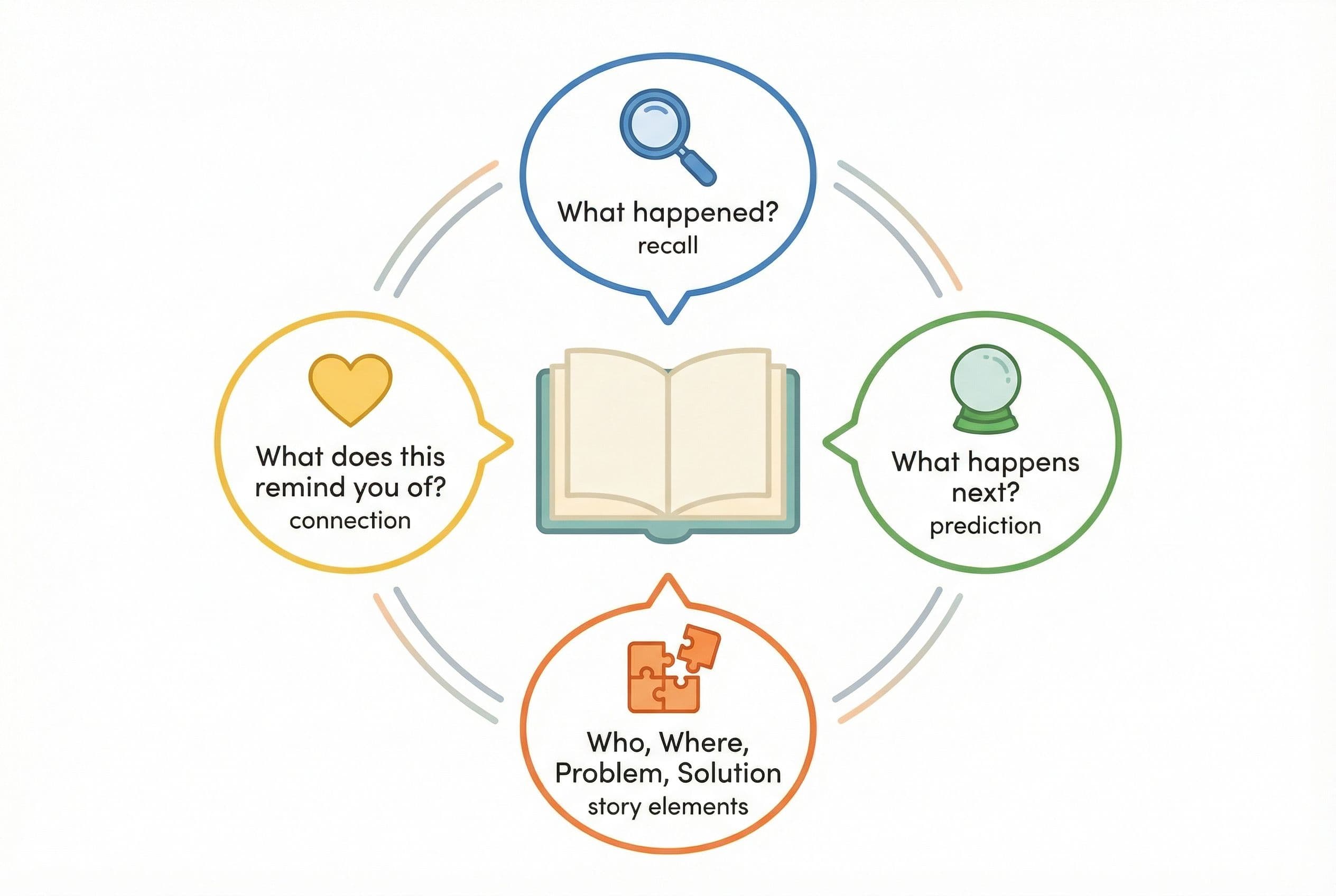
1. Recall Questions (What Happened?)
These are the basics. Can your child retell what just happened?
- "What happened on that page?"
- "Who was in the story so far?"
- "What did [character] do when [event] happened?"
Don't accept "I don't know." If they can't answer, go back and reread the page together. No shame, no frustration — just, "Let's read it again and really pay attention this time."
2. Connection Questions (What Does This Remind You Of?)
This is where comprehension goes from surface-level to deep. You're asking your child to link the story to their own experience.
- "Has anything like that ever happened to you?"
- "How would you feel if you were [character] right now?"
- "Does this remind you of another story we've read?"
Lian and I had a great moment with this. We were reading a story about a kid who felt left out at recess, and I asked, "Has that ever happened to you?" She got quiet and said, "Yeah, when Maya didn't want to play with me at co-op." And suddenly the story wasn't just words on a page. It was real.
That's comprehension. That's the whole point.
3. Prediction Questions (What Will Happen Next?)
These teach your child to actively think while reading, not just passively absorb.
- "What do you think will happen next?"
- "What would you do if you were [character]?"
- "Do you think [character] will make a good choice or a bad choice?"
Stop before a page turn. Let them guess. Then read on and see. They'll be wrong half the time. That's fine. The guessing itself builds the muscle.
4. Story Element Questions (The Building Blocks)
Story elements for first graders don't need to be complicated. You're just getting them to identify the basic parts:
- Characters: "Who is this story about?"
- Setting: "Where does this story happen?"
- Problem: "What's the problem the character has?"
- Solution: "How did they fix it?"
Once your kid can reliably answer these four questions after a story, they're building a mental framework they'll use for the rest of their reading life. Every novel, every textbook passage, every news article — it all comes back to these building blocks.
Retelling: The Comprehension Skill That Rules Them All
If I had to pick one comprehension exercise for a 6-year-old, it would be retelling. Hands down.
After you finish a story, close the book and say: "OK, tell me the whole story in your own words. From the beginning."
Then sit there and listen.
Retelling strategies for kids are deceptively simple. Your child has to remember the characters, the order of events, the problem, and the solution — and organize it all into a coherent narrative. That's high-level thinking for a 6-year-old. It's also the foundation of every book report, essay, and presentation they'll ever give.
At first, Lian's retellings were a mess. "There was a dog and he... um... he went to the park? And then he was sad. The end." I'd gently prompt her: "OK, but what happened before the park? Why was he sad? What happened at the very end?"
Over weeks — not days, weeks — her retellings got longer, more detailed, more organized. She started using words like "first" and "then" and "at the end" without me coaching her. That's comprehension growing in real time.
First Grade Comprehension Activities You Can Do At Home
You don't need a curriculum for this. You need books and 15-20 minutes a day.
Here's my actual routine — what I did with Lian at 6, what I'm starting with my 4-year-old now:
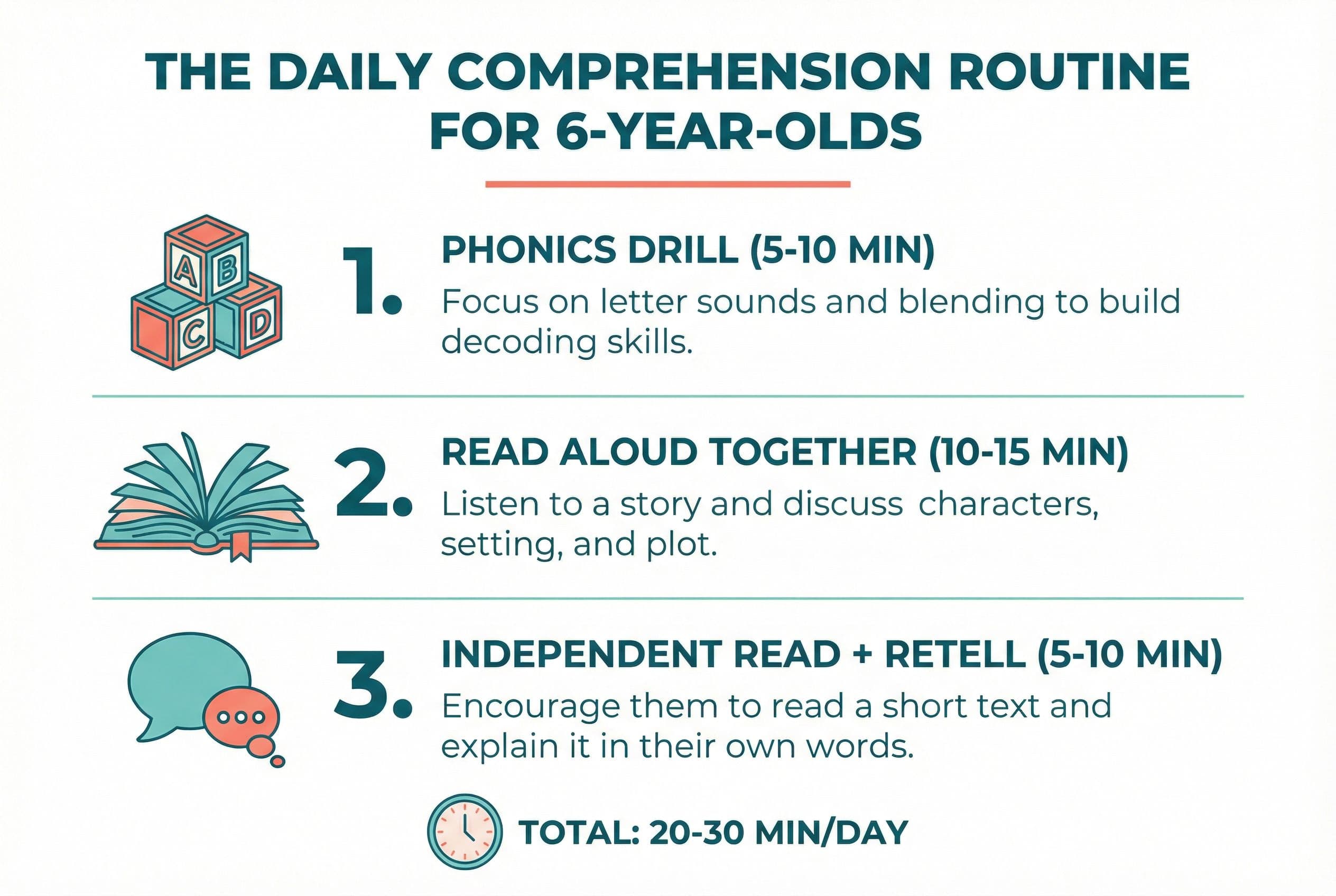
Step 1: Phonics practice (5-10 minutes). Before we read anything, we drill sounds. CVC words, blends, digraphs — whatever level they're at. You can use our app at start lesson one free or get hands-on reading material that takes you step by step through the process. The point is systematic, sequential phonics instruction. Not random letters on a fridge.
Step 2: Read aloud together (10-15 minutes). I pick a book slightly above their independent reading level and read it to them. Or we take turns — I read a page, they read a page. During the read-aloud, I stop every few pages and ask 1-2 questions. Nothing heavy. Just checking in.
Step 3: Independent reading + retelling (5-10 minutes). They read a short, decodable book on their own — one at their level. Then they close the book and retell the story to me. I ask follow-up questions based on what they say.
That's it. 20-30 minutes total. Every day. Birthdays, Christmas, vacation.
No App Will Teach Your Child to Read Without You
Let me be blunt about something.
There is no app that will teach your child to read without a lot of time, effort, and involvement from you. None. Zero. I don't care what the App Store reviews say.
Apps can be great tools. Our app at Teach Your Kid to Read is specifically designed to walk parents through phonics instruction step by step — and it works because you're doing it with your child. You're sitting next to them. You're hearing them sound out words. You're correcting mistakes in real time. You're asking, "What did that word mean?" and "What happened in that story?"
An app your kid uses alone while you scroll your phone in the other room? That's not reading instruction. That's an electronic babysitter with a literacy-themed skin.
The parent-guided approach is the whole thing. It's the secret. It's also the hard part, which is why most people don't want to hear it.
What Reading Comprehension Looks Like at Age 6 (Realistic Expectations)
I don't make false promises about reading timelines. Every kid is different. But here's roughly what solid reading comprehension for 6-year-olds looks like:
- They can retell a simple story with a beginning, middle, and end — even if they need a prompt or two.
- They can identify the main character and something that happened to them.
- They can answer basic "who, what, where" questions about a story they just read or heard.
- They're starting to make predictions ("I think the cat will run away") even if the predictions are wild.
- They can connect a story to something in their own life ("That's like when my brother took my toy").
If your 6-year-old can't do these things yet, don't panic. But don't wait, either. Start the daily routine. Ask the questions. Build the skill.
And if your 6-year-old is still struggling with decoding — still guessing at words from pictures, still not blending letter sounds — address that first. Comprehension can't happen if decoding isn't solid. Get your phonics foundation locked in, then layer comprehension on top.
Frequently Asked Questions
How do I know if my 6-year-old has a comprehension problem or a decoding problem?
Simple test: read them a story out loud (so they don't have to decode anything) and then ask them to retell it. If they can retell a story they heard but can't retell a story they read, the issue is decoding — their brain is working so hard to sound out words that there's no mental energy left for meaning. Fix the phonics first. If they can't retell a story they heard either, you're looking at a comprehension issue and need to start with the question framework and daily read-alouds.
How long does it take to improve reading comprehension in first grade?
You'll start seeing improvement within a few weeks of consistent daily practice — better retellings, more detailed answers, unprompted connections to their own life. But real, deep comprehension is a long game. Think months, not days. The daily habit is what gets you there.
What books are best for building reading comprehension for 6-year-olds?
Use two types: (1) decodable readers at their independent level for the stories they read on their own, and (2) richer picture books or early chapter books that are slightly above their level for your read-alouds. The decodable readers build decoding fluency. The read-alouds build vocabulary, story structure awareness, and give you material for great comprehension questions.
Should I correct my 6-year-old when they retell a story wrong?
Gently, yes. Don't say "Wrong!" Say something like, "Hmm, let me see — I think something different happened. Let's look back at the page together." Then reread the section and ask the question again. The goal is accuracy without shame. You're training their brain to pay attention while reading, and gentle corrections teach them that details matter.
My child's school uses Balanced Literacy. Is that enough for comprehension?
Honestly? Probably not. Balanced Literacy programs often teach kids to guess at words using picture clues and context — which means the decoding foundation is shaky from the start. If the decoding is unreliable, comprehension suffers. Supplement at home with systematic phonics and the daily comprehension routine I outlined above. Don't wait for the school to catch up to the reading science.
The Bottom Line
Reading comprehension for 6-year-olds isn't magic. It's not a gift some kids have and others don't. It's a skill, and like every skill, it responds to practice.
Teach phonics first — sounds before letter names. Read to your child every single day from real books. Slow down the reading and start asking questions: what happened, why, what does this remind you of, what do you think happens next. Practice retelling. Do it every day. Do it on birthdays and holidays and when you're tired and when they're tired.
The parents who judged me at the park for the flashcards? They're now asking me for advice. The kids who were "ahead" because they were watching educational YouTube at age 4? They're struggling in second grade.
Boring consistency beats trendy shortcuts. Every time.
Get started with Teach Your Kid to Read — our app and resources walk you through every step, from first letter sounds to fluent reading with real comprehension. Visit start lesson one free or call us at (314) 285-9505. Your kid's reading life doesn't start "when they're ready." It starts when you start.
Part of these guides

Xia Brody
Co-Founder, Teach Your Kid to Read
Mom of 4 who has successfully taught her kids to read. Currently in the trenches with her 4-year-old while her two oldest (10 and 7) devour books on their own. Passionate about phonics-based methods and building a lifelong love of reading.
Related Articles
My 7 Year Old Can't Read: 9 Steps to Act Now
If your 7-year-old still can't read, don't panic—but don't wait. Here's how to check the gap, stop guessing habits, and start a real phonics plan at home.
Read More →
Best Reading App for 4th Graders Behind + Free Plan
Your 9-year-old is guessing at words and hiding books in his backpack. Most reading apps are built for 5-year-olds and will waste his time. Here's what a real 4th grade reading intervention app has to do — and the exact daily plan I use.
Read More →
Best Reading App for 2nd Graders in 2026: 6 Tested & Compared
Most reading apps for 2nd graders are dressed-up guessing games. I tested 6 of the most popular ones against actual reading science — here's what I found, what I'd skip, and what I'm using with my own kids.
Read More →