Phonics Rules Every Parent Should Know: The 20 Most Important Rules
What You'll Learn
- The 20 phonics rules that cover a huge chunk of everyday English words — and why most schools skip half of them
- The one mistake parents make when their kid gets stuck on a word (hint: it involves pictures)
- The exact order to teach these rules so your kid builds skill on top of skill instead of drowning in exceptions
- Why knowing these rules yourself is the single biggest advantage you can give your child before they hit the 3rd grade cliff
The Problem: You Can't Teach What You Don't Know
I've got a question for you that's gonna keep you up tonight, and honestly, I don't feel bad about it one bit. Can you explain the Floss Rule? The Bonus Letter Rule? Can you tell me when C says /s/ instead of /k/?
If you're staring at the screen right now thinking "the what rule?" — you're not alone. Most adults learned to read so long ago that the underlying rules became invisible. We read automatically. We don't think about why "phone" starts with PH or why "cake" has a silent E. We just... know.
But your kid doesn't just know. Your kid needs the rules.
And here's what drives me crazy: most schools don't teach them either. For over 20 years, the dominant reading curricula in America — Lucy Calkins' Units of Study, Fountas & Pinnell's Leveled Literacy Intervention, Irene Fountas' guided reading model — told teachers to have kids guess words using picture clues, sentence context, and the first letter. That's not reading. That's a party trick.
Emily Hanford's 2023 APM Reports investigation Sold a Story blew the lid off this. She documented how these programs, used in tens of thousands of schools, actively discouraged sounding out words. Meanwhile, the 2022 NAEP — that's the Nation's Report Card — showed only 33% of 4th graders reading at proficient level.
One-third. Of the entire country.
The Tiger Truth: What Happens If You Wing It
I was at a playground in Raleigh last fall when another mom mentioned her son's school had just switched from Lucy Calkins to a Science of Reading curriculum. North Carolina passed SB 387 — the Excellent Public Schools Act — and her district was scrambling to comply. She was confused and honestly a little ticked off. "He was doing just fine before," she said, half-laughing, arms crossed tight against her chest.
So I asked if her kid could read the word "splint." He's in second grade. Seven years old.
He could not.
He stared at it, squinted hard, and said "split." Close — but that's a guess, not decoding. He didn't know the consonant blend rules. He didn't know how to segment the final consonant blend NT at the end. He was using partial letter cues and filling in the rest from memory, which is exactly what Balanced Literacy trains kids to do.
I parked myself on that playground bench for a solid 20 minutes and just... unloaded on her — Hanford's reporting, the 2022 NAEP scores (only 33% of fourth graders reading proficiently, which is honestly criminal), and Stanislas Dehaene's brain imaging work from his lab in France. He's this neuroscientist who showed in Reading in the Brain back in 2009 that your brain has to be deliberately trained to read — it doesn't just magically click the way learning to talk does. She went home and listened to the Sold a Story podcast that night. Texted me at 11pm: "I had no idea. "Why the hell didn't anyone tell us this sooner?" she said.
Nobody tells you. And that's the real problem right there.
The Annie E. Casey Foundation put out a study in 2010 — and the finding hit me like a truck — kids who can't read proficiently by the end of 3rd grade are four times more likely to drop out of high school. Four times. And once they fall behind, catching up costs real money — private tutoring with an Orton-Gillingham specialist runs $80-$150 per hour, and a full remedial program like Lindamood-Bell or the Wilson Reading System can cost $10,000-$15,000 a year. And no, insurance doesn't cover a dime of it.
You know what costs basically nothing? Teaching your kid the phonics rules at home. Right now.
So let's actually do this thing.
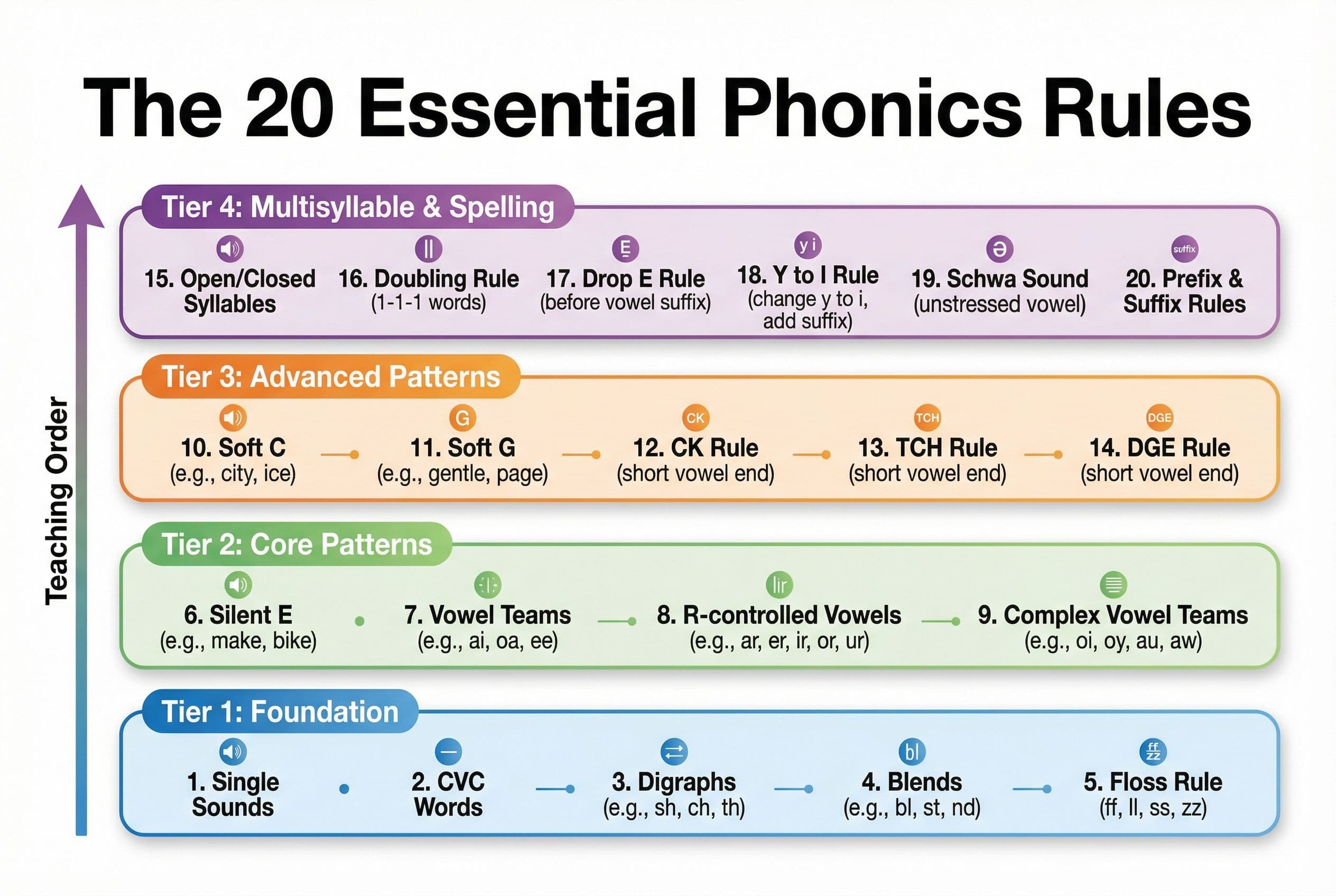
The 20 Phonics Rules Every Parent Must Know
I'm going to walk you through these in a logical teaching order — the same progression used by systematic synthetic phonics programs like UFLI Foundations (developed at the University of Florida) and Fundations (based on Wilson Language Training). This isn't random. Each rule builds on the one before it.
A quick note: English is pattern-based, not perfectly rule-governed. These 20 rules won't cover every word your kid will ever see — but they cover a lot of the words your kid needs to read, and they give your child a reliable system for attacking unfamiliar words instead of guessing. That right there? That right there is the whole game.
Grab a pen. I mean it — seriously.
Rule 1: Every Syllable Has a Vowel Sound
The vowels are A, E, I, O, U — and sometimes Y (like in "my" or "gym," where Y is doing the vowel's job). Here's something that probably never crossed your mind: every single syllable in English contains at least one vowel sound. This seems obvious, but it's foundational. When my 4-year-old tries sounding out a word and gets lost, the very first thing I ask her is: "OK, find the vowel — where is it?" That's her anchor point.
Why it matters: Kids who can't identify the vowel in a syllable can't decode anything. This is step zero.
Rule 2: Short Vowel Sounds in CVC Words
When a single vowel is sandwiched between consonants (Consonant-Vowel-Consonant), it usually makes its short sound. Cat. Bed. Sit. Hot. Cup.
This is where every phonics program on earth starts — and for good reason. Linnea Ehri's research on the phases of word reading development (her 2005 meta-analysis) shows that kids move from "partial alphabetic" to "full alphabetic" by mastering these simple CVC patterns first.
Teach it: Start with word families. -at words (cat, bat, sat, mat). Then -an, -ap, -ig, -ot, -ug. Drill these until they're automatic.
Rule 3: Consonant Digraphs
Two consonants that team up to make one brand-new sound. The big ones:
- SH (ship, wish)
- CH (chip, much)
- TH (this, with) — actually two sounds: voiced TH ("the") and unvoiced TH ("thin")
- WH (when, whale)
- CK (back, kick)
The kicker: These aren't blends. In a blend, you hear both sounds (like S-T in "stop"). In a digraph, the two letters fuse into a single new sound. SH doesn't sound like S + H. It's its own thing.
Rule 4: Consonant Blends
Two or three consonants sitting next to each other where you can hear each sound. Think BL, CR, ST, SPR, STR.
This is exactly where that second grader at the playground fell apart. "Splint" has a three-letter blend at the start (SPL) and a final blend at the end (NT). If you've never been explicitly taught to segment those blends, you're going to guess. And guessing isn't reading.
Common initial blends: bl, cl, fl, gl, pl, sl, br, cr, dr, fr, gr, pr, tr, sc, sk, sm, sn, sp, st, sw Common final blends: nd, nk, nt, mp, ft, lt, lk
Rule 5: The Floss Rule (FLoSS)
Here's your rule: right after a short vowel at the end of a one-syllable word, you double F, L, S, and sometimes Z. (Programs like Fundations and Orton-Gillingham call this one of the first spelling rules kids should learn, and honestly, it sticks fast once you teach it.)
- Stuff
- Bell
- Miss
- Buzz
This is honestly one of those rules that makes kids feel like straight-up geniuses once they get it. My 7-year-old literally said "Mom, that's why 'hill' has two L's!" She was grinning. I was grinning. We were both grinning at a spelling rule. Honestly? This is my life now — getting excited about spelling patterns at 9pm — and I'm not even mad about it.
Exceptions: "if," "bus," "yes," "this," "us." Teach the rule first. Teach exceptions later.
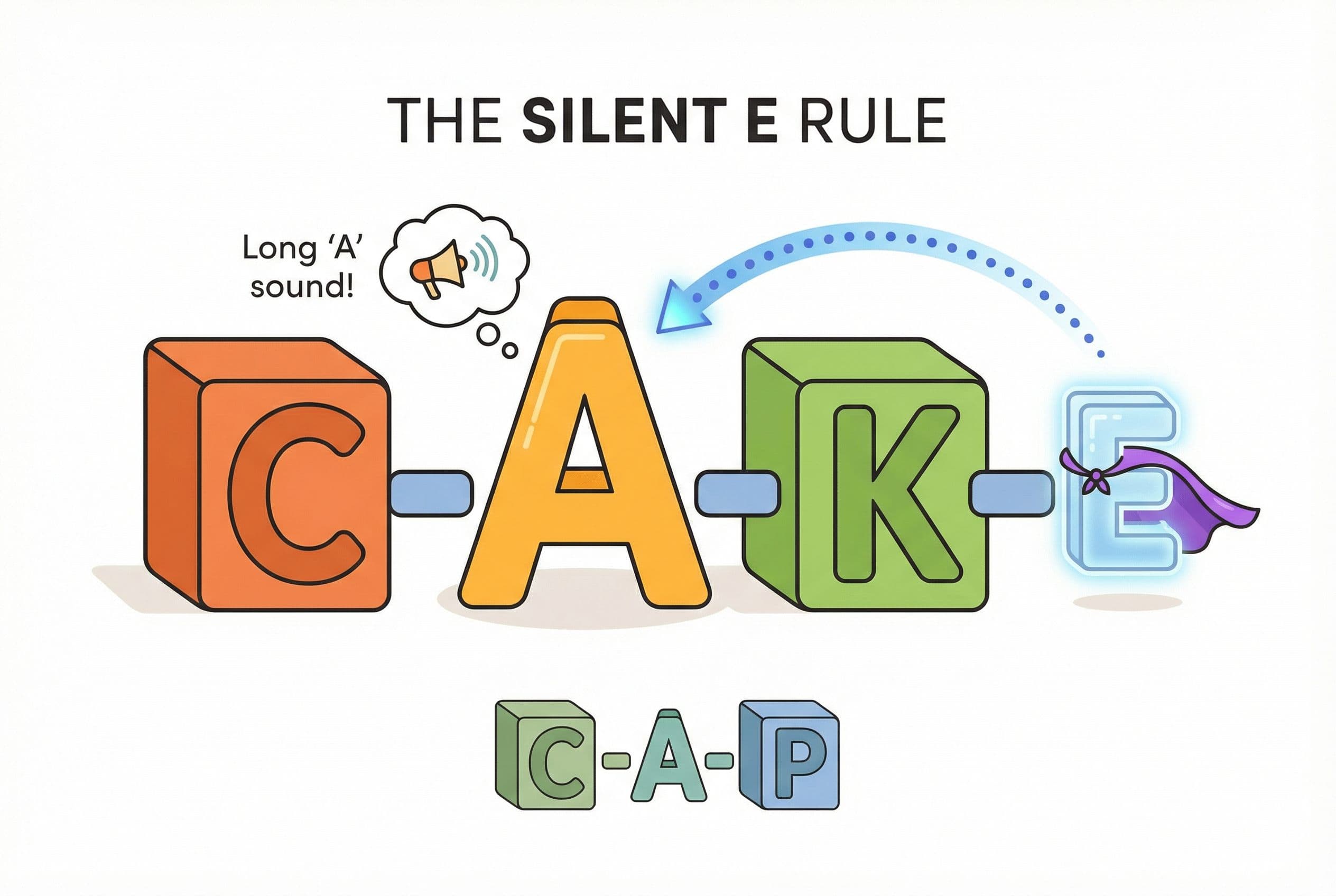
Rule 6: The Silent E Rule (Magic E / VCe)
When a word ends in a consonant followed by E, the E is silent and the vowel before it says its long name.
- cap → cape
- kit → kite
- hop → hope
- cub → cube
This is probably the most famous phonics rule in existence. It's common and high-utility, though English has plenty of exceptions (have, give, done, come). The Simple View of Reading (Gough & Tunmer, 1986) tells us that reading comprehension = decoding × language comprehension. The Silent E rule is a massive piece of the decoding puzzle.
Rule 7: Vowel Teams (Part 1 — The Long Ones)
Two vowels sitting together often make one long vowel sound. The old saying is "when two vowels go walking, the first one does the talking." Honestly? That rule only works about 45% of the time. But these specific teams are reliable:
- AI and AY → long A (rain, play)
- EE and EA → long E (tree, bead) — but EA can also say short E, like in "bread"
- OA → long O (boat, road)
- OE → long O (toe, doe)
Real talk: Don't teach the "two vowels walking" rhyme as a universal law. Teach each vowel team as its own pattern. Mark Seidenberg hammered this point in Language at the Speed of Sight (2017) — he said oversimplified rules do more harm than good because kids lose trust in the system when the rules keep failing.
Rule 8: Vowel Teams (Part 2 — The Tricky Ones)
These vowel teams don't follow the "first vowel talks" pattern at all:
- OI and OY → the /oi/ sound (coin, boy)
- OU and OW → the /ow/ sound (house, cow) — but OW can also say long O (snow, blow)
- AU and AW → the /aw/ sound (sauce, claw)
- OO → two sounds: /oo/ as in "moon" AND /oo/ as in "book"
Teaching tip: I use minimal pairs with my kids. "Is it cow-OW or snow-OW?" We sort words into two columns. That's fifteen minutes at the kitchen table, tops. Done.
Rule 9: R-Controlled Vowels (Bossy R)
When R follows a vowel, it changes the vowel's sound. The vowel is neither short nor long — it's something else entirely.
- AR → /ar/ (car, star)
- OR → /or/ (fork, corn)
- ER, IR, UR → all make the same /er/ sound (her, bird, turn)
That last one is a nightmare for spelling, by the way. Three different spellings for the same sound. But for reading, just teach your kid that ER, IR, and UR all sound like /er/. Spelling comes later.
Rule 10: The Soft C Rule
C says /s/ (instead of /k/) when followed by E, I, or Y.
- ce: cent, face, mice
- ci: city, pencil, circle
- cy: cycle, fancy, icy
Otherwise, C says /k/: cat, cup, cot, clap.
Rule 11: The Soft G Rule
G says /j/ (instead of /g/) when followed by E, I, or Y.
- ge: gem, cage, huge
- gi: giraffe, giant, magic
- gy: gym, energy, allergy
But here's the catch: This rule has more exceptions than the Soft C rule. "Get," "give," "girl," "gift" — all hard G before E or I. Teach the pattern, but warn your kid that G is a rebel.
Rule 12: The -CK Rule
Use CK right after a short vowel. Use K after a consonant or a long vowel.
- Short vowel → baCK, siCK, duCK
- Consonant → banK, milK, desK
- Long vowel → breaK, spooK
This rule is a no-brainer for spelling, and it makes reading easier too because it confirms the preceding vowel is short.
Rule 13: The -TCH Rule
After a short vowel, use TCH. After everything else, use CH.
- Short vowel → caTCH, kiTCHen, wiTCH
- After other sounds → muCH, riCH, lunCH, beaCH
Exceptions that'll drive you nuts: "which," "such," "much," "rich," "touch." English, everybody.
Rule 14: The -DGE Rule
After a short vowel, use DGE for the /j/ sound. After everything else, use GE.
- Short vowel → baDGE, friDGE, juDGE
- After other sounds → larGE, staGE, chanGE
See the pattern forming? Rules 12, 13, and 14 are all the same concept: after a short vowel, add an extra "guard" letter. CK guards the K. TCH guards the CH. DGE guards the GE. When I broke it down this way for my 7-year-old — DGE guards the GE — she nailed all three rules in a single sitting.
Rule 15: Open and Closed Syllables
This is the big one for multisyllable words.
- Closed syllable: Ends in a consonant. The vowel is short. (cat, nap-kin, rab-bit)
- Open syllable: Ends in a vowel. The vowel is long. (me, o-pen, ti-ger)
When your kid hits two-syllable words — and they will, fast — this rule is the skeleton key. David Kilpatrick's research on orthographic mapping (explained in Equipped for Reading Success, 2016) shows that kids who understand syllable types can store words in long-term memory far more efficiently than kids who memorize words as whole shapes.
Rule 16: The Doubling Rule (for Suffixes)
OK so here's how this works: when you're adding a suffix that starts with a vowel (-ing, -ed, -er) to a one-syllable word with a short vowel followed by one final consonant — you double that last consonant. Programs like Fundations and Wilson Reading drill this one hard because kids trip on it constantly.
- run → running
- hop → hopped
- big → bigger
Why? To keep the vowel short. Without doubling, "hoping" and "hopping" would look the same. The double consonant is a signal: "Hey, that vowel is short."
Rule 17: Drop the E Rule
When adding a suffix that starts with a vowel to a Silent E word, drop the E.
- make → making (not makeing)
- hope → hoping (not hopeing)
- ride → rider
Rule 18: Change Y to I Rule
When a word ends in a consonant + Y, change the Y to I before adding a suffix (unless the suffix starts with I).
- happy → happier, happiest, happily
- carry → carried (but carrying — don't create a double I)
- baby → babies
Rule 19: The /k/ Sound Spelling Rule
The /k/ sound is spelled three ways:
- C before A, O, U (cat, cot, cup)
- K before E, I, Y (kite, key, sky)
- CK after a short vowel (back, kick)
This is one of those rules that looks random until you teach it explicitly, and then suddenly English spelling seems 40% less insane.
Rule 20: Schwa — The Boss of Unstressed Syllables
In unstressed syllables, any vowel can make the lazy /uh/ sound (schwa).
- about (the A says /uh/)
- lemon (the O says /uh/) — split it: lem/on
- pencil (the I says /uh/) — split it: pen/cil
Schwa is the most common vowel sound in spoken English. It's also the reason spelling is harder than reading. Here's the thing though — schwa is mostly a later skill that matters for multisyllable words. Teach your kid to try the expected vowel sound first, then try schwa if the word still doesn't sound right. Don't stress over it — pun very much intended.
Knowing the Rules Isn't the Same as Your Kid Using Them
You now know more phonics than most classroom teachers were taught. The kicker: your kid doesn't learn these rules by hearing them. They learn them by decoding hundreds of words that follow each rule, in the right order, with someone catching the guesses. That's a daily drill, not a reference chart.
If you're not sure whether your child is actually applying these rules or just memorizing whole words, take the 2-minute reading check. Kids who guess from the first letter and the picture can look fluent on familiar books and fall apart on new ones.
The easiest way to run the sequence below without building it yourself: Teach Your Kid to Read teaches these exact rules in this exact order, with decodable text for each one, 10-15 minutes a day. Lesson one is free with no card, then a 7-day trial, then $9.95 a month. start lesson one free and let the app hold the sequence while you hold the kid's attention.
Why Order Matters: The Non-Negotiable Phonics Sequence
You don't teach Rule 20 before Rule 2. That's like teaching algebra before addition.
Every evidence-based phonics program follows a systematic sequence — and they all look roughly the same because the research is clear. The 2000 National Reading Panel report (the one Congress actually commissioned) found that systematic phonics instruction — where skills are taught in a defined, sequential order — produces significantly greater reading gains than unsystematic or no-phonics instruction.
Here's the general teaching order:
- Letter-sound correspondence (single consonants and short vowels)
- CVC words (cat, bed, sit)
- Consonant digraphs (sh, ch, th, wh, ck)
- Consonant blends (bl, st, cr, spl)
- Floss Rule and other spelling patterns
- Silent E / Magic E
- Vowel teams (ai, ay, ee, ea, oa)
- R-controlled vowels
- Diphthongs (oi, oy, ou, ow)
- Multisyllable strategies (open/closed syllables, suffixes)
If your kid's school is bouncing around this list randomly — or worse, not teaching explicit phonics at all — you need to fill the gaps at home. Period.
How Teach Your Kid to Read Makes These Rules Stick
Look, I can list 20 rules all day long. But a list on a screen doesn't teach your kid to read. Practice does. Daily, consistent, systematic practice.
That's exactly why we built Teach Your Kid to Read. Our program follows an Orton-Gillingham scope and sequence — the same instructional approach used by nearly every successful dyslexia intervention program in the country — and breaks it into short, daily lessons that a parent with zero teaching background can deliver.
Every rule on this list is taught explicitly, practiced with decodable text (not guessing-from-pictures leveled readers), and reinforced through phonological awareness drills. We don't skip rules. We don't assume your kid will "figure it out." We don't hand them an iPad and cross our fingers, either.
The Clackmannanshire study out of Scotland (Johnston & Watson, 2005) followed kids for seven years and found that children taught through systematic synthetic phonics outperformed analytic phonics kids in both reading and spelling — and the advantage increased over time. And that wasn't some one-off fluke, either — Kilpatrick cites this same body of research in Equipped for Reading Success when he makes the case for systematic synthetic phonics instruction. That's what happens when you teach the actual code.
Your Action Plan: Start This Week
OK so here's exactly what you're gonna do, step by step — no excuses.
Step 1: Assess where your kid is right now. Don't guess. Use two quick tools. First, David Kilpatrick's PAST test (the Phonological Awareness Screening Test) — it's free, takes about 5 minutes, and tells you if your child has gaps in the auditory processing that underlies reading (like blending and segmenting sounds). You can find it in his book Equipped for Reading Success or search for the PAST administration guide online. Second, use a phonics screener — like the free UFLI Foundations Quick Placement assessment — to check which written phonics rules your kid actually knows. The PAST tells you if the ear is ready. The phonics screener tells you which rules the eyes and brain have locked in.
Step 2: Identify which rules your kid has mastered and which are shaky. Go through the 20 rules above. For each one, give your kid 3-5 words that use that pattern. Can they read them accurately and quickly? Or are they hesitating, guessing, looking at you for confirmation? Hesitation means the rule isn't automatic yet.
Step 3: Start at the first rule they DON'T know. Don't skip ahead. Don't jump to the "cool" rules. If your 6-year-old can't reliably blend CVC words, they're not ready for vowel teams. Go back to Rule 2 and drill it until it's rock solid.
Step 4: Practice 15-20 minutes every day. Every. Single. Day. Birthdays. Christmas morning. Vacation. We call this the Tiger Rule in our house: We Never Skip. My 4-year-old practices CVC blending at the kitchen table while I'm making dinner. My 7-year-old reads decodable chapter books from Flyleaf Publishing before bed. It really doesn't have to be fancy — trust me. It has to be consistent.
Step 5: Use Teach Your Kid to Read to structure the whole thing. And listen — you don't have to build lesson plans from scratch. We already did that. Our program walks you through every one of these rules in order, with decodable practice at every stage. start lesson one free
Benchmarks to aim for:
- By mid-kindergarten: 17+ correct letter sounds per minute on DIBELS nonsense word fluency
- By end of kindergarten: 28+ correct letter sounds per minute; decoding CVC words and common digraphs fluently
- By end of 1st grade: Decoding Silent E words, common vowel teams, and R-controlled vowels
- By end of 2nd grade: Multisyllable word decoding and 90+ words per minute oral reading fluency
These aren't my arbitrary numbers. They come from DIBELS 8th Edition benchmark data and align with the oral reading fluency norms published by Hasbrouck and Tindal.
The Bottom Line
English has roughly 26 letters, 44 phonemes, and over 250 graphemes (letter combinations that represent those sounds). Look, it's messy — I won't sit here and pretend it isn't. I won't pretend otherwise.
But here's what Louisa Moats taught us in her landmark 1999 paper Teaching Reading IS Rocket Science for the American Federation of Teachers: reading is complex, but it's also knowable. The code can be cracked. These 20 rules aren't some secret — they're just the rules nobody bothered to teach you, or your kid's teacher, or your kid.
Mississippi proved what happens when you change that. After passing the Literacy-Based Promotion Act in 2013 and mandating evidence-based phonics instruction statewide, Mississippi went from 49th to 21st in national reading scores in six years. Six years. They went from 49th in reading to 21st — bottom of the barrel to middle of the pack — after passing the Literacy-Based Promotion Act and going all-in on the science of reading. Six years did that.
If Mississippi can do it, you can do it at your kitchen table.
Learn the rules. Teach the rules. Drill the rules until your kid doesn't need them anymore — until the words just flow, automatic and effortless, the way they do for you.
That's not magic. That's phonics.
Frequently Asked Questions
Do kids need to memorize all 20 phonics rules at once?
Oh god, no. You teach them sequentially, one at a time, starting from Rule 1 and building up. A typical systematic phonics program like UFLI Foundations or Fundations takes about 1-2 years to move through the full scope and sequence. Rush it and you'll build on a shaky foundation. Think of it like a ladder — you don't step to the next rung until the one under your foot can hold your full weight, right? Ehri's phases of word reading work the same way.
At what age should I start teaching phonics rules to my child?
You can start phonological awareness activities (rhyming, clapping syllables, identifying first sounds) as young as age 2-3. Explicit letter-sound instruction can start around age 3-4 for most kids. By age 4-5, many children are ready for CVC blending — that's Rule 2 on this list. Don't wait for kindergarten. Linnea Ehri's research on the phases of word reading shows that the earlier kids begin mapping sounds to letters, the stronger their reading foundation becomes.
My kid's school uses Balanced Literacy. Should you be worried about that?
Short answer? Yes, absolutely. I'm not gonna sugarcoat this one for you. Balanced Literacy programs often teach kids to guess at words using picture cues and context clues instead of sounding them out. The 2022 NAEP scores showed reading scores dropped significantly — the largest decline in over 30 years. During that same period, many districts were using Balanced Literacy and three-cueing approaches that research doesn't support for decoding instruction. Over 40 states have now passed Science of Reading legislation since 2019 to move away from these methods. If your school hasn't switched yet, supplement at home with systematic phonics. Teach Your Kid to Read can fill that gap. start lesson one free
What if my child struggles even with explicit phonics instruction?
Some kids need more repetition. That's normal. But if your child has had consistent, systematic phonics instruction for 6+ months and is still struggling significantly, it might be worth screening for dyslexia or other reading difficulties. Start with Kilpatrick's PAST test to identify specific phonological awareness weaknesses. If you see significant gaps, ask your pediatrician for a referral to a reading specialist or look into structured literacy programs like the Wilson Reading System or Barton Reading & Spelling, which are designed for students who need more intensive intervention.
How is Teach Your Kid to Read different from other phonics apps?
Most "phonics apps" are dressed-up games that teach letter sounds in isolation and never get to actual reading. Teach Your Kid to Read follows a complete Orton-Gillingham scope and sequence — the same methodology used by the top reading intervention programs in the country. We teach every one of the 20 rules listed in this article, in order, with decodable text practice at every level. No guessing. No picture cues. No skipping ahead. That's what your kid's school should already be doing — and now you can do it yourself at home in 15 minutes a day, using programs like UFLI Foundations or Fundations as your guide. contact us today
Part of these guides

Xia Brody
Co-Founder, Teach Your Kid to Read
Mom of 4 who has successfully taught her kids to read. Currently in the trenches with her 4-year-old while her two oldest (10 and 7) devour books on their own. Passionate about phonics-based methods and building a lifelong love of reading.
Related Articles

Homeschool Reading Curriculum for Kindergarten: 7 Picks
Most kindergarten reading programs sold to homeschoolers still teach kids to guess at words. Here are the 7 structured-phonics curricula I'd actually put in front of a 5-year-old — with honest pros, cons, and prices — plus the ones I'd throw in the recycling.
Read More →
ABCmouse vs Reading Eggs Cost: Cheapest Pick in 2026
ABCmouse and Reading Eggs both look cute. But price means nothing if your child is still guessing at words. Here’s the no-nonsense 2026 cost comparison parents actually need.
Read More →
Reading Eggs vs HOMER Australia: Best Prep App?
Choosing between Reading Eggs and HOMER for your 4–6 year old? Here’s the blunt phonics-first comparison Australian parents need before Prep, Foundation or Kindy.
Read More →