Phonics for Beginners: The Parent's Guide to Letter Sounds
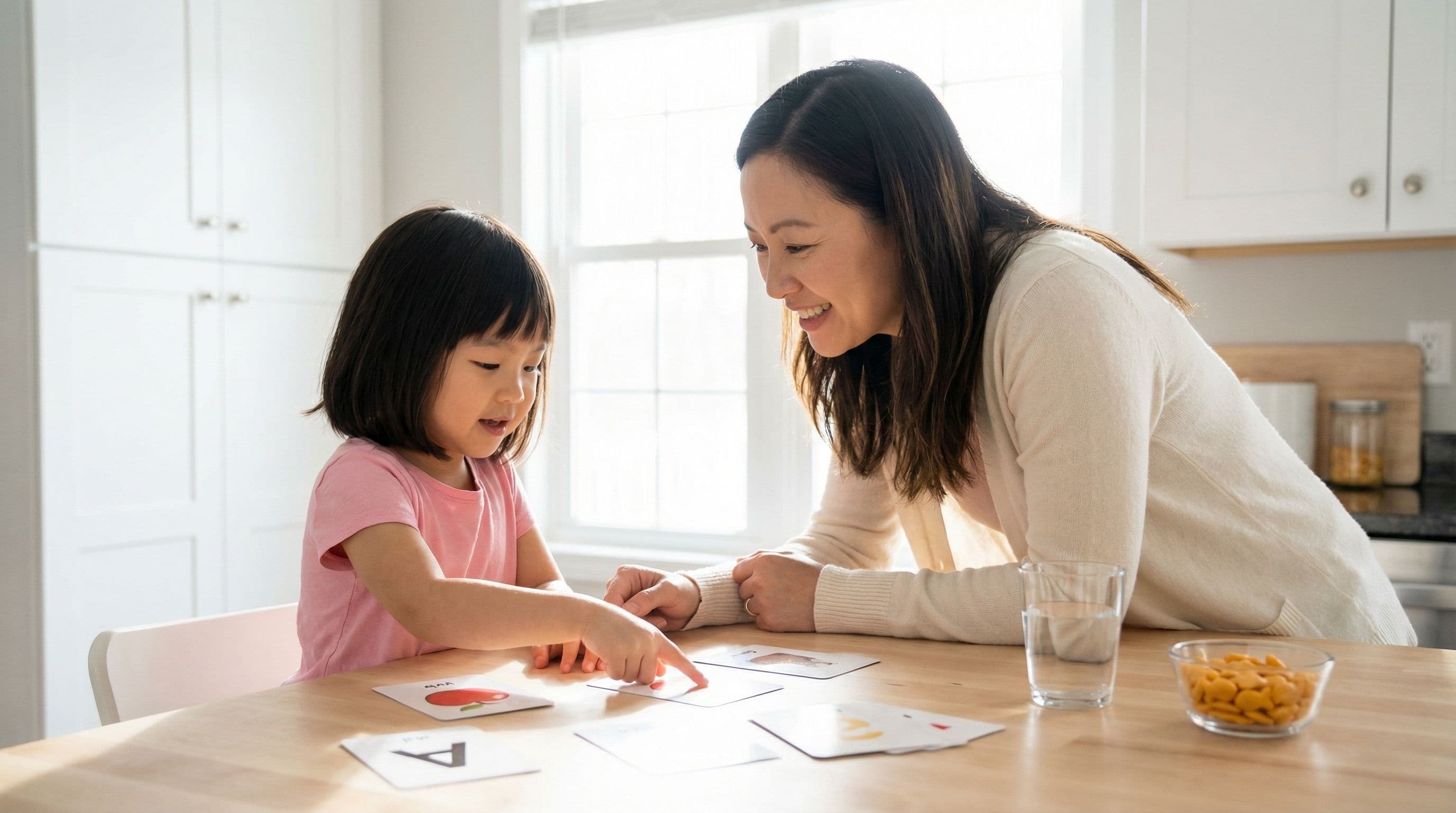
What You'll Learn
- Why teaching letter NAMES before letter SOUNDS is one of the biggest mistakes parents make — and what to do instead
- The #1 skill that trips up every new reader (hint: it's not memorizing sounds — it's blending them together)
- How to spot when your child is guessing instead of reading — and exactly how to stop it before it becomes a habit
- A 15-minutes-a-day phonics routine you can start today, even if you've never taught anyone to read
The Alphabet Song Is Lying to You
I'm going to say something that'll sound borderline heretical to most parents.
Stop teaching the alphabet song.
I know, I know. It's cute. It's catchy. Your toddler looks adorable singing it. But here's what that song actually teaches your kid: the names of letters. And when a beginning reader is trying to sound out a word, letter names don't help — they actively get in the way.
Think about it. Your 4-year-old sees the word "bat." If they know their letter names, their brain goes: "bee-ay-tee." How on earth do you get "bat" from that? You don't. You get a frustrated kid who gives up and guesses "ball" because there's a picture of one on the page.
When I started teaching my oldest to read, I made this exact mistake. I thought knowing the ABCs was step one. Nope. Step one is knowing the sounds letters make. Not "bee" — just /b/. Not "ay" — just /a/ (like in "apple"). Not "tee" — just /t/.
That's phonics for beginners in its purest form: sounds first, names later. Make sounds the priority for decoding. Letter names have their place eventually — classroom participation, talking about spelling, that kind of thing — but during this critical window when your child is learning to crack the code? Sounds need to be front and center. Don't let names steal the spotlight.
The Reality Check: Most Kids Aren't Learning to Read Properly
Here's what's actually happening in most American classrooms right now. Kids are being taught to look at the first letter of a word, glance at the picture, and guess. This approach — often called three-cueing or context guessing — has been the dominant strategy in many schools for decades, and it's been wrecking reading outcomes the whole time.
The National Assessment of Educational Progress (NAEP) says roughly two-thirds of American 4th graders are not reading at a proficient level. Two-thirds. (Worth noting: "NAEP Proficient" is a high bar, but even at the "Basic" level, the numbers are grim.) That's not a gap. That's a crisis.
And the kids who fall behind? Many don't catch up without intensive support.
Researchers call it the 3rd Grade Cliff. Up through 2nd grade, kids are "learning to read." Starting in 3rd grade, they're "reading to learn." Every subject — math, science, history — suddenly requires reading comprehension. If your kid can't decode words fluently by then, they don't just struggle with reading. They struggle with everything.
So what does this actually mean for your child?
It means you can't outsource this. You can't assume school will handle it. You definitely can't "wait and see" whether your kid figures it out on their own. Beginning phonics for kids starts at home, with you, and it starts now.
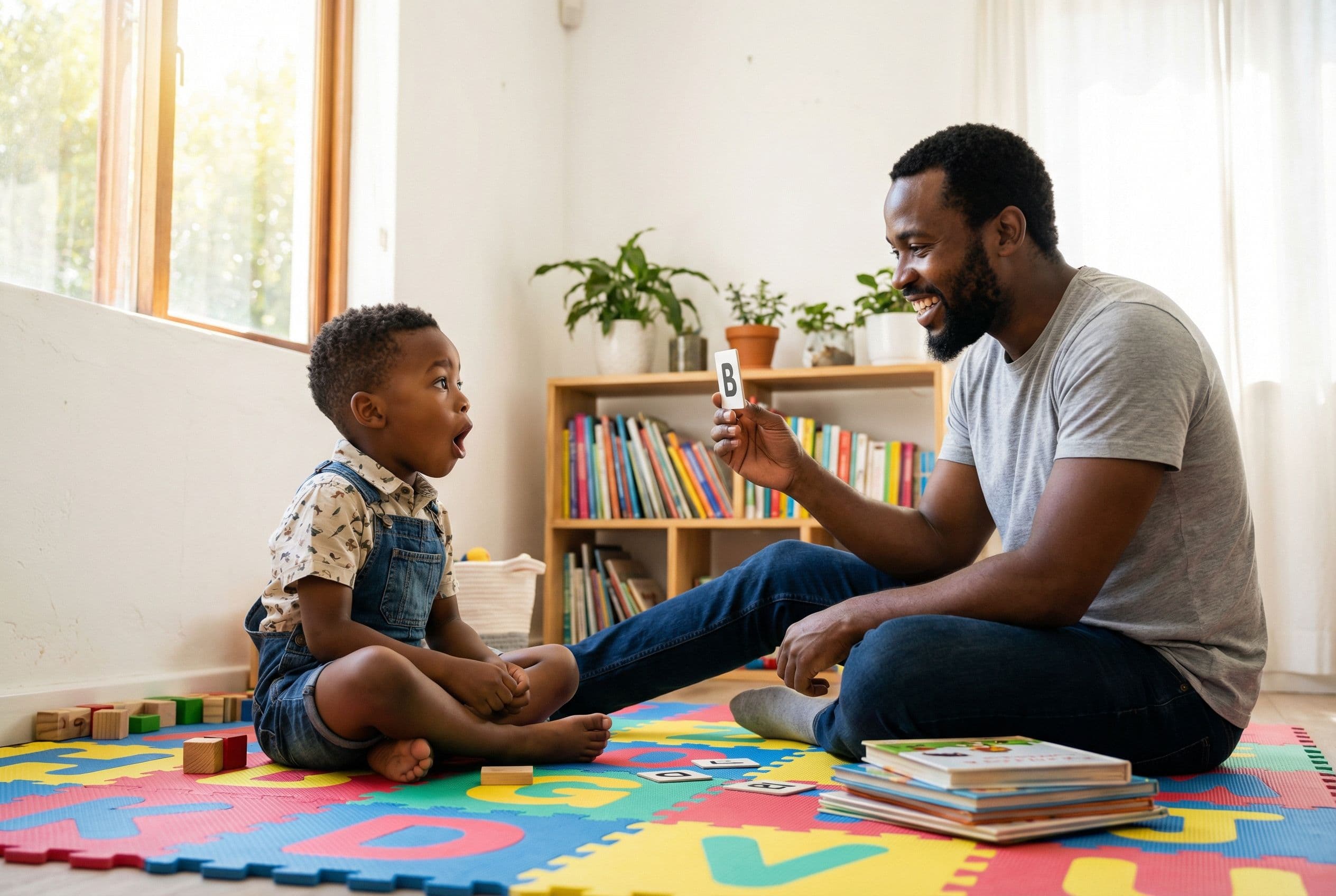
Why Phonics? Because Guessing Isn't Reading
Let me paint a picture.
Imagine your 5-year-old, let's call her Mia, is reading a simple book about animals. She gets to the word "horse" and says... "pony." She looked at the picture. She guessed. And honestly? It sounds close enough that some parents would let it slide.
Don't let it slide.
That guess just trained Mia's brain to skip the actual word and rely on context clues. Do that enough times and you don't have a reader. You have a guesser. And guessing works just well enough in early books (with their big pictures and simple sentences) to fool everyone into thinking the kid can read — right up until 3rd grade when the books have fewer pictures, harder words, and Mia's whole system collapses.
Phonics for beginners is the antidote to guessing. The synthetic phonics method teaches kids to look at each letter (or letter combination), produce the sound, and blend those sounds together to read the word. Every word. No guessing. No picture clues. No memorizing words by shape.
This is how you teach a child to decode the vast majority of English words — and have a strategy for the rest. Not just the ones on their classroom word wall.
Real talk — this is harder than the guessing method. It takes longer in the beginning. Your kid will be slower at first. But you're building a real foundation of skill instead of a house of cards.
The Sounds: Get Them Right or Don't Bother
OK so here's where it gets really practical. Before you teach a single word, you need to teach individual letter sounds. And you need to teach them correctly.
This is the part that trips up almost every parent I've ever talked to.
When you teach the letter "b," the sound is /b/. A quick, clean pop of air. Not "buh." When you teach "p," it's /p/. Not "puh." The letter "t" says /t/, not "tuh." The letter "d" says /d/, not "duh."
Why does this matter so much? Because when your kid tries to blend sounds together — which is the whole point — those extra "uh" sounds create garbage.
Watch what happens. If your child thinks "b" says "buh" and "a" says "ah" and "t" says "tuh," they'll try to blend "buh-ah-tuh." That doesn't sound like "bat." That sounds like a sneeze. But if they blend clean sounds — /b/ /a/ /t/ — they hear "bat" immediately.
This one drives me crazy because it's so fixable. Practice the clean sounds yourself before you ever sit down with your kid. Say them in front of a mirror. Record yourself. I'm serious. The goal is to minimize that extra vowel sound as much as possible — some consonants will always have a tiny hint of it in natural speech, and that's OK. But the closer you get to a pure, clipped sound, the easier blending will be for your child.
Here are some of the worst offenders to watch for:
- b → /b/, not "buh"
- d → /d/, not "duh"
- g → /g/, not "guh"
- p → /p/, not "puh"
- t → /t/, not "tuh"
- k → /k/, not "kuh"
- m → /mmm/, not "muh"
- n → /nnn/, not "nuh"
Get these right from day one. Fixing a bad habit later is way harder than building the right one now.
Sound Blending: The Hardest Part (and How to Push Through It)
I've taught three kids to read so far, and I'm in the middle of number three right now with my 4-year-old. And I can tell you without hesitation: blending is the hardest part.
Not learning the individual sounds. Kids pick those up pretty fast. The real wall is when they have to smoosh multiple sounds together and hear a word come out the other side.
Here's what it looks like in real life. Last week I had my 4-year-old at the kitchen table with a simple CVC word: "sat." She could tell me each sound perfectly. /s/... /a/... /t/. Beautiful. But when I said, "Now put them together," she just stared at me like I'd asked her to solve a calculus problem.
This is totally normal. And it's the reason so many parents give up on phonics — they think their kid "isn't getting it" and switch to flashcards or whole-word memorization. Don't.
Sound blending is a skill. It takes repetition. Lots of it. And it clicks at different times for different kids.
Here's how to practice it the right way:
- Start with continuous sounds. Letters like /s/, /m/, /f/, /n/ are easier to stretch and blend because you can hold them. So start with words like "sam," "man," "fan," "sun" — not words that start with stop sounds like /b/ or /t/.
- Model it first. Say: "Watch my mouth. /sss/... /aaa/... /mmm/... ssssaaammm... sam!" Stretch the sounds into each other like taffy.
- Shrink the gaps slowly. First say the sounds with pauses between them. Then bring the pauses closer. Then eliminate them entirely. Your kid's brain needs to hear the word emerge from the blended sounds.
- Use two-sound combinations first if needed. If three sounds are too many, try just blending /s/ and /a/ → "sa." Then add the /m/ → "sam." Baby steps.

I can't stress this enough: be patient during this stage. Some days my daughter blends like a champ. Other days she acts like she's never seen a letter before. That ebb and flow is completely normal. Don't panic when they seem to regress. Sleep, mood, hunger, whether they just had a fight with their sibling — all of it affects performance. Every child goes at their own pace, and the skill is still building underneath, even on the bad days.
The "No Guessing" Rule: Your Job as the Parent
Here's something nobody tells you about teaching phonics at home: your kid WILL try to guess. Constantly. Every chance they get.
They'll look at the first letter and guess. They'll look at a picture and guess. They'll say a word that rhymes with the right word. They'll say a totally random word that starts with the same sound. Kids are natural pattern-matchers, and guessing feels faster and easier than sounding out.
Your job — your non-negotiable, every-single-session job — is to catch it and stop it.
When my 7-year-old was learning to read, she'd see the word "plan" and say "play" because she recognized the first few letters and just winged the rest. Every. Single. Time. And every single time, I'd say: "Don't guess. Look at all the letters. Sound it out."
Was it tedious? Yes.
Did she roll her eyes at me? Frequently.
Did it work? She reads chapter books independently now.
The kicker is this: if you let guessing slide even occasionally, your kid learns that guessing is acceptable. It becomes their default strategy. And then you're not just teaching them to read — you're un-teaching a bad habit while teaching a new skill, which is twice the work.
So make this your household rule: We sound it out. We don't guess.
And here's the flip side that's just as important — make sure your child knows it's OK to not know a sound. If they forget what "sh" says or blank on the vowel sound, that's fine. They should feel safe saying, "I forgot — what's that one?" and asking you for help. If they're afraid to admit they don't know something, they'll fill that gap with — you guessed it — guessing.
Create an environment where asking is safe and guessing is not. That's the sweet spot.
The Rules: Yes, You Have to Memorize Them Too
English is a messy language. I wish I could tell you it's all simple one-letter-one-sound stuff. It's not.
There are phonics rules. Lots of them. And here's the part that surprises most parents: you have to learn them right alongside your kid.
The silent E rule. The two-vowel rule ("when two vowels go walking, the first one does the talking" — sort of). Digraphs like "sh," "ch," "th." R-controlled vowels. Soft C and soft G. The list goes on.
And yes — English has plenty of irregular words that don't follow the rules neatly. Your child will run into those too. But here's the thing: a kid who's been trained to decode has a strategy for tackling new words. They sound it out, check if it makes sense, and adjust. A kid who's been trained to guess? They've got nothing.
Why do you need to know the rules? Because your child will encounter a word that breaks a pattern they just learned, and they'll look at you with those big confused eyes, and you need to say: "Remember the rule? When there's an E at the end, it makes the first vowel say its name. So 'cap' becomes 'cape.'"
If you don't know the rule yourself, you can't remind them. And in the early stages, they need constant reminding. They're not going to internalize "silent E" after one lesson. Or five. Or maybe even twenty. They need you to be a walking, talking phonics reference guide until the rules become automatic — and that only happens with mountains of reading practice.
Eventually — and I've seen this with both of my older kids — they just know what the sounds should be. They don't think about the rules anymore. The rules become invisible. But that automaticity comes from hundreds of hours of practice, and in the beginning, brute-force memorization of rules is how you get there.
So when you sit down to teach beginning phonics for kids, grab the materials, learn the lesson yourself first, and stay one step ahead of your child. This is a team effort.
Your 15-Minute Daily Phonics Routine (Plus the Secret Bonus Round)
Here's the good news. Teaching phonics for beginners doesn't require three-hour study sessions. It requires 15 minutes a day. That's it.
But — and this is the Tiger Mom part — it requires 15 minutes every single day. Not five days a week. Not "when we feel like it." Every day. Birthdays. Vacations. Saturday mornings. We Never Skip.
Here's what those 15 minutes look like:
Step 1: Review Known Sounds (3 minutes)
Flash through letter sounds your child has already learned. Quick-fire. Hold up a card, they say the sound. If they get one wrong, don't skip it — practice it three more times. Drill until it's automatic.
Step 2: Introduce or Practice New Material (5 minutes)
This might be a new letter sound, a new phonics rule, or a new set of words. Follow whatever curriculum or program you're using. Keep it focused — one new concept at a time.
Step 3: Blending Practice (5 minutes)
Sound out real words together. Start with CVC words (consonant-vowel-consonant) like "mat," "sip," "hug." Model the blending. Have your child try. Correct gently but firmly — no guessing allowed.
Step 4: Read Together (2 minutes)
Even if it's just three sentences from a decodable reader. Let your child apply what they've learned to actual connected text. This is where the magic happens — when isolated sounds become real reading.
Now here's the secret bonus round that costs you zero extra minutes.
When you're walking around the house, driving in the car, standing in line at the grocery store — quiz them casually. "Hey, what sound does 'apple' start with?" "What sound do you hear at the beginning of 'banana'?" "Can you tell me the first sound in 'dog'?"
Keep it to sounds they've already learned. Don't quiz them on stuff they haven't covered yet — that's a recipe for frustration. But take those known sounds and bring them into the real world. The kitchen. The backyard. The Target checkout line.
This is phonemic awareness in action — the ability to hear and manipulate individual sounds in spoken words. And it doesn't feel like school. It feels like a game. My kids actually ask me to do this now. (OK, my 4-year-old does. My 7-year-old mostly tolerates it. But still.)
These little real-world moments are where the learning cements itself. Your child starts to realize that the sounds they're practicing at the kitchen table exist everywhere — in every word they hear and say. That's a lightbulb moment you can't manufacture with a worksheet.
The Patience Talk (Yes, This Is for You, Not Your Kid)
Look, I need to be straight with you.
Teaching your child to read with phonics is time-consuming. It's the long road. You're teaching them to decode the vast majority of English words — not just memorize a list of 50 sight words and fake it. That kind of mastery takes time, and some days it'll feel like you're going backward.
I've been there. Last month my 4-year-old read "cat" perfectly on Monday, and by Thursday she was staring at the same word like she'd never seen the letter C in her life. I wanted to scream. I didn't. (OK, I screamed internally.)
Expect the ebb and flow. Some days will be great. Some days will be rough. This doesn't mean your child isn't learning. It doesn't mean phonics "isn't working." It means they're four. Or five. Or six. Their brains are doing an enormous amount of work, and it doesn't always show up on a linear graph.
Here's what matters: don't let your frustration become their stress. If you sigh heavily every time they forget a sound, if you snap "we JUST went over this," if your body language says "why can't you get this" — they feel it. And they shut down.
Be their coach, not their critic. Every child goes at their own pace. Your job is to show up every day, keep the sessions short and focused, praise the effort, correct the mistakes gently, and trust the process.
When they get something wrong, say: "That's OK! Let's try that one again. Remember, this letter says /sh/, not /s/. Let's sound it out together."
When they blank on a sound they knew yesterday, say: "No worries — it's /e/ like in 'egg.' Let's keep going."
This supportive environment is what keeps kids willing to sit down for those 15 minutes every day. If they dread it, you've already lost. Make it firm but safe. That's the balance.
How Teach Your Kid to Read Makes This Easier
I built start lesson one free because I lived through exactly what I just described — three times — and I know how overwhelming it feels to piece together phonics instruction from random YouTube videos and Pinterest printables.
Teach Your Kid to Read gives you a structured, parent-guided phonics program based on the synthetic phonics method. It's available online, so it doesn't matter if you're in St. Louis or Seattle — if you've got a kitchen table and 15 minutes, you're set. It's not an app that babysits your kid with animations and reward stickers. It's a system you use to teach your child, with clear lessons, the correct sound pronunciations, phonics rules spelled out in plain English, and decodable reading practice built right in.
Here's why it works for the beginning phonics approach I've been describing:
- Sounds first, not letter names. The program teaches letter sounds from day one — no alphabet song confusion.
- Clean sound production. Every sound is modeled correctly — /b/ not "buh," /t/ not "tuh" — so your child learns to blend properly from the start.
- Blending practice baked into every lesson. You won't have to figure out how to teach blending on your own. It's structured and progressive.
- Rules taught to both parent and child. You learn the phonics rules right alongside your kid, so you're always ready to correct and remind.
- No guessing tolerated. The program is built on decoding, not picture clues or context guessing. Every word is earned through sounding out.
This is the tool I wish I'd had when I started teaching my first child. It would've saved me months of trial and error.
Want the exact sound sequence and blending plan laid out for you? [Get the roadmap here →]start lesson one free
Phonics Basics for Preschoolers: When to Start
Parents always ask me: "Is my kid too young for phonics?"
Short answer: if they're 3-4 and can sit with you for 10-15 minutes, they're ready to start learning letter sounds. Not reading full sentences — just sounds. Phonemic awareness activities. Listening games. "What sound does 'mmmonkey' start with?"
You're planting seeds. You're training their ears to hear individual sounds inside words. This is the pre-reading work that makes everything else easier when you start formal phonics for beginners lessons.
By 4-5, most kids are ready for systematic phonics instruction — learning sounds, blending CVC words, reading simple decodable sentences.
By 5-6, you're pushing into digraphs, blends, long vowel patterns, and connected reading.
But here's the bottom line: there's no perfect age. There's only "too late," and that's when your kid is already struggling in 2nd grade and hating books. Start now. Start imperfectly. Start with 15 minutes at the kitchen table and a handful of letter sounds.
Frequently Asked Questions
Should I teach uppercase or lowercase letters first?
Lowercase. Hands down. The vast majority of text your child will encounter is in lowercase letters. Uppercase letters look cool on alphabet posters, but your kid needs to recognize the letters they'll actually see in books. Teach lowercase sounds first, and introduce uppercase as a secondary association later.
My child already knows the alphabet song. Have I ruined everything?
No. Take a breath. You haven't ruined anything. But you do need to shift the focus away from letter names and toward letter sounds starting now. When your child says "that's a B," gently redirect: "Right — and the sound it makes is /b/." Over time, the sounds will take priority in their brain. Just stop reinforcing the names as the main thing.
How long until my child can actually read?
Honest answer: it depends on the kid. Some children start blending CVC words within a few weeks. Others take a few months to crack blending. I've seen both in my own house — my oldest picked up blending fast, while my second child took almost three months to get comfortable with it. Don't compare your child to anyone else's. Stay consistent with those 15 minutes a day and you'll see progress.
What if my child gets frustrated and doesn't want to do phonics?
Keep the sessions short. Fifteen minutes, then stop — even if you didn't finish the lesson. End on a positive note whenever possible. If they got one word right, celebrate that. If the whole session was rough, say "You worked really hard today, I'm proud of you" and move on. Come back tomorrow. Consistency over intensity, every time.
Do I need a curriculum, or can I just teach letter sounds myself?
You can DIY it, but I'd strongly recommend a structured program — especially if you're new to phonics. A good curriculum gives you the right sequence (which sounds to teach first), the right pacing, and the phonics rules laid out clearly so you're not Googling "what is a schwa" at midnight. That's exactly why I created start lesson one free — it's the structure and support that makes parent-led phonics actually doable.
Stop Waiting. Start Teaching.
Your child's school might get to phonics eventually. They might not. They might teach it well. They probably won't — not if the national reading scores are any indication.
But you? You can start today. Fifteen minutes. A kitchen table. A few letter sounds taught the right way — clean sounds, no letter names, no guessing allowed.
This is phonics for beginners, and it's the single most important thing you can do for your child's future.
Ready to start? Check out Teach Your Kid to Read at start lesson one free or call us at (314) 285-9505. We'll give you the exact roadmap — lesson by lesson, sound by sound — so you never have to wonder "am I doing this right?"
Because your kid's reading life is too important to leave to chance.
Part of these guides

Xia Brody
Co-Founder, Teach Your Kid to Read
Mom of 4 who has successfully taught her kids to read. Currently in the trenches with her 4-year-old while her two oldest (10 and 7) devour books on their own. Passionate about phonics-based methods and building a lifelong love of reading.
Related Articles
Best Phonics App for Letter Sounds: 6 Picks for 2026
Looking for the best phonics app for letter sounds? Xia Brody compares 6 popular apps for real phonics, explicit instruction, price, and best age range.
Read More →
Reading Eggs vs HOMER Australia: Best Prep App?
Choosing between Reading Eggs and HOMER for your 4–6 year old? Here’s the blunt phonics-first comparison Australian parents need before Prep, Foundation or Kindy.
Read More →
Reading Apps for 5-Year-Olds: 6 Skill-Level Picks
Most reading apps for 5-year-olds look cute. Too many teach guessing, tapping, and screen-zombie habits instead of real decoding. Here’s how I’d pick a phonics app by skill level if I were sitting at your kitchen table.
Read More →