Kindergartner Behind in Reading? A Catch-Up Plan That Actually Works
What You'll Learn
- The one hidden advantage your "behind" kindergartner actually has over the kids who started reading instruction at age 3 (and how to use it)
- Why your child's school might be using a reading method that's not supported by decades of reading science — and what to do about it
- A week-by-week catch-up framework you can run at your kitchen table in 15 minutes a day
- The specific free assessment that tells you exactly where your child's reading broke down — in about 5–15 minutes
Your Kindergartner Can't Read. Now What?
Let's skip the part where I tell you "every child learns at their own pace" and "don't compare your kid to other kids." You've heard that. It didn't help. You're here because your kindergartner is behind in reading and you can feel the clock ticking.
Maybe the teacher sent home a note. Maybe your kid's classmates are sounding out words and yours is staring at the page. Maybe you just watched your 5- or 6-year-old try to "read" by looking at the pictures and guessing.
That gut feeling you have? Trust it.
I'm Xia — I'm a homeschooling mom of four, co-founder of TeachYourKidToRead.org, and I've personally taught two of my kids to read from scratch. My 4-year-old is next in line. I've been through this process enough times to know exactly where the wheels fall off, and more importantly, how to get them back on.
Here's the good news that nobody tells you: a kindergartner who starts "behind" actually has a built-in advantage. More on that in a second. But first, the reality check.
The Tiger Truth: What Happens If You Wait
I need to scare you a little. Not because I enjoy it (okay, maybe a little), but because the "Wait and See" approach is the single most destructive piece of advice in early education.
Here are the numbers.
Only 33% of 4th graders read at proficient level on the 2022 NAEP — that's the Nation's Report Card. Two out of three kids. Below proficient. Let that sink in.
The Annie E. Casey Foundation published a landmark study in 2010 showing that kids who can't read proficiently by the end of 3rd grade are four times more likely to drop out of high school. Four times. And if they're also from low-income families? The odds get even worse.
Know what the worst part is? The 3rd Grade Cliff isn't a mystery. We know exactly why it happens. Up through about 2nd grade, kids are "learning to read." Starting in 3rd grade, they flip — now they're "reading to learn." Every subject. Science. Social studies. Even math word problems. A kid who can't decode text by that point doesn't just fall behind in reading. They fall behind in everything.
And the remediation? It's brutal. Private Orton-Gillingham tutoring runs $80–$150 per hour. A full Wilson Reading System program through a learning center can cost $10,000–$15,000 a year. Insurance doesn't cover it. Schools will tell you they're "monitoring" your child while precious months evaporate.
So no. We're not waiting.
🐯 Action Step (Today): Text yourself the word "PAST" right now. That's your reminder to download the free phonological awareness screener I'll tell you about in a few sections. Don't wait until you finish reading this post.
The Silver Lining Nobody Mentions: The Late-Start Advantage
Okay, here's the part I promised — the piece of this puzzle that actually makes me excited for parents in your position.
Starting later is not all bad. In fact, there's a real, practical advantage that parents of toddlers and young preschoolers don't have.
When I began phonics instruction with my oldest at age 3, it was a slog. Her attention span was about 90 seconds. She couldn't sit still. She didn't have strong opinions about anything except which color cup she wanted at lunch. Picking out motivating reading material? Forget it. She didn't care about dinosaurs or princesses or trucks yet. She was three.
But a 5- or 6-year-old? That's a completely different kid.
Your kindergartner has better working memory, longer attention span, stronger fine motor skills, and — this is the big one — actual interests. They know what they like. They have opinions. They have favorite animals, favorite shows, favorite topics they'll talk your ear off about.
Real talk — that's gold for reading motivation.
Because here's what the research on reading motivation shows: kids who care about the content of what they're reading stick with it longer and push through difficulty more willingly. And your kindergartner, unlike a toddler, can tell you "I want to read about sharks" or "I want to read about volcanoes."
So the very first thing I want you to do — before you buy a single phonics workbook — is go to the library. Take your kid. Let them wander. Let them pull books off shelves. Find out what they gravitate toward. Those topics are going to be your secret weapon.
When your kid is sounding out "The s-n-a-k-e s-l-i-d" and they want to know what the snake did next because they're obsessed with snakes? That's intrinsic motivation doing the heavy lifting. You can't manufacture that with a 3-year-old who doesn't know what a snake is yet.
I had my 7-year-old reading early readers about outer space because she was deep in a NASA phase. My 4-year-old right now? She's all about dogs. Every decodable reader I can find that involves a dog, I grab. The content match matters enormously. And your kindergartner is old enough to tell you exactly what that match should be.
That's your advantage. Use it.
🐯 Action Step (This Week): Take your kid to the library. Don't steer them. Let them pull whatever they want off the shelves. Write down three topics they gravitate toward — those are your reading motivation cheat codes.
But First — Figure Out Exactly Where the Breakdown Is
Before you start drilling phonics, you need to know where your child actually got stuck. "My kindergartner can't read" is not a diagnosis. It's a symptom. The underlying issue could be any one of these:
- They don't know all their letter sounds. (Not letter names — letter sounds. Huge difference.)
- They know sounds in isolation but can't blend them together. (They can say /c/ /a/ /t/ but can't push those sounds into "cat.")
- They have weak phonological awareness. (They can't hear rhymes, can't clap syllables, can't isolate the first sound in a word.)
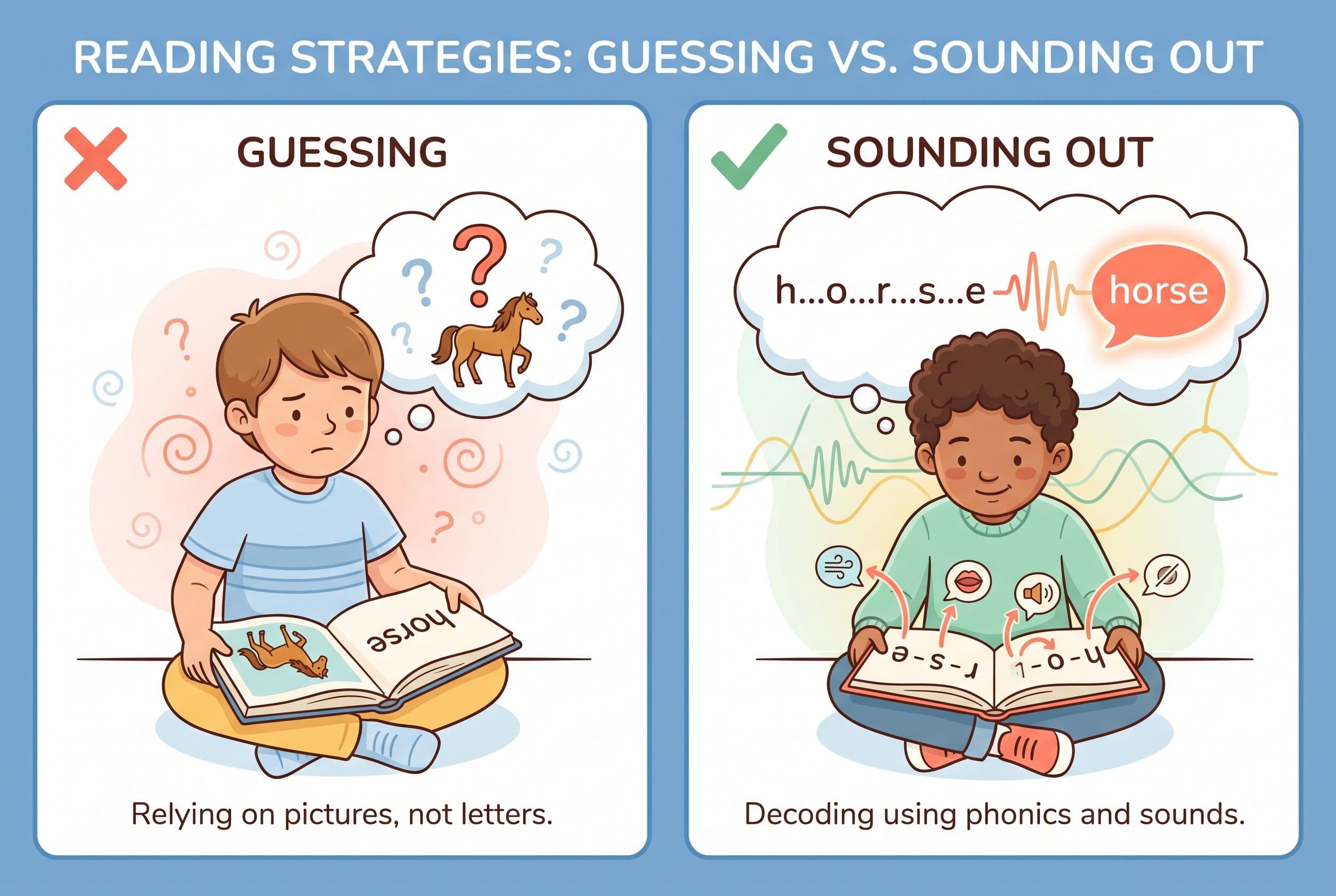
- They've been taught to guess. (They look at the picture, look at the first letter, and make something up. This is Whole Language instruction and it's a disaster.)
Each of these problems needs a different fix.
Here's what I recommend: grab David Kilpatrick's PAST test — the Phonological Awareness Screening Test. It's widely available for free download, and it typically takes 5–15 minutes to give, depending on your child's age and skill level. Make sure you grab the form that matches your child's grade level — the test has different starting points for different ages. It tells you exactly which phonological skills your child has and which ones are missing. You don't need to be a reading specialist to give it. You just need a quiet room and the scoring sheet.
If your child's school has given a DIBELS assessment (Dynamic Indicators of Basic Early Literacy Skills), ask for those scores too. Specifically, look at the Nonsense Word Fluency — Correct Letter Sounds (NWF-CLS) subtest. Under the DIBELS 8th Edition, the mid-kindergarten benchmark is 17+ correct letter sounds per minute. If your kid is below that, you have clear confirmation that intervention needs to happen now. (A quick note: benchmarks vary by DIBELS edition and sometimes by district, so check your school's specific benchmark sheet if the numbers on the report look different from what I'm listing here.)
Not next month. Not next quarter. Now.
🐯 Action Step (Today): Download the PAST test and give it to your child this week. Also email your child's teacher and ask: "Can you send me my child's most recent DIBELS or AIMSweb scores, specifically the NWF-CLS subtest?" That one email takes 30 seconds.
Why Your Child's School Might Be Teaching Reading Wrong
I need to tell you a story.
I was at a playground in Raleigh last year when I got into a conversation with another mom. Her kid's school had just switched curricula — dropped Lucy Calkins and moved to a Science of Reading program because of North Carolina's SB 387, the Excellent Public Schools Act. She was confused. A little annoyed, honestly. "He was doing fine before," she told me.
So I asked a simple question. Can he read the word "splint"?
Her son was in second grade. He could not read "splint."
She kind of froze. I could see it registering — her kid had been getting by on memorization and guessing, not actual decoding. He'd memorized enough high-frequency words to fake fluency on his leveled readers, but throw a word at him he'd never seen before? He was stuck.
I spent 20 minutes on that playground bench walking her through what had happened — how Emily Hanford's 2023 APM Reports investigation "Sold a Story" had blown the lid off Balanced Literacy, how the NAEP data had been screaming about a reading crisis for decades, how Stanislas Dehaene's neuroscience research ("Reading in the Brain," 2009) had shown that reading recruits specific visual and language networks in the brain — it doesn't develop naturally the way spoken language does. The brain learns to read by mapping letters to speech sounds, and that mapping has to be taught. Systematically. Through phonics.
She went home and listened to the "Sold a Story" podcast that night. Texted me at 11pm: "I had no idea. Why didn't anyone tell us this sooner?"
And honestly? That's the question. Why didn't anyone tell you sooner?
Here's the answer: for 30+ years, American schools taught reading using methods (Whole Language, then its rebranded cousin "Balanced Literacy") that told kids to guess at words using context clues and pictures. Cognitive science, classroom outcome studies, and the 2000 National Reading Panel report — the one Congress actually commissioned — all pointed the same direction: systematic phonics instruction produces significant benefits for reading achievement. That was twenty-five years ago. Most schools ignored it.
Now over 40 states have passed Science of Reading legislation since 2019. Mississippi did it earliest with their Literacy-Based Promotion Act of 2013, and they went from 49th to 21st in national reading scores in six years. The evidence is overwhelming.
So if your kindergartner is behind in reading, the first question to ask is: what method is the school using? If they're still on leveled readers, if the teacher tells your kid to "look at the picture" when they get stuck, if nobody is explicitly teaching letter-sound correspondences in a systematic order — that's your answer. The instruction is the problem.
And you can fix it at home.
The Catch-Up Plan: Kindergarten Reading Intervention at Home
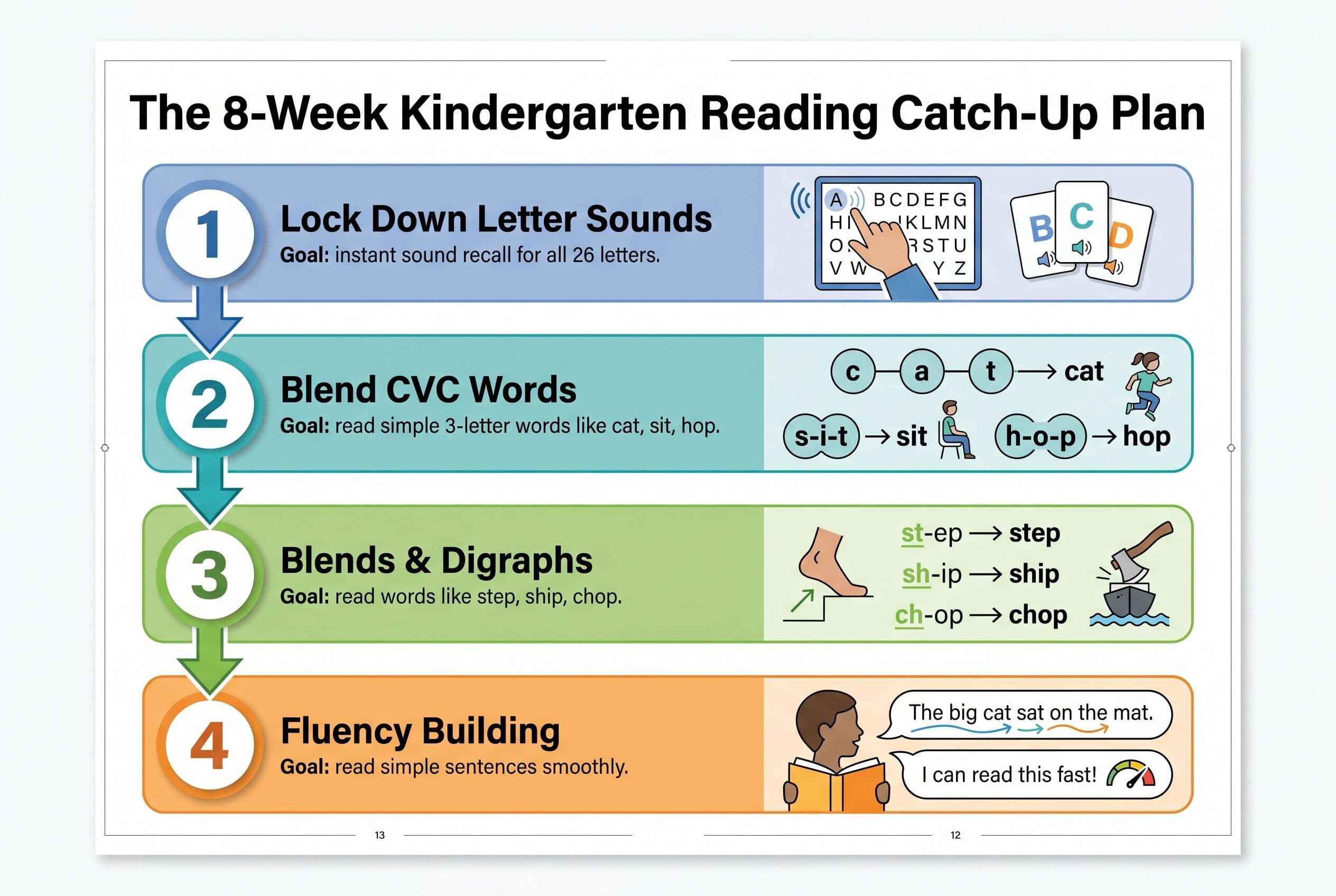
Here's your framework. I'm going to break this into phases because a kindergartner who's behind could be stuck at different points. Use the PAST test results to figure out where to start.
Phase 1: Lock Down Letter Sounds (Week 1–2)
Goal: Your child can instantly produce the sound (not the name) of every letter when shown the written letter.
This is non-negotiable foundation work. If your kid sees the letter M and says "em" instead of /mmm/, you're not ready for blending. Period.
What to do:
- Teach 4–5 new letter sounds per day. Start with the most useful ones: s, a, t, p, i, n. (These let you build real words fast.)
- Use flashcards. Hold up the letter, your child says the sound. Three seconds or less. If they hesitate, tell them the sound and move on — come back to it.
- Drill for 5–10 minutes. That's it. Short, intense, daily.
- Review ALL previously learned sounds at the start of each session.
I know "drill" sounds harsh. I know some parents cringe at flashcards. But Linnea Ehri's research on the phases of word reading development (her 2005 meta-analysis is the gold standard here) shows that kids need to move from the "pre-alphabetic" phase — where they're basically treating words as pictures — into the "full alphabetic" phase where every letter maps to a sound. Flashcard drill is the fastest way to build that automatic letter-sound retrieval.
My Tiger Rule: We Never Skip. Five minutes of letter sounds happens every single day. Birthday? Yes. Vacation? Yes. Saturday morning cartoons? After phonics.
🐯 Action Step (Today): Write out letters S, A, T, P, I, N on index cards. That's tomorrow morning's first phonics session. No fancy supplies needed.
Phase 2: Blending CVC Words (Week 2–4)
Goal: Your child can look at a simple three-letter word like "sit" or "map" and blend the sounds together to read it.
This is where most struggling kindergartners get stuck. They know the sounds individually but can't push them together.
What to do:
- Start with continuous blending. Have your child hold the first sound: "sssss... iiiii... t." Stretch those sounds like taffy. Don't let them chop: "suh... ih... tuh." That "uh" after each consonant kills the blend.
- Use letter tiles or magnetic letters on the fridge. Physically push the letters together as your child blends the sounds. The visual movement helps.
- Practice 5–10 CVC words per session. Mix word families: -at, -it, -op, -un, -eg.
- No guessing. If your child looks at "pin" and says "pen," stop immediately. Point to each letter. Sound it out. My Tiger Rule: every sound gets its due.
The library connection (here's where your late-start advantage kicks in): Once your child can blend basic CVC words, get them decodable readers — NOT leveled readers. Decodable readers only use letter-sound patterns the child has already been taught. Look for Flyleaf Publishing or High Noon Books decodables, or the free downloadable sets from UFLI Foundations.
And here's the trick — find decodable readers that match your kid's interests. If your kindergartner is obsessed with cats, find the decodable with "The cat sat on the mat." Is it great literature? No. Does your kid care because there's a cat? Yes. That matters more than you think when you're asking a frustrated 5-year-old to push through difficulty.
Phase 3: Consonant Blends and Digraphs (Week 4–6)
Goal: Your child can read words like "step," "clap," "ship," and "chop."
This is the jump from simple CVC words to more complex structures. Consonant blends (two consonant sounds together: bl, cr, st, tr) and digraphs (two letters making one sound: sh, ch, th, wh) are what separate a kid who can kinda-sorta read from a kid who can actually decode unfamiliar words.
What to do:
- Teach blends explicitly. Don't assume your child will figure out that "st" is /s/ + /t/ just because they know both sounds.
- Drill blends the same way you drilled letter sounds: flashcards, 3-second response time, daily review.
- Introduce digraphs as single units. "SH makes one sound: /sh/." Don't let your child try to sound out S and H separately.
- Read decodable texts that include these patterns. Bob Books Set 2 and Explode the Code Book 2 both hit blends and digraphs well.
Phase 4: Fluency Building (Week 6–8 and ongoing)
Goal: Your child reads simple sentences and short passages without laboring over every single word.
Fluency is where reading starts to feel like reading instead of a phonics exercise. And this is where those library trips pay off big time.
What to do:
- Repeated reading. Have your child read the same decodable passage 3 times. First time is decoding. Second time is smoother. Third time should sound almost natural.
- Timed drills for letter sounds and sight words. Under DIBELS 8th Edition, kids should hit roughly 28+ correct letter sounds per minute on the NWF-CLS by end of kindergarten. That's your target. (Again — check your school's specific benchmark sheet, since editions and district cut points can vary.)
- Graduate to easy readers on topics they love. By this point, your child can handle simple nonfiction — "All About Dogs," "Sharks!," "Big Trucks." Head to the library and let them pick. A kindergartner who's been told what to read for weeks will light up when they get to choose.
Remember what I said about the late-start advantage? This is the payoff. Your 5- or 6-year-old has real interests, real curiosity, real opinions about what they want to spend time reading. A kid who was drilled on phonics starting at age 3 might read earlier, but they didn't have the self-awareness to choose their own material. Your child does. And a child who chooses to read about volcanoes because they're obsessed with volcanoes is a child who will practice reading voluntarily.
That's the whole game. Voluntary practice. Everything you're doing with this catch-up plan is building the skills so your child can get to the point where reading is rewarding enough that they want to do it.
How Teach Your Kid to Read Makes This Easier
Look, I just gave you an 8-week plan. You can absolutely run it yourself with flashcards, magnetic letters, and library books. I did it with my oldest using basically that exact setup.
But I also know what it's like to have four kids, dinner to cook, and a toddler pulling everything off the counter while you're trying to do phonics with your kindergartner.
That's why we built Teach Your Kid to Read.
The app is built on systematic synthetic phonics — the same Orton-Gillingham principles used in clinical dyslexia intervention, but designed for parents to use at home without any special training. It follows the exact progression I outlined above: letter sounds → blending → consonant patterns → digraphs → fluency. Every lesson builds on the last. There's no guessing, no picture clues, no skipping ahead.
And because it's app-based, it's consistent. Even on the days when you're exhausted and tempted to skip (don't skip — Tiger Rule), your child can still get their 10–15 minutes of structured practice.
The app also tracks progress so you can see exactly where your child is and where they're getting stuck — basically a built-in assessment that saves you from having to manually score fluency drills.
Have questions about where to start? Call us at (314) 285-9505 or visit start lesson one free to learn more about the program. We'll help you figure out exactly where your child is and what comes next.
The 15-Minute Daily Schedule (Steal This)
Here's exactly what a daily catch-up session looks like. Post this on your fridge.
Minutes 1–3: Warm-Up Review Flash through all previously learned letter sounds. Speed matters — you want automatic retrieval, not hesitation.
Minutes 3–8: New Skill Introduction Teach 2–3 new letter sounds, a new blend, or a new digraph (depending on your phase). Model it, practice it together, then have your child do it independently.
Minutes 8–12: Word Reading Practice Your child reads 8–12 words using the patterns they've learned. Mix new and review words. If they guess, stop them. Sound it out. Every time.
Minutes 12–15: Connected Text Read a decodable sentence or short passage together. This is where it starts feeling like "real reading" and where your kid's confidence builds.
Bonus (optional but powerful): 5 minutes of read-aloud You read to your child from a book on a topic they love — above their reading level is fine. This builds vocabulary, background knowledge, and the desire to read independently. Scarborough's Reading Rope model shows that language comprehension and word recognition are both required for skilled reading. The read-aloud builds the comprehension strand while phonics builds the decoding strand.
The kicker? Fifteen minutes. That's it. You do not need an hour. You do not need a tutoring center. You need consistency and the right method.
🐯 Action Step (This Week): Print the schedule above, tape it to your fridge, and start Phase 1 tomorrow morning. Not Monday. Not "when things calm down." Tomorrow.
What NOT to Do (The Mistakes I See Every Week)
Don't use leveled readers as your primary tool. Fountas & Pinnell leveled readers are everywhere — schools send them home in book bags constantly. But they're whole-language aligned. They're designed around predictable text patterns that encourage guessing, not decoding. If your child is reading "I see the dog. I see the cat. I see the bird" — they're memorizing a sentence pattern, not reading.
Don't tell your child to "look at the picture." This is the #1 bad habit from Balanced Literacy instruction. When your kid gets stuck on a word, the only correct response is: "Sound it out." Point to each letter. Help them blend. Never let them guess from context.
Don't download random reading apps and call it done. Most "educational" apps are dressed-up games with almost zero actual phonics instruction. If the app doesn't teach systematic, sequential letter-sound correspondences, it's entertainment. Not education.
Don't compare your child to the "early readers" in class. Some kids crack the code at 4. Some at 6. The Simple View of Reading (Gough & Tunmer, 1986) tells us that reading comprehension = decoding × language comprehension. Your kindergartner who starts later but gets solid, systematic instruction can absolutely catch and pass kids who were "reading" earlier via memorization and guessing.
Don't panic. Do act.
There's a big difference between panicking and taking action. Panicking is buying 17 workbooks, signing up for three tutoring programs, and crying on a Facebook group at midnight. Taking action is getting the PAST test results, identifying the gap, starting a 15-minute daily routine, and sticking with it.
You can do this. I promise.
FAQ: Your Kindergartner Behind in Reading
How far behind is "behind" for a kindergartner?
Kindergarten reading level expectations vary, but by mid-kindergarten, most kids should know the majority of letter sounds and be starting to blend simple CVC words (cat, sit, hop). By the end of kindergarten, the goal is reading simple decodable sentences. If your child can't produce letter sounds automatically by January of their kindergarten year, it's time to intervene — don't wait for the end-of-year assessment.
Should I get my kindergartner tested for dyslexia?
If your child has been getting consistent, systematic phonics instruction for 8–12 weeks and is still making minimal progress — especially with blending sounds together — yes, pursue an evaluation. David Kilpatrick's "Equipped for Reading Success" (2016) explains that weak phonological processing is the core deficit in dyslexia, and early identification makes a massive difference. Ask your pediatrician for a referral or contact your school district about an evaluation. Don't let anyone tell you "it's too early to test" — screening tools exist for kids as young as 4.
Can my kindergartner really catch up to grade level?
Absolutely — and this is where the late-start advantage is real. A 5- or 6-year-old has stronger working memory, better attention span, and more developed language skills than a 3- or 4-year-old. They can learn letter sounds faster, blend sooner, and move through phonics progression more quickly. Mark Seidenberg, a University of Wisconsin cognitive scientist, notes in "Language at the Speed of Sight" (2017) that the key factor isn't when instruction starts — it's whether the instruction is systematic and phonics-based. With the right method and daily consistency, many kindergartners can reach grade-level benchmarks within 2–3 months of focused intervention.
How long should I practice each day with a struggling kindergartner?
Fifteen minutes of focused, structured phonics practice daily beats an hour of unfocused "reading time" every single time. Keep sessions short, intense, and consistent. If your child melts down at 10 minutes, do 10 minutes. The non-negotiable part isn't the length — it's the daily piece. We Never Skip.
What if the school says my child is fine?
Trust your gut over a standardized letter home. Schools often use benchmarks that define "on track" very generously in kindergarten. Ask specifically: "Can my child decode unfamiliar CVC words without picture support?" If the answer is no, or if they hesitate, you have your answer. Request DIBELS or AIMSweb scores if available, and supplement at home regardless. You are your child's first and best reading teacher.
Bottom Line
Your kindergartner is behind in reading. That's not a life sentence — it's a starting point. You know the problem now. You have a plan. You have the advantage of a child who's old enough to have interests, opinions, and the cognitive horsepower to learn fast once someone teaches them correctly.
Stop waiting for the school to fix it. Stop hoping they'll "grow into it." Start the 15-minute daily routine this week. Use systematic phonics. Take your kid to the library and let them pick out books about whatever they're obsessed with.
And if you want a structured program that walks you through every step — the letter sounds, the blending, the progression, the fluency building — Teach Your Kid to Read was built for exactly this moment.
Call (314) 285-9505 or visit contact us today to get started. Your child's reading future starts with what you do this week. Not next semester. Not "when they're ready."
They're ready. Are you?
Part of these guides

Xia Brody
Co-Founder, Teach Your Kid to Read
Mom of 4 who has successfully taught her kids to read. Currently in the trenches with her 4-year-old while her two oldest (10 and 7) devour books on their own. Passionate about phonics-based methods and building a lifelong love of reading.
Related Articles
Best Reading App for a Struggling Kindergartner 2026
If your kindergartner is guessing words from pictures, that’s not reading. Here’s my no-nonsense 2026 comparison of kindergarten reading apps, with Teach Your Kid to Read ranked first for systematic phonics.
Read More →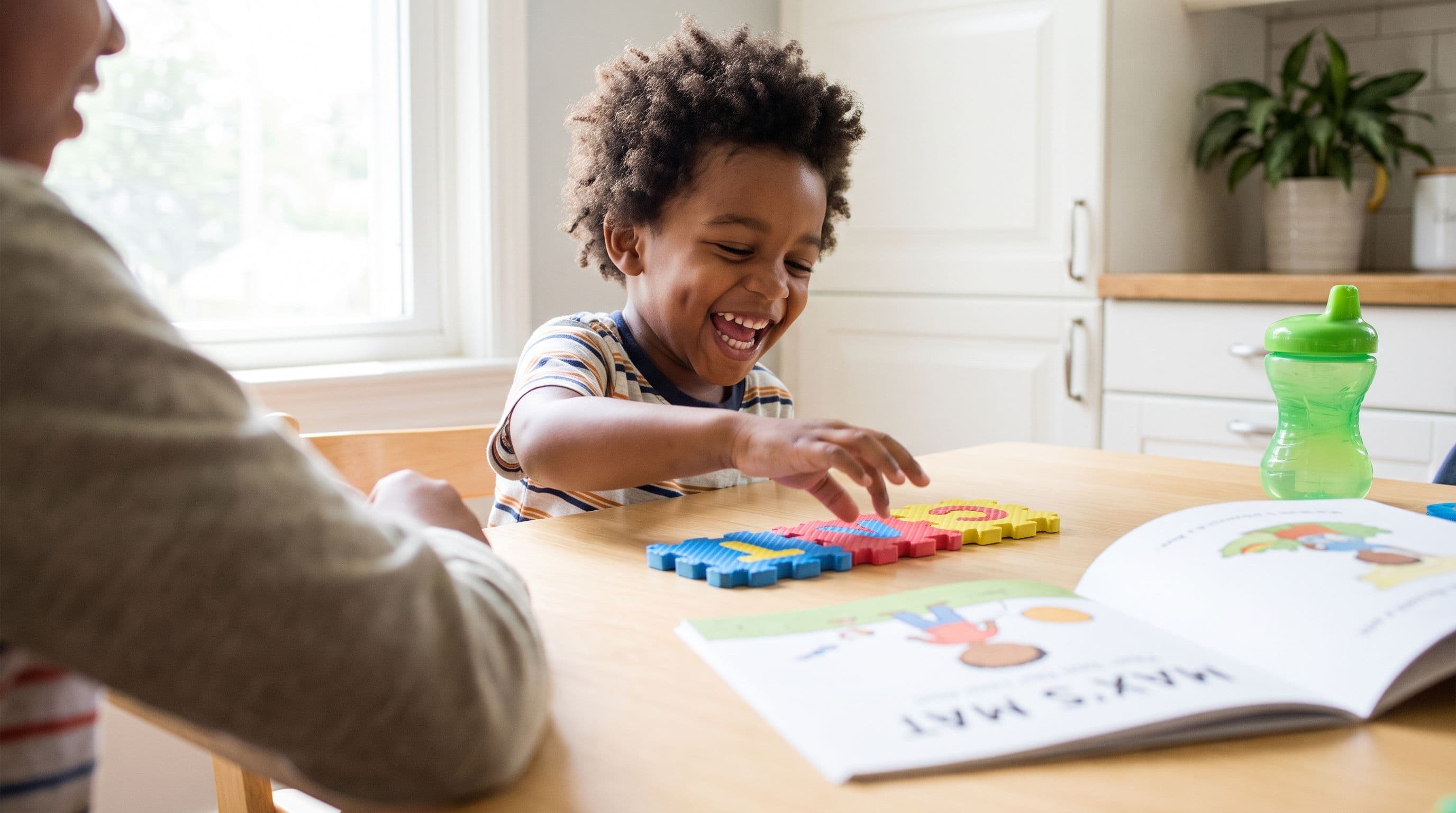
My First Grader Can't Read? The 90-Day Catch-Up Plan
If your 6-year-old is guessing at words, memorizing books, or melting down at the page, you don't have a motivation problem — you have an instruction problem. Here's the exact 90-day catch-up plan I'd run, starting tonight.
Read More →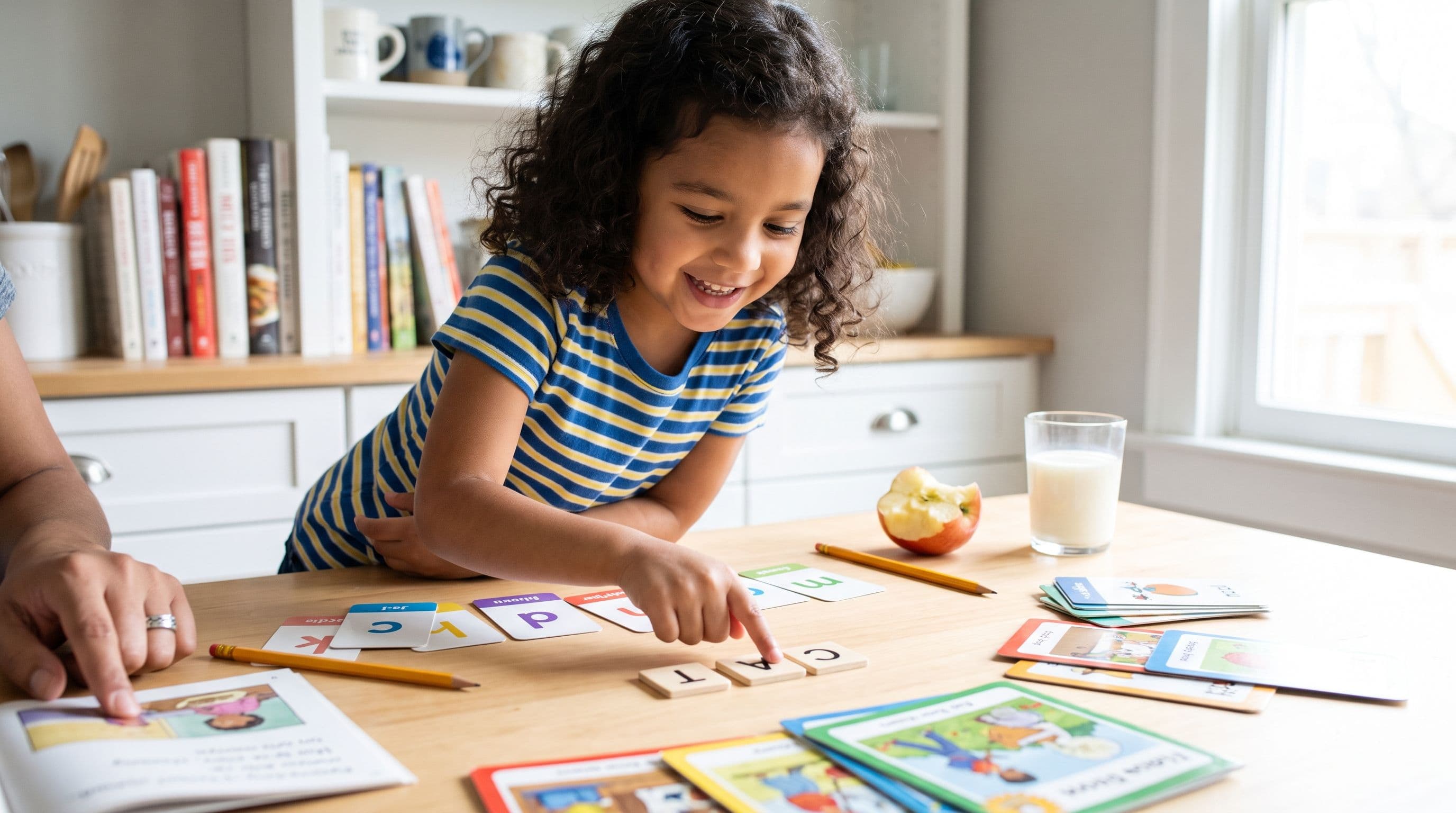
My 9 Year Old Can't Read: Parent Action Plan
If your 9-year-old can't read, don't wait for school to fix it someday. Here's how to check their reading level, stop guessing habits, and start a real phonics-based intervention at home.
Read More →