Is My Child Behind in Reading? How to Tell (and Fix It)
What You'll Learn
- The age where "behind in reading" actually means something — and why panicking about your 3-year-old is counterproductive
- The one window (around ages 5-7) where you need to seriously crank up effort — and what happens if you miss it
- Specific reading milestones by grade so you can stop guessing and start measuring
- The exact steps to catch your child up at home — no tutors, no expensive programs, no waiting for the school to figure it out
The Word "Behind" Is Doing a Lot of Heavy Lifting
Let me say something that might surprise you coming from me — the tiger mom with flashcards at the playground.
"Behind" is incredibly subjective when it comes to young children and reading.
I know. I'm the last person you'd expect to say "relax." But here's the thing — I see parents in my DMs absolutely spiraling because their 3-year-old can't sound out words yet. I see moms on Instagram posting videos of toddlers reading sentences, and then every other parent in the comments is panicking that their kid is broken.
Your toddler is not broken. Your 4-year-old who'd rather eat crayons than look at flashcards is not broken. Some kids are ready for letters at 3. Some aren't ready until 5 or 6. Both of those kids can end up reading at the same level by age 8.
Now — if your kid is 10 and can't read? That's a different conversation entirely, and yes, that child is behind (unless there's a serious learning disorder involved, in which case you need a specialist, not a blog post).
But for the vast majority of parents reading this? The question isn't "Is my child behind in reading?" The real question is: "Am I doing the right things at the right time?"
Stop Stressing Your Toddler Out (and Yourself)
I'm going to be honest about something I don't see enough people talk about.
Pushing formal reading instruction on a child who isn't developmentally ready is a disaster. It stresses the kid out. It stresses you out. And worst of all, it can make your child associate reading with anxiety and failure before they've even had a real shot at it.
I've watched parents try to drill sight words into a 2-year-old's head and then wonder why the kid screams every time a book comes out. No kidding. You turned reading into punishment.
Here's what you should be doing with toddlers and very young children:
- Read to them every day. Out loud. With silly voices. Let them turn the pages.
- Take them to the library. Let them pick books. Let them see that books are everywhere and normal and fun.
- Have books in your home. On shelves, on tables, in the car. Normalize the physical object.
- Play sound games with them. This is the part most parents skip — and it matters a lot. Before your kid ever touches a flashcard, they need phonemic awareness: the ability to hear and play with the sounds in spoken words. Rhyming games ("What rhymes with cat?"), clapping out syllables, asking "What sound does 'ball' start with?" — all of this trains their ear to break words into sounds, which is the foundation phonics is built on. No letters needed. Just talking and playing.
- Let them "read" on their own. My 4-year-old flips through books and narrates stories based on the pictures. She's not reading. She's pretending to read. And that pretending is building a foundation.
This early exposure? Non-negotiable. But formal phonics drills for a 2-year-old? Skip it. You're wasting everyone's time and emotional energy.
OK, So When Should I Actually Worry?
Here's where my tiger mom energy kicks in.
Here's how I think about the timeline, because I've seen way too many parents either panic too early or wait too long:
- Ages 3-4 (Pre-K): This is your foundation phase. Read aloud daily, play those oral sound games I just mentioned, and let your kid explore books on their own terms. No formal phonics yet. Keep it playful.
- Age 5 (Kindergarten entry): Time to start introducing letter sounds and simple blending — short, playful lessons. Most kids are ready for this, and your kindergarten milestones (see below) actually require it. If your child is 5-6 and isn't picking up letter sounds or blending even with consistent, gentle instruction? Don't "wait and see." Start structured help now.
- Ages 6-7: This is when you crank up the intensity. By this age, your kid has a long enough attention span to sit through a 15-minute lesson. Their memory is strong enough to retain letter-sound relationships from day to day. And here's the kicker: they actually have a use for reading now. They're in school. They're seeing words everywhere. They want to read the menu at the restaurant and the signs at the store.
If I could choose one subject for my kids to be advanced in, it would be reading. Hands down. Not math. Not science. Reading. Because reading opens the door for learning everything else. A kid who reads well can teach themselves almost anything. A kid who can't read is locked out of every other subject — including the ones they love.
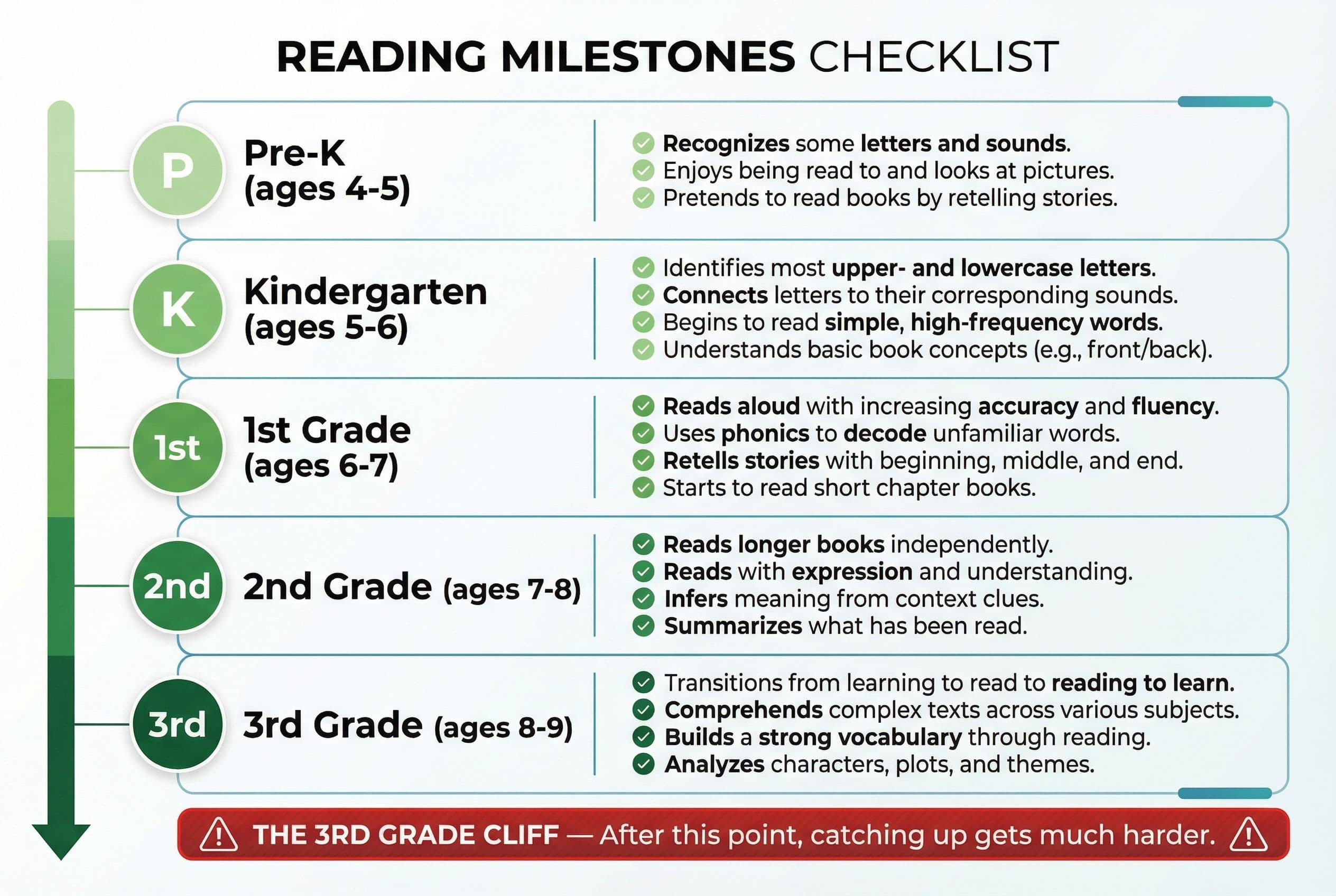
So here are the actual milestones you should watch for, grade by grade:
Reading Milestones by Grade
Pre-K (Ages 4-5):
- Recognizes some letters (not all — that's fine)
- Knows that print goes left to right
- Can "read" familiar books from memory (this counts!)
- Shows interest in letters and sounds
- Can rhyme, clap syllables, or tell you the first sound in a spoken word (phonemic awareness!)
Kindergarten (Ages 5-6):
- Knows most letter names and sounds
- Can blend simple CVC words (cat, dog, sit)
- Recognizes a handful of sight words
- Can follow along while being read to
First Grade (Ages 6-7):
- Reads simple sentences independently
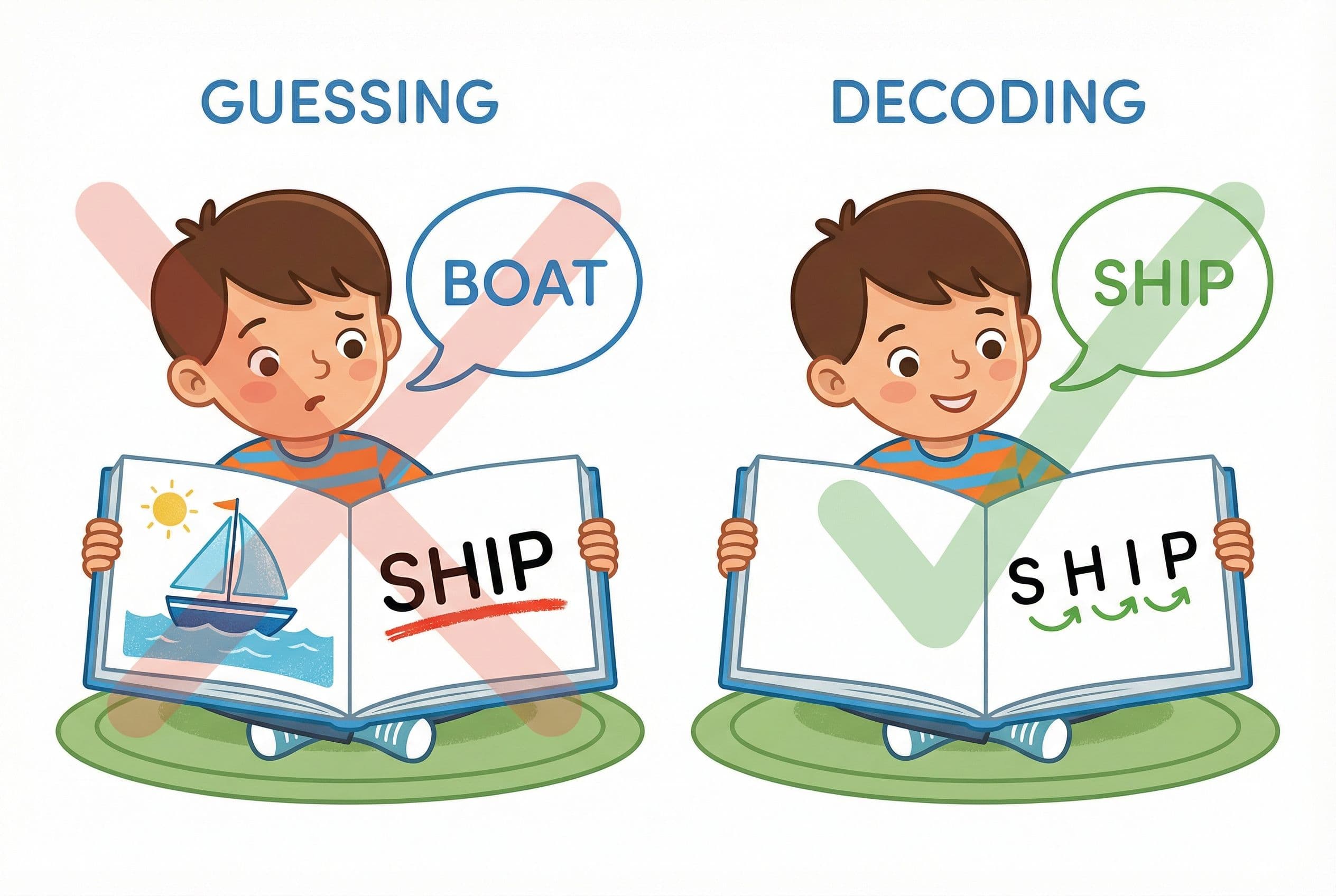
- Decodes unfamiliar words by sounding them out (NOT guessing from pictures)
- Reads aloud with some fluency
- Understands what they've read
Second Grade (Ages 7-8):
- Reads grade-level text with accuracy and fluency
- Self-corrects when something doesn't make sense
- Reads silently for short periods
- Can retell the main idea of a story
Third Grade (Ages 8-9):
- Reads independently for 20+ minutes
- Tackles multi-syllable words
- Reads to learn, not just to decode
- Comprehends both fiction and nonfiction
If your child is a full year behind these benchmarks? That's when you need to act. Not panic — act.
The 3rd Grade Cliff Is Real (and It's Brutal)
Here's the part where I stop being reassuring and start being scary. Because you need to hear this.
Research from the Annie E. Casey Foundation found that children who can't read proficiently by the end of 3rd grade are up to four times more likely to drop out of high school — and the risk is even higher for kids also facing economic disadvantage. It's a correlation, not a guarantee, but it's a strong one, and every reading researcher I've ever followed backs up the basic pattern.
Why 3rd grade? Because that's when school flips. In K-2, kids are learning to read. Starting in 3rd grade, they're reading to learn. Every subject — science, social studies, even math word problems — assumes your child can read the material. If they can't? They don't just fall behind in reading. They fall behind in everything.
And the gap widens every single year.
A child struggling to read in first grade still has time. Plenty of time. But a child struggling to read in first grade whose parents adopt the "wait and see" approach? That child hits the 3rd grade cliff at full speed.
"Wait and see" is not a strategy. It's neglect in slow motion.
I know that sounds harsh. I mean it to.
What a Child Behind in Reading Actually Looks Like
Here's the thing most parents miss — a child who's behind in reading doesn't always look like they're struggling. Sometimes they look like they're doing fine because they've gotten really good at faking it.
Watch for these signs:
The Guesser: Your kid looks at the picture on the page and guesses the word. The page shows a boat, the word says "ship," and your child says "boat." That's not reading. That's a parlor trick.
The Memorizer: They've "read" the same 10 books so many times they've memorized them. Hand them a new book at the same level and they freeze.
The Avoider: They suddenly hate reading time. They need to go to the bathroom. They're hungry. They're tired. They have a stomachache. Every single time.
The Slow Decoder: They can sound out words, but it takes so long that by the end of a sentence, they've forgotten the beginning. Comprehension is zero.
The Frustrated Crier: They try, they get stuck, they melt down. This one breaks my heart because it usually means they've been struggling silently for a while and the pressure has built up.
If you're seeing any of these patterns — especially in a child who's 6 or older — don't wait for the school to flag it. Schools are overwhelmed. Teachers have 25 kids in a class. Your child's reading level is your problem to solve.
Real talk — that's not the school's fault. It's just reality.
How My Kid Went from Zero to Chapter Books in Two Years
My second kid, Lian, knew zero letter sounds at age 4. Zero. She could sing the alphabet song (who can't?) but she had absolutely no idea that the letter B made a "buh" sound. I wasn't worried. Four is young. She wasn't ready for formal instruction, and I knew pushing it would backfire.
What I did do was read to her every night, take her to the library every week, and keep books scattered all over the house like some kind of literacy landmine situation. We played rhyming games in the car and I'd ask her silly questions like "Does 'cat' start with the same sound as 'cow'?" She'd flip through picture books on her own and make up stories. Perfect. That's exactly what a 4-year-old should be doing.
Then she turned 5, and I started introducing letter sounds casually. By the time she hit 6, we went full intensity. Phonics practice every single day. Birthdays, Christmas, vacation — didn't matter. My husband thought I was insane. Other parents at the park would give me looks when I'd pull out flashcards between the swings and the slide.
By age 6 and a half, Lian was reading simple chapter books. Not because she's gifted — she's not. She's a totally average kid who happens to have a mom who refused to skip a day.
She's 7 now and reads for actual fun. She'll curl up with a book instead of asking for the iPad. She reads menus at restaurants. She reads signs in the car. She reads the instructions on her board games instead of asking me to do it.
And every single parent who judged me for the flashcards-at-the-park thing? They've all asked me how I did it.
The answer is boring: consistency. Every. Single. Day.
No magic curriculum. No expensive tutor. No secret method. Just phonics, done daily, starting at the right time.
The Solution: Reading Intervention at Home That Actually Works
If your child is behind in reading — or you want to make sure they never fall behind — here's exactly what to do.
Step 1: Figure Out Where They Actually Are
Forget grade levels on standardized tests for a second. Sit down with your child and a simple book. Can they:
- Name all 26 letters? (If no, start here.)
- Tell you the sound each letter makes? (Not the name — the sound.)
- Blend three sounds together to read a CVC word like "hat" or "pin"?
- Read a simple sentence like "The cat sat on the mat"?
Wherever they get stuck, that's your starting point. Don't skip ahead. Don't assume they "probably know" the earlier stuff. Verify it.
Step 2: Commit to Daily Practice (Yes, Daily)
I'm not talking about hour-long sessions. For a 5 or 6-year-old, 10-15 minutes of focused phonics practice is plenty. But it has to happen every day.
Not "most days." Not "when we have time." Every day.
This is my Tiger Rule #1: We Never Skip. My kids know that phonics happens the way brushing teeth happens. It's not a question of whether we feel like it. It just happens.
Step 3: Use a Systematic Phonics Approach
This is where most parents go wrong. They grab random worksheets off Pinterest. They download five different apps. They buy a $200 curriculum and abandon it after two weeks.
You need a system that:
- Teaches letter sounds in a logical order
- Builds from simple to complex (CVC words → blends → digraphs → long vowels)
- Requires your child to actually decode words, not memorize them
- Gives you, the parent, a clear roadmap so you're not guessing what comes next
This is exactly what we built start lesson one free Teach Your Kid to Read to do. It's a parent-guided, phonics-based program that walks you through each step. You don't need a teaching degree. You don't need to figure out the scope and sequence yourself. You just follow the plan and practice daily.
Step 4: Eliminate Guessing Immediately
This is Tiger Rule #2: No Guessing.
If your child looks at a picture and guesses the word? Cover the picture. If they guess a word based on the first letter? Stop them. Make them sound it out. Every. Single. Time.
Guessing feels like reading. It's not reading. It's a survival strategy that falls apart the second the books get harder and the pictures disappear.
Step 5: Add Real Books as Soon as Possible
Once your child can decode CVC words, get them reading actual decodable books — not leveled readers full of words they can't sound out yet. Decodable books use only the phonics patterns your child has already learned. They build confidence because your kid can actually read every word on the page without guessing.
As their skills grow, graduate them to harder material. The goal is independent reading — the kind where they pick up a book because they want to, not because you told them to.
"But My Kid Is Already in First Grade and Struggling"
Deep breath. A child struggling to read in first grade is NOT a lost cause. Not even close. First grade is still early. You have time — but you don't have time to waste.
Here's your game plan for catching up in reading:
- Go back to basics. Don't care what the class is doing. If your kid doesn't know all their letter sounds cold, start there. Pride is irrelevant. Mastery is everything.
- Practice at home every day on top of school. 15 minutes. Non-negotiable. Use a systematic phonics program like Teach Your Kid to Read start lesson one free so you're not reinventing the wheel.
- Talk to the teacher. Ask specifically: "Is my child decoding or guessing?" If the teacher says your child is "using context clues and picture cues," that's code for guessing, and you need to fix it at home.
- Track progress weekly. Write down which sounds and words your child has mastered. When you can see the progress on paper, you'll stay motivated — and so will your kid.
- Don't outsource it entirely. Tutors can help. Apps can supplement. But nobody is going to care about your child's reading level as much as you do. Be in the room. Be the teacher.
The bottom line: a reading level below grade level in first grade is fixable. A reading level below grade level in first grade that nobody addresses? That becomes a reading level below grade level in third grade. And then you're fighting uphill against the cliff.
What NOT to Do (Please)
A quick list of things that will make the problem worse:
- Don't hand them an iPad and call it "reading practice." Most reading apps are glorified games that teach nothing. Your kid taps pretty buttons and you feel productive. Nobody learns anything.
- Don't wait for the school to fix it. Schools use curricula that may or may not be phonics-based. Many still use Balanced Literacy, which teaches kids to guess at words. You can't control what happens in the classroom, but you can control what happens at your kitchen table.
- Don't compare your kid to the neighbor's kid. That 4-year-old who's "already reading" might be memorizing, might be guessing, or might genuinely be an early reader. Doesn't matter. Your kid is your kid.
- Don't make reading a punishment. If your child is struggling, the absolute worst thing you can do is turn reading time into a battle. Keep sessions short. Celebrate small wins. End on a positive note even if the session was rough.
- Don't skip days because "they already know this." Repetition builds fluency. Fluency builds confidence. Confidence builds a reader. Drill the sounds even when it feels redundant.
The Payoff Is Worth Every Awkward Flashcard Moment
I think about those parents at the park who gave me the side-eye when I pulled out phonics cards with Lian. I think about my husband raising his eyebrows when I insisted on a quick lesson on Christmas morning before presents.
And then I think about Lian last week, curled up on the couch reading a chapter book she picked out herself, completely absorbed. Not because I asked her to. Not for a reward. Because she wanted to.
That's the payoff. That's what catching up in reading — or never falling behind in the first place — looks like in real life. It's not a test score. It's a kid who can learn anything because they can read anything.
If you're wondering whether your child is behind in reading, stop wondering and start measuring. Use the milestones above. Sit with your kid and see what they can actually do. And if they need help? Start today. Not Monday. Not next semester. Today.
Fifteen minutes. Phonics. Daily.
That's the whole secret. It's boring. It works.
Frequently Asked Questions
How do I know if my child is behind in reading for their age?
Use grade-level milestones as a rough guide. By the end of kindergarten, most kids should know their letter sounds and blend simple CVC words. By the end of first grade, they should read simple sentences independently. If your child is more than a year behind these benchmarks, it's time to intervene — but don't panic about toddlers or preschoolers who aren't interested yet. Start playful phonics around age 5, and ramp up the intensity around age 6-7.
My child is only 3 (or 4) and can't read. Should I be worried?
No. Most children aren't developmentally ready for formal reading instruction until age 5 at the earliest, and many don't really hit their stride until 6 or 7. At age 3-4, focus on reading to your child daily, visiting the library, surrounding them with books, and playing oral sound games — rhyming, clapping syllables, identifying first sounds in words. This phonemic awareness work is the bridge between just loving books and actually learning to decode them. Don't push phonics drills on a child who can't sit still for 5 minutes — you'll stress both of you out and risk making them hate books.
Can a child who is behind in reading catch up?
Absolutely — especially if you catch it early. A child struggling to read in first grade can often reach grade level within a year with daily, systematic phonics practice at home. The key is consistency (every single day, even short sessions) and using a real phonics-based approach, not guessing strategies. The longer you wait, the harder it gets, which is why "wait and see" is such dangerous advice.
What's the best way to help my child catch up in reading at home?
Start by figuring out exactly where your child is — can they name letters? Make their sounds? Blend CVC words? Whatever skill they're missing, that's your starting point. Then commit to 10-15 minutes of daily phonics practice using a systematic program like Teach Your Kid to Read start lesson one free. Eliminate guessing (cover the pictures, make them sound out every word), and track their progress weekly so you can see the gains.
At what age should I start getting serious about teaching my child to read?
There's a ramp-up, not a single switch. At ages 3-4, build the foundation — read aloud together, play sound games (rhyming, first-sound identification), and keep it low-pressure. At age 5, start introducing letter sounds and simple blending through short, playful lessons. By ages 6-7, go full intensity with daily phonics practice. If your child is 5-6 and isn't picking up letter sounds despite consistent, gentle instruction, don't wait — get structured help going right away.
Part of these guides

Xia Brody
Co-Founder, Teach Your Kid to Read
Mom of 4 who has successfully taught her kids to read. Currently in the trenches with her 4-year-old while her two oldest (10 and 7) devour books on their own. Passionate about phonics-based methods and building a lifelong love of reading.
Related Articles
My First Grader Can't Read? The 90-Day Catch-Up Plan
If your 6-year-old is guessing at words, memorizing books, or melting down at the page, you don't have a motivation problem — you have an instruction problem. Here's the exact 90-day catch-up plan I'd run, starting tonight.
Read More →
Best Reading App for 4th Graders Behind + Free Plan
Your 9-year-old is guessing at words and hiding books in his backpack. Most reading apps are built for 5-year-olds and will waste his time. Here's what a real 4th grade reading intervention app has to do — and the exact daily plan I use.
Read More →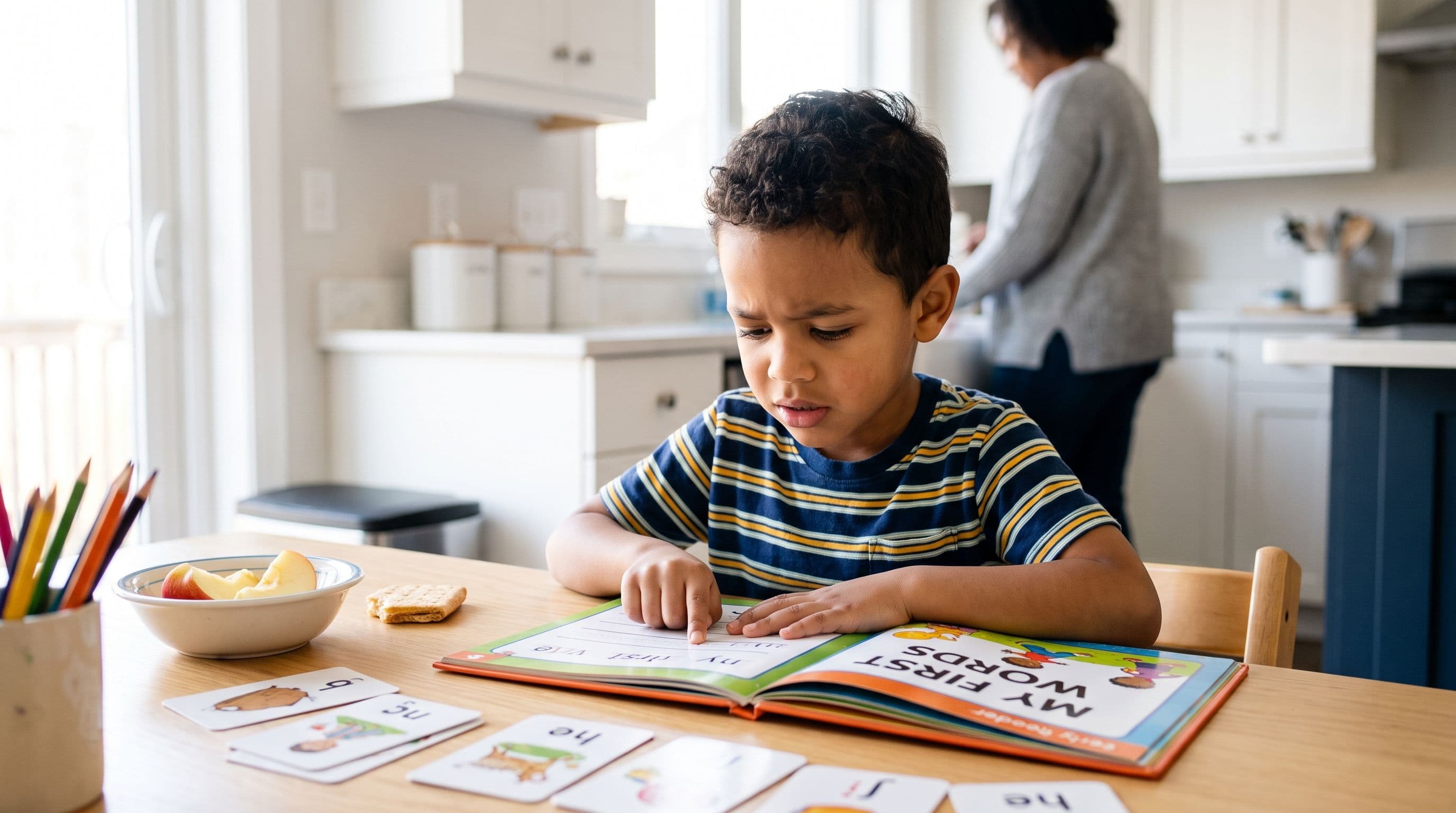
Is My 2nd Grader Behind in Reading? 9 Signs
Wondering if your 2nd grader is behind in reading? Here are the real warning signs, what 2nd graders should be able to do, and what to do next if your child is guessing, slow, or stuck.
Read More →