How to Choose a Reading Tutor for Your Child (Tiger Mom Guide)

What You'll Learn
- Why the most expensive reading tutor might actually make your child worse at reading (and the one method that matters more than credentials)
- The two non-negotiable traits every reading tutor must have — and neither one is a teaching certificate
- Why the best tutor for your child might already be in your family — and how to equip them even if they know nothing about phonics
- Exact questions to ask any tutor before you hand over a single dollar (plus the answer that should make you walk away immediately)
Reality Check: Most Reading Tutors Are Doing It Wrong
Here's something that'll keep you up at night — and it's exactly why knowing how to choose a reading tutor matters so much. Your child is struggling to read. You Google "find reading tutor near me." You find someone with a nice website, maybe a master's degree in education. You pay $75-$150 an hour. And they sit there teaching your kid to look at the picture and guess.
That's not tutoring. That's expensive guessing practice.
I see this constantly. Parents pouring money into reading help that's built on the exact same broken methods their kid's school already uses — Whole Language, three-cueing, "Balanced Literacy." The tutor smiles. Your kid draws pictures. You get a progress report that says "making growth." But hand your child an unfamiliar word like "splint" and they freeze. Or worse — they look at the picture of a bandage and say "hurt."
And you know what the worst part is? The parents think it's working because their kid seems happier. But happiness without skill is just... expensive daycare.
Let me tell you about a conversation I had at a playground here in Raleigh. My 4-year-old was attempting to scale a climbing structure clearly built for 7-year-olds (she's fearless, that one) when another mom dropped onto the bench next to me. Her kid's school had just switched from Lucy Calkins to a [INTERNAL_LINK:Science of Reading] curriculum because of North Carolina's SB 387 — the Excellent Public Schools Act. She was confused and honestly a little annoyed. "He was doing just fine before," she told me, clearly irritated.
So I asked if her second-grader could read the word "splint."
He could not.
I sat on that bench for a good 20 minutes breaking it all down — how Emily Hanford's "Sold a Story" investigation ripped the curtain off Balanced Literacy, how the 2022 NAEP showed only 33% of fourth-graders reading at proficient level, how Stanislas Dehaene's brain imaging studies proved once and for all that reading doesn't come naturally the way speech does. She went home that night and listened to the full "Sold a Story" podcast. Texted me at 11pm: "I had no idea. Why didn't anybody tell us this sooner?"
Nobody told her because the system wasn't built to tell her. And most reading tutors? They came out of the same system.
So if you're figuring out how to choose a reading tutor for your child, you need to understand one thing first: the method matters more than the degree.
The "Scare" — What Happens If You Pick the Wrong Tutor (or Do Nothing)
I'm gonna hit you with some real numbers here, because this isn't some abstract thing.
The Annie E. Casey Foundation published a study in 2010 that found kids who can't read proficiently by the end of third grade are four times more likely to drop out of high school. Four times. That's the [INTERNAL_LINK:Third Grade Cliff], and it's real.
The NAEP scores — that's the Nation's Report Card — tell a brutal story. In 2022, roughly one-third of fourth-graders scored at or above NAEP Proficient in reading, and scores dropped 3 points between 2019 and 2022. Largest decline in 30 years. And that was before you factor in the full scope of post-pandemic learning loss.
Now here's the financial gut-punch. Private reading tutoring typically runs $75-$150 per hour. Specialized programs like Lindamood-Bell can cost $4,000-$8,000 for a single intensive block. A full course of Wilson Reading System tutoring might run $10,000-$15,000 over a year or two. Insurance won't cover it. Schools might offer some support, but the waitlists are brutal and the interventions are often watered-down.
And if you pick the wrong tutor — someone using guessing strategies, cueing systems, or leveled readers without phonics — you're not just wasting money. You're actively building bad habits that a future tutor will have to undo. David Kilpatrick's research in "Equipped for Reading Success" (2016) makes it painfully clear: kids who develop a habit of guessing at words instead of decoding them have much harder time building the orthographic mapping skills needed for fluent reading.
So yeah. The stakes here? They're high. The wrong tutor doesn't just fail to help — they can make things worse.
How to Choose a Reading Tutor: The Two Non-Negotiables
OK so here's where I'm going to say something that most "how to find a reading tutor" articles won't say.
The best reading tutor for your child is probably not a stranger.
I mean it. Before you start interviewing professionals and comparing hourly rates, I need you to think about who your child already trusts. Already feels safe with. Already has a relationship with.
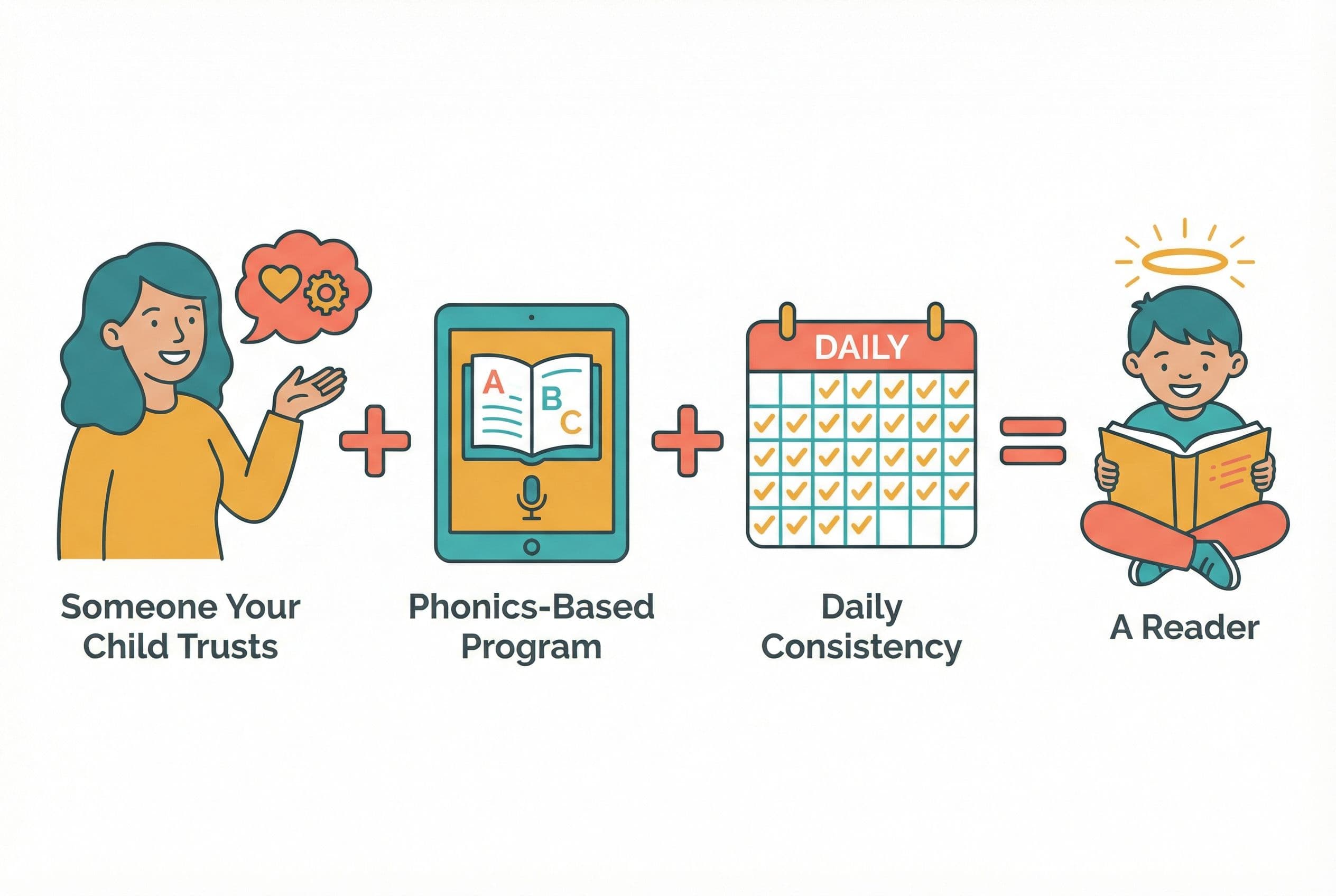
Because reading instruction requires two things above all else:
Non-Negotiable #1: Phonics-Based Instruction
The tutor — whoever they are — must teach reading through systematic, explicit phonics. Period.
What this means in practice: they're teaching your child to decode words by mapping sounds (phonemes) to letters (graphemes) — what Linnea Ehri calls grapheme-phoneme correspondence in her phases of word reading research. They don't ask your kid to look at the picture. They don't say "what word would make sense here?" They don't rely on memorizing whole words by sight alone.
The 2000 National Reading Panel report — the one Congress actually commissioned — found that systematic phonics instruction produces significant benefits for reading accuracy and comprehension, especially for kids in K-2 and for struggling readers. That report came out over two decades ago, people. The evidence is overwhelming that beginners need explicit decoding instruction, and struggling readers usually need it even more.
Structured literacy is the standard here — and Orton-Gillingham methodology is one of its most well-known and widely used approaches. OG is a structured, multisensory method developed in the 1930s (yes, we've known this stuff that long) that teaches grapheme-phoneme correspondence in a logical sequence. Programs like Wilson Reading System, Barton Reading & Spelling, and UFLI Foundations are all built on these principles.
But here's the thing — the tutor doesn't need to be Orton-Gillingham certified to be effective. They need to understand and use systematic phonics-based instruction. That's the baseline.
Non-Negotiable #2: A Trusting Relationship With Your Child
This is the one that gets overlooked in every "what to look for in a reading tutor" checklist I've ever seen.
Learning to read is hard work. For a struggling reader, it's vulnerable. They've probably already internalized the message that they're "not good at reading" or that reading is something other kids can do but they can't. Sitting across from a stranger and being asked to sound out words they've been getting wrong for months? Honestly, that's terrifying when you're 5 or 6.
Your child needs a tutor they trust. Someone who can sit with them through the frustration of blending /sh/ and /i/ and /p/ for the fifteenth time without either of them losing it. Someone who will celebrate the small wins — the first time they decode a new word without help, the first time they self-correct instead of guessing.
Real talk — this person might be you. It might be Grandma. Maybe it's your kid's favorite aunt, or an older sibling who's home from college, or that family friend who shows up for dinner every Thursday.
I taught my oldest two to read myself. No teaching degree. I'm a mom who did the research, found the right tools, and sat at the kitchen table every single day — yes, including Christmas morning (Tiger Rule: We Never Skip). The relationship I have with my kids is the secret weapon. They trust me. They know I'm not gonna quit on them. And that trust is what got us through the hard parts.
The Best Tutor Might Already Be at Your Kitchen Table
I already know what you're thinking right now. "Xia, I'm not a reading specialist. I don't know phonics. I can barely remember what a vowel is."
Good news: you don't need to know phonics to teach phonics. You need the right tool.
This is exactly why we built Teach Your Kid to Read. The app walks you and your child through systematic, explicit phonics instruction step by step. No prior experience required. No teaching degree. No $150-an-hour specialist. Just you (or Grandpa, or Auntie, or whoever your child trusts) sitting next to your kid, working through lessons together.
The app does the heavy lifting on the methodology. It handles the scope and sequence — which sounds to introduce first, how to build from CVC words to blends to digraphs. It follows Orton-Gillingham principles. All the tutor needs to bring is two things:
Consistency and patience.
I had my 4-year-old practicing CVC words at the kitchen table last Tuesday. She got "mat" and "sat" right away but melted down on "fig." Full tears. The /f/ sound was giving her trouble. Wanna know what I did? I stayed calm, we took a 30-second break to eat some goldfish crackers (the irony of the /f/ sound was not lost on me), and we went back to it. She got it on the fourth try.
That moment — the patience through the meltdown, the gentle push back to the work — that's what a stranger charging $100/hour can rarely replicate. Because your child doesn't trust that stranger yet. But they trust you.
Who Can Be Your Child's Reading Tutor?
- You (the parent). Hands down the best option if you can commit the time. 15-20 minutes daily.
- A grandparent. Retired, available, endlessly patient, and your kid already adores them. This is an incredibly underused resource.
- An older sibling. My 10-year-old has helped my 4-year-old practice letter sounds. It's not her primary instruction, but it's great reinforcement — and it builds her confidence as a reader too.
- A trusted family friend or neighbor. Someone your child already knows and feels comfortable with.
- A hired tutor — but only if the above options genuinely aren't available, and only if they meet the criteria I'm about to lay out.
The bottom line: a passionate, consistent family member using a good phonics program will outperform an inconsistent, expensive stranger almost every time.
If You Do Hire a Professional: Reading Specialist vs Tutor
OK, so maybe you truly don't have a family member or trusted person who can commit to consistent daily sessions. Maybe your child has significant reading difficulties — possible dyslexia indicators, for example — and you feel they need professional support. That's legitimate. OK so let me walk you through what to actually look for.
First, understand the difference between a reading specialist and a tutor. Not the same thing — not even close.
A reading specialist typically has an advanced degree (master's or higher) in reading or literacy education, plus state certification. They can administer formal assessments like the DIBELS (Dynamic Indicators of Basic Early Literacy Skills) or Kilpatrick's PAST test (Phonological Awareness Screening Test) and design individualized intervention plans. They understand Linnea Ehri's phases of word reading development — pre-alphabetic, partial alphabetic, full alphabetic, consolidated — and can pinpoint exactly where your child is stuck.
A reading tutor can be anyone. There's no licensing requirement. No certification needed. Your neighbor's college-age kid can hang a shingle and call themselves a reading tutor tomorrow.
This isn't automatically bad — remember, I just told you that a passionate family member with the right tool can be a fantastic tutor. But when you're paying a stranger, you need to vet them hard.
Questions to Ask Before Choosing a Reading Tutor
-
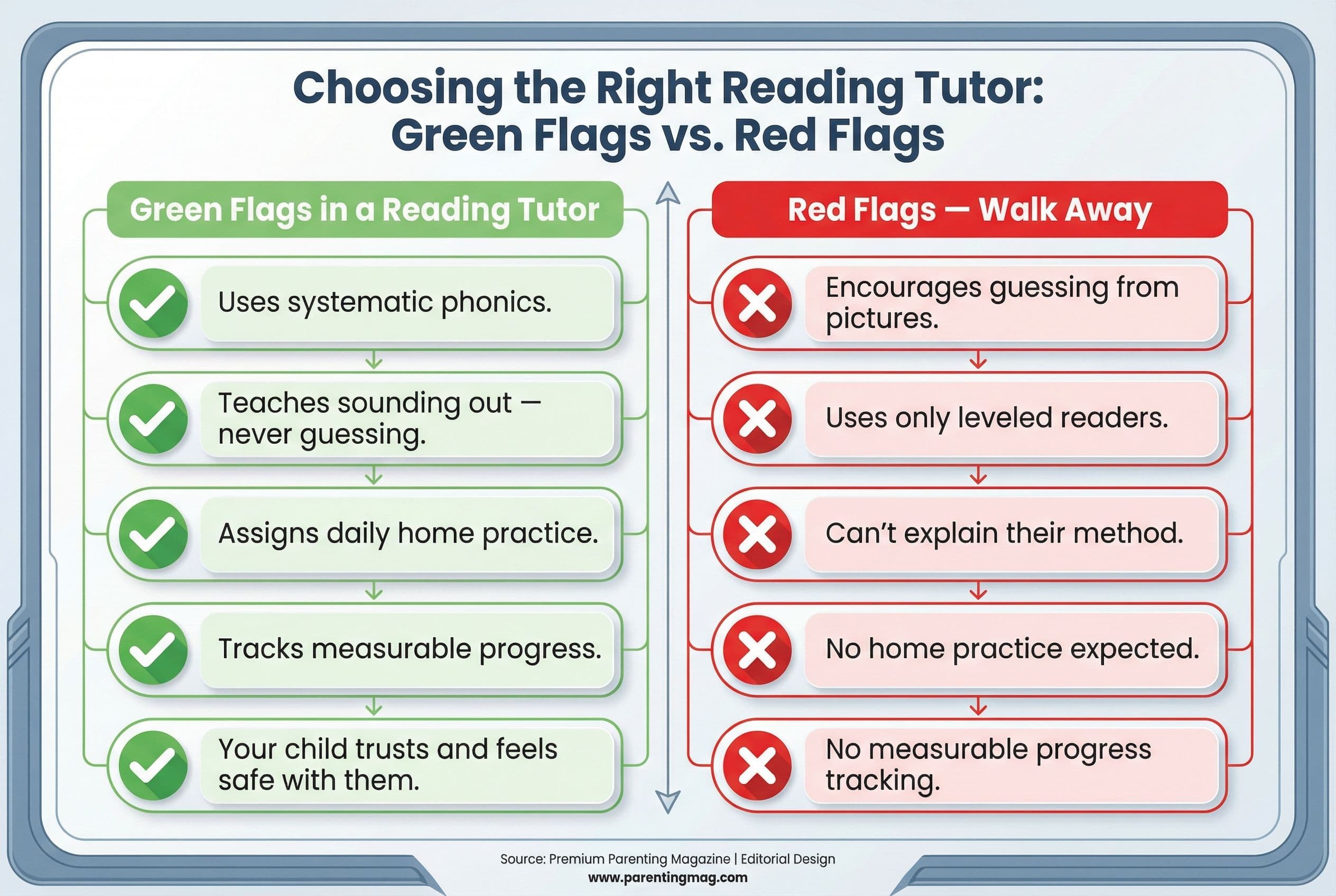
"What method do you use to teach reading?" — You want to hear: systematic phonics, synthetic phonics, Orton-Gillingham, structured literacy. If they say "Balanced Literacy," "multiple cueing systems," "we follow the child's lead," or "I use leveled readers" — walk away. I don't care how sweet or well-meaning they are.
-
"How do you handle a child who gets stuck on a word?" — The right answer: "I help them sound it out, starting with the individual phonemes." The wrong answer? Any of these: "I ask them to look at the picture," "I tell them to skip it and come back," or "I ask what word would make sense there." That's three-cueing. That's guessing. Run.
-
"What assessment do you use to determine my child's current level?" — Good answers: DIBELS, AIMSweb, PAST, PALS (Phonological Awareness Literacy Screening). Bad answer: "Oh, I just listen to them read for a bit and get a feel for where they are." Or worse: Fountas & Pinnell leveled reading assessments — which are whole-language aligned and tell you almost nothing about a child's actual decoding ability.
-
"What's your training in phonics instruction?" — A tutor trained in structured literacy or Orton-Gillingham has gone through extensive preparation (programs like Barton, Wilson, or an accredited OG fellowship). This matters if your child has dyslexia or significant reading delays. For a child who just needs foundational support, a tutor using a good systematic phonics program (like Teach Your Kid to Read, Fundations, or UFLI Foundations) can be very effective without OG certification.
-
"How often do you recommend sessions, and what does the parent do between sessions?" — A good tutor will insist on daily practice at home between sessions. Reading instruction can't happen twice a week for 30 minutes and work. Mark Seidenberg's "Language at the Speed of Sight" (2017) — he's a University of Wisconsin cognitive scientist — makes it clear that reading skill development requires massive amounts of practice. If the tutor tells you "just bring them to me and I'll handle everything," that's a massive red flag. You should still be practicing phonics at home every single day.
Red Flags: When to Walk Away From a Reading Tutor
I've seen parents stick with bad tutors for months because "my kid likes going" or "she seems so qualified." So let me make this painfully clear.
Walk away immediately if the tutor:
-
Encourages guessing from pictures or context. This is the single biggest red flag. If your child reads "pony" when the word says "horse" because there's a picture of a horse, and the tutor says "close enough!" — that tutor is teaching your child to not read.
-
Uses only leveled readers (like Fountas & Pinnell levels) without [INTERNAL_LINK:decodable readers]. Leveled readers introduce words kids can't actually decode yet, which forces guessing. Look for decodable readers instead — texts where every word can be sounded out using phonics patterns the child has already learned. Flyleaf Publishing, High Noon Books, and the Bob Books series are solid options.
-
Can't explain their methodology. If you ask "what method do you use?" and they give you vague fluff like "I meet each child where they are" or "I use a mix of strategies" — they either don't have a method or they're using Balanced Literacy, which is just Whole Language in a nicer outfit.
-
Doesn't assign or expect daily home practice. Twice-a-week tutoring without daily reinforcement is like going to the gym on Mondays and Wednesdays and eating pizza the other five days. The kicker is that many tutors won't push this because they don't want to seem demanding. But a good tutor — like a good coach — demands daily practice.
-
Focuses primarily on comprehension strategies with a child who can't decode. This drives me crazy. If your child can't sound out the word "ship," they don't need lessons on "making connections" and "visualizing." They need phonics. Scarborough's Reading Rope model makes this clear: word recognition (decoding) and language comprehension are both required for reading, but you can't build comprehension on words you can't read.
-
Has no way to measure progress. The tutor should be tracking specific, measurable skills — letter-sound fluency, nonsense word decoding, oral reading fluency (words correct per minute). Ask for DIBELS benchmark targets for your child's grade and time of year — these give you concrete numbers so you can tell if your child is actually improving. If your tutor can't give you numbers, they can't prove your child is improving.
The Real Cost of Reading Tutoring (and a Better Path)
Let's talk about private reading tutoring cost, because I know that's on your mind.
Here's the damage, laid out plain:
- General reading tutor: $40-$80/hour
- Certified reading specialist: $75-$150/hour
- Orton-Gillingham certified tutor: $80-$200/hour
- Intensive programs (Lindamood-Bell, etc.): $4,000-$8,000 per block
- Full intervention (Wilson, Barton, etc.): $10,000-$15,000 over 1-2 years
At 2-3 sessions a week, that's somewhere between $400 and $1,200 a month flying out of your bank account for a professional tutor. For a year? We're talking $5,000-$15,000. And remember — this doesn't replace daily practice at home. It supplements it.
Now compare that to equipping yourself (or Grandma, or your trusted neighbor) with a research-based phonics app and committing to 15-20 minutes a day. The cost difference is staggering. But more importantly, the consistency difference is what changes outcomes.
A professional tutor sees your child 2-3 hours per week. A family member using Teach Your Kid to Read can work with your child every single day. Seven days a week — no days off. Consistency is the single biggest predictor of reading progress — bigger than the tutor's credentials, bigger than the price tag.
Here's my Tiger Rule: We Never Skip. Phonics happens on birthdays. It happens on Christmas. It happens on vacation. 15 minutes. Every single day. That's 105 minutes a week of practice with someone your child trusts, using systematic phonics instruction. No professional tutor schedule can match that frequency.
How to Get Started Today — With or Without a Professional
Here's your action plan. Pick the path that fits your family.
Path 1: You (or a Trusted Family Member) Are the Tutor
-
Download Teach Your Kid to Read. The app gives you the complete scope and sequence — systematic synthetic phonics, built on Orton-Gillingham principles. No teaching experience needed.
-
Set a daily time. Same time every day. Non-negotiable, people. We do it right after breakfast in my house. Find what works for yours and lock it in.
-
Commit to 15-20 minutes. That's it — seriously. Longer sessions lead to burnout for young kids. Short, focused, daily — that's the formula.
-
Follow the Tiger Rules. No guessing (if your child guesses, gently redirect: "Let's sound it out"). No skipping days. Celebrate small wins loudly.
-
Track progress. Use the app's built-in tracking, and if you want an external benchmark, ask your child's school about a phonological awareness screener like the PAST (Phonological Awareness Screening Test). It takes about 5 minutes and tells you exactly where your child's phonological awareness stands.
Path 2: You Need a Professional Tutor
-
Get a baseline assessment first. Ask your child's school to administer the DIBELS or request a PAST screening. Know exactly where the breakdown is before you hire anyone.
-
Use the questions above to vet candidates. Print them out. Bring them to the consultation. Seriously, don't hold back. You're hiring someone for the most important job — teaching your kid to read.
-
Prioritize structured literacy or Orton-Gillingham trained tutors if your child shows signs of dyslexia or has been struggling for more than a year. The Wilson Reading System and Barton Reading & Spelling are both OG-based and have strong track records.
-
Demand daily home practice assignments. And use Teach Your Kid to Read for that home practice so you're reinforcing the same phonics-based approach the tutor uses.
-
Set a review checkpoint. After 8-12 weeks, your child should show measurable progress on DIBELS or a similar assessment. If they haven't? The tutor isn't working. Switch.
Look — the states that made the biggest gains didn't do it with expensive private tutors. Mississippi went from 49th to 21st in national reading rankings after they passed the Literacy-Based Promotion Act in 2013. They did it with systematic phonics instruction, delivered consistently, by trained (not necessarily credentialed) adults. You can do the exact same thing at your kitchen table.
FAQ: How to Choose a Reading Tutor for Your Child
How do I know if my child needs a reading tutor vs. just more practice at home?
Start with an assessment. Ask your child's school about a phonological awareness screener like the PAST — it takes about 5 minutes and shows exactly where your child's phonological awareness breaks down. If your child is behind but the gaps are in basic phonics (letter sounds, blending CVC words), a parent or family member using a systematic phonics app like Teach Your Kid to Read may be all they need. If the gaps are significant — especially if there are signs of dyslexia — a professional trained in structured literacy or Orton-Gillingham methodology is worth the investment.
What's the difference between an Orton-Gillingham certified tutor and a regular reading tutor?
An Orton-Gillingham certified tutor has completed structured training (often 60+ hours of coursework plus supervised practicum) in a multisensory, systematic approach to teaching reading. A regular reading tutor may have no specific training at all — "reading tutor" isn't a licensed or regulated title. For kids with dyslexia or severe reading delays, OG certification matters. For kids who need foundational phonics support, any trusted adult using a solid phonics-based program can be effective.
How much should I expect to pay for a reading tutor?
General tutors run $40-$80/hour. Certified reading specialists typically charge $75-$150/hour. Orton-Gillingham certified tutors can run $80-$200/hour. But here's what I really want you to think about: a family member using the Teach Your Kid to Read app 15 minutes daily gets your child 105 minutes of practice per week — that's more total instruction than a professional tutor seeing your kid twice a week for 30-45 minute sessions, and it costs a fraction of the price. Consistency beats credentials for most children.
Can I be my child's reading tutor even if I don't know anything about phonics?
Absolutely. This is exactly what Teach Your Kid to Read is designed for. The app provides the systematic phonics instruction — the scope, the sequence, the methodology. All you bring is the relationship, the consistency, and the patience. I taught my two oldest kids to read exactly this way, and right now I'm doing it with my 4-year-old. You don't need a degree in reading science. You need a commitment — 15 minutes a day, every day, no excuses.
How long does it take a reading tutor to get results?
With consistent, daily phonics-based practice, most children show measurable improvement within 8-12 weeks. You should see gains on specific benchmarks — like nonsense word fluency or phoneme segmentation — not just vague statements about "confidence." If you're 12 weeks in and your child can't decode any new words independently, something needs to change. Either the method is wrong, the practice isn't consistent enough, or a professional evaluation for a learning disability might be the next step.
The Bottom Line
When you're figuring out how to choose a reading tutor for your child, don't start with Google. Start with your kitchen table.
The research is clear. The method that works is systematic, explicit phonics. The person who delivers it needs to be consistent, patient, and trusted by your child. And that person? It might just be you.
If it is — grab Teach Your Kid to Read, sit down next to your kid, and start. Today. Not Monday. Not "when things calm down." Today.
Tiger Rule: We Never Skip.
Your child's reading future doesn't depend on finding the perfect tutor with the perfect credentials. It depends on someone who loves them showing up every day with the right tool and the patience to see it through.
Be that person.
Part of these guides

Xia Brody
Co-Founder, Teach Your Kid to Read
Mom of 4 who has successfully taught her kids to read. Currently in the trenches with her 4-year-old while her two oldest (10 and 7) devour books on their own. Passionate about phonics-based methods and building a lifelong love of reading.
Related Articles

Best Reading App for a 4-Year-Old with Dyslexia Signs: My Top Pick
If your 4-year-old mixes up sounds, guesses from pictures, or avoids letters, don’t wait and see. Here’s my tiger-mom ranking of reading apps that help — and the ones I’d skip.
Read More →
Best Reading App for a 5-Year-Old with Dyslexia: 2026 Picks
A dyslexic 5-year-old doesn't need guessing games or pretty animations. They need systematic phonics, daily drill, parent coaching, and a plan that refuses to wait.
Read More →
Reading Eggs Alternatives for Dyslexia: 7 Better Apps (2026 Picks)
Reading Eggs is fine for typical readers, but if your kid has dyslexia, it's the wrong tool. Here are 7 reading eggs alternatives that use structured, Orton-Gillingham-based phonics — the only approach proven to work for struggling readers.
Read More →